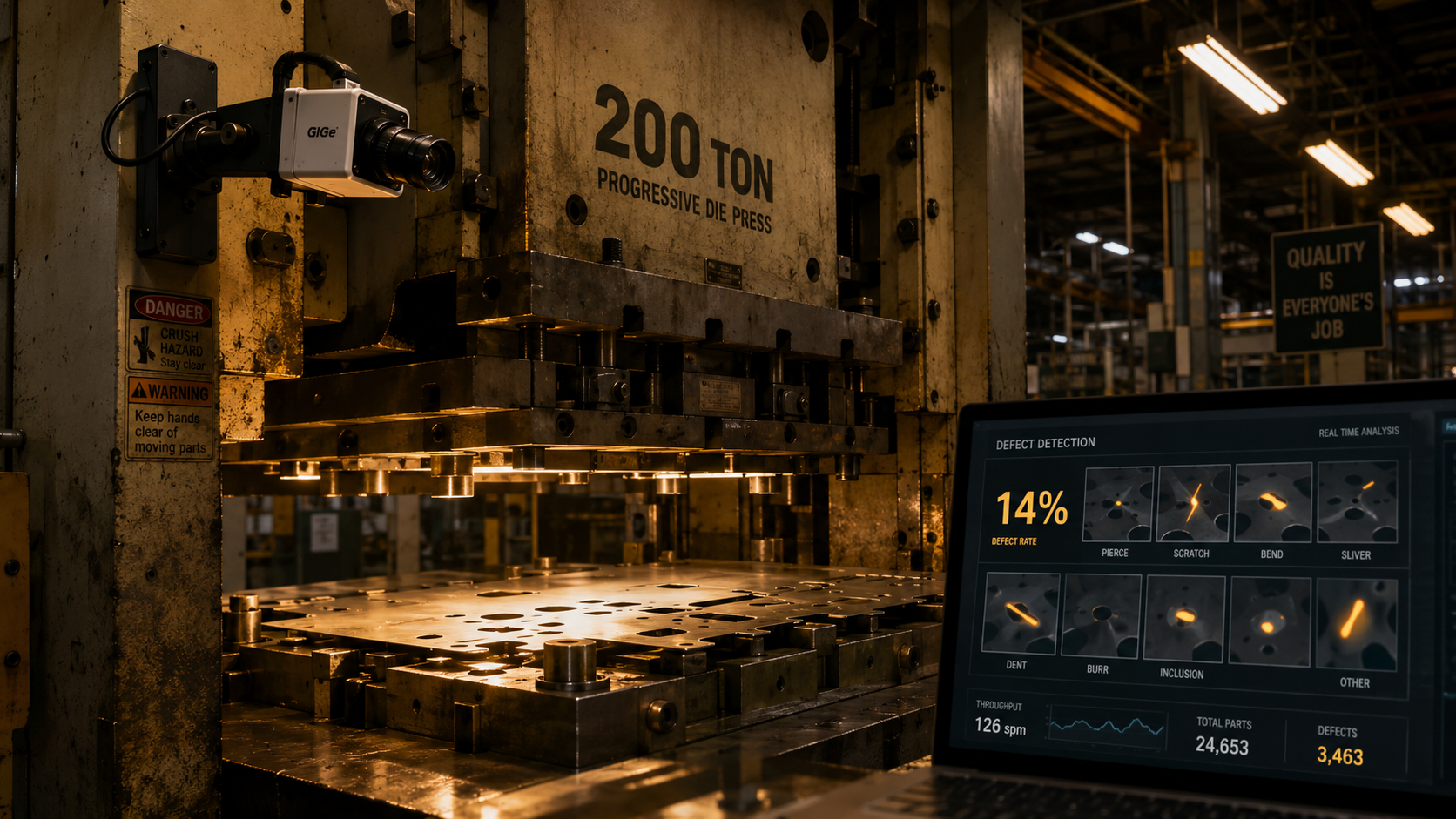
I thought edge AI quality inspection was an inference problem. The first stamping line I commissioned for vision inspection disabused me of that within two weeks.
The model hit 97% accuracy on our validation images. Day one on the production floor, the false reject rate was climbing. By week two it was at 14%. Every instinct I had said to retrain the model — add more production samples, tune the thresholds, run the validation cycle again. I ran that loop more than once before someone walked me to the overhead bay lights and asked me to watch what happened to the sheet metal surface at different stroke angles.
The lab had a fixed LED ring. The press had overhead fluorescents reflecting differently off the metal with each stroke angle. Stamping lubricant pooled differently on warm versus cold dies. The model was performing correctly on what it had been trained to see. We just hadn't trained it to see the press floor.
That correction — from "retrain the model" to "fix the photometric environment first" — is where most edge AI inspection projects die before they start. The Edge AI Vision Alliance's 2026 production-line review found the same pattern: environmental preparation is the root cause of inspection failures, not model architecture. And the vendors selling the inference stack don't have a diagnostic interest in pointing you toward the overhead lights. They already shipped the hardware.
Well-optimized systems get false reject rates from the typical 5–15% out-of-box AOI range to under 2%. Getting there requires pixel-level segmentation, confidence thresholds calibrated per defect criticality, multi-frame verification for borderline cases, and scheduled photometric rechecks. That's a commissioning process. It's not something you install.
The OPC-UA Conversation I Have at Every New Project
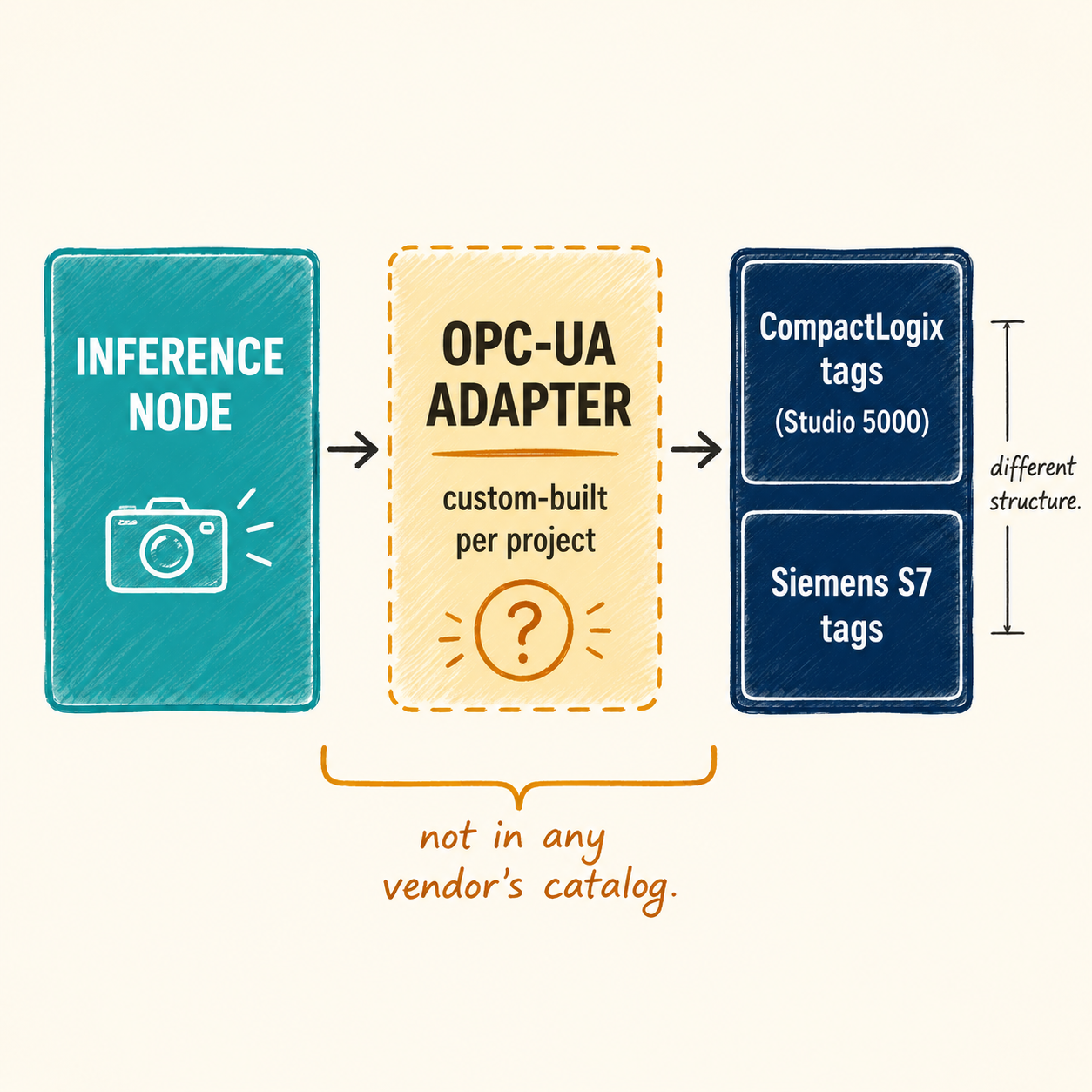
My standard approach to scoping a new inspection engagement now starts with a question I didn't ask on the first one: what PLC is the line running, and who built the reject gate logic?
The protocol for connecting inference output to a PLC is OPC-UA, but knowing the protocol name doesn't close the gap. I've wired inference nodes to Allen-Bradley CompactLogix systems and to Siemens S7 systems, and the tag file structures are completely different. The adapter that maps inference output to the right tag in the right dialect doesn't ship with any inference vendor's product. It gets written from scratch. Every project.
When I explained this once to an automation engineer at a mid-size automotive plant, drawing out the tag structure on a whiteboard, his takeaway captured the scope of it: we were writing the adapter from scratch, for every line. He was right, and the project scoping reflected it.
The OPC Foundation launched a dedicated working group in 2025 — OPC UA for AI — specifically because this gap was blocking industrial deployments. It's a well-intentioned initiative. The adapter is still getting built from scratch in the meantime. Two-thirds of manufacturers hit production holdups because systems can't communicate properly. The organizations that engineer past this gap achieve 4x faster AI deployment and 3x higher value capture rates than those still fighting the communication layer.
What I've settled on architecturally is: edge inference on IEC 62443-4-2 certified hardware (the OT security baseline most plant networks require), a thin OPC-UA adapter layer feeding the MES, and quality management system integration to close the loop. That architecture — starting from the integration path before touching the model — is documented at Veriprajna's edge AI manufacturing inspection practice. The model is the last design decision, not the first.
The Call That Comes Eight Months Later
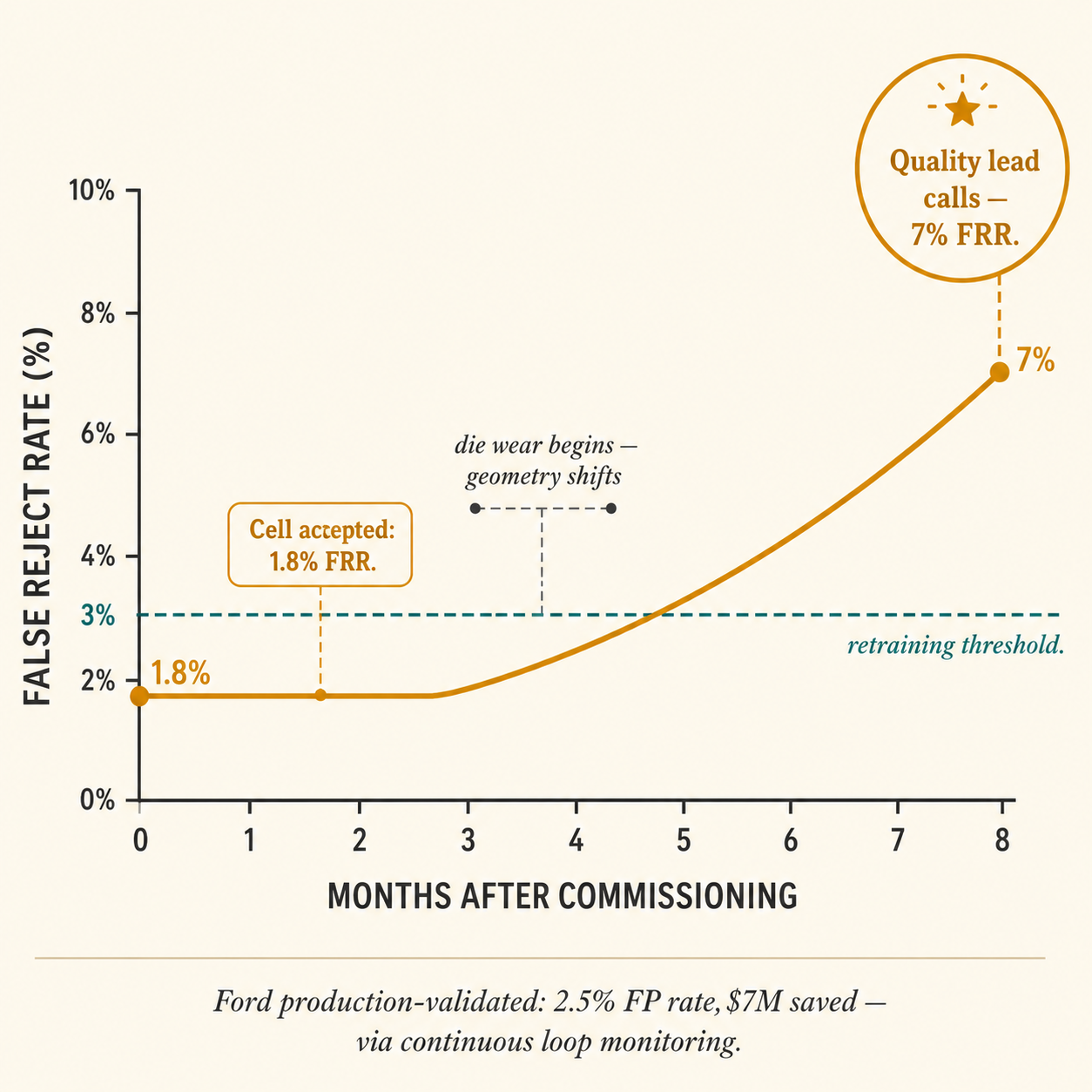
The call I've come to dread arrives about six to eight months after a cell goes live. The plant is running well. The false reject rate was at 1.8% in month two. Then it started climbing.
I got one of those calls from a quality lead at a stamping facility. The reject rate had crept to 7%. They'd been watching it climb for weeks and assumed it was a seasonal shift — different alloy batches, changed line speed. It was tool wear. The dies had worn enough that part surface gradients had shifted by fractions of a millimeter from what the training data captured. Confident acceptable-part classifications were sliding into the uncertain range.
Nobody had set a monitoring threshold for false reject rate per shift. The system tracked accuracy against confirmed defects, but FRR — the metric that tells you whether the model is drifting on good parts — wasn't in anyone's dashboard.
Ford's production-validated predictive maintenance system achieved a 2.5% false positive rate and saved roughly $7M for a single component type. The mechanism wasn't a better algorithm. It was continuous loop monitoring with human-in-the-loop checkpoints at defined thresholds.
What that call taught me: per-shift FRR telemetry isn't a nice-to-have. A threshold trigger that flags retraining candidates when the false reject rate exceeds 3%, a change-management gate on new training data so rushed retraining doesn't compound the problem — these belong in the operational handoff, not in month eight. Augury built its $1B+ acoustic AI platform on exactly this distinction: the operational framework for how teams act on signals, and how the model evolves when it encounters new failure signatures, is the product. The algorithm is what enables it.
The ROI Math My CFO Counterparts Ask For
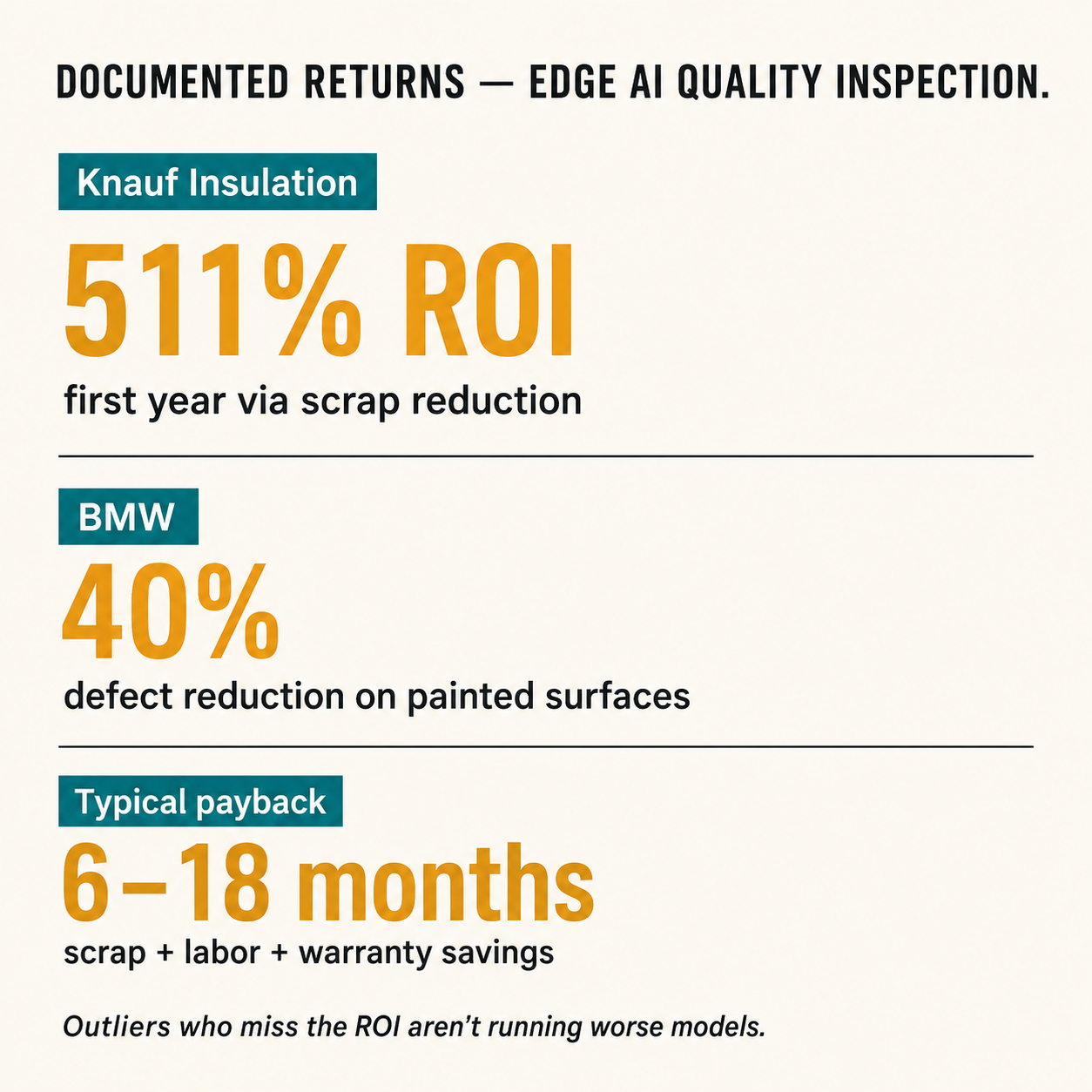
The question I get on every new engagement from whoever owns the P&L is how to project the return before approving the build.
I reach for documented cases: Knauf Insulation's edge-vision deployment achieved 511% ROI in the first year, primarily through scrap reduction. BMW's CNN-based system for painted surfaces and critical parts reduced defects by 40%. A food manufacturer saved $94,000 annually from an 8.7% scrap rate the system caught. Typical payback on a well-scoped deployment runs 6 to 18 months, through a combination of scrap reduction, labor savings, and warranty cost avoidance.
The qualifier I always add is "well-scoped." The plants that don't capture those returns aren't running worse models. They're running models calibrated to lab conditions on integration architectures that couldn't grow from one cell to fifteen. The ROI is real. Getting to it requires the integration work that most vendors stop short of.
A Deadline I Have Marked in My Calendar
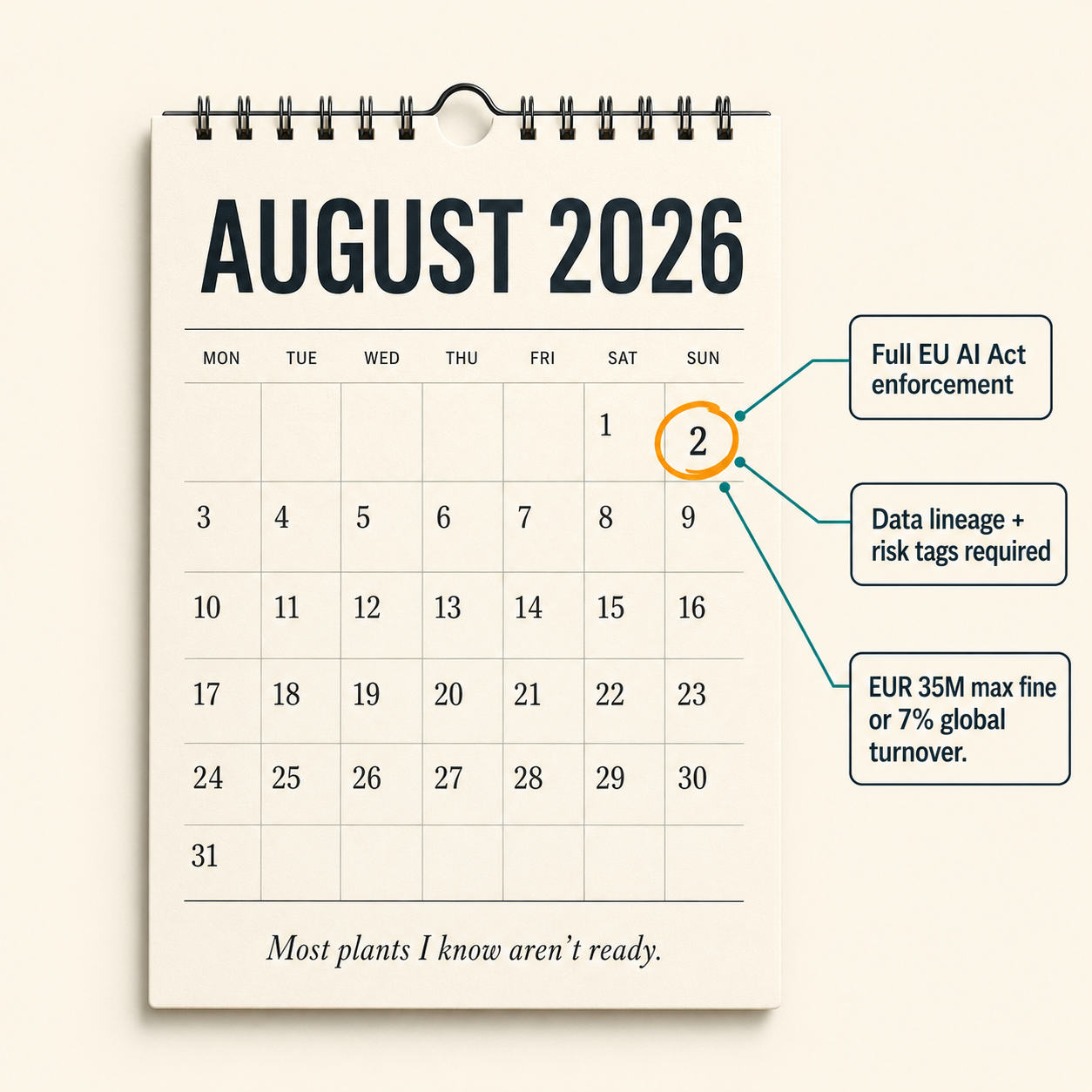
The EU AI Act deadline I think about most is August 2, 2026 — when all high-risk manufacturing AI obligations become fully applicable. The specific requirements cover data lineage tracking for every model in production, risk classification tags on each model with its risk level and usage context, and human-in-the-loop checkpoints for safety-relevant workflows. Maximum fines run to EUR 35 million or 7% of global annual turnover.
Most plants running edge AI pilots I know aren't thinking about this yet. What I find interesting — and somewhat reassuring — is that a well-run inspection deployment is already most of the way there. A system with per-shift FRR logging, model version tracking, and defined escalation paths isn't just operationally sound. It's also close to what the regulation requires. The compliance work isn't a separate project from the operational discipline. It's the same discipline applied with documentation intent from the start.
What I'd Tell Someone Evaluating This Now
What I'd do differently from the beginning: scope the photometric environment before anything else, and design the OPC-UA integration path into day one rather than treating it as a late-stage problem. The FRR monitoring question — who watches the false reject rate per shift, what triggers a retraining review — belongs in the operational handoff conversation, not after a quality lead calls eight months in.
The full architecture for getting from 14% false rejects to under 2%, and keeping it there across a fleet, is at veriprajna.com/solutions/edge-ai-manufacturing-inspection.
The question I'd leave with anyone starting this evaluation: when your pilot passes the benchmark and gets signed off, what is the plan for month eight if nobody is watching the false reject rate?