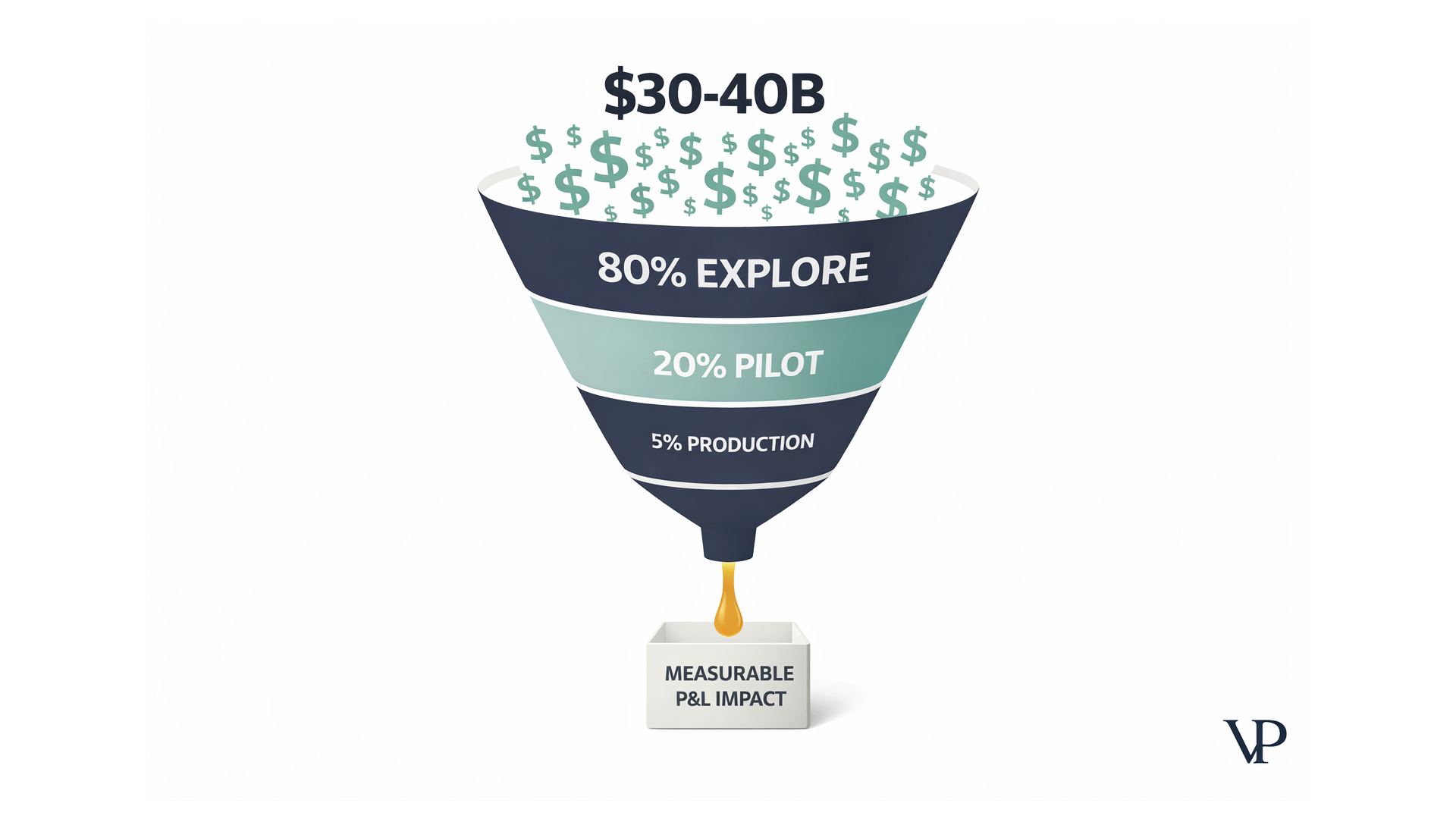
Enterprises have poured an estimated $30 to $40 billion into generative AI. According to MIT's 2025 NANDA study, 95% of those AI pilots have failed to deliver a measurable impact on the profit and loss statement. That's not a rounding error — it's a systemic misunderstanding of what it takes to make AI work inside a real business.
McKinsey's 2025 Global Survey reinforces the picture: 88% of organizations say they're using AI somewhere, but only 39% can point to any impact on enterprise-wide earnings. The gap between "using AI" and "generating returns from AI" has become the defining challenge of this technology cycle. And after spending the past year studying where enterprise AI breaks down — and where it actually works — our team believes the root cause isn't the technology. It's the architecture.
The Funnel of Failure
Of the 80% of organizations that explore generative AI tools, only 20% ever reach the pilot stage. Of those, a mere 5% make it to full-scale production with measurable business outcomes. MIT's researchers call this a "learning gap" rather than a technology gap, and that distinction matters enormously.
The problem isn't that AI doesn't work. It's that most companies never learn how to make it work beyond a demo.
Pilots succeed in controlled environments because they run on curated data and narrow prompts. They collapse when they meet the messy reality of enterprise operations — edge cases, inconsistent data, regulatory requirements where "close enough" is a liability. In the MIT study, 60% of users reported that models couldn't learn from feedback over time, and 55% said providing context for every prompt required excessive manual effort.
The result is a "shadow AI economy." Over 90% of employees are secretly using personal ChatGPT, Claude, or Gemini accounts for work tasks because their company's official AI tools can't handle specialized workflows. Individual productivity goes up. Enterprise-level returns stay flat.
Why LLM Wrappers Are Built on Quicksand
Most of the AI tools flooding the market right now are what the industry calls wrappers — thin user interfaces layered on top of an API call to a large language model. They're fast to build, easy to demo, and fundamentally incapable of scaling inside an enterprise.
The typical wrapper crams all its rules, data, and instructions into a single massive prompt. This creates three problems that compound at scale. There's no way to verify that the model followed instructions in the correct order — a dealbreaker in compliance-heavy industries. Long context windows and repetitive retries inflate token costs, making the economics unsustainable. And minor changes in prompt wording can produce wildly different outputs, making it impossible to establish reliable service-level agreements.
There's also a structural business problem. As OpenAI and Anthropic reduce their API prices, wrapper companies watch their margins evaporate. Without owning the data or the workflow, they're renting intelligence from someone else's infrastructure — and they're easily displaced by incumbents who already have distribution and domain expertise.
We explored the full economics of this breakdown in our interactive analysis of the GenAI divide, including a cost dimension that most organizations overlook entirely.
The Hidden Cost Most Companies Never Calculate
Token pricing looks straightforward until you examine what different models actually charge for the same work. The discrepancy between efficient and inefficient tokenizers — the component that converts text into the units a model processes — can produce a 450% difference in total cost for identical tasks.
For standard English queries, an inefficient tokenizer uses roughly 1.7 times as many tokens as an efficient one. For complex scripts like Tamil, that ratio jumps to 4.5x. An enterprise processing 100,000 daily customer inquiries could see annual costs balloon from $36,500 to over $164,000 for the exact same workload, simply by choosing the wrong model.
Picking the wrong tokenizer is like paying highway tolls per letter of your license plate instead of per vehicle. Same road, radically different bill.
This is where architectural decisions start compounding. Deep AI systems mitigate this by routing high-volume, low-complexity tasks to smaller, task-specific models or deterministic logic — code that follows fixed rules and always produces the same output for the same input. Expensive LLM tokens get reserved only for the reasoning steps where they genuinely add value.
What Deep AI Actually Looks Like
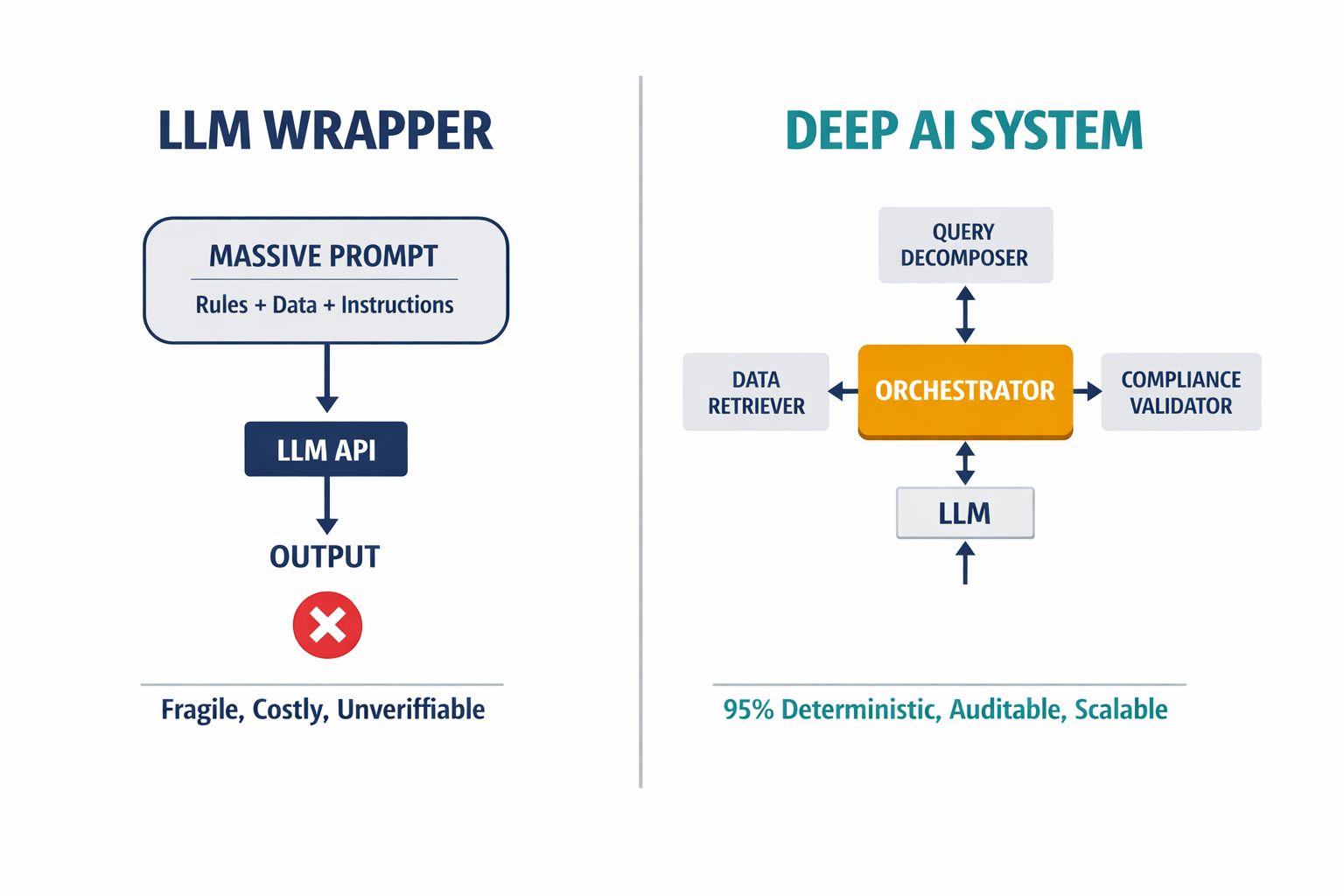
The alternative to the wrapper approach treats the large language model as one component within a broader system, not the entire system itself. Think of it as the difference between hiring one generalist to run your entire finance department versus building a team of specialists — an accounts receivable analyst, a compliance officer, a financial controller — each with a defined role.
In a multi-agent system, specialized AI agents handle distinct responsibilities. One decomposes a complex query into manageable steps. Another retrieves relevant data from internal databases. A third validates the output against compliance rules. A fourth formats the response for the end user. Each agent does one thing well, and a central orchestrator coordinates the workflow.
This architecture relies on patterns that make AI behavior predictable and auditable. A reflection pattern has the agent critique its own work before delivering output. A planning pattern breaks complex goals into sequential steps. A tool use pattern lets the agent call external calculators or databases for real-world data instead of guessing. The result is a system that's roughly 95% deterministic — meaning it follows predictable rules — while using the LLM's flexibility only where it's needed.
The Protocols Making This Possible
Two emerging standards are turning multi-agent architecture from a custom engineering project into something enterprises can actually adopt.
The Model Context Protocol (MCP), developed by Anthropic, acts as a universal connector between AI agents and enterprise data sources. It's been described as the "USB-C of AI" — a standardized way for agents to plug into internal databases, SaaS tools, and document repositories without building custom integrations for each one. Every request gets logged, creating the audit trail that regulated industries require.
The NANDA framework (Networked AI Agents in a Decentralized Architecture) provides the security and governance layer. It includes cryptographically verifiable capability attestation — essentially a tamper-proof credential system that prevents agents from accessing data or performing actions beyond their authorized scope. It extends zero-trust security principles, the same "never trust, always verify" approach used in modern cybersecurity, to autonomous AI agents.
Together, these protocols let organizations move from writing fragile code that calls a single API to building what we think of as an "agentic mesh" — a network of specialized agents that can navigate complex enterprise systems securely and autonomously.
Where the ROI Is Actually Real
While enterprise-wide AI wins remain rare, specific use cases are delivering returns that justify the investment — when implemented with this deeper architectural approach.
Healthcare is seeing an average AI ROI of 451% across implementations that go beyond demos. OSF HealthCare deployed AI virtual assistants integrated with electronic health record platforms and saved $1.2 million in costs while simultaneously increasing annual revenue by $1.2 million. Inova Health System cut its backlog of unbilled claims by 50%, recovering $1.3 million annually.
Supply chain and logistics represent a $290 billion opportunity. UPS reported $400 million in annual savings through AI-based routing. DHL reduced manual paperwork by 80% through document processing agents that extract data from complex, unstructured logistics forms. Walmart uses AI agents to redirect inventory during holiday surges, sensing demand shifts and reshaping supply in real time.
The companies seeing real AI returns aren't asking "What can AI say?" They're engineering what AI can do — inside governed, auditable workflows.
The common thread across these successes isn't the model they chose. It's that they built systems around the model — with defined workflows, domain-specific data, human oversight gates, and clear metrics tied to business outcomes.
The 10-20-70 Rule the Top 6% Follow
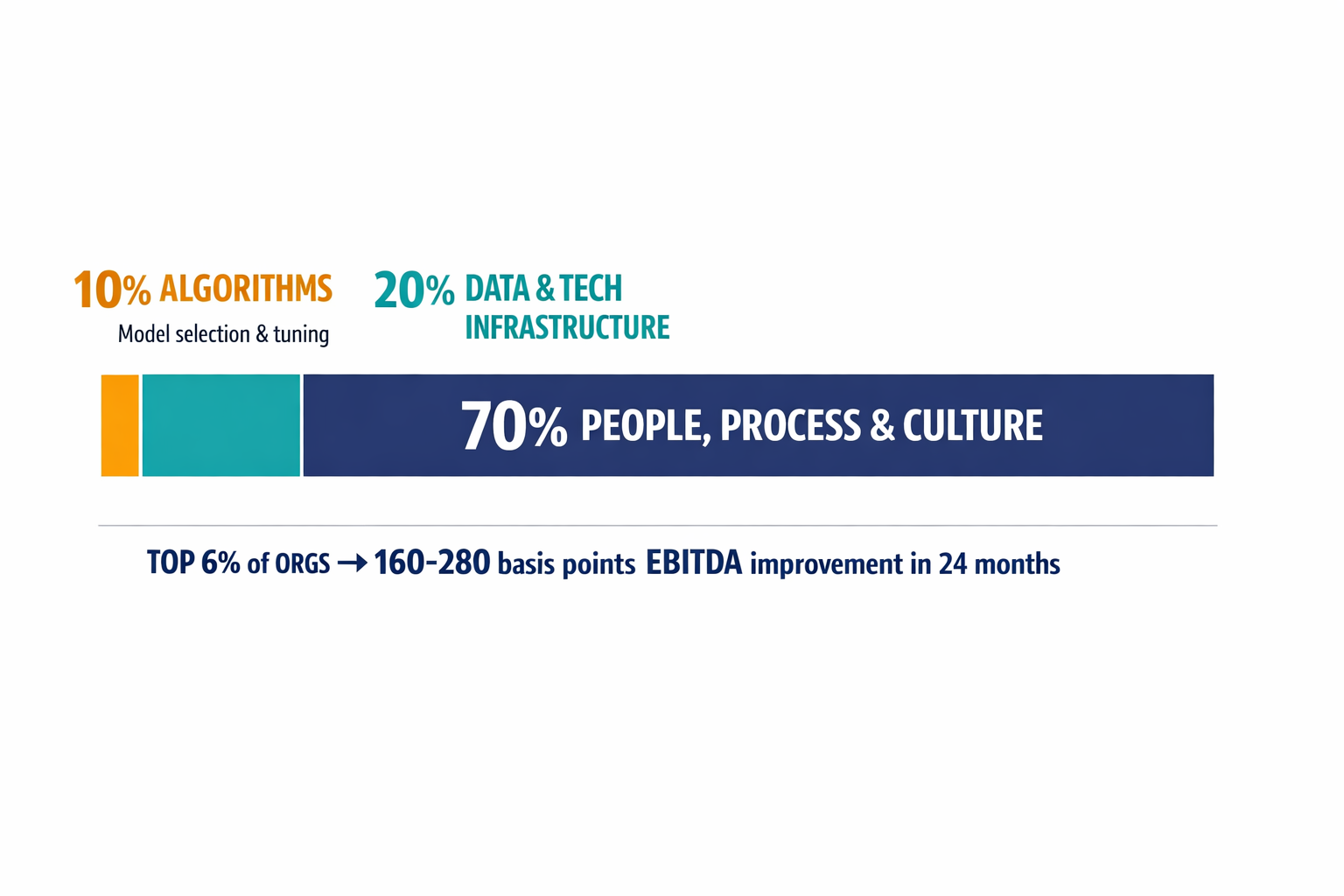
McKinsey's data shows that only 6% of organizations are seeing significant earnings impact — defined as more than 5% of total EBIT — from their AI investments. What separates them isn't bigger budgets or better models.
Leading organizations follow what's known as the 10-20-70 principle: 10% of effort goes to choosing and tuning algorithms, 20% to building data and technology infrastructure, and a full 70% to managing people, processes, and cultural transformation. Mid-market firms that follow this allocation have improved their EBITDA by 160 to 280 basis points within 24 months.
The wins come from areas that rarely make headlines — revenue cycle management, cash application automation, cloud cost optimization. Not flashy. Not demo-worthy. But directly connected to the P&L.
For the full technical methodology behind these findings, including the multi-agent design patterns and operational frameworks, see our detailed research on transitioning from LLM wrappers to deep AI systems.
Running AI in Production Is a Different Discipline Entirely
Getting a pilot to work and keeping a production system reliable are fundamentally different problems. Traditional machine learning operations (MLOps) was built for structured data and predictive models with stable metrics like accuracy scores. Generative AI needs something different — what the industry is calling LLMOps.
The differences are stark. Traditional ML costs are predictable and compute-based; LLM costs are variable and token-based. Traditional ML validates against static test sets; LLM systems need real-time human-in-the-loop review gates and behavioral metrics like helpfulness, relevance, and hallucination rate. The core requirement is what we call a "context retention layer" — a system that ensures the AI doesn't treat every interaction as an isolated event but builds long-term memory of organization-specific knowledge.
And as AI agents gain the ability to act autonomously — navigating browser interfaces, executing API calls, making decisions — security becomes a different game entirely. Session-level monitoring, least-privilege enforcement (giving agents access only to the specific data needed for a single task), and complete audit trails aren't optional. They're the difference between a production system and a liability.
What Does This Mean for Your Organization?
If you're part of the 95%, the path forward isn't to abandon AI. It's to stop treating it as a plug-and-play tool and start treating it as an architectural challenge.
Data quality is the number one blocker — 58% of CXOs cite it as their primary obstacle. Before choosing a model or building an agent, the first question should be: can our AI actually access the context it needs to do this job? If the answer involves copying and pasting from emails and spreadsheets, you have an infrastructure problem, not an AI problem.
Start with high-value, low-risk use cases where failure doesn't create regulatory exposure. Build a cross-functional team that pairs business domain experts with AI engineers — the 70% of the work that's about people and process, not technology. And measure relentlessly against business outcomes, not model benchmarks.
The GenAI divide isn't between companies that use AI and companies that don't. It's between companies that bolted a chatbot onto their existing processes and companies that redesigned their workflows around what AI systems can actually do reliably, at scale, under governance.
The billions have been spent. The question now is whether they become sunk costs or the foundation for something that genuinely moves the P&L. We believe the answer depends entirely on architectural depth — and the willingness to do the unglamorous work that makes AI production-ready.
If your team is navigating this transition, we'd welcome the conversation. What's working? What's breaking? The 5% who've figured this out have lessons the rest of us need to hear.