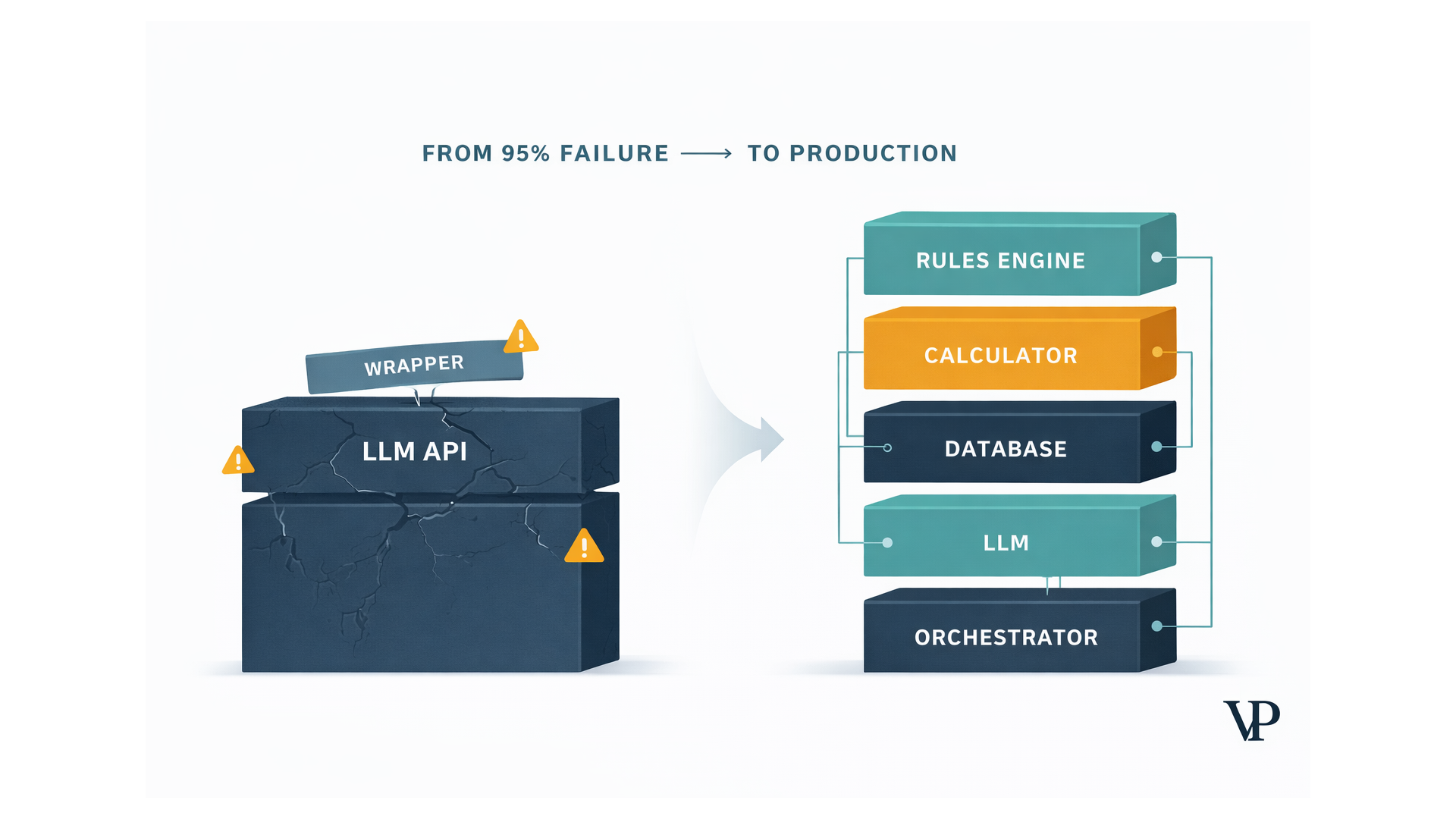
Enterprises have spent somewhere between $30 billion and $40 billion on generative AI. Ninety-five percent of those pilots have delivered zero measurable impact on the bottom line. That's not my number — that's MIT's NANDA initiative, published in their 2025 study "The GenAI Divide." When I first read that report, my reaction wasn't surprise. It was recognition. Because the pattern MIT describes — companies buying API access, wrapping a chatbot around it, and calling it an AI strategy — is exactly what my team at Veriprajna has spent the last two years helping enterprises move past.
The enterprise AI failure rate isn't a technology problem. It's an architecture problem. And the gap between companies that treat AI as a product to purchase versus those that treat it as a system to build is now wide enough to define who wins the next decade.
The Funnel of Failure Is Steeper Than You Think
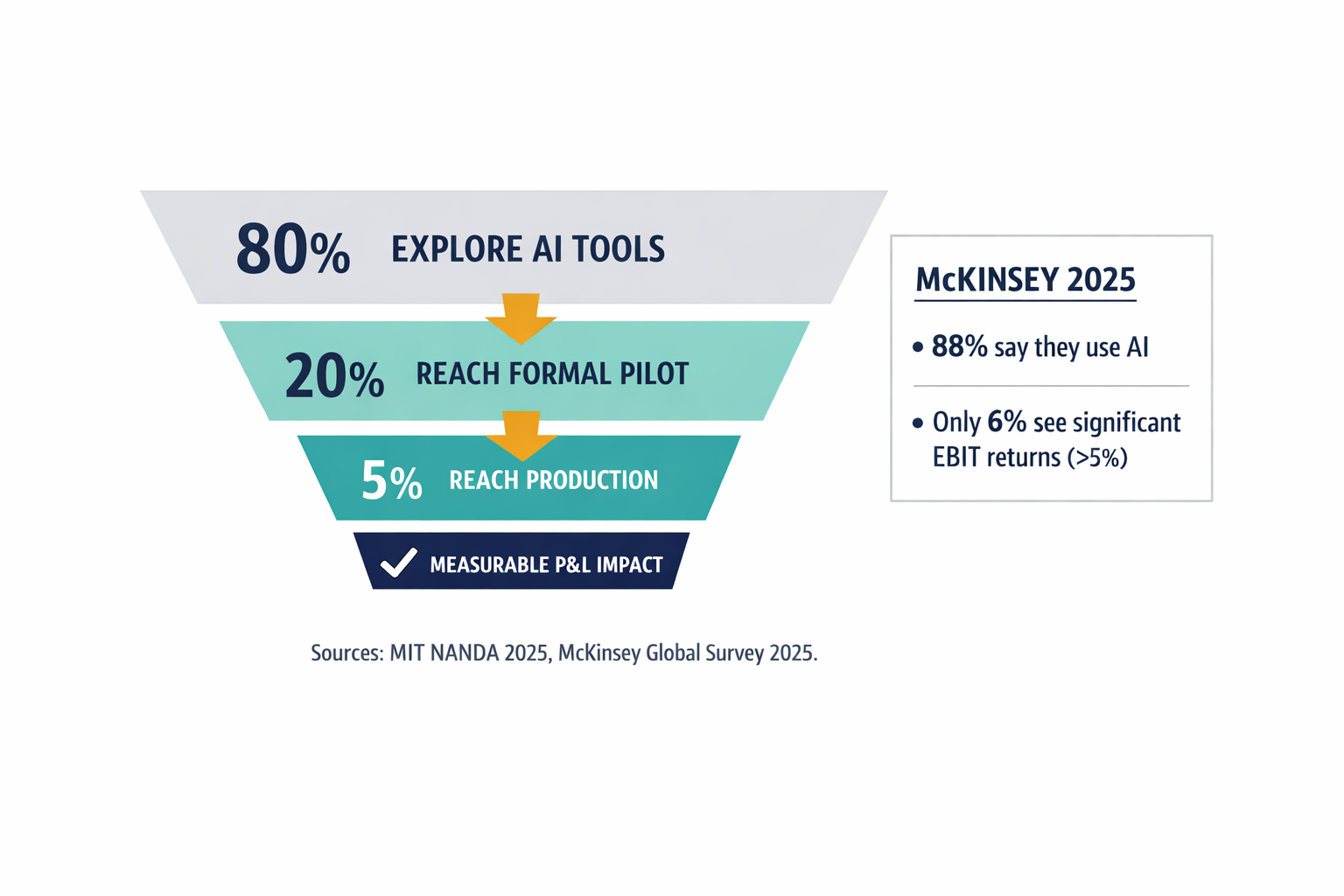
MIT's numbers tell a brutal story. Of the 80% of organizations that experiment with generative AI tools, only 20% make it to a formal pilot. Of those, just 5% reach full-scale production with outcomes that show up on a P&L statement. McKinsey's 2025 Global Survey paints a similar picture: 88% of organizations say they're using AI somewhere, but only 39% can point to any earnings impact at all. A mere 6% are seeing significant returns — defined as more than 5% of total EBIT.
Eighty percent of companies explore AI. Five percent get it to production. The other seventy-five percent are paying for education they never finish.
What kills most pilots isn't bad technology. It's what MIT calls a "learning gap." Teams build demos that work beautifully on curated data with narrow prompts. Then they expose those demos to the messy reality of enterprise operations — edge cases, inconsistent data, internal definitions that vary by department — and the whole thing collapses. Users in the MIT study reported three recurring frustrations: models that can't learn from feedback (60% of users), the exhausting need to re-explain context with every prompt (55%), and systems that break the moment they encounter anything non-standard (40%).
I've watched this happen firsthand. A client's AI demo would nail the happy path every time. But the moment a customer inquiry deviated even slightly from the training examples, the system would confidently produce nonsense. In compliance-heavy environments, confident nonsense is worse than no answer at all.
Why Wrappers Are Built on Quicksand
Most enterprise AI products on the market right now are what the industry calls "wrappers" — a user interface layered on top of an API call to a large language model like GPT or Claude. They're fast to build, easy to demo, and fundamentally incapable of scaling.
The typical wrapper works by cramming everything — rules, data, instructions, context — into a single massive prompt. My team calls this the "mega-prompt" approach, and it creates three problems that become existential at scale. First, there's no way to verify that the model followed the instructions in the right order, which makes compliance auditing impossible. Second, long prompts burn through tokens at unsustainable rates, destroying unit economics. Third, minor changes in wording can produce wildly different outputs, which means you can never make reliable promises about performance.
The economic trap is even more fundamental. As OpenAI and Anthropic keep dropping their API prices — and they will — the margins of every wrapper-based product collapse in lockstep. If you don't own the data, the workflow, or the business logic, you're renting intelligence from someone who can undercut you tomorrow.
When your entire product is a prompt and an API key, you don't have a moat. You have a subscription.
One detail from our research that shocked even our own engineers: the choice of model tokenizer alone — the component that converts text into the numerical tokens the model processes — can create a 450% cost difference for the same workload. Processing customer inquiries in languages with complex scripts like Tamil can cost 4.5 times more on an inefficient tokenizer than on an efficient one. For an enterprise handling 100,000 daily inquiries, that's the difference between $36,500 and $164,000 per year on tokenization alone. Most companies never even look at this number.
The Architectural Shift: From One Model Does Everything to Specialized Teams
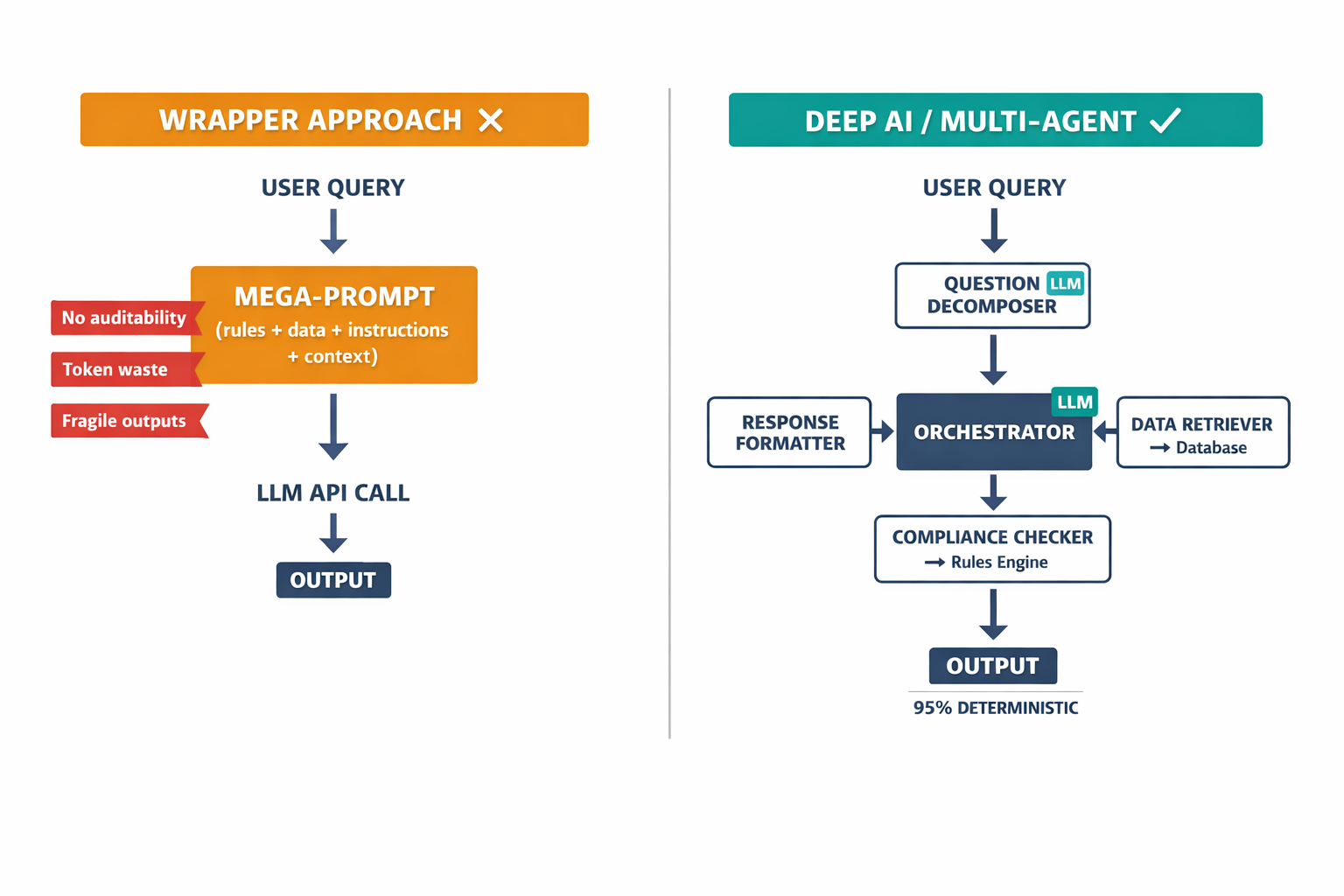
The alternative to the wrapper is what we call the "deep AI" approach, and the core idea is deceptively simple: stop asking one model to do everything.
Think of it like the difference between hiring one generalist to run your entire finance department versus building a team with a controller, an analyst, a compliance officer, and a CFO. A large language model is brilliant at reasoning and language. It's terrible at math, rule-following, and remembering what you told it last Tuesday. So you build a system where the LLM handles the reasoning, a calculator handles the math, a rules engine handles compliance, and a database handles memory.
This is multi-agent orchestration — multiple specialized AI agents, each with a defined job, coordinated by a central workflow. One agent breaks down the customer's question. Another retrieves relevant data. A third checks the answer against regulatory requirements. A fourth formats the response. The LLM only gets called for the steps where language understanding genuinely matters, which means you're not burning expensive tokens on tasks a simple database query could handle.
We explored this architectural transition in depth in our interactive analysis of the GenAI divide, and the efficiency gains are striking. Systems built this way can be 95% deterministic — meaning only 5% of the processing relies on the probabilistic nature of a language model. The rest follows predictable, auditable, verifiable logic.
The patterns that make this work have names in the industry: reflection (the agent checks its own work before responding), planning (complex goals get broken into sequential steps), tool use (the agent calls external databases or calculators instead of guessing), and orchestration (a supervisor agent assigns sub-tasks to the right specialist). None of these are theoretical. They're running in production right now.
Where the Money Actually Shows Up
I'm skeptical of any AI article that doesn't name specific dollar amounts, so let me share the use cases where deep AI is producing real, audited returns.
Healthcare is averaging a 451% ROI on well-implemented AI. OSF HealthCare deployed AI virtual assistants integrated with their electronic health records and saved $1.2 million in costs while generating an additional $1.2 million in revenue. Inova Health System cut its backlog of unbilled claims by 50%, saving $1.3 million annually. These aren't demo metrics. They're P&L line items.
Supply chain and logistics is where the scale gets staggering. UPS reported $400 million in annual savings through AI-based route optimization. DHL reduced manual paperwork by 80% using document processing agents that extract data from unstructured logistics forms. Walmart uses AI agents to redirect inventory during demand surges in real time. Across the industry, the shift from linear supply chains to autonomous, agent-driven networks is projected to cut functional costs by 3-4% globally — a value opportunity exceeding $290 billion.
The companies seeing real AI returns aren't chasing flashy demos. They're automating billing, routing, and inventory — the unsexy work that directly hits EBIT.
The common thread in every success story is the same: these organizations aren't using AI to generate text. They're using AI to execute business processes — end to end, with human oversight at critical checkpoints, not at every step.
The 10-20-70 Rule That Separates Winners from Experimenters
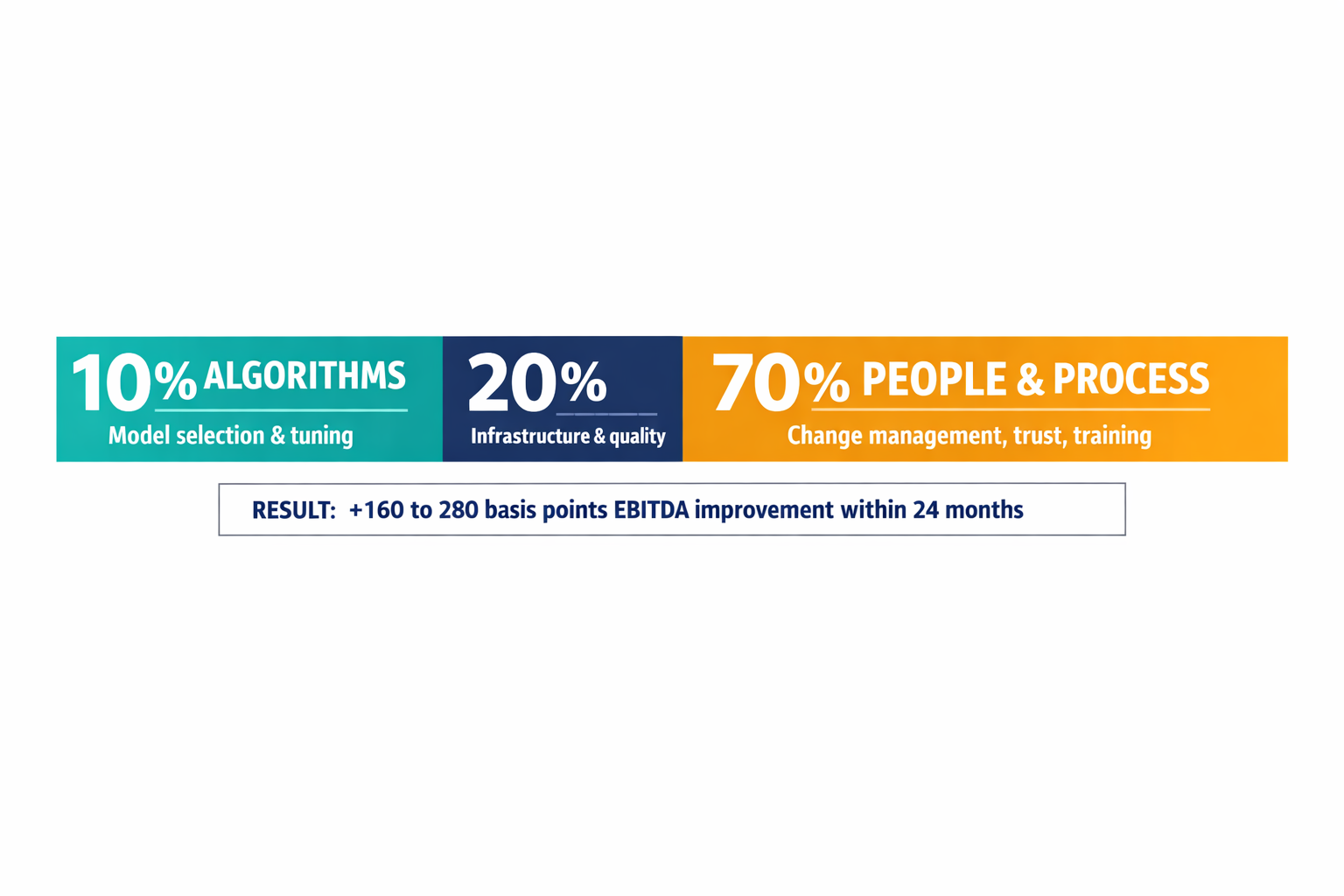
One of the most useful frameworks I've encountered comes from studying mid-market firms that actually moved their EBITDA with AI. They follow a resource allocation pattern: 10% of effort goes to choosing and tuning algorithms. 20% goes to building data infrastructure. 70% goes to managing people, processes, and cultural change.
That ratio surprised me initially. We're a technology company — my instinct was that the technology should be the hard part. But after watching dozens of implementations, I've come to believe the 70% is exactly right. The most sophisticated multi-agent system in the world is worthless if the operations team doesn't trust it, the compliance team can't audit it, or the executives don't understand what it's actually doing.
Mid-market firms that follow this principle have improved their EBITDA by 160 to 280 basis points within 24 months. That's not from moonshot AI projects. It's from applying deep AI to revenue cycle management, cash application, and cloud cost optimization — the operational backbone that most AI vendors ignore because it doesn't make for a compelling demo.
The Infrastructure That Makes 2026 Different
Two emerging standards are about to change the economics of enterprise AI dramatically, and I think most executives haven't heard of either one.
The first is Model Context Protocol (MCP), developed by Anthropic. Think of it as a universal adapter — like USB-C, but for connecting AI agents to enterprise data sources. Instead of building custom integrations for every database, CRM, and ERP system, MCP provides a standardized way for AI to plug into your existing infrastructure. This alone eliminates months of integration work that currently kills AI projects in their infancy.
The second is the NANDA framework (Networked AI Agents in a Decentralized Architecture), which solves the security problem that keeps CISOs awake at night. When AI agents can autonomously browse systems, call APIs, and execute actions, you need cryptographically verifiable identity management, zero-trust access controls, and complete audit trails for every action an agent takes. NANDA provides all of this as a standardized layer.
For the full technical methodology behind how these protocols integrate into enterprise architectures, see our detailed research on the GenAI divide.
What About Companies That Have Already Invested Heavily in Wrappers?
This is the question I get most often, and I want to be honest: the wrapper investment isn't entirely wasted, but it can't be the foundation. The user research, the workflow mapping, the change management — all of that transfers. What doesn't transfer is the architecture. You can't incrementally evolve a mega-prompt into a multi-agent system. It's a different design philosophy, and trying to bridge the two creates more technical debt than starting fresh.
The practical path for most organizations is a 12-to-18-month transition. Months one through three: identify high-value, low-risk processes where AI failure doesn't create regulatory exposure. Months three through six: fix your data — 58% of CXOs cite data quality as their number one blocker, and they're right. Months six through twelve: build multi-agent prototypes connected to your actual systems via MCP, iterating rapidly against real-world data. Months twelve through eighteen: deploy to production with full operational support — drift detection, bias monitoring, cost governance.
That timeline isn't fast. But the companies that skip the foundation-building phase are the ones who end up in MIT's 95%.
Is This Just Another Hype Cycle?
Fair question. I had a conversation with an investor last year who said, "Ashutosh, every enterprise technology goes through this. The first wave overpromises, the second wave overdelivers. You're just selling the second wave." And honestly, he's partially right. But the difference this time is that the first wave left behind something valuable: proof that language models can genuinely reason about unstructured data. What was missing wasn't the intelligence — it was the architecture to make that intelligence reliable, auditable, and economically sustainable.
The 95% failure rate isn't evidence that AI doesn't work. It's evidence that wrappers don't work. The 5% who succeed are building systems, not buying products.
The question for 2026 isn't whether AI can think. It's whether your organization can build the system that turns thinking into doing.
If you're in the middle of this transition — or stuck in pilot purgatory trying to figure out the next step — I'd genuinely like to hear what's blocking you. The patterns we're seeing are remarkably consistent across industries, and the solutions are more accessible than most vendors want you to believe.