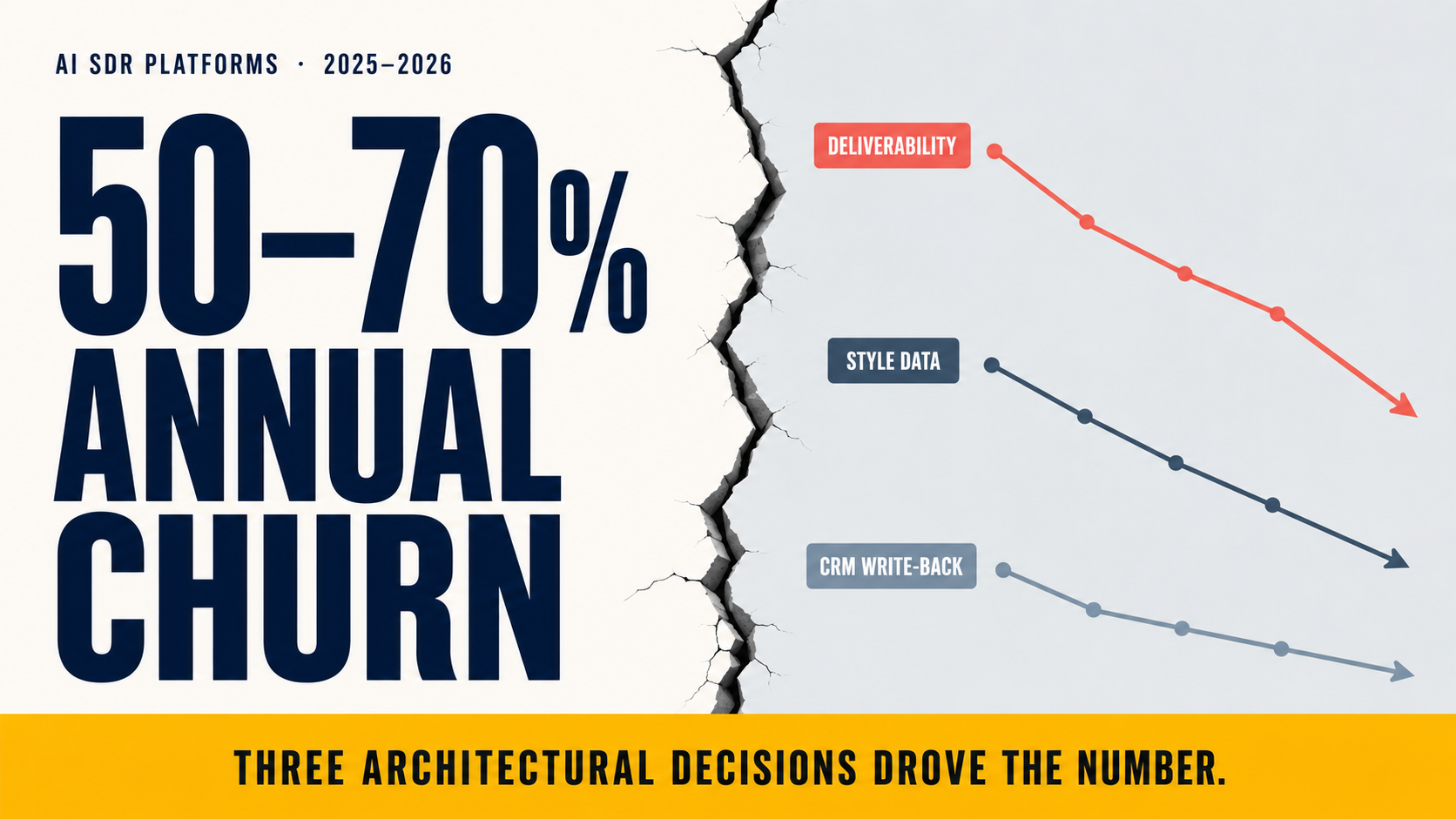
The verdict on fully autonomous AI SDRs is in, and it isn't a technology verdict. It's an architectural one. 11x.ai — backed by $74M from a16z and Benchmark — lost 70–80% of its customers within months of launch, while claiming $14M ARR against what TechCrunch later reported were roughly $3M in real contracts. ZoomInfo publicly stated that 11x's AI "performed significantly worse than their SDR employees." The AI SDR category as a whole sees 50–70% annual tool churn, roughly double the turnover of the human SDRs the tools were supposed to replace.
We've spent the past year analyzing where these architectures break. The failure pattern isn't random. Every platform that churned at category-defining rates made the same set of bets about what could be treated as commodity and what couldn't. Understanding those bets is the prerequisite to building AI-assisted outbound that actually works.
The Metric That Makes the Math Look Better Than It Is
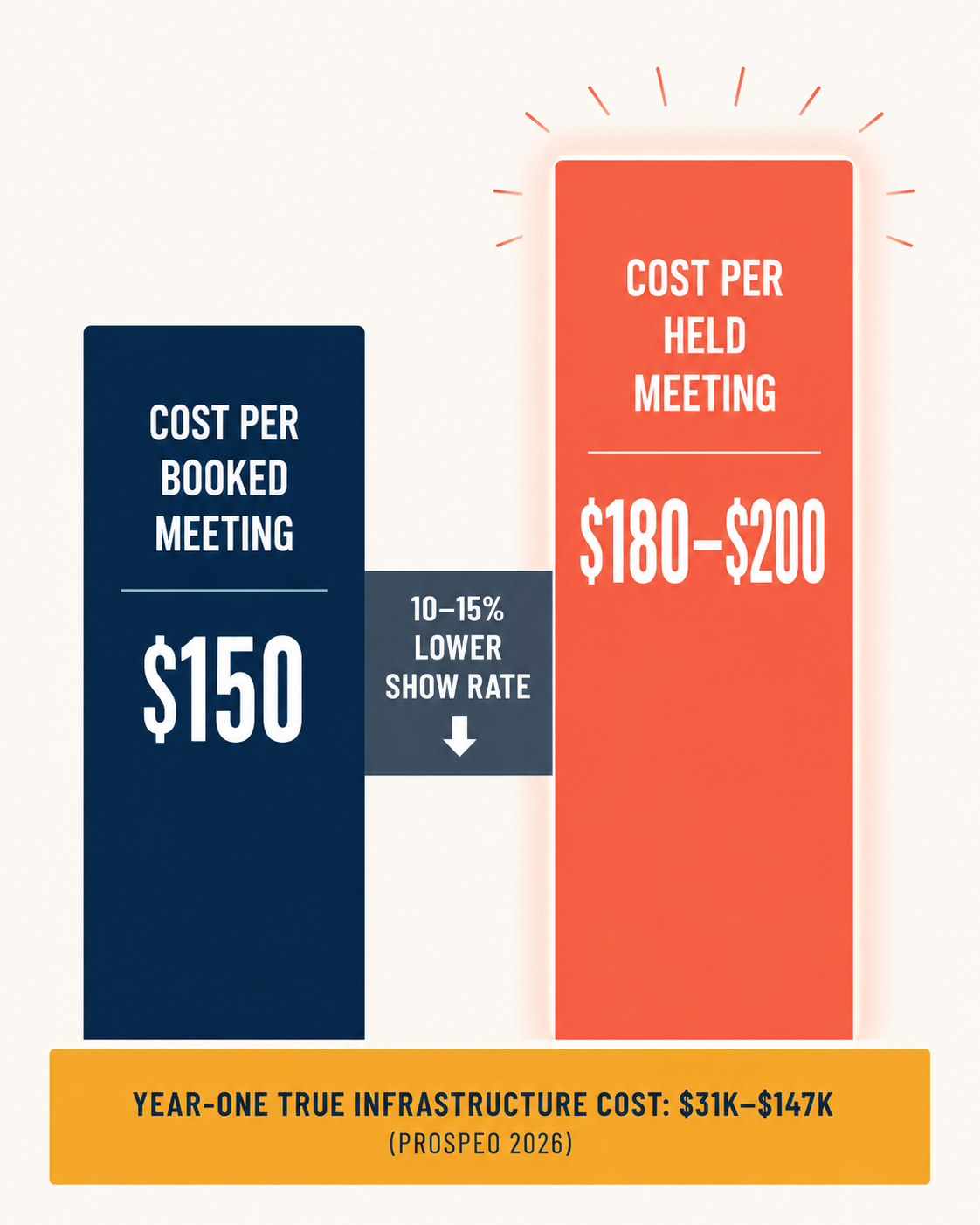
The cost figures AI SDR vendors publish are cost-per-calendar-invite, not cost-per-held-meeting. Those are different numbers, and the gap is large enough to invert the economics.
AI-booked meetings show at rates 10–15% lower than human-booked. A vendor quoting $150 per booked meeting is quoting closer to $180–$200 per conversation that actually happened — and that gap compounds when year-one true costs (infrastructure, warm-up, tooling) are factored in. Prospeo's 2026 analysis puts those costs at $31K–$147K for a properly architected system. The $50K–$60K annual licenses autonomous platforms advertise are a starting line, not a ceiling.
The economics of AI outbound depend entirely on which denominator you use: calendar invites or conversations that actually happened.
Vendors don't advertise held-meeting rates because that measurement requires connecting calendar data with CRM attendance logs — a step most platforms skip because they're not built CRM-natively. That data gap is itself a diagnostic. In our work building AI SDR systems at Veriprajna, the first thing we instrument is a cost-per-held-meeting tracker with disposition codes for no-shows, cancellations, and completed conversations. Without that, teams are optimizing a metric the vendor controls rather than one the business cares about.
What Deliverability Actually Costs You
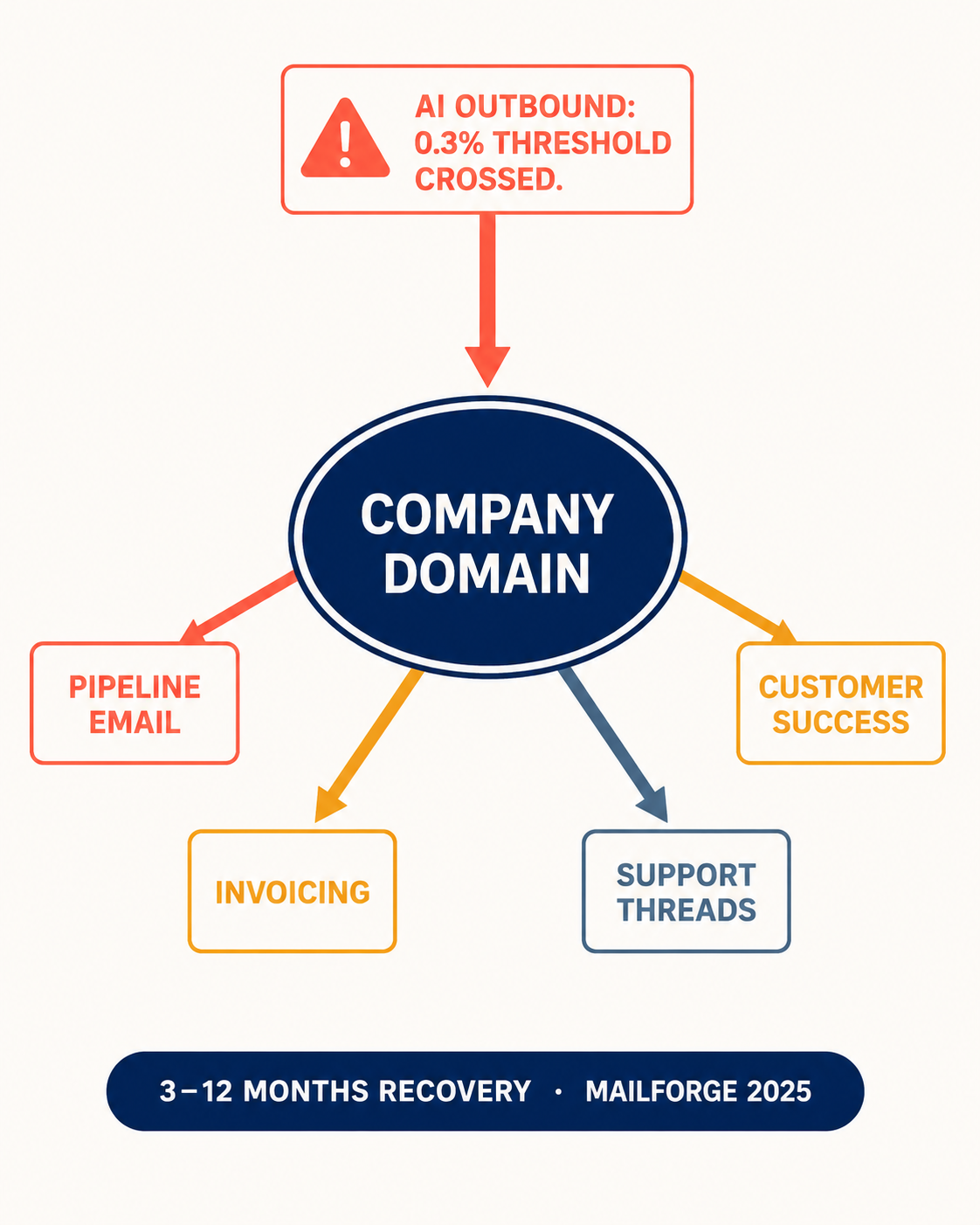
The AI SDR failure mode that gets discussed least is the one with the widest blast radius.
Google has actively rejected non-compliant bulk email since November 2025. Microsoft enforced bulk sender requirements starting May 5, 2025. The shared standard: SPF, DKIM, and DMARC mandatory, spam complaint rates below 0.3%, one-click unsubscribe for 5,000+ daily sends. Volume-based AI outreach — the kind that sends at scale without per-email signal quality checks — is structurally incompatible with those requirements.
What most sales leaders don't model is what happens after the threshold is crossed. When a domain exceeds the 0.3% Google complaint rate, the deliverability collapse spreads to all email on that domain within 48 hours — customer success threads, invoicing confirmations, support ticket responses. The outbound campaign that triggered the problem runs on the same domain as ARR expansion emails to existing accounts. A 50% drop in overall deliverability and a 5–10x increase in spam folder placement aren't isolated to pipeline-building; they affect whether renewal discussions land in the inbox at all. Domain blacklisting recovery runs 3–12 months (Mailforge, 2025).
Domain blacklisting recovery runs 3–12 months. During that window, every piece of company email — renewal discussions, invoicing, customer support — pays the same deliverability tax as the campaign that caused it.
Cold email at quality scale still delivers: 18x lower cost per meeting than cold calling, $153 versus $2,778 (SalesCaptain, 2025), with elite reply rates above 10% compared to the 3.43% category average (Instantly Benchmark Report, 2026). The architecture question is whether a system is structured to deliver quality or volume. Domain isolation — separate sending domains for cold outreach, with staged warm-up schedules that ramp send volume progressively over weeks — is the standard for protecting the main company domain. It's also infrastructure most off-the-shelf platforms either don't provide or don't configure by default.
Why Personalization Still Sounds Like AI
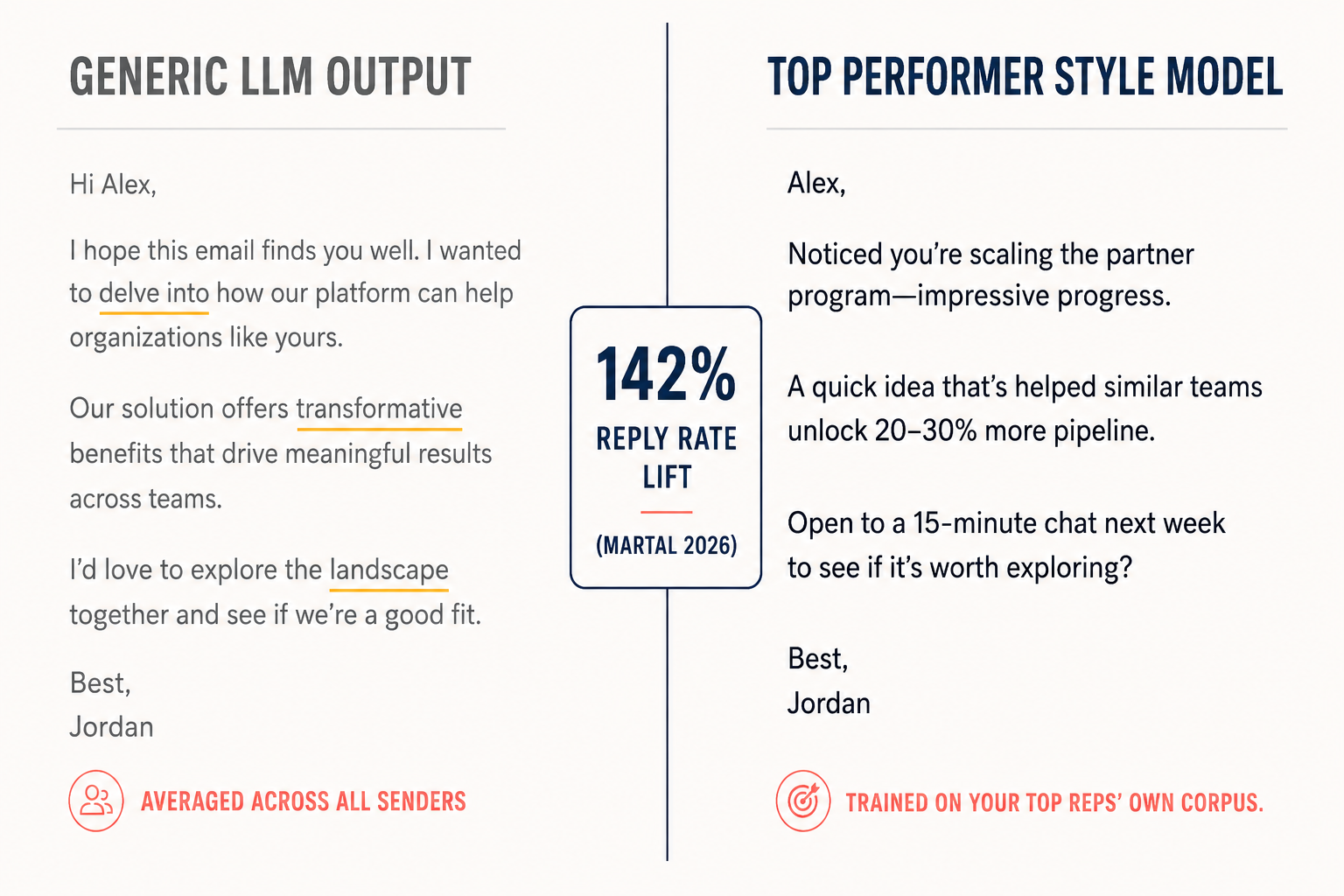
The platforms that didn't solve the deliverability problem also didn't solve the personalization problem, and both failures trace to the same architectural choice: using generic language models as the personalization engine without grounding in rep-specific style data.
Highly personalized campaigns produce a 142% lift in reply rate over generic outreach (Martal, 2026). What personalization actually requires is building a style model from your own top performers' sent email history — a statistically meaningful corpus of successful sends from individual reps — not a generic LLM trained to approximate professional tone.
Without sufficient rep-specific data, the system averages across senders and produces output that sounds like the midpoint between your reps: professional, grammatically correct, and audibly AI-generated. Sophisticated buyers in 2026 have been conditioned by enough synthetic outreach that phrases like "delve," "landscape," and "transformative" register as AI markers even when the reader can't articulate why the email feels off. Artisan's "Ava" SDR product — positioned as full autonomy at approximately $24K/year — quietly reverted toward a hybrid human-AI model for exactly this reason: the quality bar required human editorial judgment that the style output wasn't clearing on its own.
The systems we build at Veriprajna are trained on the client's own top-performer email corpus, enriched by a Clay waterfall across 75+ data sources to ground each message in verified prospect signal before any generation runs.
The CRM Gap That Makes Everything Else Irrelevant
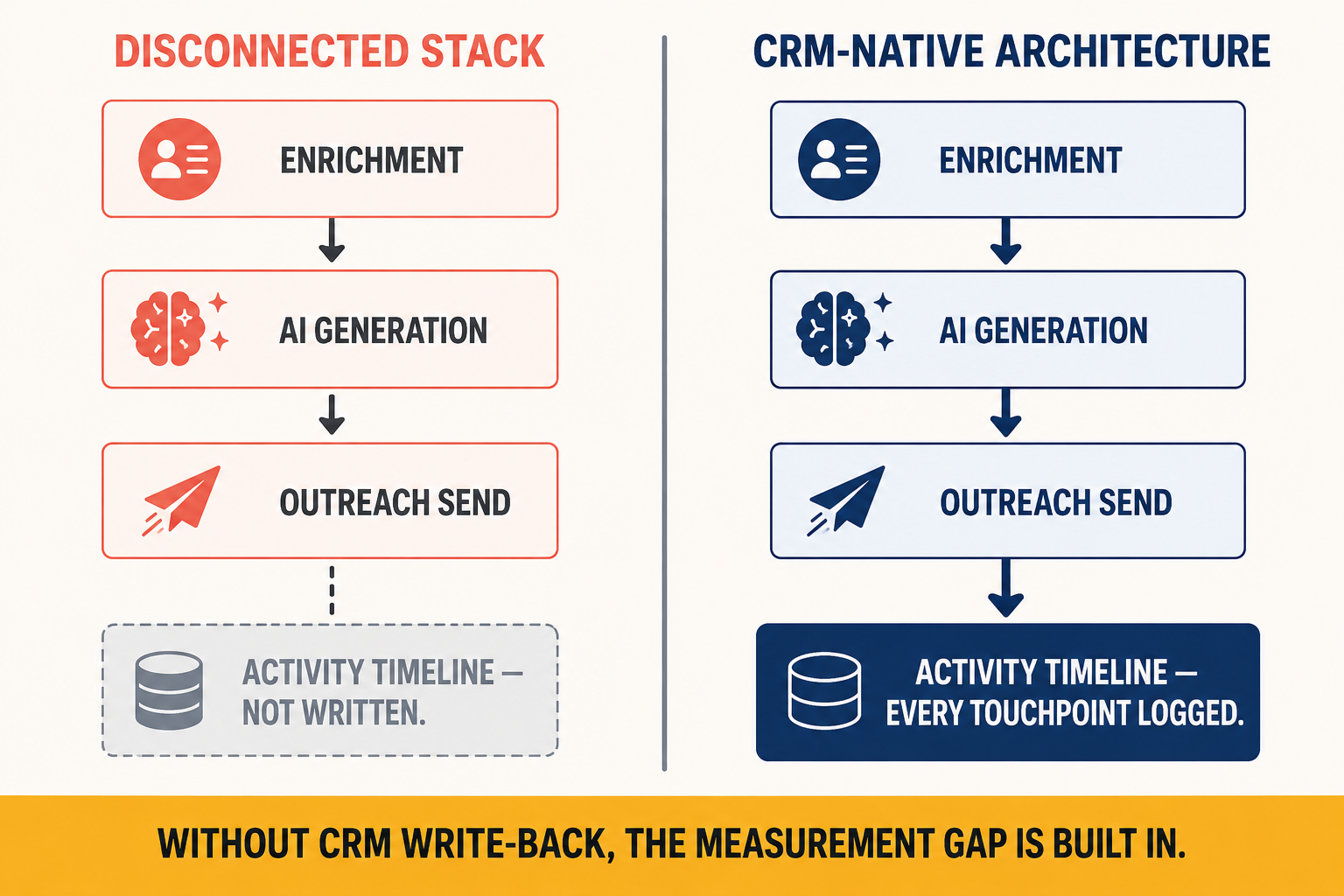
A well-enriched, deliverability-compliant outbound system that doesn't write activity data back into Salesforce or HubSpot creates another tool for reps to check before a call — not sales intelligence.
Salesforce Agentforce SDR at $125–$550/user/month plus base CRM solves the integration problem by requiring full platform lock-in as the price of entry — which works if you've already committed to the Salesforce ecosystem and are willing to pay for it. The other incumbents (Apollo.io, Outreach.io) have CRM write-back in their feature lists, but the depth of that integration varies enough by configuration that it requires active instrumentation rather than a default assumption.
The measurement problem is downstream from the integration problem. If AI-generated touchpoints don't appear in the Salesforce activity timeline next to the rep's notes, you can't compare AI performance to human performance on the same metrics — and you can't trust the cost-per-held-meeting figure, because you're measuring numerator and denominator in different systems.
The Compliance Layer Nobody Priced In
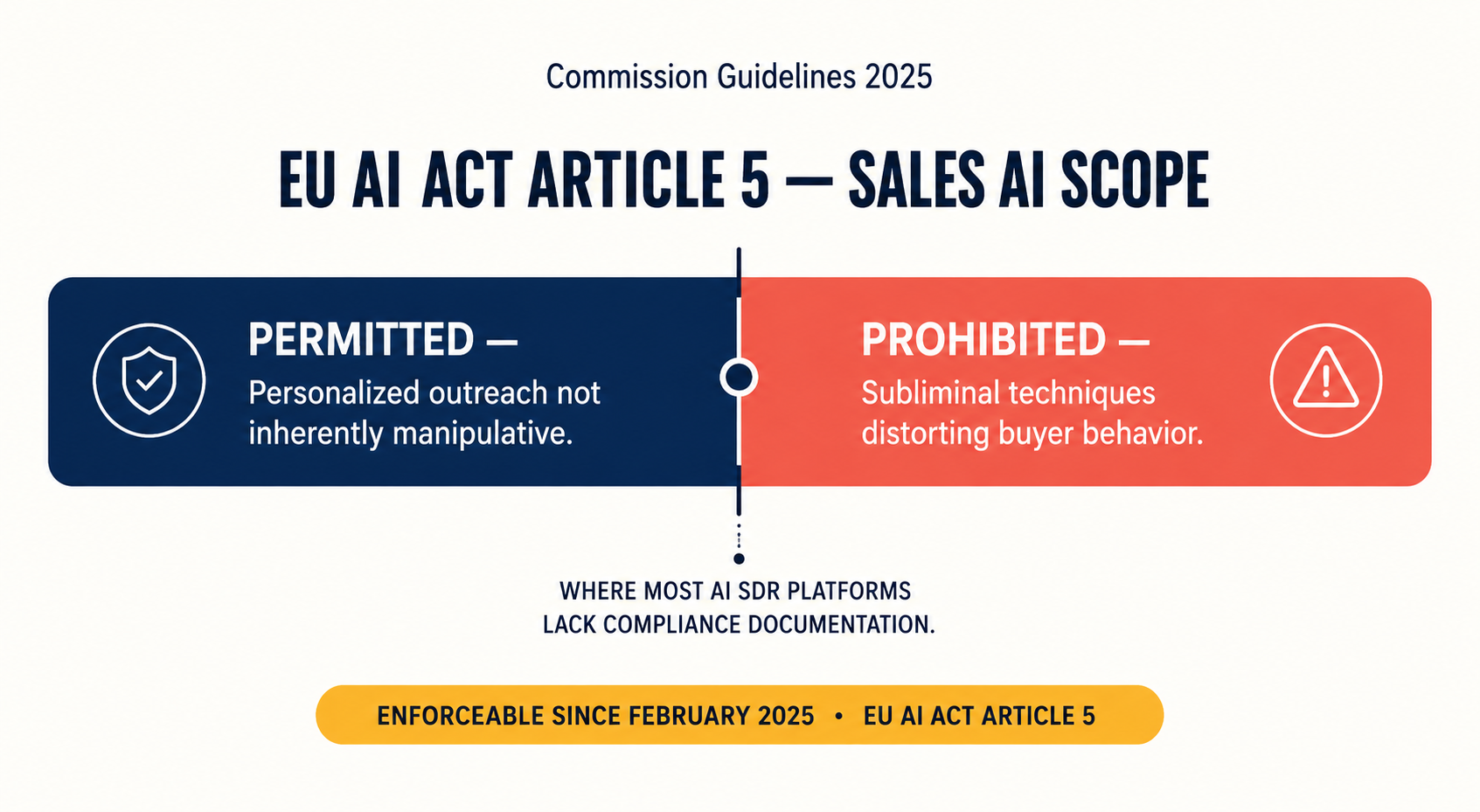
EU AI Act Article 5 has been enforceable since February 2025. Commission guidelines clarify that personalized outreach is "not inherently manipulative" — but AI that uses subliminal techniques to distort buyer behavior below the awareness threshold IS prohibited. Most AI SDR platforms haven't updated their compliance documentation to reflect this. For teams selling into financial services, healthcare, or insurance, the audit surface of a vendor-managed platform with a shared model is meaningfully different from a custom architecture built for a specific stack.
Where the Market Actually Landed
The Gartner projection of 75% of B2B sales organizations augmenting their playbooks with AI tools by 2026 reflects a structural shift, but not the one autonomous AI SDR vendors predicted. The shift is toward hybrid: AI-generated personalization built from rep-specific style data, deliverability infrastructure treated as a design constraint from day one, and CRM write-back as a non-negotiable output — with humans in the loop for editorial judgment and relationship management.
11x.ai and Artisan ran the full-autonomy experiment at venture scale. The data from those experiments points toward what the architecture needs to include: deliverability-first design, rep-style grounding, and measurement frameworks built around the held-meeting denominator. The full scope of what that looks like in a custom system — architecture, tooling, integration, and measurement — is documented at AI Sales Personalization That Books Meetings.
The teams that figured out AI outbound weren't the ones who picked the best platform. They were the ones who built the right architecture underneath it — and measured the thing that actually matters when the calendar invite becomes a conversation.