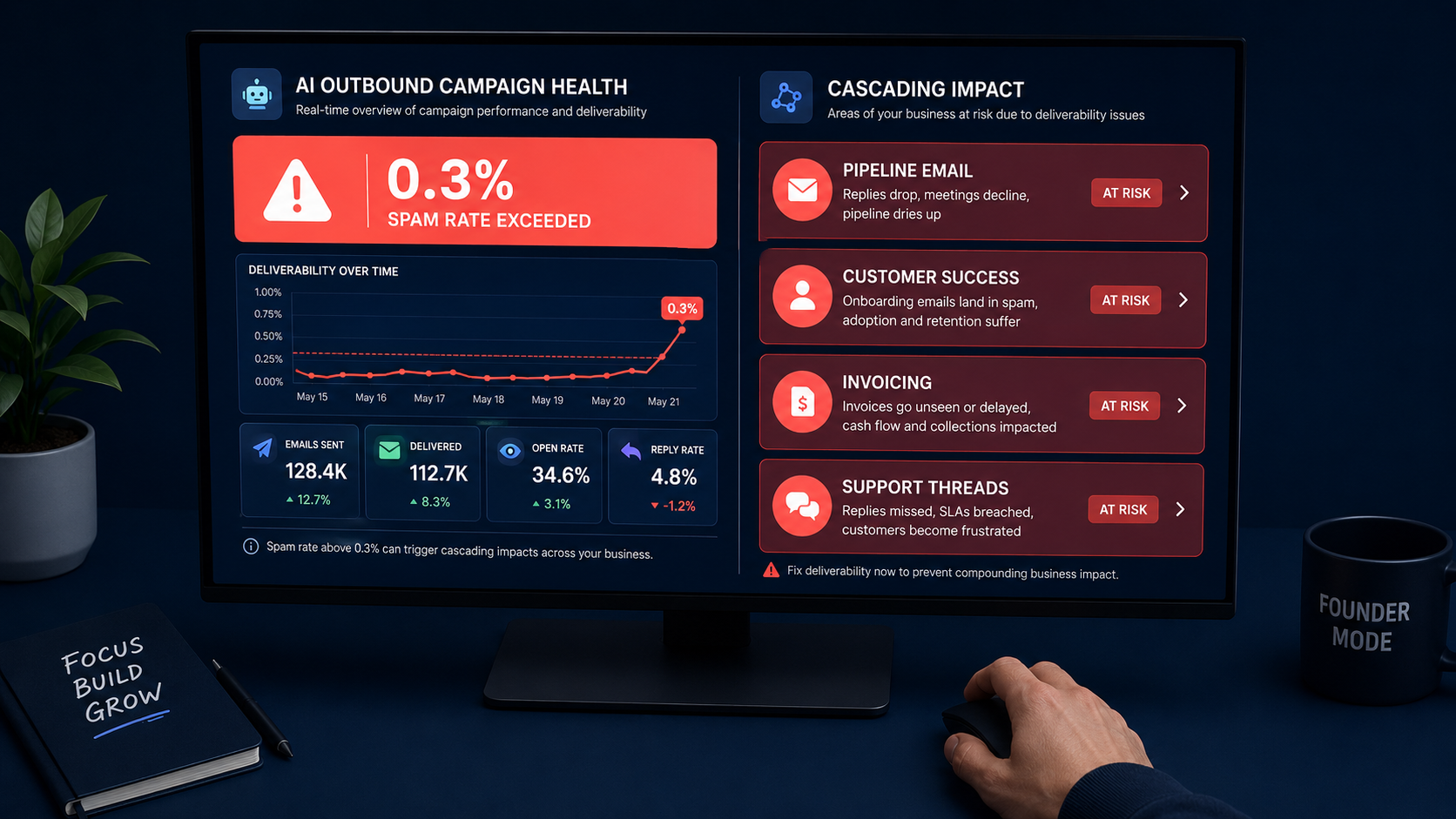
When the TechCrunch piece on 11x.ai's customer implosion came out — 70-80% churn against a company that had raised $74M from a16z and Benchmark, claiming $14M ARR with what turned out to be roughly $3M in real contracts — my first instinct wasn't "the AI doesn't work." It was: look at what the architecture assumed was optional. The AI SDR category as a whole was running 50-70% annual tool churn, roughly double the human SDR turnover it was supposed to eliminate. That's not a product failure. That's a set of shared architectural bets going wrong at the same time.
The bets weren't hidden. They were just treated as defaults.
The Number Every Vendor Had and Nobody Would Show Me
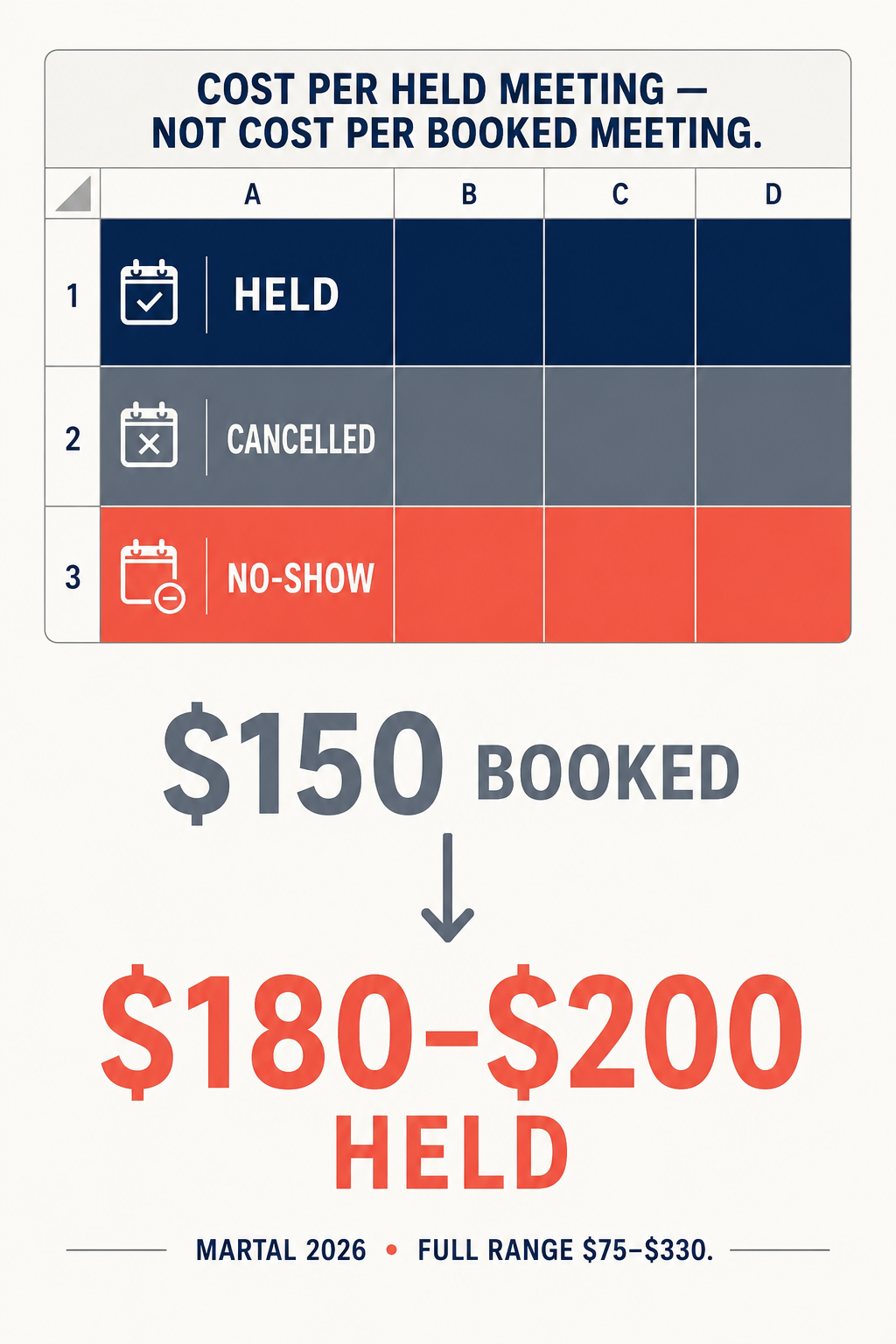
The measurement problem I kept hitting was deceptively simple: vendors publish cost-per-booked-meeting, and no platform I evaluated had a clean answer for cost-per-held-meeting. Those are different numbers.
I built a tracking spreadsheet with disposition codes — held, cancelled, no-show — because that was the only way to make the comparison honest. What I found: AI-booked meetings showing at 10-15% lower rates than human-booked, which takes a $150-per-booked-meeting quote and turns it into $180-$200 per conversation that actually happened. Martal's 2026 analysis puts the full range at $75-$330 per held meeting once infrastructure is factored in. Prospeo's year-one cost modeling runs $31K-$147K for a properly instrumented system — against the $50K-$60K annual license that a platform like 11x.ai was selling.
That gap is the held-meeting adjustment meeting the infrastructure reality. Vendors don't advertise held-meeting rates because measuring them requires connecting calendar attendance to CRM disposition — a step that requires CRM-native architecture, which most platforms don't have.
I built the held-meeting framework because the vendors' metric wasn't the one I could defend in a conversation with a sales leader who'd been burned before. The full system we've built at Veriprajna instruments this measurement from day one.
The Deliverability Math I Ran When No One Was Expecting the Answer
My read of the domain blacklist risk changed entirely when I modeled what the blast radius actually looks like. Most people model it as a pipeline problem: outbound stops working, reply rates drop, leads dry up. That's real. What surprised me was how far beyond the outbound sequences the damage extends.
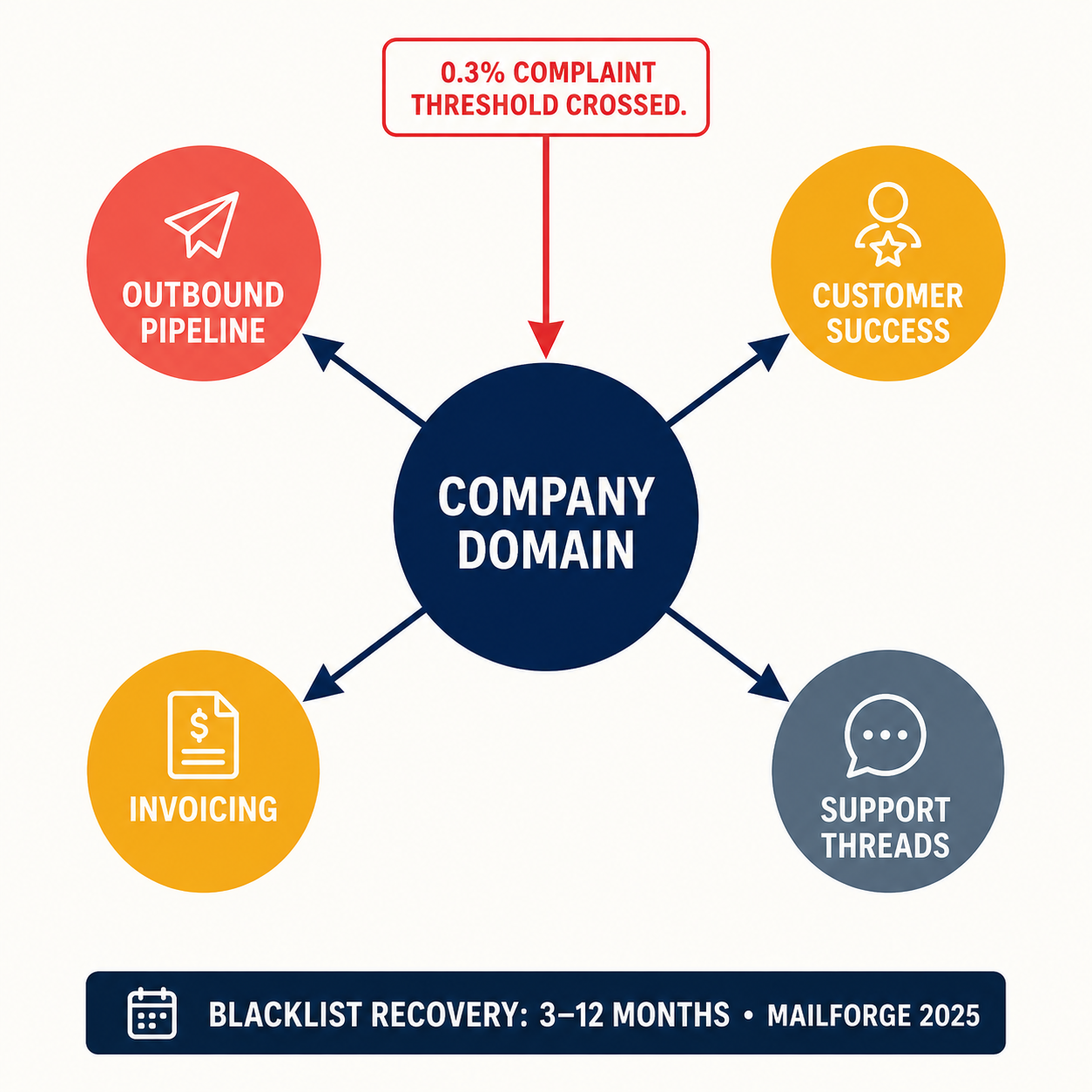
When a sending domain exceeds the 0.3% Google complaint threshold — which Google has been enforcing actively since November 2025, alongside Microsoft's bulk sender requirements from May 5, 2025 — the deliverability collapse doesn't stay in the outbound sequences. It spreads to everything on that domain within 48 hours. Customer success emails. Invoicing confirmations. Support thread responses. The cold outreach campaign and the renewal discussion sit on the same domain. Recovery runs 3-12 months (Mailforge, 2025), and during that window, the ARR expansion conversation your CS team spent months setting up is landing in a spam folder.
Domain blacklisting isn't a pipeline problem. It's a revenue-operations problem — because it affects the email you need your existing customers to see.
That's the analysis that made domain isolation non-negotiable in every system I build. Separate sending domains for cold outreach, staged warm-up calendars that ramp volume progressively over weeks — not optional infrastructure, but the constraint that makes everything else defensible. Cold email at quality scale still delivers: 18x lower cost per meeting than cold calling ($153 versus $2,778 per SalesCaptain's 2025 analysis), with elite campaigns above 10% reply rates against a 3.43% category average (Instantly Benchmark Report, 2026). But that math doesn't hold if the campaign is sharing a domain with your customer success operation.
Why I Build Style Systems from Your Reps' Own Data
I spent time evaluating the vendors who claimed to solve personalization before building my own approach. The one I tracked most closely was Artisan's "Ava" — positioned as full autonomy at approximately $24K/year — which quietly reverted toward a hybrid human-AI model because the style output required editorial judgment the autonomous system wasn't providing on its own.
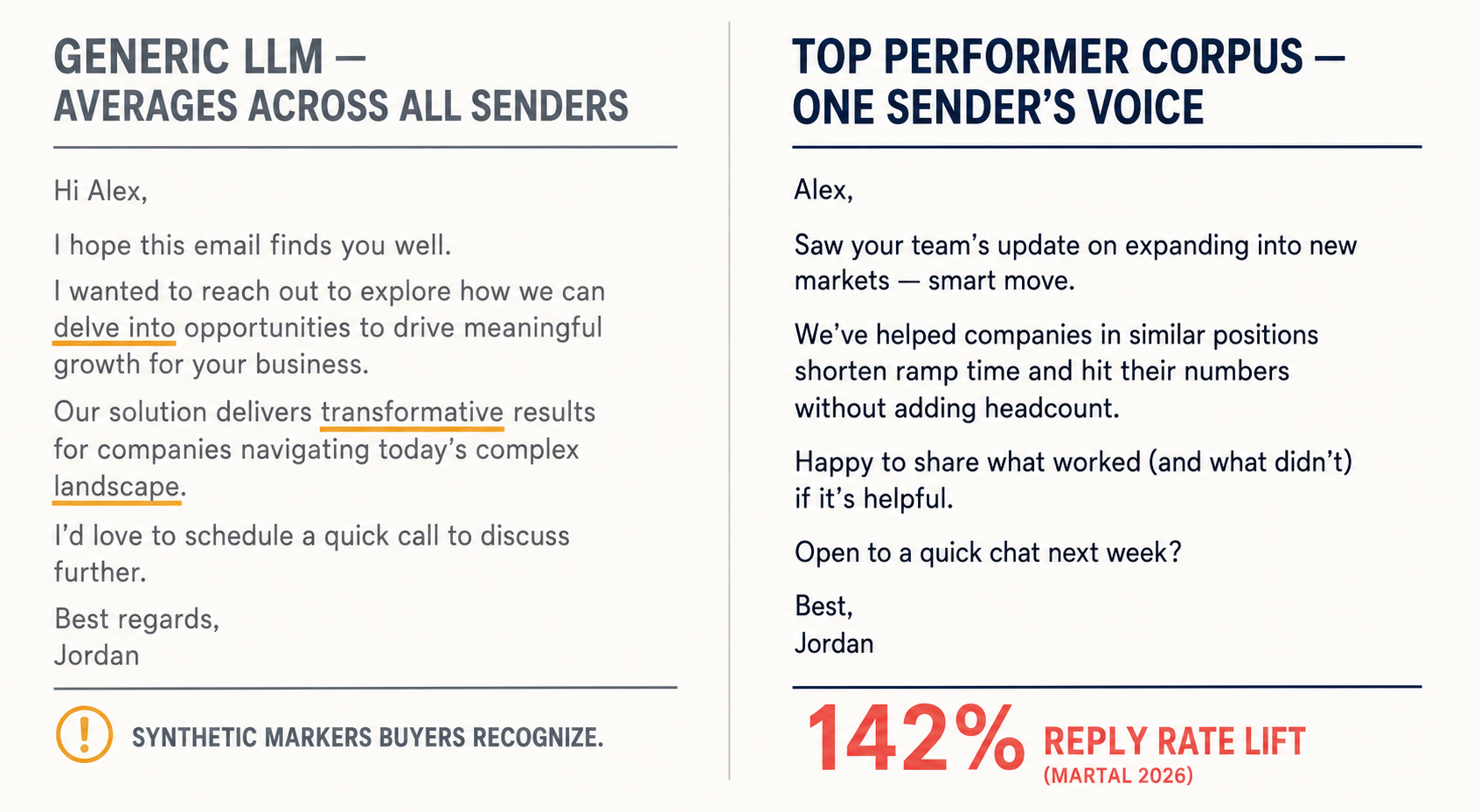
What that experience taught me is that the 142% reply-rate lift from deep personalization versus generic outreach (Martal, 2026) isn't something you get from a generic LLM trained to approximate professional tone. You get it from building a style model on your own top performers' email corpus — their actual sentence lengths, opener variety, CTA phrasing patterns, the things that made buyers respond. Without that corpus, the system averages across senders and produces the professional midpoint: grammatically correct, tone-appropriate, and audibly synthetic to a buyer who's been receiving this kind of outreach for 18 months.
The enrichment layer matters too. Every system I build runs a Clay waterfall across 75+ data sources to ground each outreach in verified prospect signal before any generation runs. The style system without the signal layer produces personalization that sounds right but doesn't know anything about the buyer.
The Compliance Layer That Most Buyers Don't Know They're Inheriting
What I've noticed in conversations with teams selling into regulated verticals — financial services, healthcare, insurance — is that EU AI Act Article 5 hasn't yet landed as a practical constraint on how they evaluate AI sales tooling. It's been enforceable since February 2025. The Commission's guidelines on sales AI clarify that personalized outreach isn't inherently prohibited, but AI that uses subliminal techniques to distort buyer behavior below the awareness threshold IS.
Most off-the-shelf AI SDR platforms haven't updated their compliance documentation to locate where their systems fall relative to that line. For a team that eventually faces an audit, the difference between a vendor-managed platform with a shared model and a custom architecture built for a specific stack matters — not as a theoretical concern, but as a practical question about what documentation exists and what decisions were made.
I build custom systems partly for this reason: the audit surface is legible.
What I Tell Everyone Who Asks "How Is This Different from the Last Platform?"
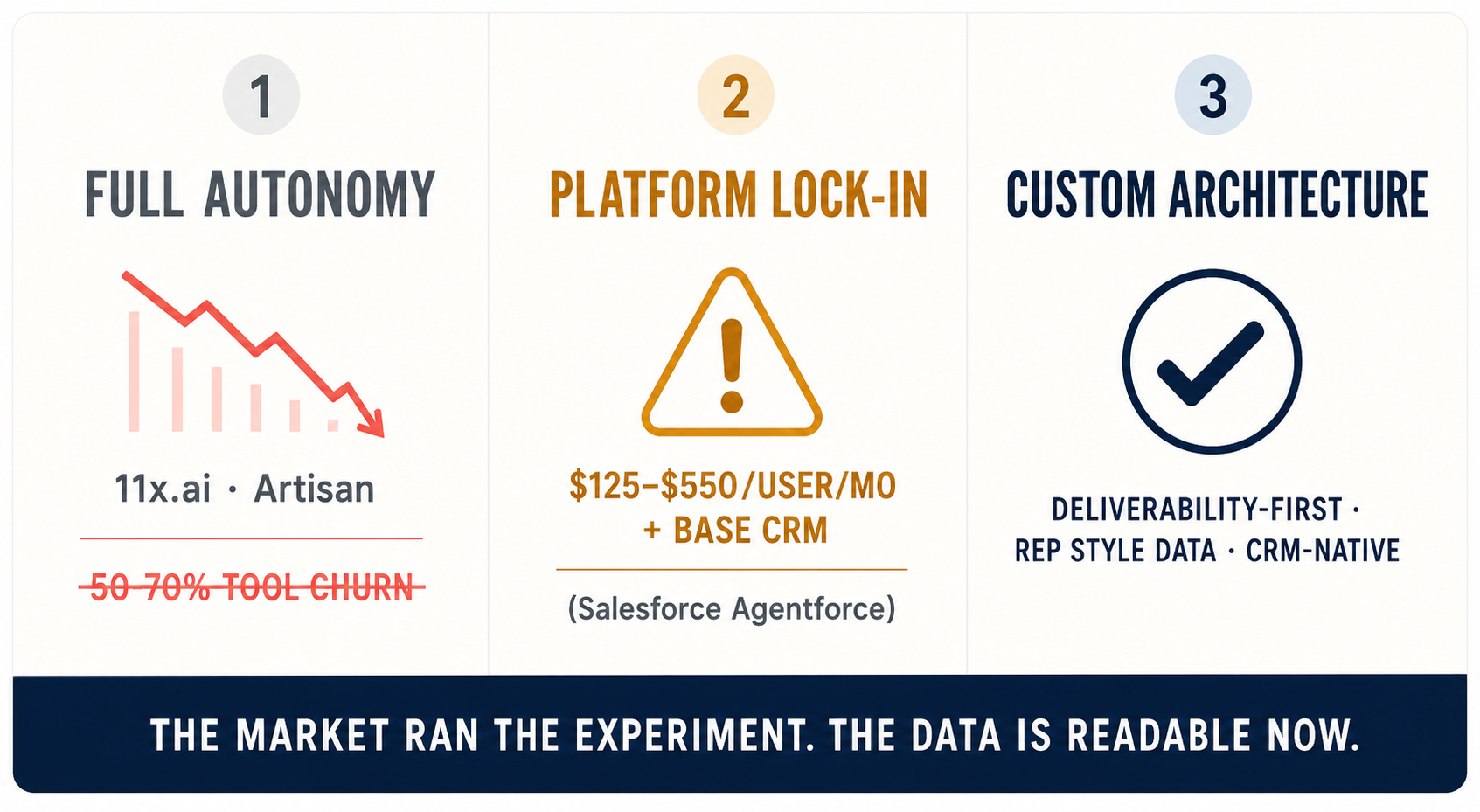
The question I get most often from VP Sales and RevOps leaders isn't about the AI itself. It's about why this architecture is different from the last thing they evaluated that promised to augment or replace their SDRs — and they've evaluated several.
My answer has gotten shorter over time. The market ran the full-autonomy experiment at scale: 11x.ai on the mid-market side, Artisan on the SMB side, Salesforce Agentforce SDR at $125-$550/user/month plus base CRM on the enterprise side. The data from those experiments is clear enough now to read. Full autonomy failed on deliverability and style quality. Platform lock-in solves the integration problem by making you ecosystem-dependent at a price that doesn't always make sense. The architecture that works doesn't require either bet.
The full technical scope is at AI Sales Personalization That Books Meetings. But the honest version of the answer is this: the teams who figured out AI outbound weren't the ones who picked the right platform. They were the ones who treated deliverability, rep-style data, and held-meeting measurement as design constraints — not features on a vendor's marketing page.
Whether or not you're evaluating what we built, that constraint framing is the thing worth taking into your next vendor conversation.