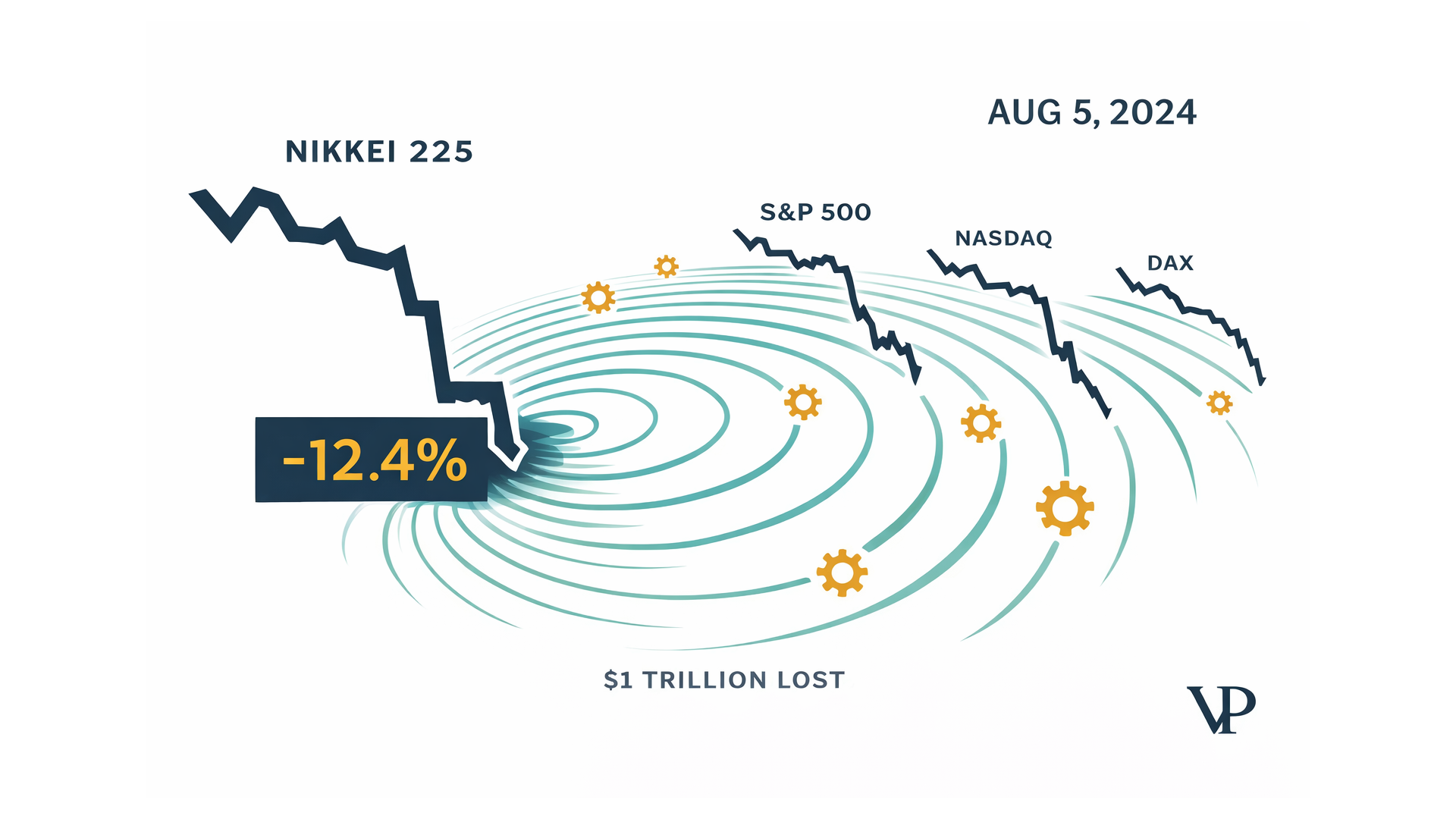
On August 5, 2024, Japan's Nikkei 225 dropped 12.4% in a single day — its worst crash since Black Monday in 1987. Within hours, roughly $1 trillion in market value evaporated from AI and tech stocks worldwide. The VIX, Wall Street's so-called "fear gauge," recorded its largest single-day spike in history, hitting 65.73.
I watched it unfold in near real-time, and what struck me wasn't the crash itself. Markets crash. What struck me was why the crash was so violent — and how preventable that violence was. The triggers were ordinary: a small interest rate hike by the Bank of Japan, a soft U.S. jobs report. The catastrophe was manufactured by algorithms that couldn't tell a liquidity drought from the end of the world.
Between 60% and 70% of global trades are now executed by automated systems. Most of these systems are what I'd call probabilistic wrappers — thin layers of logic draped over statistical models that predict the next likely price movement based on historical patterns. They're fast. They're cheap to build. And on August 5, they nearly broke global markets.
A Fear Gauge That Was Measuring the Wrong Thing
The technical story of what went wrong is almost absurd once you understand it.
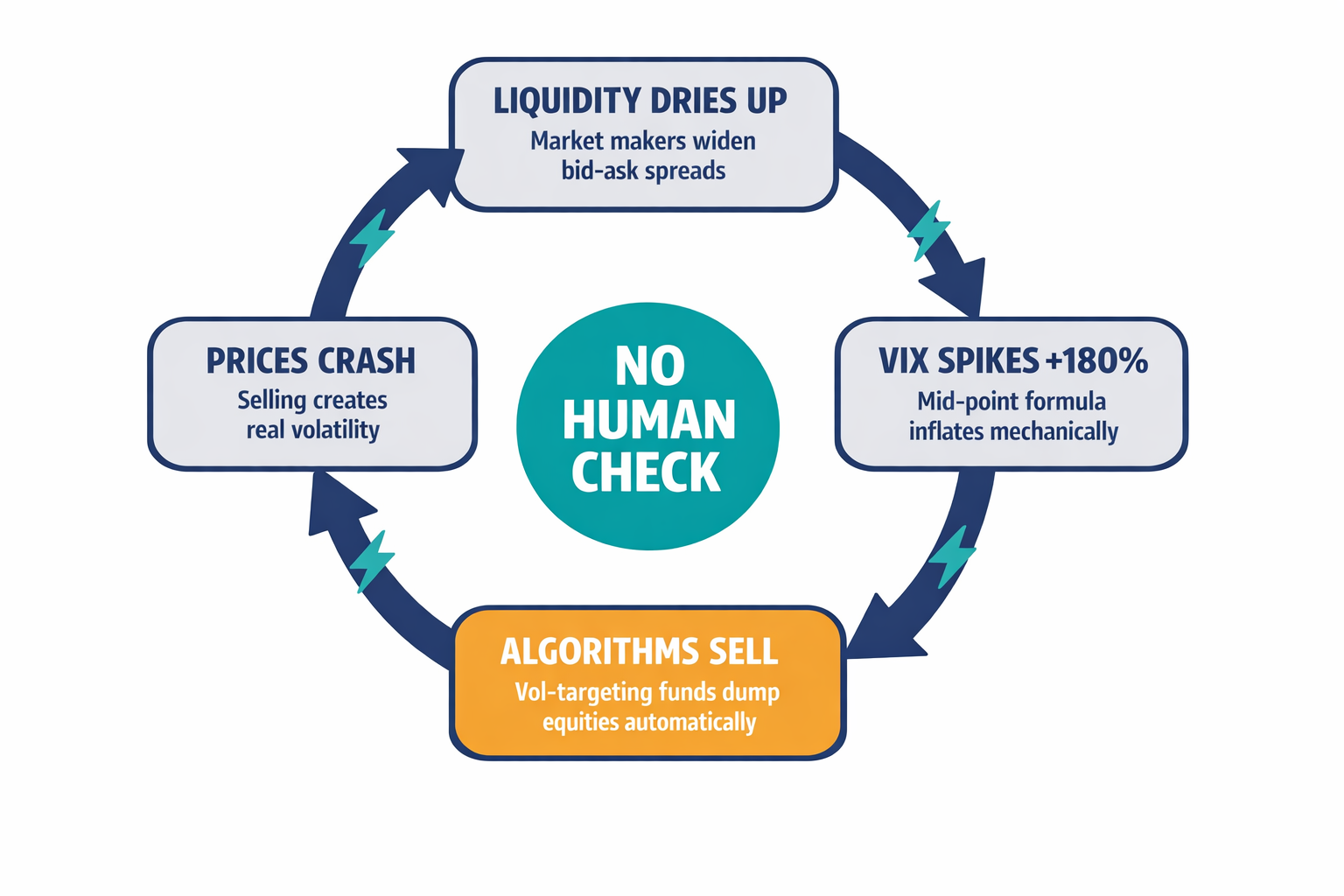
The VIX isn't calculated from actual trades. It's derived from the mid-point of bid-ask quotes on S&P 500 options. That distinction matters enormously. When markets get chaotic and liquidity dries up, market makers widen their spreads to protect themselves. The minimum bid on an option is often fixed at 5 cents, so when the ask price shoots up but the bid stays anchored, the mid-point — the number the VIX formula uses — rises mechanically.
On the morning of August 5, the VIX spiked 180% before the market even opened. Not because realized fear was that extreme, but because spread-widening in a thin market inflated the formula's inputs.
A 180% spike in the "fear gauge" was partly a math artifact of widened spreads — and thousands of algorithms treated it as gospel.
Volatility-targeting funds and Commodity Trading Advisors are programmed with a simple rule: when implied volatility rises, sell equities. So thousands of automated sell orders fired simultaneously, triggered by a signal that was, in significant part, a technical distortion rather than a reflection of what was actually happening in the economy. The selling created more volatility, which triggered more selling. A feedback loop with no human in the middle to ask: wait, is this signal real?
The Carry Trade Domino
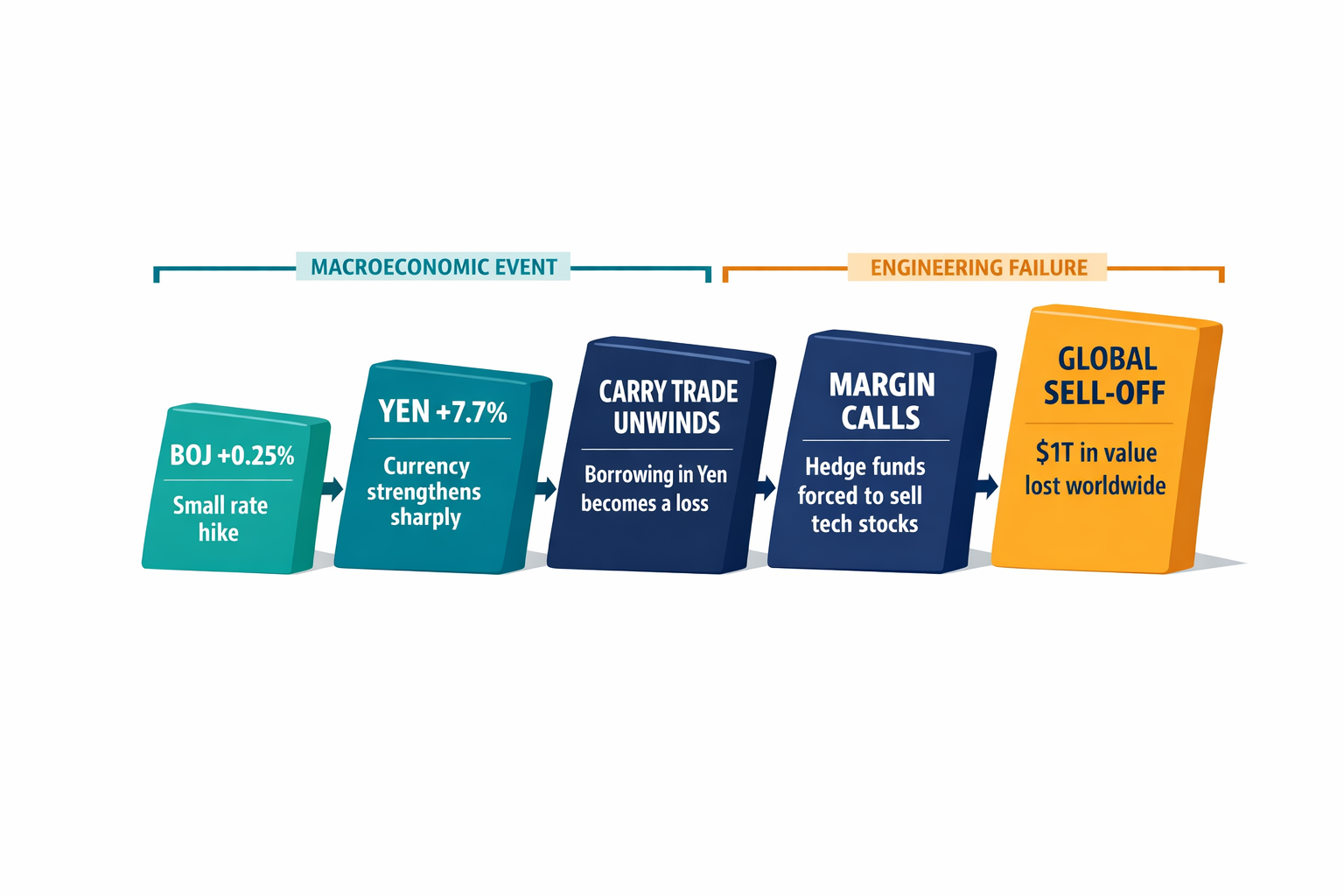
Underneath the VIX anomaly sat an even larger structural problem: the unwinding of the Yen carry trade.
For anyone unfamiliar, the carry trade works like this. You borrow money in a currency with near-zero interest rates (the Japanese Yen, for over a decade), then invest it in higher-yielding assets — U.S. tech stocks, emerging market bonds, even crypto. The spread between Japan's 0% rates and the U.S. Fed's 5.5% rates made this trade enormously profitable. Hedge funds, retail traders, and Japanese institutional investors had built massive leveraged positions on this foundation.
Economic theory says this shouldn't work — exchange rate movements should offset the interest rate advantage. In practice, high-interest currencies tend to appreciate in the short term, a well-documented anomaly called the Forward Premium Puzzle. So the trade kept working, and positions kept growing.
Then the Bank of Japan raised rates by a quarter point. The Yen strengthened 7.7% against major currencies in a single week. Suddenly the "carry" became a loss, and the deleveraging was violent. Margin calls forced hedge funds to dump tech stocks. Japanese portfolio investors pulled billions from markets worldwide.
The carry trade unwind was a macroeconomic event. The algorithmic cascade that followed was an engineering failure.
My team and I spent weeks dissecting this sequence, and what became clear was that the algorithms driving the sell-off had no understanding of why prices were moving. They saw price signals and reacted. They couldn't distinguish between a Yen-driven liquidity squeeze and a fundamental collapse in the value of the assets they were selling. We published our full analysis of the crash mechanics and architectural alternatives to make the case that this wasn't just a bad day — it was a design flaw.
Why "Smarter" AI Doesn't Fix This
After the crash, I heard a lot of people argue that the solution was better AI — more data, bigger models, faster inference. I think that misses the point entirely.
The trading systems that failed on August 5 weren't stupid. They were probabilistic. They were built to predict the next most likely price movement based on patterns in training data. That's what large language models and deep learning systems do — they're engines of statistical likelihood. In normal markets, that works beautifully. In a crisis, it's dangerous, because a crisis is by definition a situation where historical patterns break down.
I'll give you a concrete example of how this plays out in practice. Many AI-driven news analysis tools use a technique called Retrieval-Augmented Generation, or RAG. The system splits market reports into chunks, converts them to mathematical representations, and retrieves the "most similar" matches when asked a question. During the August crash, these systems failed in three specific ways:
They ignored time. A chunk discussing the 2010 housing crash might be mathematically "similar" to a 2024 market report, leading the AI to conflate decade-old policy responses with current conditions. They lost narrative context — a BOJ rate decision in July and a margin call in August lived in different chunks, so the system couldn't connect them. And they couldn't reason across relationships — understanding that Asset A is linked to Company Y, which is exposed to the Yen carry trade, requires connecting dots across multiple steps. Standard retrieval can't do that.
Probabilistic AI asks: "What happened before that looked like this?" Deterministic AI asks: "What are the rules that govern what can happen next?"
That distinction is the core of everything we build.
Building AI That Knows What It Cannot Do
At Veriprajna, we call our approach "Deep AI" — not as a marketing term, but as a genuine architectural distinction from the wrapper model that dominates the market right now.
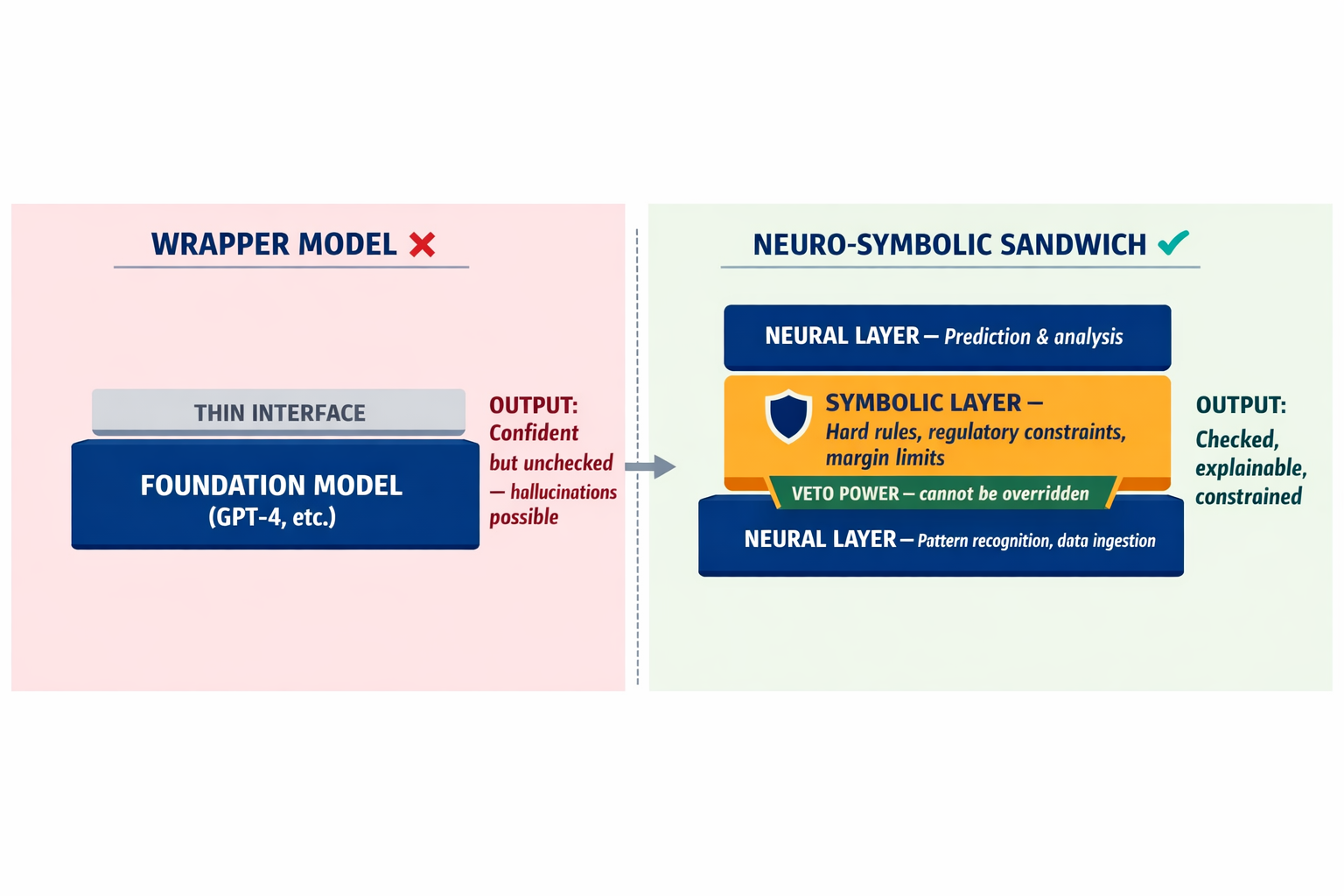
The wrapper model works like this: take a foundation model (GPT-4, Claude, whatever), bolt a thin interface on top, and sell it as an "AI solution." It's fast to build and easy to pitch. It also inherits every limitation of the underlying model, including the tendency to generate confident-sounding nonsense — what the industry politely calls "hallucinations." In a financial context, a hallucination isn't an embarrassment. It's a potential catastrophe.
Our architecture is fundamentally different. We use what I sometimes describe as a neuro-symbolic sandwich. Neural networks handle perception — ingesting data, recognizing patterns, processing unstructured information. But their outputs pass through a deterministic symbolic layer that enforces hard rules: regulatory constraints, margin requirements, liquidity thresholds, temporal logic. The neural network can suggest; the symbolic layer decides what's actually permissible.
Think of it like an experienced trader paired with a compliance officer who has veto power. The trader reads the room, spots opportunities, makes gut calls. The compliance officer checks every proposed trade against a rulebook and kills anything that violates a constraint — no matter how confident the trader sounds.
In practice, this means encoding market mechanics and regulatory rules into formal logic that the system cannot override. An AI agent literally cannot recommend a trade that violates margin requirements. It cannot conflate a liquidity-driven price drop with a fundamental valuation change, because the symbolic layer maintains an explicit model of why prices are moving, not just that they're moving.
Mapping Markets as Networks, Not Spreadsheets
One of the insights that changed how my team thinks about financial risk: markets aren't spreadsheets. They're networks.
Traditional risk models like Value-at-Risk treat assets as independent data points or use static correlation matrices — fixed tables that describe how assets move together. These matrices are calibrated during normal times and break down spectacularly during crises, which is exactly when you need them most.
We use Graph Neural Networks to model markets as what they actually are: interconnected webs where nodes represent assets (the Nikkei 225, the USD/JPY exchange rate, Nvidia stock) and edges represent the intensity of information flow between them. When a shock hits one node — say, a Yen appreciation — the GNN traces how that shock propagates through the network, identifying contagion pathways before they trigger a cascade.
In testing, GNNs achieved a Mean Square Error of 0.0025 in volatility prediction — significantly better than traditional sequential models like LSTMs or Transformers. The advantage comes from capturing what we call multi-hop relationships: the Yen strengthens, which pressures a hedge fund's carry trade position, which forces selling of U.S. tech stocks, which triggers volatility-targeting funds to reduce equity exposure. A sequential model sees each of these as separate events. A graph model sees the chain.
We pair this with reinforcement learning agents trained in environments that simulate realistic constraints — leverage limits, margin calls, weekend liquidity gaps. These agents don't just predict what might happen; they learn policies for what to do about it, including the option of doing nothing and waiting. For the full technical methodology behind these architectures, we've published a detailed breakdown.
The Explainability Problem Is Really a Trust Problem
There's a moment I keep coming back to from the weeks after the crash. I was in a conversation with a risk officer at an institutional firm — someone responsible for billions in assets. He told me, almost offhand: "We had an AI system flag a sell signal at 3 AM. Nobody could explain why it fired. We executed anyway because overriding it would have required three levels of approval and the market was moving."
That's the real crisis. Not that AI makes mistakes — humans make mistakes too. The crisis is that we've built systems where the cost of questioning the machine is higher than the cost of trusting it blindly.
Regulators are catching up. The CFTC and SEC are increasingly focused on the opacity of AI in derivatives markets. A black-box algorithm that executes a $100 million sell order without an auditable rationale isn't just a technical problem — it's a governance failure.
We address this through two layers of explainability. For critical risk functions, we use inherently interpretable models — decision trees, symbolic logic — where the reasoning is transparent by design. For high-performance prediction tasks where deep learning is necessary, we apply post-hoc techniques: SHAP and LIME analysis to identify which variables drove a decision, counterfactual explanations ("if U.S. unemployment had been 0.2% lower, the model would have held the position"), and visual heatmaps that show traders exactly what the AI is focusing on in the order book.
If your AI can't explain why it's selling, you don't have a trading system. You have an expensive coin flip.
What About Speed? Can Deterministic Systems Keep Up?
This is the objection I hear most. Financial markets move in microseconds. Doesn't adding a symbolic logic layer slow everything down?
The honest answer: yes, slightly. A pure probabilistic system with no guardrails will always be faster than one that checks its work. But "faster" isn't the same as "better." The algorithms that fired sell orders fastest on August 5 were also the ones that lost the most money. Speed without understanding is just a more efficient way to be wrong.
In practice, the latency overhead of our symbolic layer is measured in single-digit milliseconds — negligible for all but the most extreme high-frequency strategies. And for the vast majority of institutional trading, the relevant timescale is seconds to minutes, not microseconds. The question isn't whether you can afford the extra milliseconds. It's whether you can afford not to have a system that knows the difference between a real crisis and a broken formula.
Does This Mean AI Shouldn't Be Used in Trading?
Absolutely not. AI has made markets more efficient in countless ways — better price discovery, tighter spreads, faster execution. The problem isn't AI in trading. The problem is unsupervised AI in trading. Probabilistic models without deterministic constraints. Pattern-matching without reasoning. Speed without understanding.
The NIST AI Risk Management Framework lays out a sensible approach: Govern (establish oversight and accountability), Map (identify where risks live in your system, including third-party data dependencies like the VIX quote feed), Measure (continuously monitor for drift as market regimes change), and Manage (have kill switches ready and response plans tested). We've aligned our deployments with this framework because it captures something important — AI governance isn't a one-time audit. It's an ongoing practice.
The Wrapper Era Is Ending
The August 5 crash cost the market roughly $1 trillion. The recovery was swift — within weeks, most indices had bounced back. That speed of recovery has led some people to dismiss the event as a blip. I think that's exactly the wrong lesson.
The recovery happened because this particular cascade was driven by a carry trade unwind and a VIX anomaly, not by a genuine economic crisis. The underlying businesses were fine. But the mechanism that amplified a modest rate hike into a global sell-off is still in place. The same algorithms, the same wrapper architectures, the same absence of deterministic reasoning. Next time, the trigger might be something with real economic substance behind it, and the amplification effect could be far worse.
What I'd urge anyone building or buying AI systems for financial markets to consider:
Audit your signal chain. Do you know exactly which data inputs drive your automated decisions? Could a technical artifact in one of those inputs — like a quote-based index during a liquidity drought — trigger cascading actions?
Demand explainability. If your system can't tell you why it made a decision in terms a human can evaluate, you're not managing risk. You're outsourcing it to a black box.
Separate prediction from action. A model that predicts volatility is useful. A model that predicts volatility and automatically executes trades based on that prediction, with no deterministic constraints, is a liability.
The era of building thin wrappers around foundation models and calling it "AI strategy" is ending. What comes next requires actual engineering — symbolic logic, knowledge graphs, explainable architectures, hard-coded safety constraints. It's harder to build. It's harder to sell. And it's the only thing that will hold up when markets do what markets inevitably do.
If you're wrestling with how to make AI systems more resilient in high-stakes environments — financial or otherwise — I'd genuinely like to hear what's working and what isn't. The problems are too big for any one team to solve alone.