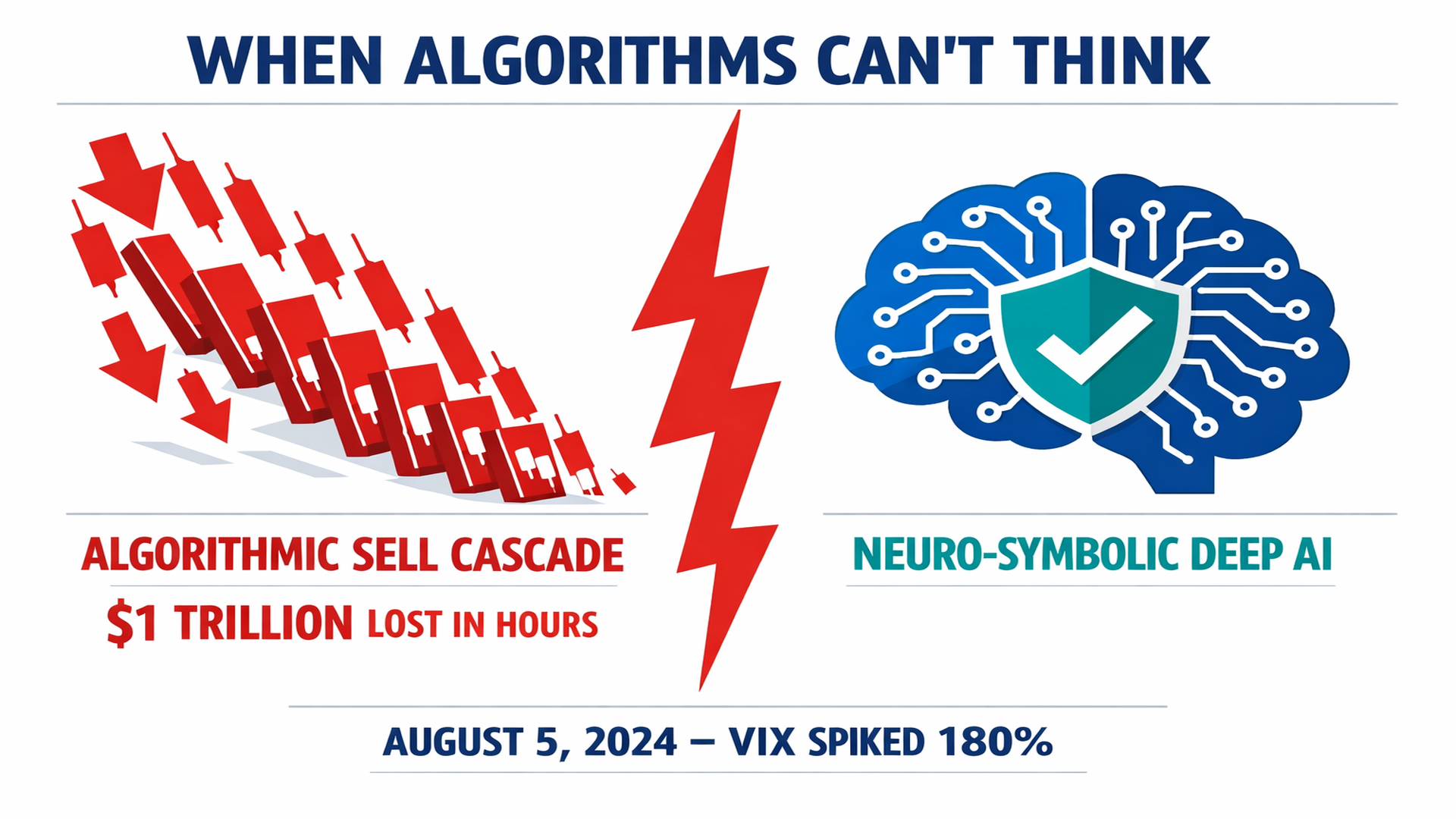
On August 5, 2024, approximately $1 trillion in market capitalization evaporated from top-tier AI and technology firms in a single trading session. Japan's Nikkei 225 plunged 12.4% — its worst day since Black Monday in 1987. The CBOE Volatility Index (VIX), Wall Street's so-called "fear gauge," spiked to 65.73, a level exceeded only during the 2008 financial crisis and the 2020 pandemic.
The triggers were macroeconomic: a surprise interest rate hike by the Bank of Japan and a weak U.S. jobs report. But the scale of the destruction was algorithmic. Between 60% and 70% of global trades are now executed by automated systems, and on that day, those systems entered a cascading feedback loop of sell orders — each one triggering the next. No human was driving the bus. The algorithms couldn't tell the difference between a currency adjustment and a fundamental collapse. This is exactly the kind of failure that neuro-symbolic "Deep AI" — an architecture that combines pattern recognition with rule-based reasoning — is designed to prevent.
Our team has spent considerable time analyzing what went wrong — not just in the markets, but in the AI architectures powering them. What we found points to a structural problem that extends far beyond finance: most AI systems deployed in high-stakes environments today are probabilistic wrappers incapable of reasoning about what's actually happening. We detailed this analysis in our interactive research on neuro-symbolic deep AI for market resilience.
A trillion dollars wasn't lost because the economy broke. It was lost because the algorithms couldn't think.
What Happens When the "Fear Gauge" Becomes the Fear Itself?
One of the most striking technical findings from the August crash involves the VIX itself. Unlike most indices, the VIX isn't calculated from actual trade prices — it's derived from the mid-point quotes of S&P 500 options. That distinction matters enormously during a liquidity drought.
When market makers pulled back on August 5 to avoid holding imbalanced books, bid-ask spreads on options widened dramatically. Because option prices can't go below zero and minimum bids are often fixed at around 5 cents, the widening was asymmetric — it mechanically pushed the VIX calculation upward. The result: the VIX surged 180% in pre-market trading, largely as a technical artifact of thinning liquidity rather than a genuine measure of realized market fear.
Thousands of volatility-targeting funds and Commodity Trading Advisors (CTAs) — programmed to dump equities when implied volatility rises — took the bait. Automated sell orders cascaded through the system, driven by an index signal that was, in significant part, a measurement distortion.
Forty years of financial engineering, and the smoke detector still can't tell the difference between a fire and burnt toast.
Think of it like a smoke detector that triggers the building's sprinkler system. If the detector malfunctions and reports smoke that doesn't exist, the water damage is just as real. The trading systems had no mechanism to check whether the "smoke" was genuine.
How Did the Carry Trade Become a Time Bomb?
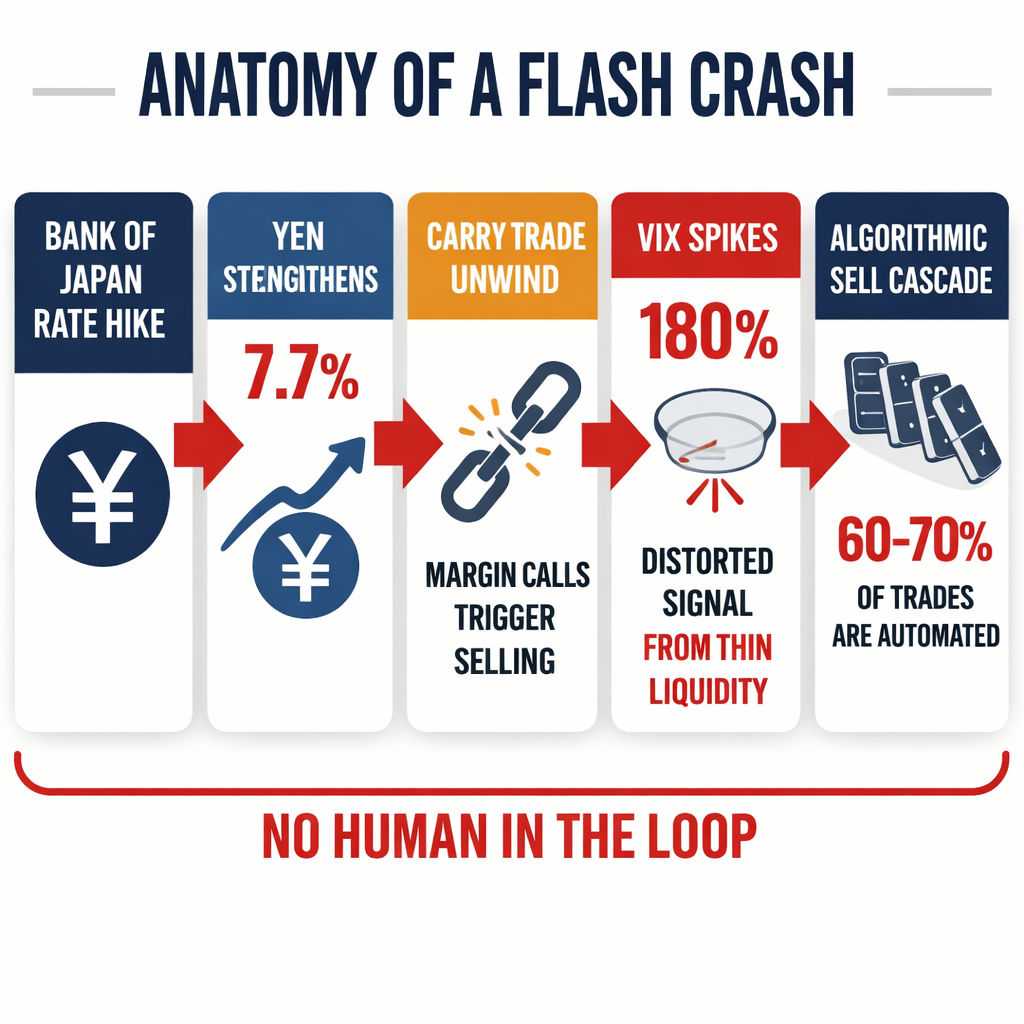
The volatility was supercharged by the unwinding of the Yen carry trade — a strategy where investors borrow cheaply in Japanese Yen (at near-zero rates) to fund higher-yielding investments in U.S. tech stocks, emerging markets, and crypto. For over a decade, this worked because of the massive gap between Japanese interest rates (0% to 0.1%) and U.S. rates (as high as 5.5%).
In theory, currency movements should neutralize this arbitrage. In practice, they didn't — high-interest currencies kept appreciating in the short term, a well-documented anomaly called the "Forward Premium Puzzle" (where the textbook relationship between interest rates and exchange rates simply doesn't hold in the real world). The result was an enormous, leveraged bet on global risk assets.
When the Bank of Japan raised rates to 0.25% and the Yen strengthened 7.7% against major currencies in a single week, the carry became a loss. Hedge funds covering margin calls, Japanese foreign portfolio investors pulling capital, retail traders hitting liquidation — it all happened simultaneously. The algorithms amplified every wave.
This is where conventional AI failed completely. A probabilistic model trained on historical patterns couldn't reason about the specific mechanics of a carry trade unwind interacting with a VIX measurement anomaly. It could only react to price signals, the same way every other algorithm was reacting.
Why Do "AI Wrappers" Break Under Pressure?
Most enterprise AI solutions today are thin interfaces built on top of large language models (LLMs) like GPT-4 or Claude. These models predict the next most likely output based on statistical patterns in their training data. For writing emails or summarizing reports, that's fine. For making decisions in a financial crisis, it's dangerous.
Our research identified three specific ways these systems fail when it matters most.
The first is temporal blindness. Retrieval-Augmented Generation (RAG) — the most common way to feed AI systems real-world data — typically works by matching text chunks based on semantic similarity. A description of the 2010 housing crash can look identical to a 2024 market report in vector space, and the AI has no way to distinguish between a historical precedent and what's happening right now.
The second failure is fragmentation. Chunking documents into retrievable fragments breaks the narrative arc of developing events, so an AI processing market data in pieces might never connect a Bank of Japan rate decision in July to a hedge fund's margin call in August — because those facts live in different chunks and the system has no way to stitch the timeline together.
The third is the inability to follow chains of reasoning across relationships. If Asset A is linked to Company Y, and Company Y is exposed to the Yen carry trade, then Yen volatility impacts Asset A. This kind of multi-hop reasoning — obvious to a human analyst — is precisely where naive retrieval systems fail.
In a financial crisis, a probabilistic model can only hallucinate based on past patterns. It cannot reason about the novel constraints of a liquidity drought it has never seen.
The Neuro-Symbolic Alternative
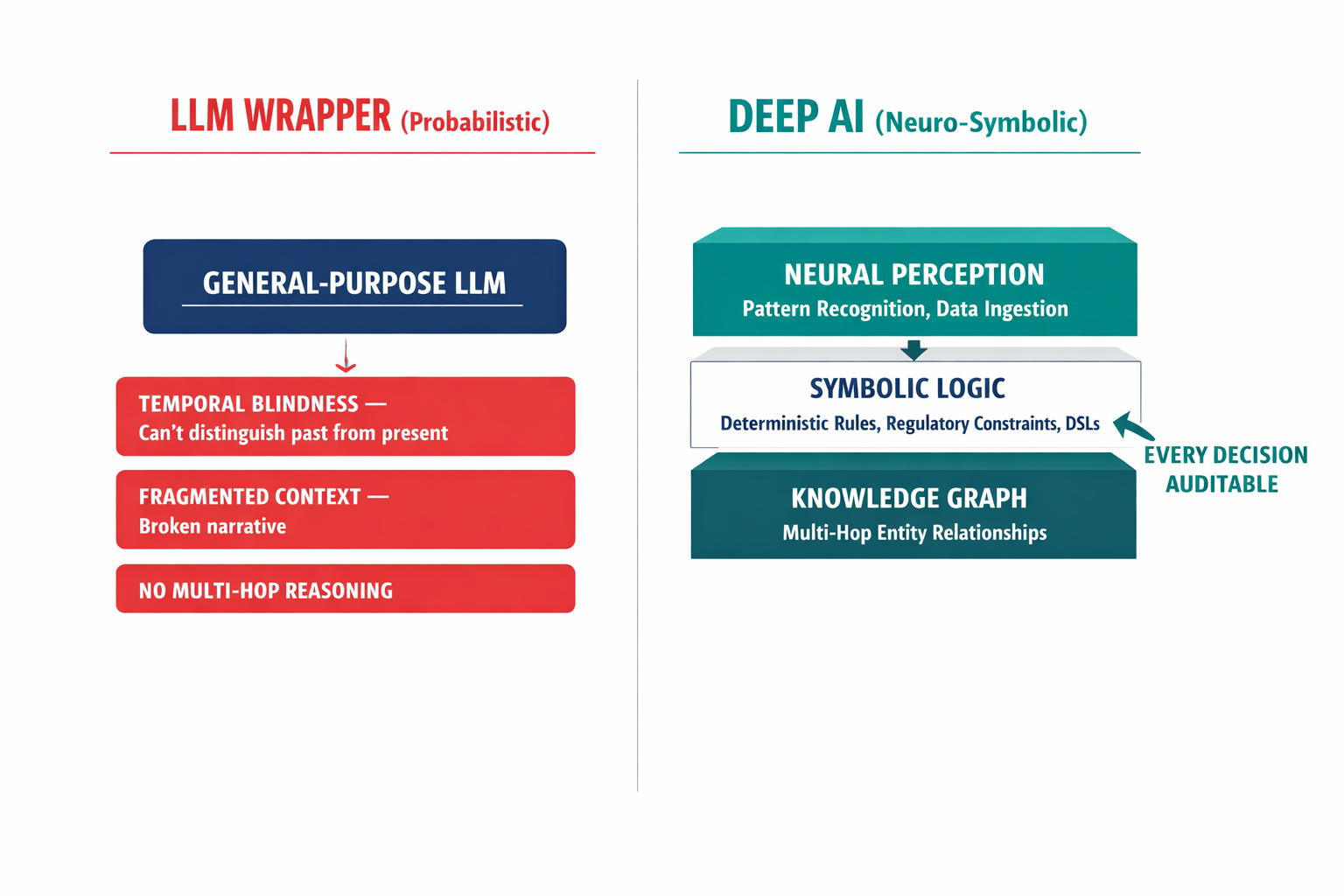
Our approach — what we call "Deep AI" — starts from a different premise. Instead of trusting a probabilistic model to figure things out, we separate what the AI perceives from what the AI is allowed to conclude.
Neural networks handle perception: ingesting data, identifying patterns, processing signals at speed. But their outputs pass through a symbolic layer — deterministic rules (meaning fixed, guaranteed logic that produces the same result every time, with no randomness or guessing) that enforce business logic, regulatory constraints, and factual consistency. The neural network says "sell." The symbolic layer asks "why, under what conditions, and does this violate any known constraint?"
This architecture rests on several concrete mechanisms. We encode statutory rules and market mechanics into Domain Specific Languages (DSLs) — specialized mini-languages purpose-built for writing precise rules in a particular field — so an AI agent physically cannot recommend a trade that violates margin requirements, regardless of how confident the neural network is. We use knowledge graphs instead of vector embeddings to map relationships between economic actors, currencies, and regulations, enabling the multi-hop reasoning that RAG systems can't do. And for trade execution, we use finite state machines — systems that move through a fixed set of defined steps, where every transition follows a pre-defined, auditable logic path, like a flowchart that can't skip a box.
The difference is fundamental: truth isn't a statistical likelihood. It's a verified, logic-backed certainty. For the full technical methodology behind this architecture, see our detailed research on deterministic alternatives for market volatility.
Can Graph Neural Networks Actually Map Market Contagion?
One of the most promising advances we've been working with is the application of Graph Neural Networks (GNNs) to financial risk. Traditional risk models like Value-at-Risk (VaR) treat assets as independent data points or rely on static correlation matrices — which break down precisely during a flash crash, when you need them most.
GNNs model the market as a network: nodes are assets (the Nikkei 225, USD/JPY, Nvidia stock), and edges represent the intensity of information flow between them. When a shock hits one node, the GNN traces how it propagates through the network — identifying contagion pathways before they trigger a systemic cascade.
The results are significant. In experimental testing, GNNs achieved a Mean Square Error of 0.0025 and Root Mean Square Error of 0.050 for volatility prediction — substantially outperforming traditional recurrent neural networks and Transformers. That edge comes from their ability to capture relational topology: not just what happened, but how connected everything is.
Combined with reinforcement learning agents trained in environments that simulate real-world constraints — leverage limits, margin requirements, weekend liquidity gaps — these systems can guide portfolio adjustments proactively. Not reacting to a crisis, but repositioning ahead of one.
"But Can You Explain Why It Did That?"
This is the question every regulator, every board member, and every compliance officer should be asking about AI trading systems. The Commodity Futures Trading Commission (CFTC) and the SEC (Securities and Exchange Commission) are increasingly focused on the opacity of algorithmic decision-making. A black box that executes a $100 million sell order without an auditable rationale is a liability.
Our systems address this through two layers of explainability. For critical risk-management functions, we use inherently interpretable models — architectures where the logic is transparent from the start. When we need the predictive power of deep learning (GNNs, for instance), we apply post-hoc techniques: feature attribution methods like SHAP and LIME (tools that break open a model's decision and show exactly which input variables mattered most and by how much) that identify exactly which variables drove a decision, and counterfactual explanations that show how the output would change if inputs were different.
The practical result: instead of "the model said sell," an analyst sees "the model recommended reducing exposure because Yen volatility exceeded the threshold while U.S. unemployment data activated the Sahm Rule recession indicator — a measure that flags a recession when the unemployment rate's three-month average rises 0.5 percentage points above its prior-year low — and if unemployment had been 0.2% lower, the model would have maintained the position."
That's the difference between a tool you can trust and one you're just hoping works.
"Doesn't Deterministic AI Sacrifice Speed?"
A fair concern. If every trade passes through a symbolic logic layer — a set of fixed, guaranteed rules rather than probabilistic guesses — does that introduce latency that kills the advantage of algorithmic speed?
The answer is architectural. The symbolic constraints aren't computed at trade time — they're compiled into the agent's action space before it ever encounters live data. Think of it less like a checkpoint the AI has to stop at and more like guardrails on a highway. The car still moves fast. It just can't drive off a cliff.
We align this with the NIST (National Institute of Standards and Technology) AI Risk Management Framework, which structures AI governance around four functions: Govern (accountability policies), Map (identifying risks and dependencies), Measure (quantifying system behavior and drift), and Manage (active monitoring with response plans). The "algorithmic kill switch" — a deterministic monitor model that can sever the connection to a generative engine when it detects a high-risk scenario — is a practical implementation of this framework.
Speed without safety built the flash crash. The engineering era is finally building both.
What This Means for Your Organization
The August 2024 flash crash wasn't an anomaly. It was a preview. As algorithmic trading continues to dominate — and as AI systems take on higher-stakes decisions across industries — the gap between "probabilistic wrapper" and "deterministic architecture" (one that follows guaranteed rules rather than statistical guesses) will define which organizations survive the next shock and which ones contribute to it.
Three questions worth asking your AI teams this week:
Can your AI systems explain why they made a specific decision, in terms a regulator would accept?
If a key data input (like the VIX) were distorted, would your system detect the distortion or blindly react to it?
Are your AI vendors building on top of general-purpose LLMs, or engineering domain-specific reasoning systems?
The wrapper era served a purpose — it proved AI could be useful. But useful and reliable are not the same thing. The organizations that build deterministic foundations now will be the ones still standing when the next trillion-dollar test arrives.
We'd welcome a conversation about how your team is thinking through these challenges. The transition from probabilistic to deterministic AI is complex, but it's also the most consequential technical decision many enterprises will make this decade.