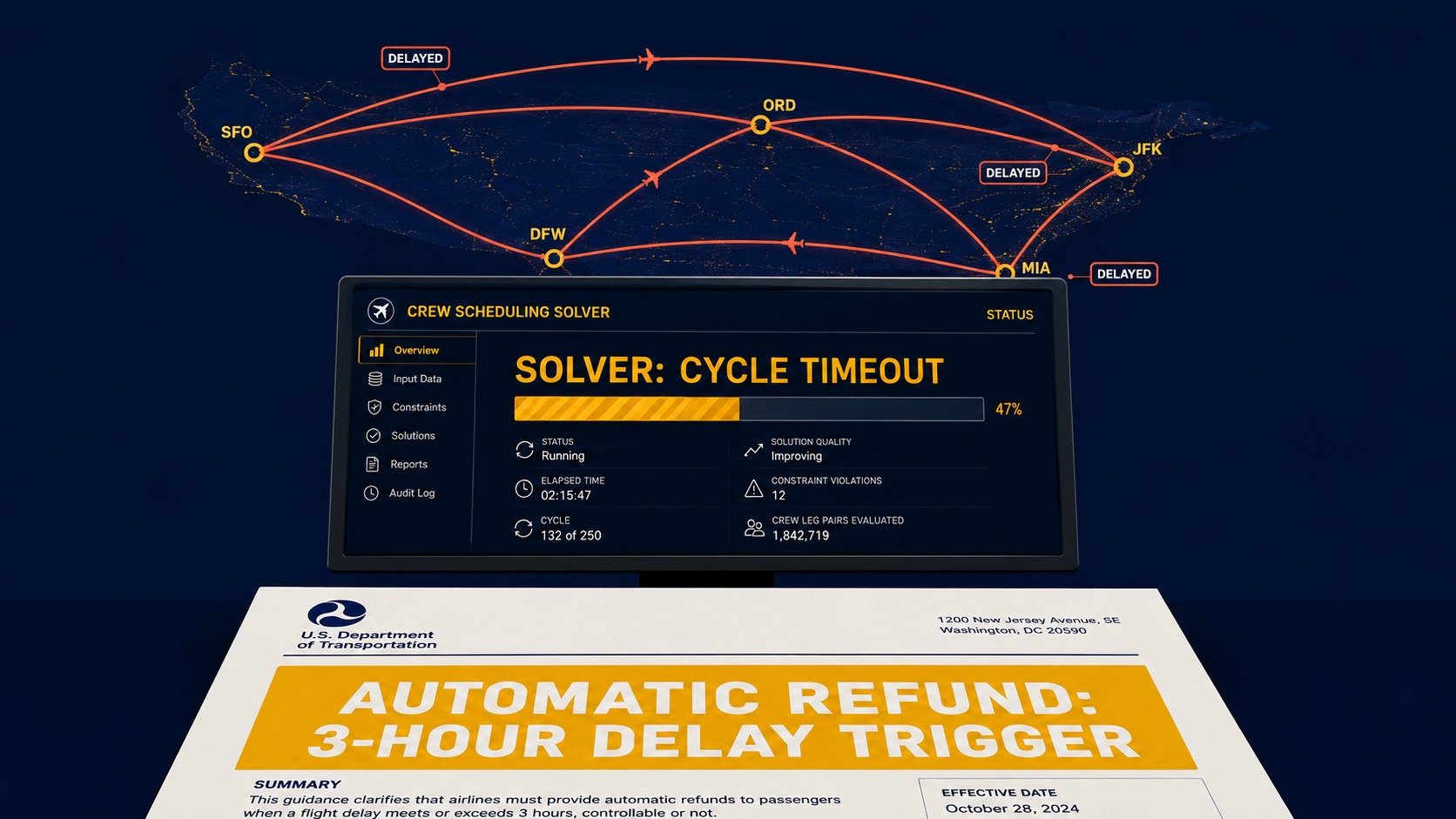
Legacy crew scheduling software has a computational cliff. Southwest Airlines found it in December 2022, when SkySolver — the column generation system the carrier relied on — collapsed as disruptions cascaded across a point-to-point network with too many simultaneous failure modes. The result: 16,900 cancelled flights, two million stranded passengers, and $1.2 billion in losses. Nineteen months later, Spirit Airlines demonstrated a different version: a scheduling algorithm that created conflicting assignments for 43% of available flight crews, contributing to an estimated $50-100 million in losses before Spirit filed for bankruptcy protection in November 2024.
The operational lesson from both events isn't "buy better software." It's that column generation and integer linear programming — the mathematical engines inside every major crew scheduling system — are optimization architectures. They find the best crew pairing for a given set of constraints under normal operations. When disruptions cascade and the constraint set explodes, they don't degrade gracefully. They time out. That distinction — between optimization and recovery — is what the industry hasn't solved.
The Cliff Is Architectural, Not Operational
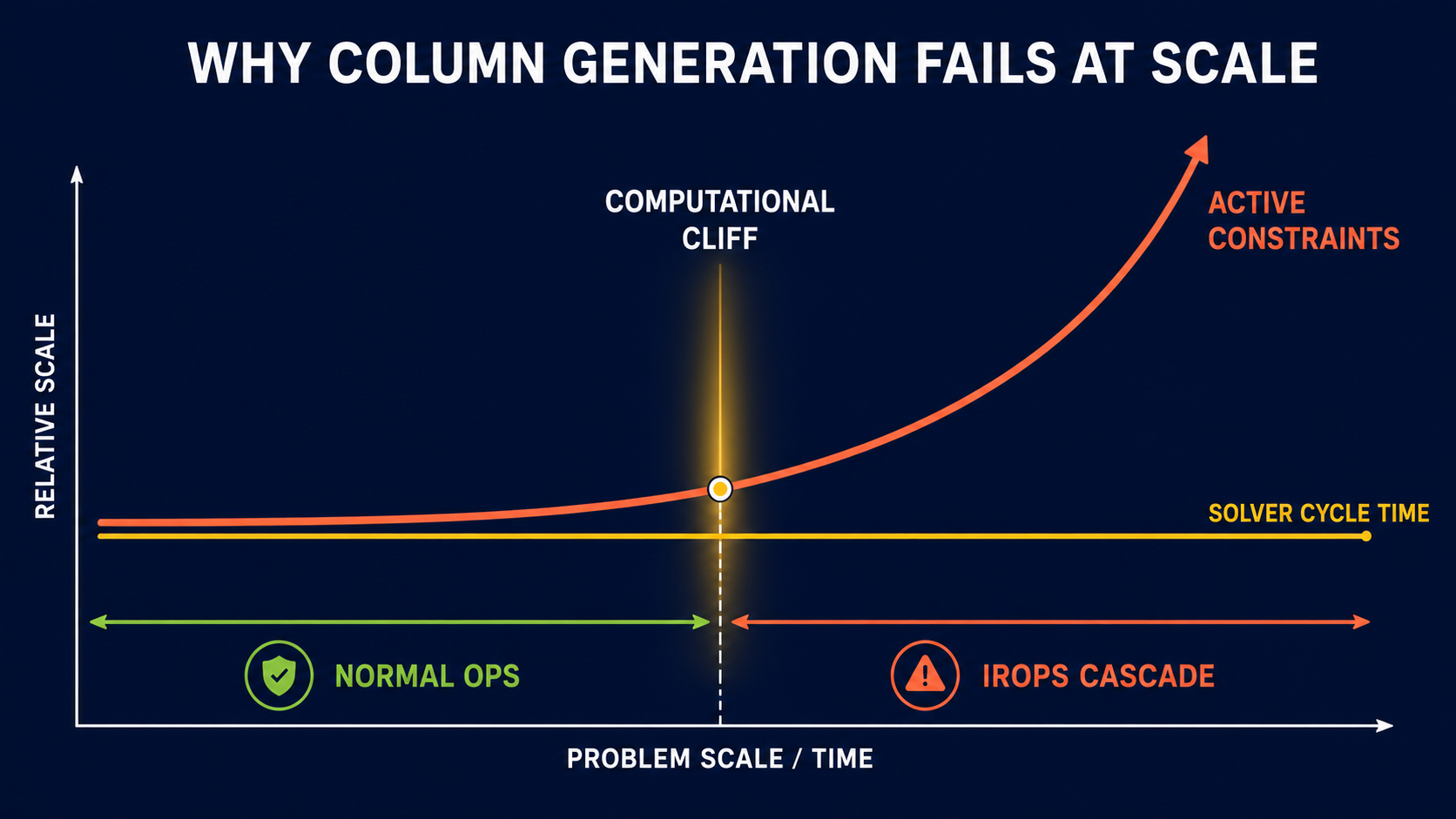
A crew scheduling solver works on a planning cycle. It takes current state, applies constraints — FAA Part 117 duty-period limits, collective bargaining agreement rules, domicile-specific rest requirements, open trip coverage — and generates optimal pairings. Under manageable disruption loads, this works. When a major IROPS event hits and the number of violated constraints multiplies, column generation starts solving a sequence of subproblems faster than it can converge. The cycle time extends. At some point the algorithm is still running when the next disruption wave arrives.
At Southwest in December 2022, phone-based crew check-in created hours of data latency. The solver was building recovery plans against crew positions that had already changed. Southwest's point-to-point topology — unlike a hub-and-spoke network, which has natural regeneration points — amplified the cascade. Every unsolved pairing propagated outward.
The solver wasn't wrong. It was solving for an airline that no longer existed on the ground.
Southwest committed $1.7 billion to technology in 2024, producing an algorithm 30% faster and replacing the phone systems that failed. What that investment didn't change is that column generation is structurally brittle during precisely the moments when it most needs to perform.
Why October 2024 Changed the Math
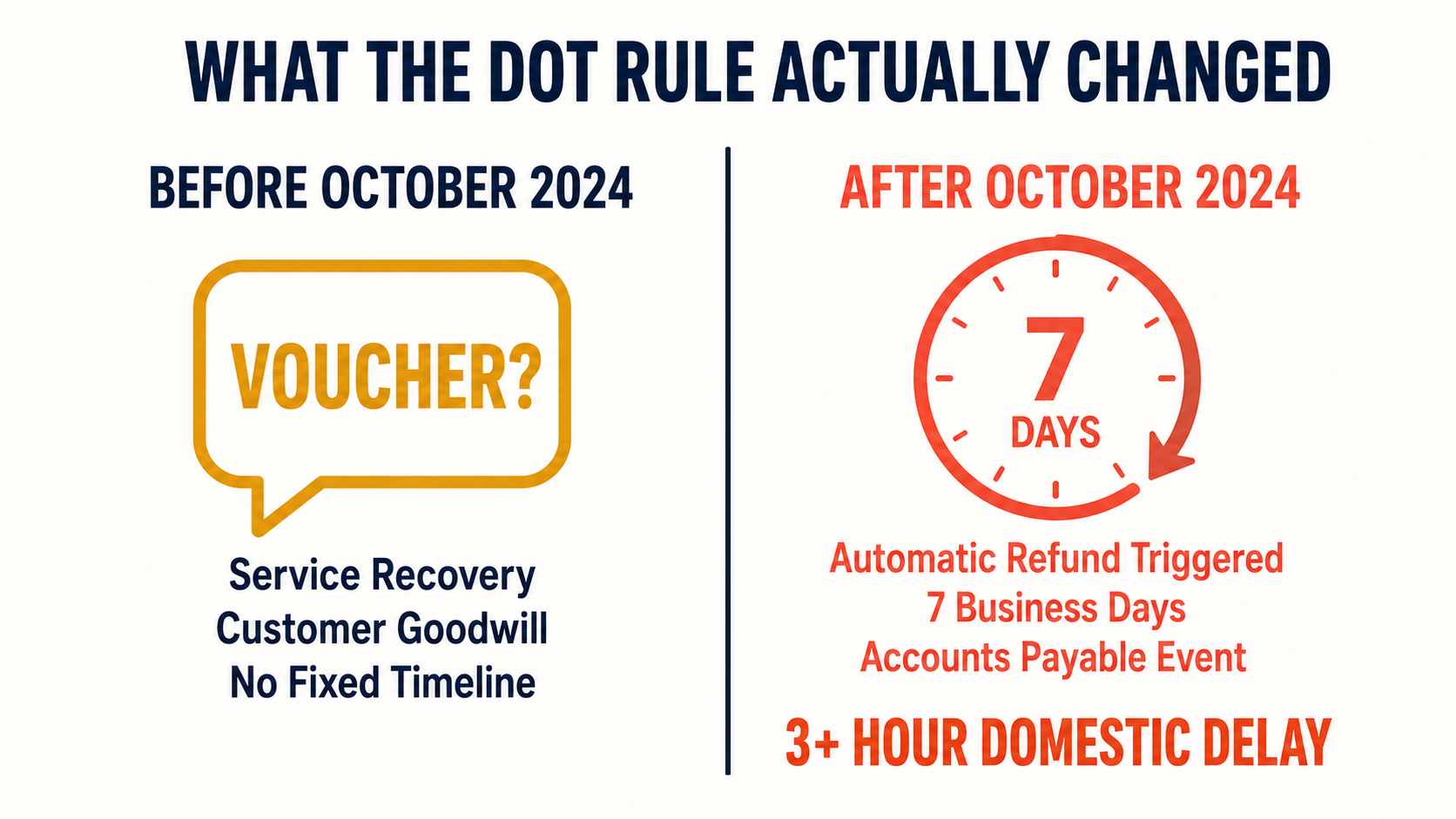
In October 2024, the Department of Transportation issued the first-ever mandatory automatic refund requirement for airline delays. Airlines must now automatically refund passengers — without being asked — for domestic delays of three or more hours. Refund window: seven business days for credit card payments, twenty calendar days for others.
Before that rule, a cascading delay that resolved in four hours was a customer service problem. Vouchers, apology emails, service desk staffing. After October 2024, that same delay is an accounts-payable trigger. The per-event financial exposure is now computed in real time, not resolved at the end of a recovery narrative.
A crew recovery that gets from a four-hour cascade to a two-hour one isn't just better for passengers. It's refund liability avoided — documented, quantifiable, reportable to the CFO.
IROPS cost airlines an estimated $60 billion per year industry-wide — roughly 8% of worldwide airline revenue (IATA). The DOT rule doesn't change that aggregate, but it makes every individual recovery decision financially legible in a way it wasn't before. The operations control center now makes decisions whose consequences show up in accounts payable, not just customer satisfaction scores.
What the Vendor Market Is Actually Offering
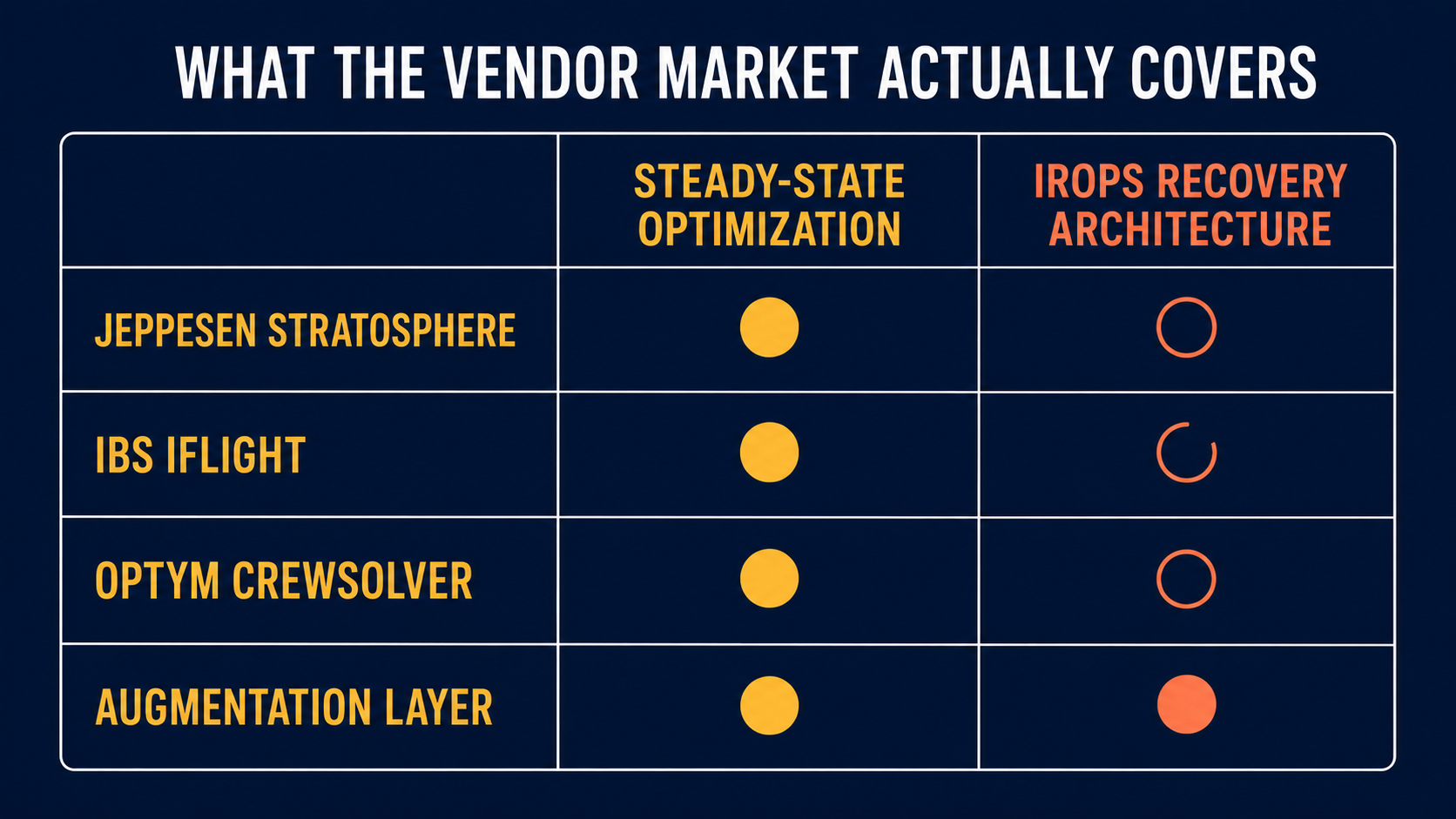
Jeppesen — now independent under Thoma Bravo, following Boeing's $10.55 billion divestiture in April 2025 — launched Stratosphere in October 2025, its AI-driven predictive disruption management platform. The new ownership signals genuine R&D investment; the stated position is that AI is the "north star for our multi-year roadmap." Stratosphere is a real product. It also runs on the same Carmen Systems crew scheduling architecture that Jeppesen has operated for years. The question an airline should ask isn't whether Jeppesen is investing in AI — they clearly are — but whether that investment changes the underlying optimization/recovery tradeoff or layers on top of it.
IBS Software's iFlight is the most active alternative platform right now. Korean Air deployed in March 2026. Groupe Dubreuil selected it in December 2025. Aeroitalia began implementing it in October 2025. IBS has a genuine AWS strategic collaboration for co-engineering AI frameworks — not just hosting infrastructure. The agent-like disruption recovery models are part of the pitch, and the deployment pace across three carriers in five months suggests real traction.
Optym's CrewSolver delivers 3-7% crew cost reduction through pairing and rostering optimization and is part of Southwest's current stack. That's a meaningful optimization win in steady state — less relevant when the pairing plan has already fallen apart and the question is how fast to reassemble it.
What all three share: they operate on a replace-or-upgrade model. Full crew scheduling system transitions take years, require re-encoding every airline-specific CBA rule and domicile constraint into a new system's configuration framework, and carry significant operational change risk. What most airlines with existing Jeppesen or IBS installations actually need is an intelligence layer that augments the system the crew desk already knows — not one that displaces it.
We built the IROPS recovery augmentation layer at https://veriprajna.com/solutions/airline-crew-scheduling-ai for that specific operational gap: ML-powered recovery running on top of existing solver infrastructure, not beside it as a competing system.
The Data Staleness Problem Most RFPs Miss
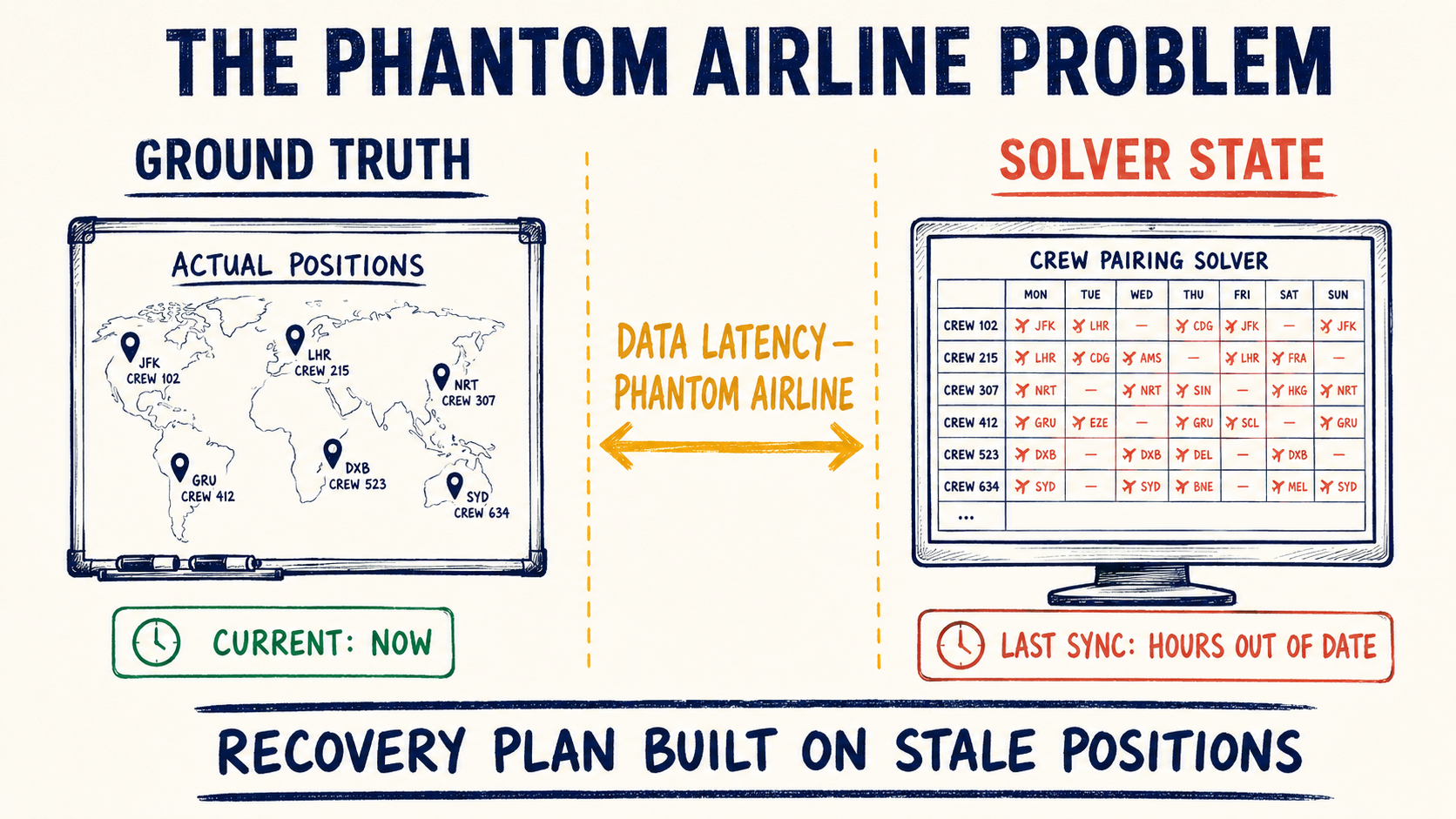
There's a second failure mode that compounds the computational cliff and remains underaddressed in most vendor evaluations: crew position data staleness.
Most carriers still rely on phone-based check-in as the primary crew position reporting mechanism. A crew member calls in; there's a propagation delay from call to system update. In normal operations, that delay is manageable. During a major IROPS event — when crews are calling from airports, hotels, and airside locations, each call requiring entry time — the solver starts building recovery plans against positions that may be hours stale. The Jeppesen SkySolver output report shows clean pairings. The war room whiteboard, updated by hand, tells a different story.
Manually re-clearing one crew member through a cascading IROPS event means working through dozens of distinct regulatory and contractual constraints before any reassignment can be offered: FAA Part 117 duty-period limits varying by start time, segment count, and augmentation level; CBA restrictions adding domicile-specific rest windows, override eligibility rules, and contractual minimums often more restrictive than the regulatory floor. Running those checks against phantom position data is what turns a recoverable cascade into an irrecoverable one.
Probabilistic crew position modeling doesn't eliminate staleness — it prices it in. Instead of treating a stale phone check-in as ground truth, it models the probability distribution of where a crew is likely to be given the disruptions underway and the airline's historical positioning patterns. The recovery recommendations carry signal-plus-uncertainty rather than false certainty. The ops control desk gets suggestions with confidence weighting, not instructions that assume perfect information.
Shadow Mode Is the Trust-Building Phase Vendors Skip
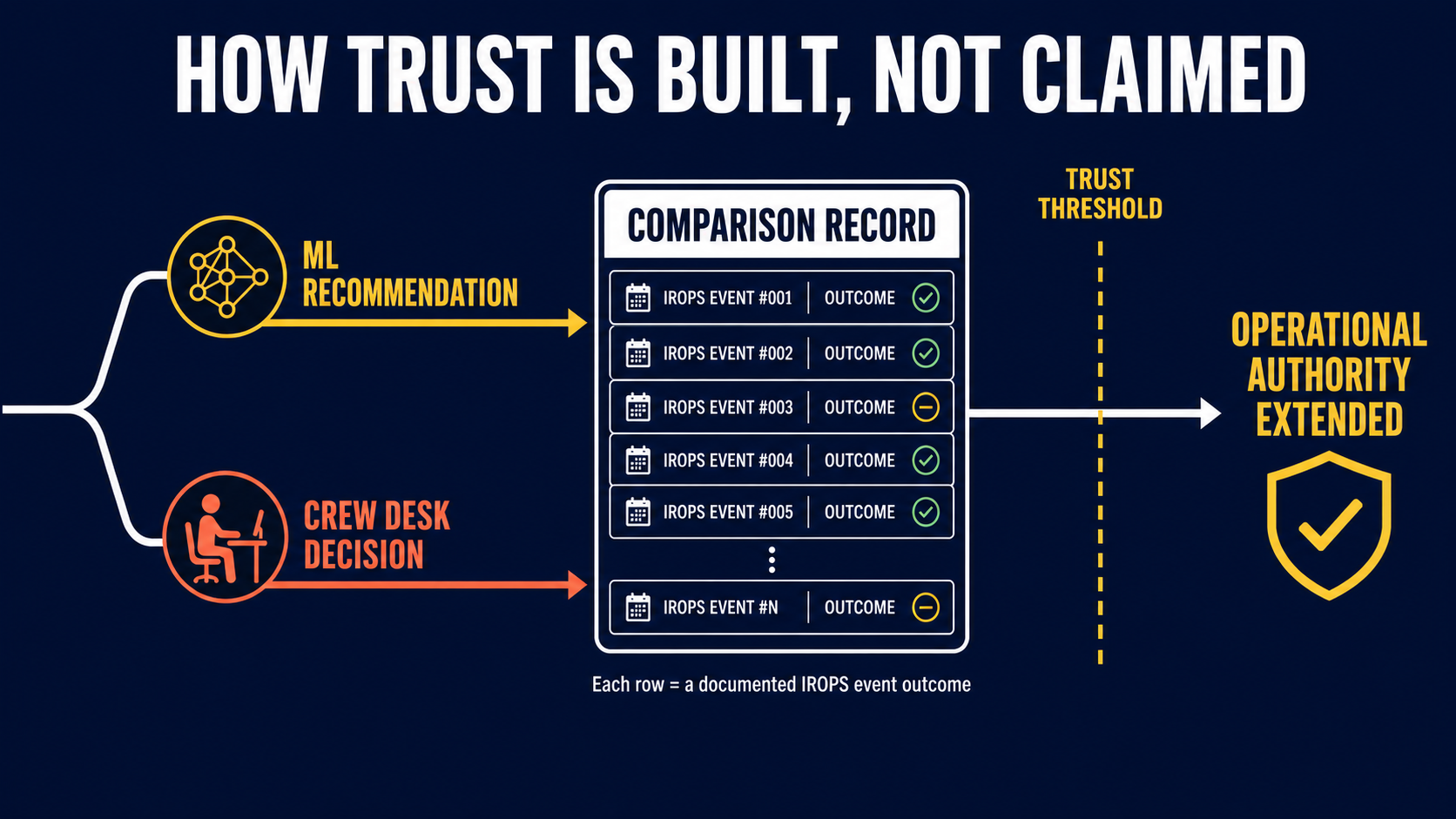
Shadow-mode deployment — running ML recovery recommendations in parallel with human crew desk decisions without operational authority — is what separates a trustworthy AI deployment from an operational risk. The system accumulates a comparison record: what it recommended, what the human decided, how each played out across the full cascade. That record is the asset.
An airline that builds shadow-mode history during normal-to-moderate IROPS conditions has a dataset that validates model performance and creates the institutional trust required to extend operational authority during a major event. Without it, the first serious disagreement between ML recommendation and crew desk judgment — which will happen — lands without context, and erodes trust in a way that takes months to rebuild.
The 2026 agentic AI narrative in aviation has mostly produced passenger-facing applications: Malaysia Airlines launched an autonomous customer service agent earlier this year, and the industry is working on shared event languages for agent interoperability. That's a real trend, useful for service recovery chatbots. Operationally trusted crew recovery recommendations require a different trust architecture — one built through shadow-run comparison records against documented IROPS events, not through chatbot deployments — and a different validation timeline.
The crew scheduling and IROPS recovery space is at the augmentation stage, not the autonomy stage. Building the shadow-run record now, during the relative operational calm of 2026, is what positions an airline to deploy ML-assisted recovery recommendations during the next major disruption — rather than starting the evaluation after the cascade has already begun.
If your operations team is working through where to start, or building the internal case for why your current recovery workflow is leaving DOT refund exposure on the table, we'd welcome a specific conversation. More at https://veriprajna.com/solutions/airline-crew-scheduling-ai. The constraints that shape what's actually deployable tend to be specific to the carrier's topology, solver stack, and CBA structure — and the most useful starting point is usually a review of how your last three major IROPS events actually resolved.