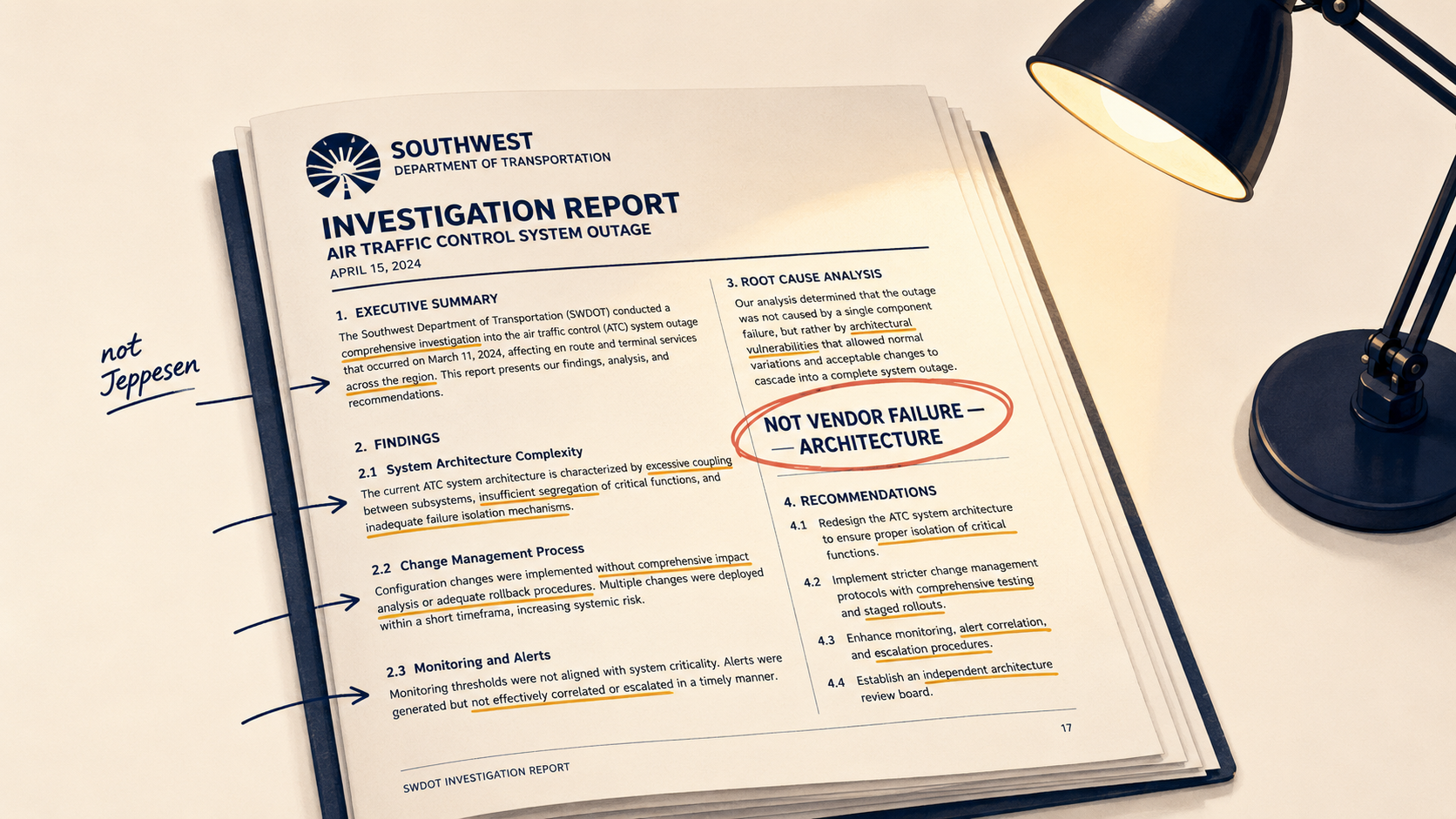
I spent the first hour with the Southwest DOT investigation assuming SkySolver was badly built. Sixteen thousand nine hundred cancelled flights, $1.2 billion in losses, two million stranded passengers — that kind of outcome feels like it has to be someone's fault, and SkySolver was the system that failed. By the third read I'd changed my mind. Column generation — the algorithm inside SkySolver and inside most other crew scheduling systems — doesn't fail during IROPS because it's poorly implemented. It hits a mathematical cliff. When disruptions cascade and the constraint set multiplies exponentially, the solver needs more cycles than real time allows. That's not a vendor shortcoming. It's the architecture.
Understanding that distinction is what shaped how we built the augmentation layer at https://veriprajna.com/solutions/airline-crew-scheduling-ai. The question wasn't "how do we replace Jeppesen or IBS." It was "what do you actually need on top of a solver that hits its limits during the worst moments."
The War Room Whiteboard
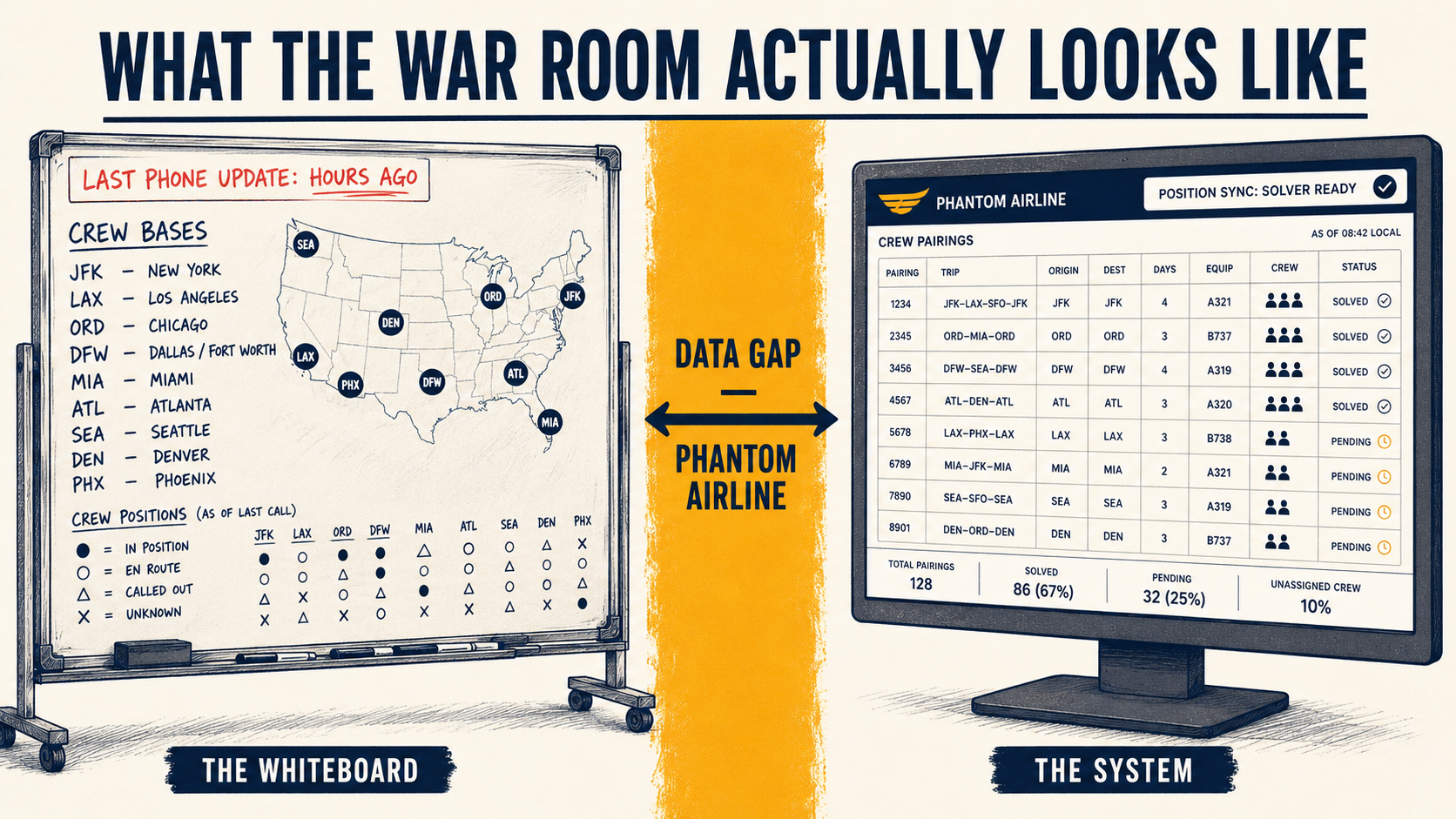
The visit that shifted my understanding of data staleness happened at a mid-size carrier's operations control center during a moderate weather event — rolling delays across a good portion of the network, a winter storm, nothing close to the scale of Southwest's December 2022.
What I saw when I walked in: a whiteboard with crew positions marked by base, updated periodically by a junior analyst taking phone calls. On the monitor beside it: the crew scheduling system's output, built from a crew position snapshot that matched the whiteboard's previous update. The senior analyst was still on the phone taking another check-in. The output report was already stale.
That's the phantom airline problem. The solver solved correctly for the positions it was given. The positions it was given had already changed. And the gap between the whiteboard's current state and the system's known state was the actual problem the ops desk was working. Every reassignment was a manual reconciliation between what the system said and what the analyst on the phone was being told.
Clearing one crew member for reassignment through that cascade meant working through dozens of distinct constraints — FAA Part 117 duty-period limits varying by start time and segment count, CBA rules adding domicile-specific rest windows and override eligibility conditions often more restrictive than the regulatory floor. Running those checks against stale position data was how a recoverable cascade became irrecoverable. Manual crew recovery typically takes 4-12 hours; automated recovery, done right, can run in 15-30 minutes. The difference isn't just the algorithm. It's whether the algorithm is working against real positions or phantom ones.
What October 2024 Changed About My Pitch
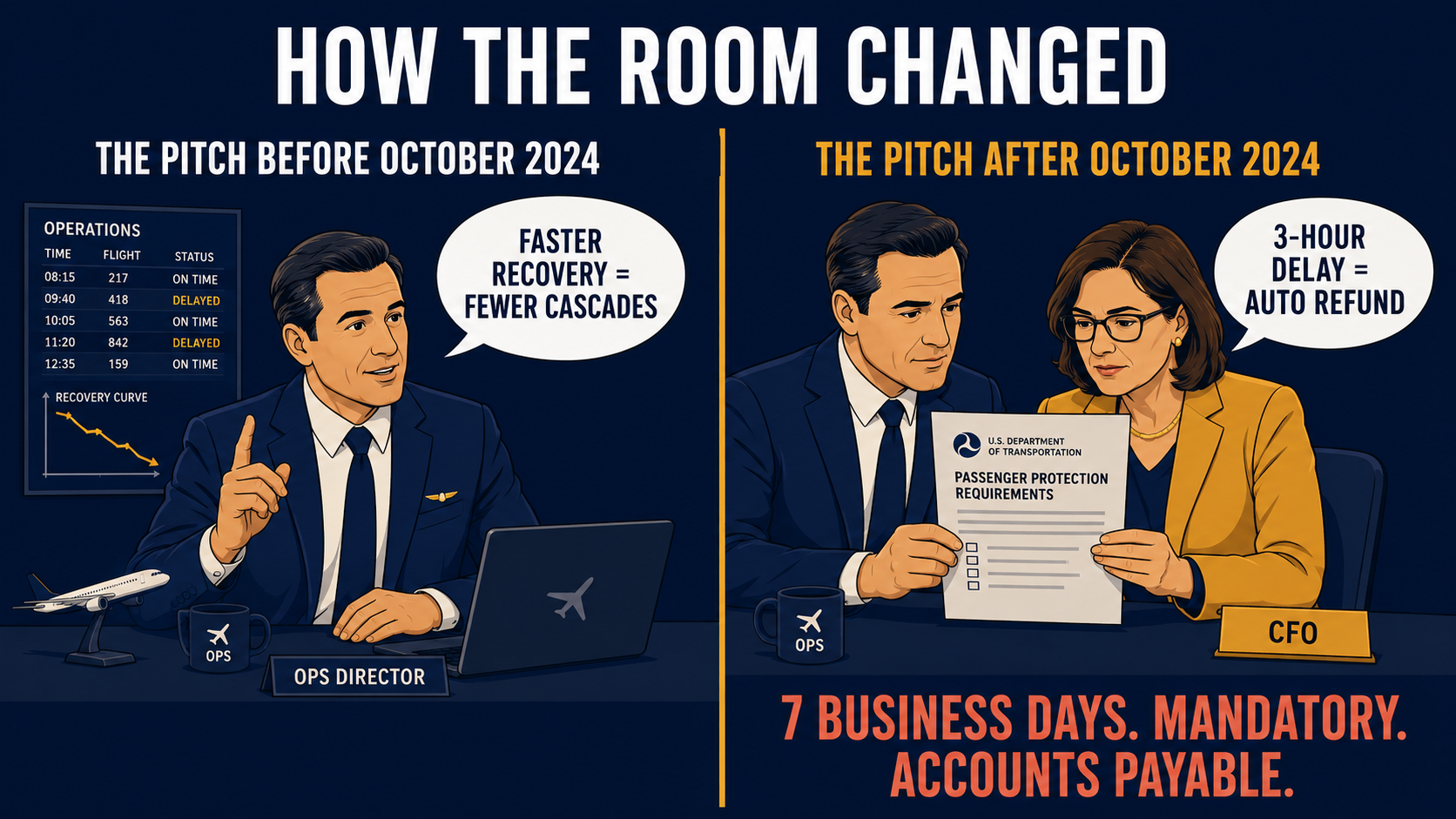
My framing for why IROPS recovery speed matters was always operational: faster recovery means fewer cascades, shorter delays, fewer crew members stranded. Operations directors understood it immediately.
The DOT's automatic refund rule, which took effect in October 2024, changed who the argument needed to reach. Airlines must now automatically refund passengers for domestic delays of three or more hours — without being asked, within seven business days for credit card payments. That converted the recovery time argument into a line item.
A cascade that resolves in two hours instead of four isn't just better customer experience. It's refund liability avoided — documented, mandatory, showing up in accounts payable.
I went back through our conversations the week after the rule took effect. The operational argument was landing. The accounts-payable version — a 3+ hour domestic cascade is now an immediate financial trigger, and the DOT doesn't wait for you to offer a voucher — was a CFO conversation we hadn't been having. IROPS costs the industry an estimated $60 billion per year (IATA). The rule didn't change that aggregate. It changed who in the airline organization feels the per-event number.
What Jeppesen's Acquisition and IBS's AWS Deal Tell Me
When Boeing sold Jeppesen to Thoma Bravo for $10.55 billion in April 2025, my first instinct was to read it as a vendor lock-in concern for the 100+ airlines running Jeppesen. Private equity taking over a crew scheduling platform that's operationally embedded in the carrier creates legitimate questions about roadmap continuity, pricing, and support priorities over a multi-year horizon.
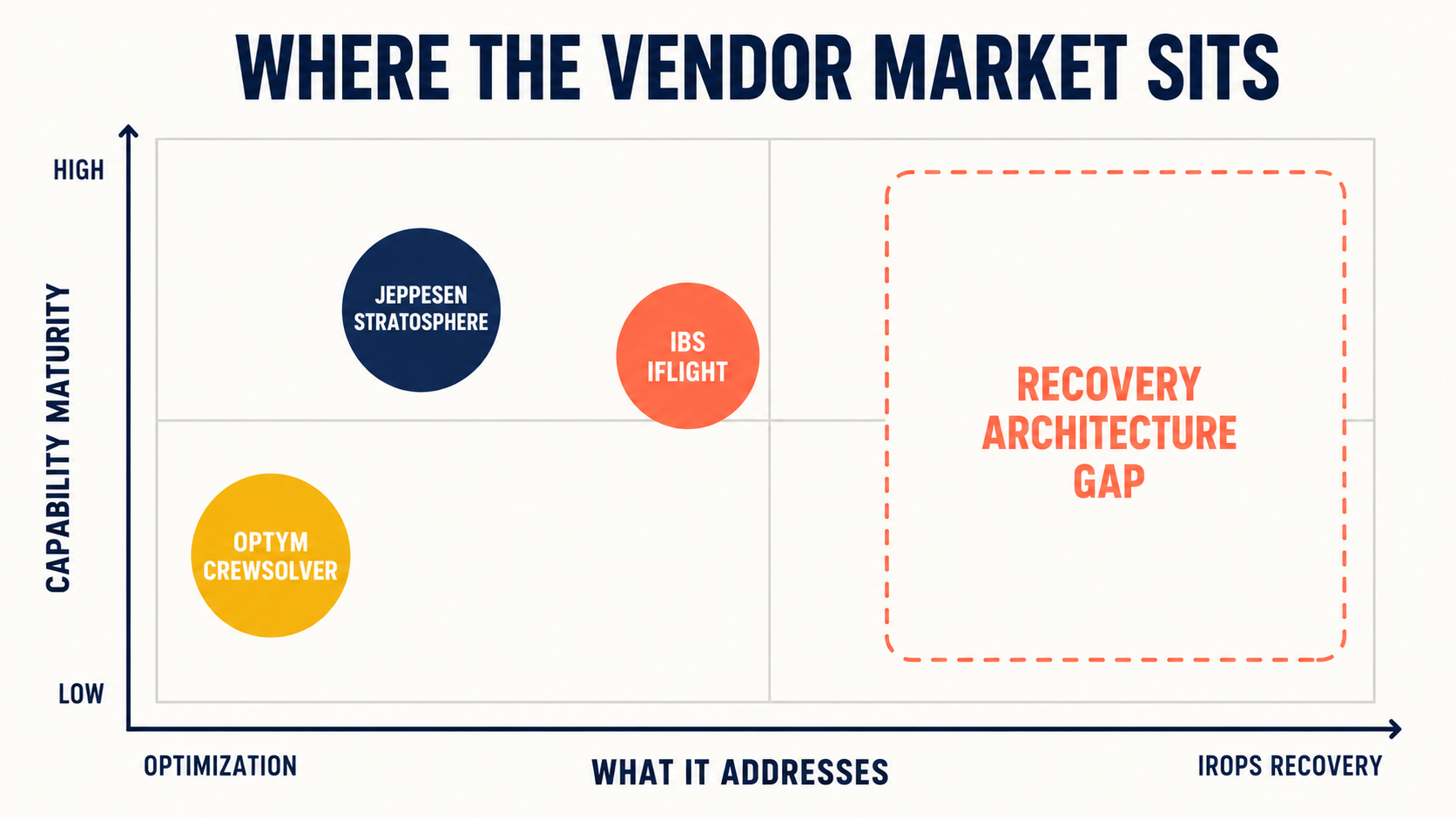
What I've come to think is more useful: Jeppesen launched Stratosphere in October 2025, and the new owners are saying AI is the "north star for our multi-year roadmap." I take that seriously as a product investment. I also notice that Stratosphere runs on the same Carmen Systems architecture. Adding an AI prediction layer on top of column generation helps you see the cliff coming earlier. That's genuinely useful. It doesn't change what happens when you arrive at it.
IBS Software's iFlight has moved quickly — Korean Air in March 2026, Groupe Dubreuil in December 2025, Aeroitalia starting in October 2025. The AWS strategic collaboration is for co-engineering AI frameworks, not just hosting, and three deployments across five months is a pace that reflects real customer traction, not just pipeline. Optym's CrewSolver at Southwest delivers 3-7% crew cost reduction on pairing and rostering — a meaningful optimization result that matters on a good day.
The question I ask about each of these platforms is the same one: does it change the recovery architecture, or improve the optimization architecture? Those are related but different problems. The carriers that have already survived a major IROPS event know the difference intuitively; it's the ones that haven't that tend to find out the hard way.
The Trust Architecture Problem Nobody Addresses in the RFP
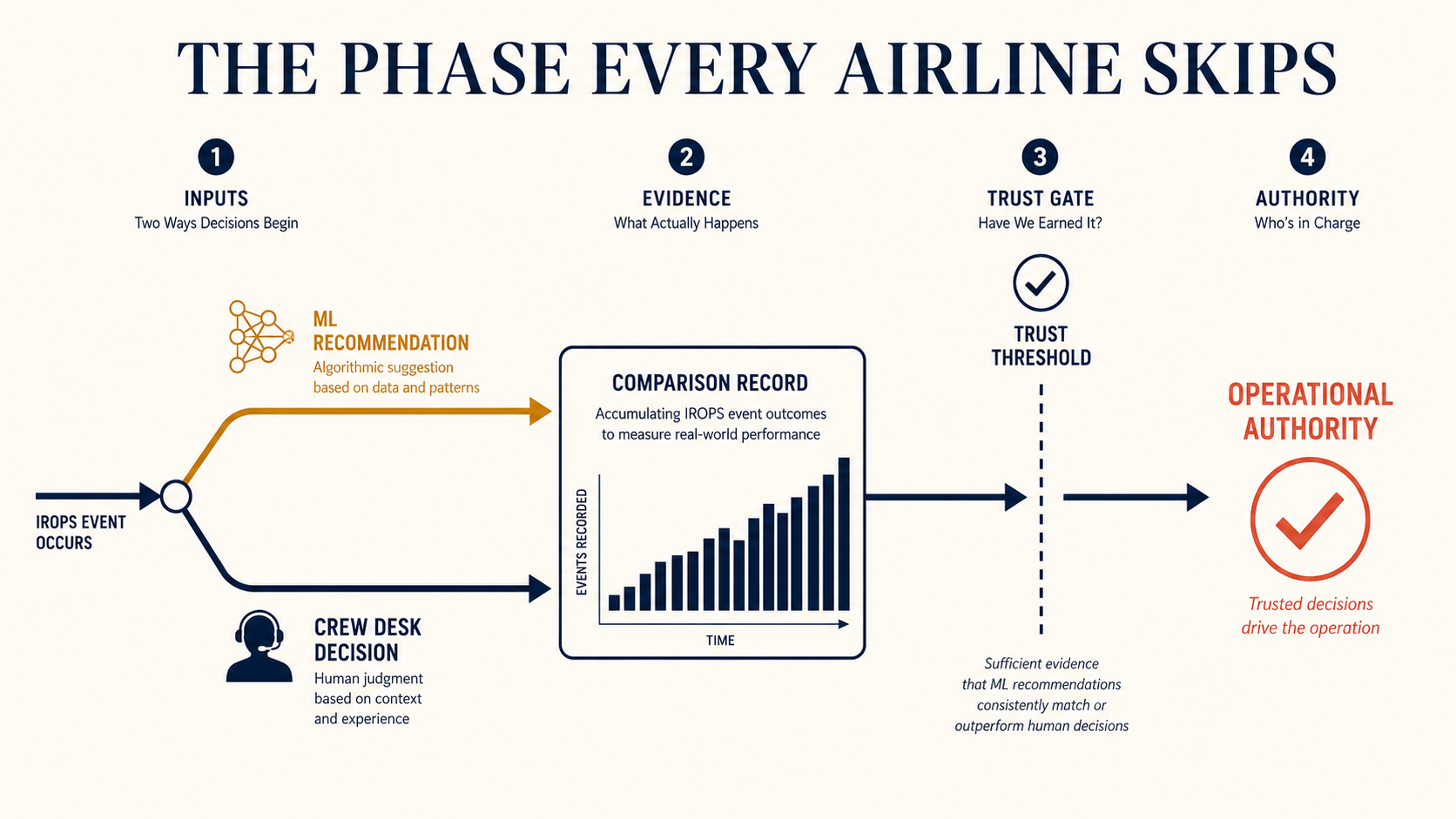
What I've learned from conversations with operations control center teams is that the barrier to deploying ML-assisted recovery isn't the algorithm. It's trust.
Crew desk managers have deep, earned expertise. They've navigated dozens of major events. The first time an ML system recommends something that contradicts their instinct, the response isn't "the model must be right." It's "this system doesn't understand my network." That's not irrational. It's the correct skepticism of someone who has been responsible for real decisions when the cascade was underway.
Shadow mode — running recommendations in parallel with human decisions, without operational authority — is how you address that. The system accumulates a comparison record: what it recommended, what the human decided, how each played out. That record is the asset. Not the algorithm. The comparison record built across a meaningful range of IROPS events is what earns the right to extend operational authority on the next major one.
The 2026 agentic AI narrative in aviation has largely produced passenger-facing automation: Malaysia Airlines' autonomous customer service agent, industry working groups on shared event languages for agent interoperability. Those are real products for real problems. Operationally trusted crew recovery recommendations require a different trust architecture, built through shadow-run comparison records on documented events, not through the same chatbot deployment infrastructure.
More on the augmentation architecture at https://veriprajna.com/solutions/airline-crew-scheduling-ai.
The question that lingers for me: when the next major cascade hits, which operations control centers will have shadow-run records that tell them where to extend trust — and which ones will be starting the evaluation while the cascade is still underway. That gap is widening with every season that passes without the work done.