Enterprises can now generate campaign assets at unlimited volume. That is not the win it looks like. Every one of those assets is a chance to ship the wrong red, a cramped logo, or an AI ad that enters the EU with no legally required label, and no brand-and-legal team reviews hundreds of AI-assisted variants a week by eye. The bottleneck of AI brand content was never generation. It is knowing what is safe to ship.
That distinction is easy to nod along to and hard to act on, so here is the failure it produces, with a real number attached. When we built the Brand Fidelity Firewall, a pre-ship governance gate that measures every AI-generated asset against a brand book before it ships, we planted an off-brand red into the test batch and ran two independent judges over it. A generic image-similarity baseline rated it 0.97 "on-brand" and would have shipped it. Real color science, the ISO/CIE-standard CIEDE2000 metric, measured that same hero red at 7.12 ΔE off the brand's Pantone red against a tolerance of 3.0, and blocked it.
Both numbers describe the same pixels. Only one of them is right. That gap is the whole argument.
Why a better generator does not close this gap
The reflexive fix for "AI content is off-brand" is "use a better model, or score it with an AI aesthetic model." Both miss the shape of the problem. A perfect generator still produces an asset that must be measured against an exact Pantone specification and stamped with the right per-market disclosure, and a generic similarity score is structurally blind to the first of those. Perceptual-similarity and hash-based scores are built to judge overall structure and luminance, which is exactly why they cannot separate your specific crimson from a competitor's. The thing you most need caught is the thing they are designed not to see.
A perfect generator still ships an asset that must be measured against an exact Pantone spec and stamped with the right per-market disclosure. The gate, not the generator, is the moat.
This is why we treat governance, not generation, as the durable layer. Model quality improves every quarter. The obligation to prove an asset is the correct color, that its logo has legal clear-space, and that it carries the disclosure its target market requires does not improve away. It is a measurement-and-rules problem, and measurement lives outside the model.
What the gate actually does with the off-brand red
Here is the catch the market case rests on, in full. The asset is a holiday social cut whose hero fill reads as brand crimson to the eye. The firewall extracts the dominant saturated hero region, converts it to CIELAB, and runs CIEDE2000 against the brand book's Lumiere Crimson, PMS 484, #9E2B25, which carries a per-color tolerance of 3.0. The measured hero, #9D2E0B, comes back at ΔE00 7.12. Over tolerance is a hard rule, so the verdict is BLOCK, and the evidence panel shows the rule that fired: "Brand primary color off-spec, ΔE00 7.12 > tolerance 3.0."
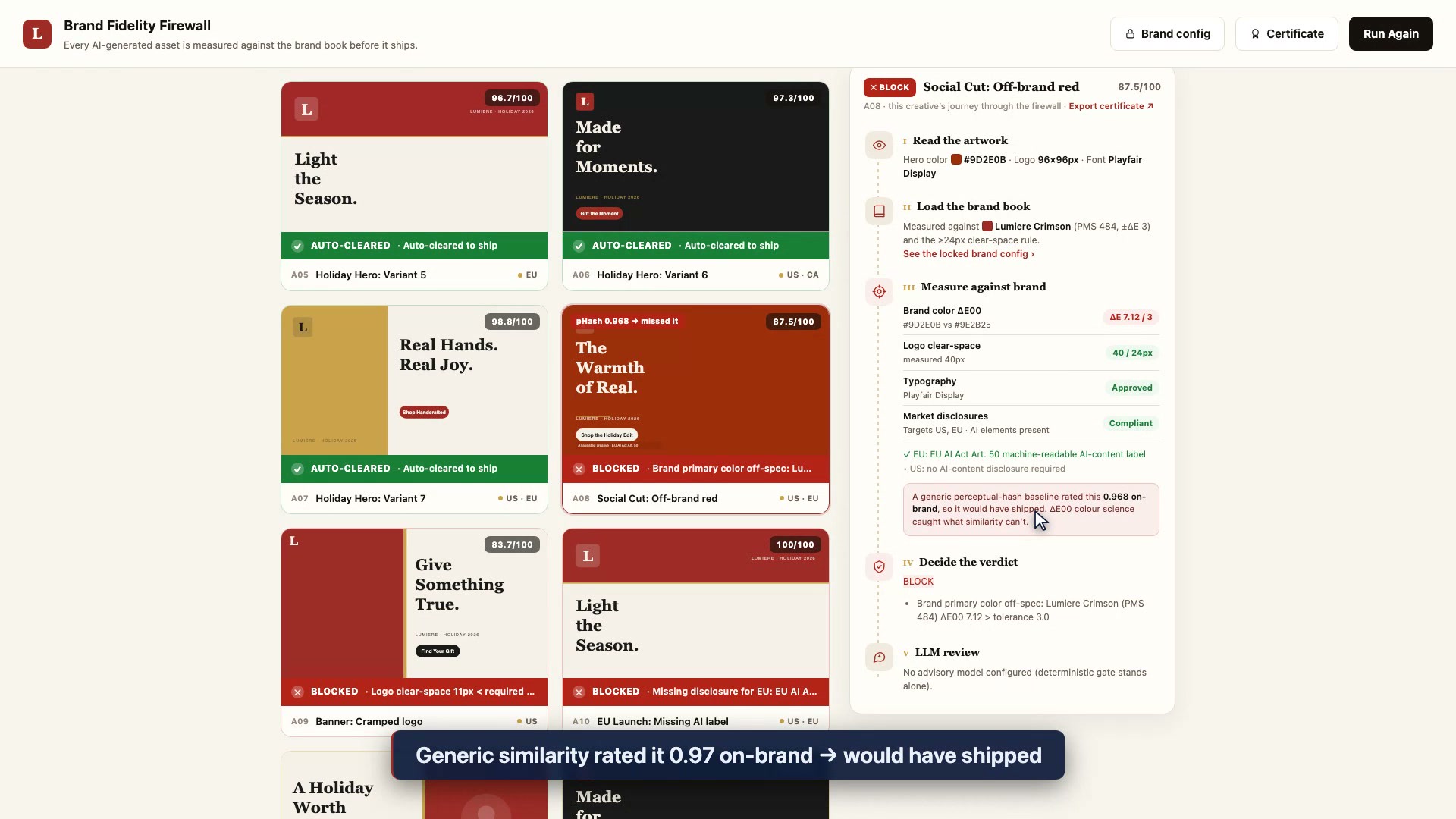 The off-brand red blocks at ΔE00 7.12 against a 3.0 tolerance. The generic perceptual-hash baseline in the same panel rated it 0.968, about 0.97 on-brand, and would have let it ship. Color science caught what similarity could not.
The independent anchor matters here. The 0.968 baseline is not a strawman we invented to lose. It is a real, widely-used perceptual-hash (DCT pHash) run, standing in concretely for the class of generic-similarity scores brands actually reach for, and it rates the wrong-red asset as on-brand because that is what generic similarity does. One judge is a guess about overall resemblance; the other is a standardized measurement against a named specification. When a governance decision is on the line, the measurement wins. The full run is at https://veriprajna.com/demos/brand-ai-content.
The color case is the sharpest of three hard gates that BLOCK. The other two are geometry and law: a logo whose clear-space measured 11px against the brand rule of 24px is a hard block on geometry, not color, and an asset shipping AI content into the EU with no Article 50 machine-readable label is a hard block on a missing required disclosure.
Compliance is not an opinion, so we did not model it as one
The disclosure gate maps an asset's provenance (which elements are AI-generated, whether a synthetic performer is present) and its target markets to the disclosures required by real, dated statutes: NY SB-8420A, the EU AI Act Article 50, CA CAITA, and FTC Section 5. When the EU-bound asset arrives without its label, the gate blocks it and cites the statute, including the EU AI Act Article 50 deadline of August 2, 2026 and its penalty ceiling.
 The EU-bound asset is pixel-perfect on color and geometry and still blocks: the EU AI Act Article 50 label is missing, and a missing required disclosure is a hard block regardless of how good the artwork is.
To be precise about what this is and is not: the firewall maps provenance and markets to the required disclosures and exports an evidence artifact. It does not certify legal compliance and it is not legal advice. It produces the filable record a legal team needs to make the call, which is a different and more honest thing than claiming the software cleared the law.
Not every case is a clean pass or a hard block, and the gate does not pretend otherwise. Two shapes route to a human instead of being bluffed either way: an AI-generated human likeness that needs authenticity sign-off, and a target market outside the brand book's coverage where the disclosure rules are unknown. Both come back as FLAG, sent to a person rather than falsely cleared. A governance layer that guesses on the ambiguous cases is not a governance layer.
The decision is code, and it leaves a receipt
One design choice makes all of this defensible: the gate is plain code that sits outside any language model. There is an advisory tonal and authenticity step in the pipeline, a single vision or language model call, but it is informational only. It abstains on a missing key and it never changes a PASS, FLAG, or BLOCK. The model advises; the deterministic gate decides. That is unit-tested as an invariant, no asset with a hard failure is ever cleared, alongside a check that our CIEDE2000 implementation matches the Sharma et al. reference color pairs (5 of 5 tests pass).
Because the decision is deterministic, every result is reproducible and exportable. Each cleared asset carries a Brand Fidelity Certificate, JSON plus printable HTML, recording the per-check measurements, the provenance, the per-market disclosure status, the gate result, the model and version, and the timestamp. On our fixed 12-asset demo batch the firewall auto-cleared 7 to ship without a human touch, blocked 3, and flagged 2 for review, and one of those blocks was the off-brand red that the generic similarity score waved through.
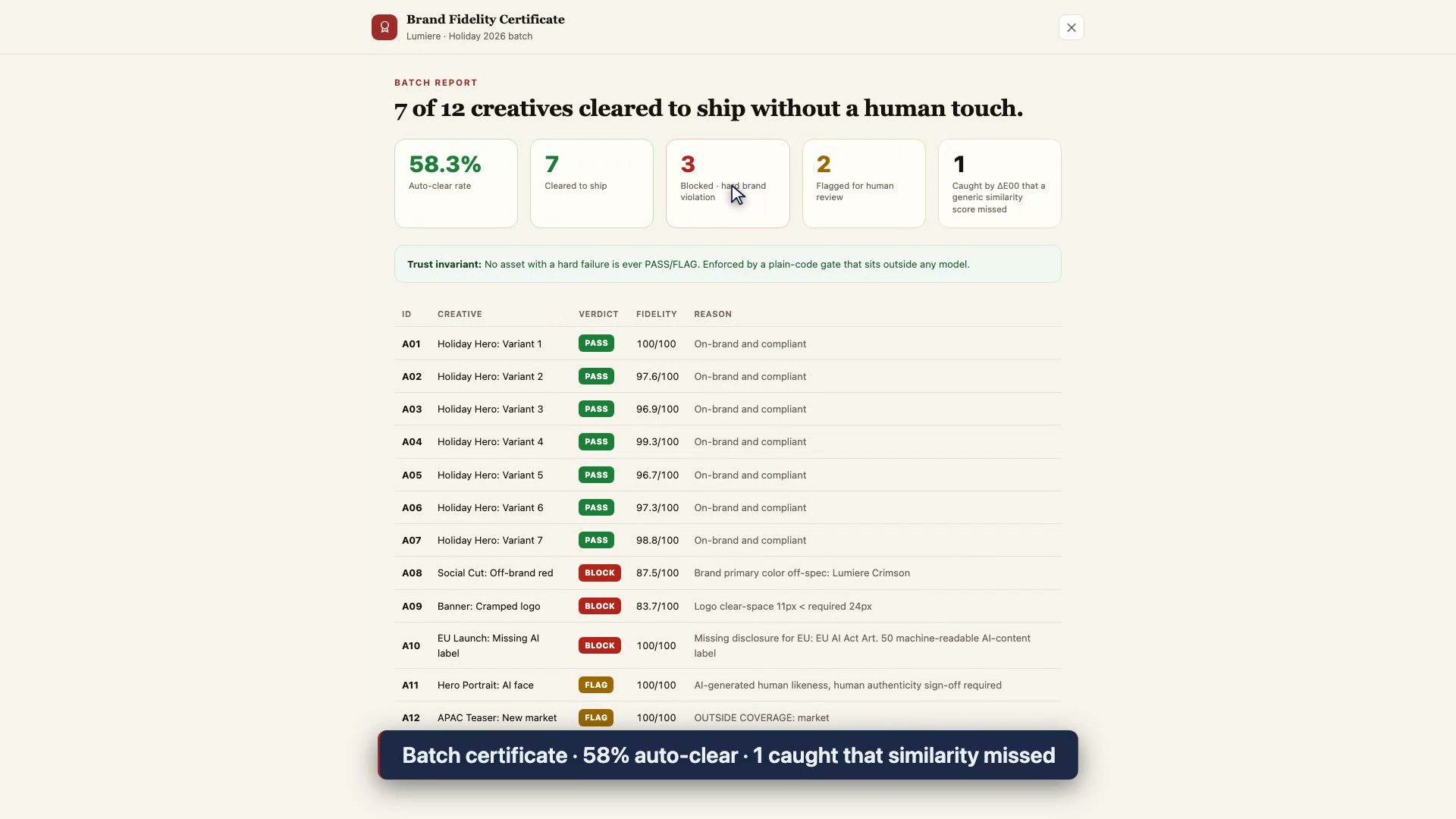 The batch certificate for the 12-asset demo batch: 7 auto-cleared, 3 blocked, 2 flagged, with the trust invariant stated on the artifact. The headline is review burden removed, since on-brand assets ship without a human touch.
On the 12-asset demo batch, no asset with a hard failure is ever cleared to ship. The invariant is enforced by code outside the model, not by the model's judgment.
Scope, stated plainly: those batch numbers describe that specific 12-asset demo batch, not an open-world guarantee, and the brand under test, "Lumiere," is a synthetic brand book we authored so that every check measures real pixels. The demo ingests pre-generated assets rather than generating anything, runs the deterministic core fully offline with no API key, and proves the mechanism rather than standing in for a deployed pipeline. What it demonstrates is the part that holds regardless of scope: a decision that can be measured, reproduced, and filed.
The market has already priced the cost of getting this wrong. Roughly half of consumers prefer brands that avoid GenAI content (Gartner, March 2026), and trust in an ad drops from 48 percent to 13 percent when it is fully AI-generated rather than co-created (Smartly.io, 2025). Against that, the answer is not slower generation. It is a gate that lets the good assets through untouched and stops the rest with a reason you can read. You can try the full run at https://veriprajna.com/demos/brand-ai-content.
So a question worth sitting with, for anyone shipping AI-assisted creative at volume: when your team publishes a campaign asset today, what actually measures it against your exact Pantone spec and each target market's disclosure law before it goes live, or does it ship on the model's word? The problem is industry-wide, and we would genuinely like to hear how you are drawing that line.