
I went and looked up exactly what CrowdStrike's "content pinning" feature meant when they rolled it out as part of the post-outage Resilient-by-Design framework. The announcement positioned it as a meaningful enterprise control — a way to prevent the kind of simultaneous forced push that crashed 8.5 million Windows machines on July 19, 2024 and produced more than $10 billion in global damages. The feature description was accurate: enterprises could configure the Falcon agent to hold a channel file update until a designated maintenance window.
What content pinning doesn't do is let the enterprise see what changed in the content file before that window opens. The schema delta between the previous and current version — the part that tells you whether the new channel file behaves differently against specific kernel configurations — isn't exposed. The delivery is deferred. The payload isn't inspected.
I think this is the most important thing to understand about CrowdStrike's post-incident remediation: the enterprise got better scheduling control. It didn't get an independent verification layer.
The Question I Couldn't Answer Rigorously
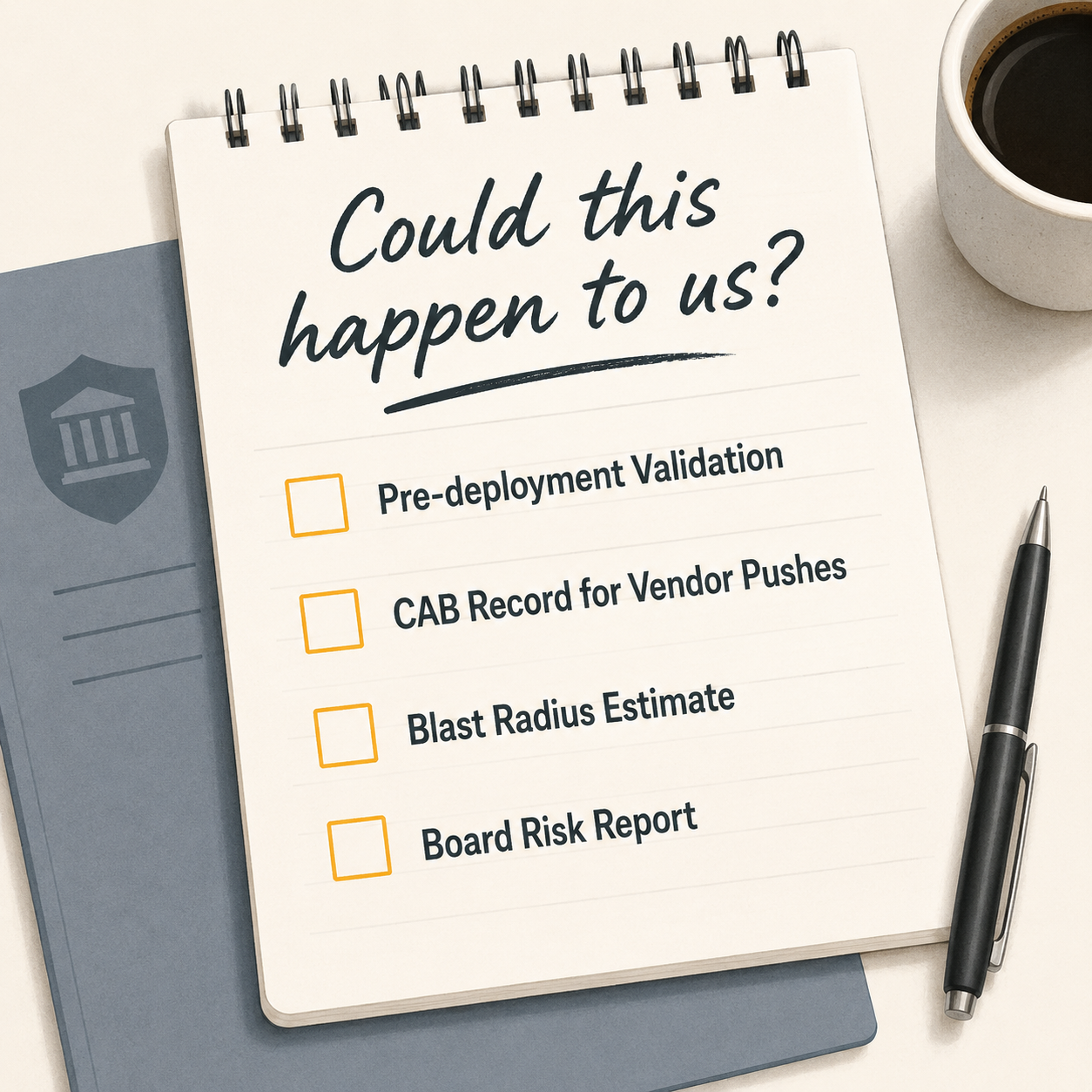
Some time after the outage, I was in a conversation with a CISO at a financial institution — someone who had dealt with a serious EDR-related incident of their own, separate from CrowdStrike, and was acutely aware of how little visibility the enterprise had into what the kernel agents were actually doing during the event. The way they described it was that every vendor protocol had been followed, and the protocols themselves turned out to have assumptions baked in that didn't hold under their specific infrastructure.
Then they asked me: "Could the CrowdStrike scenario happen to us?" And I sat with that longer than I expected to. I'd been building our approach to this problem for months. But the rigorous answer — where I could say here's the specific configuration audit, here's the documented governance record, here's the pre-deployment analysis that would tell you whether your staging gates actually intercept a forced channel file — I didn't have it fully built out.
The structural answer is: probably not at the same scale, but the underlying exposure is the same. Most enterprises run between 8 and 12 kernel-level agents simultaneously — not just endpoint detection and response, but data loss prevention, encryption management, patch orchestration, VPN, mobile device management. Each one has a content delivery mechanism. Most of those content pushes never enter a change advisory board queue, because vendor updates are categorically exempt from change control at most organizations. The ITSM change ticket that would have flagged CrowdStrike's channel file update simply doesn't exist at most enterprises — not because someone skipped a step, but because the process doesn't cover that category.
That's the gap. It's not specific to CrowdStrike. It's a category gap that every kernel-mode endpoint agent in the fleet carries.
The Delta Theory That Changed How I Think About Vendor Contracts
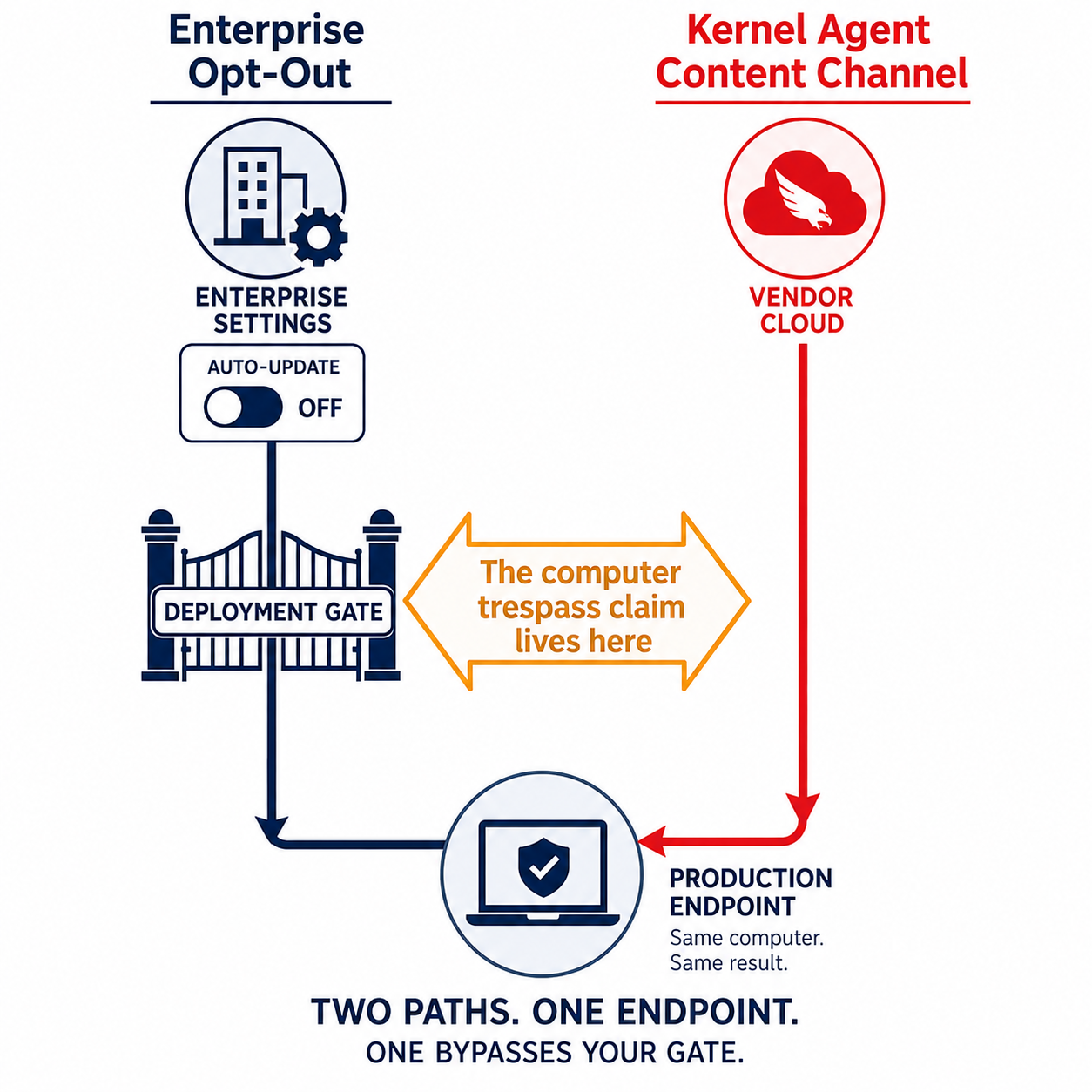
My read of the Delta Air Lines v. CrowdStrike litigation changed how I approach the vendor-contract side of this. Delta had configured its systems to opt out of automatic updates. A court allowed the "computer trespass" claim to proceed in May 2025 — the theory being that Delta's opt-out didn't reach the content-delivery mechanism inside the kernel agent. The agent delivered the channel file anyway. Delta claimed $500 million in damages; CrowdStrike is arguing its software subscription agreement caps that at single-digit millions.
I spent time working through the legal logic. If the enterprise's staging configuration doesn't actually intercept the content push — if the kernel agent's delivery path bypasses the gate the enterprise thought it had set — then the opt-out the enterprise believes it configured may not exist at the layer that matters. That's not a CrowdStrike-specific problem. Any enterprise running a kernel-mode agent with vendor-controlled content channels carries the same architecture question.
The EU Product Liability Directive — revised in 2024, effective in 2026 — takes the opposite position from CrowdStrike's SSA: software is explicitly classified as a "product" under strict liability, and vendors cannot contractually exclude liability for software defects. The two frameworks assume opposite positions about who bears the risk. The enterprises I work with that have EU market exposure need to know which framework their current endpoint security contracts were written for.
Most of them were written before July 2024. The leverage question is different now.
The Week I Spent Looking for the Right Tool
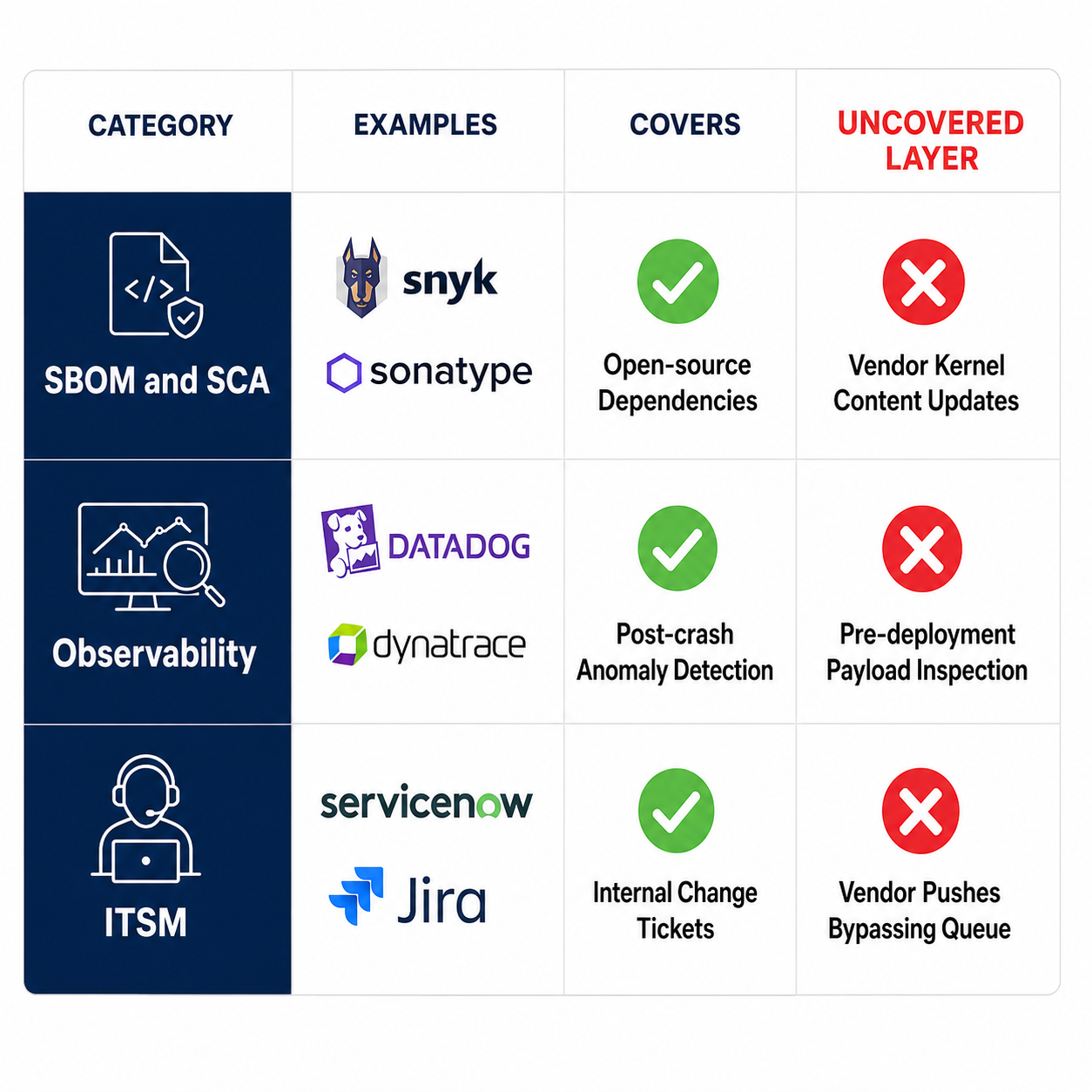
After that CISO conversation, I did a serious search for what tooling existed. SBOM scanning platforms — Snyk, Sonatype — are designed for open-source dependency tracking in the enterprise's own software. They don't touch proprietary vendor content updates or kernel-layer schema changes. That's a different layer than what those tools were built for.
Observability platforms like Datadog and Dynatrace and Splunk detect anomalies after a crash. They're excellent at what they're designed to do; they just operate after the fact. The median cost of significant IT downtime, per New Relic's September 2025 study, is $2 million per hour. An observability alert tells you when you're in the incident. It doesn't help you decide whether to push the update in the first place — and the ITSM platforms that track internal changes (ServiceNow, Jira) don't capture vendor updates that bypassed the queue in the first place.
What I was looking for was a tool that would take a CrowdStrike channel file, or a DLP policy push, or any proprietary vendor content update, run it in a sandbox mirroring the enterprise's production kernel configuration, and return a structured report: what changed between versions, any driver dependency conflicts, and a blast radius estimate if the update behaves unexpectedly. I didn't find it. What exists is CrowdStrike's own post-incident tooling — still vendor-controlled — and Microsoft's Windows Resiliency Initiative, which addresses catastrophic-crash severity by migrating third-party security products out of the kernel over 2026 and 2027. Neither provides the enterprise-controlled independent inspection layer.
My Governance Planning Shifted After Reading the EU CRA Timeline
I read the EU Cyber Resilience Act's enforcement timeline closely, and the governance conflict that stood out was: the CRA mandates that vendors begin mandatory vulnerability reporting on September 11, 2026, with a 24-hour initial disclosure requirement. My quarterly planning adjusted around that date because of what it means operationally. The vendor's CRA disclosure obligation runs faster than the window an enterprise needs to run independent pre-deployment validation. The staged-rollout process the enterprise wants to run takes longer than the regulatory clock the vendor is subject to.
For any public company with EU market exposure, the combination of the SEC's four-business-day material incident disclosure requirement and the CRA's vendor-side 24-hour reporting window means the documented governance record needs to exist before the next incident, not built retroactively. IANS Research found in March 2026 that only 29% of board directors consider CISO cybersecurity reports "very effective." My read on that gap is usually not about technical competence — it's about the absence of a framework that translates software update deployment risk into terms the board can evaluate. The question "could this happen to us?" has an answer that can be structured and quantified. It just requires having the governance infrastructure in place to produce it.
What We Built — and Why the ITSM Layer Is Where It Starts
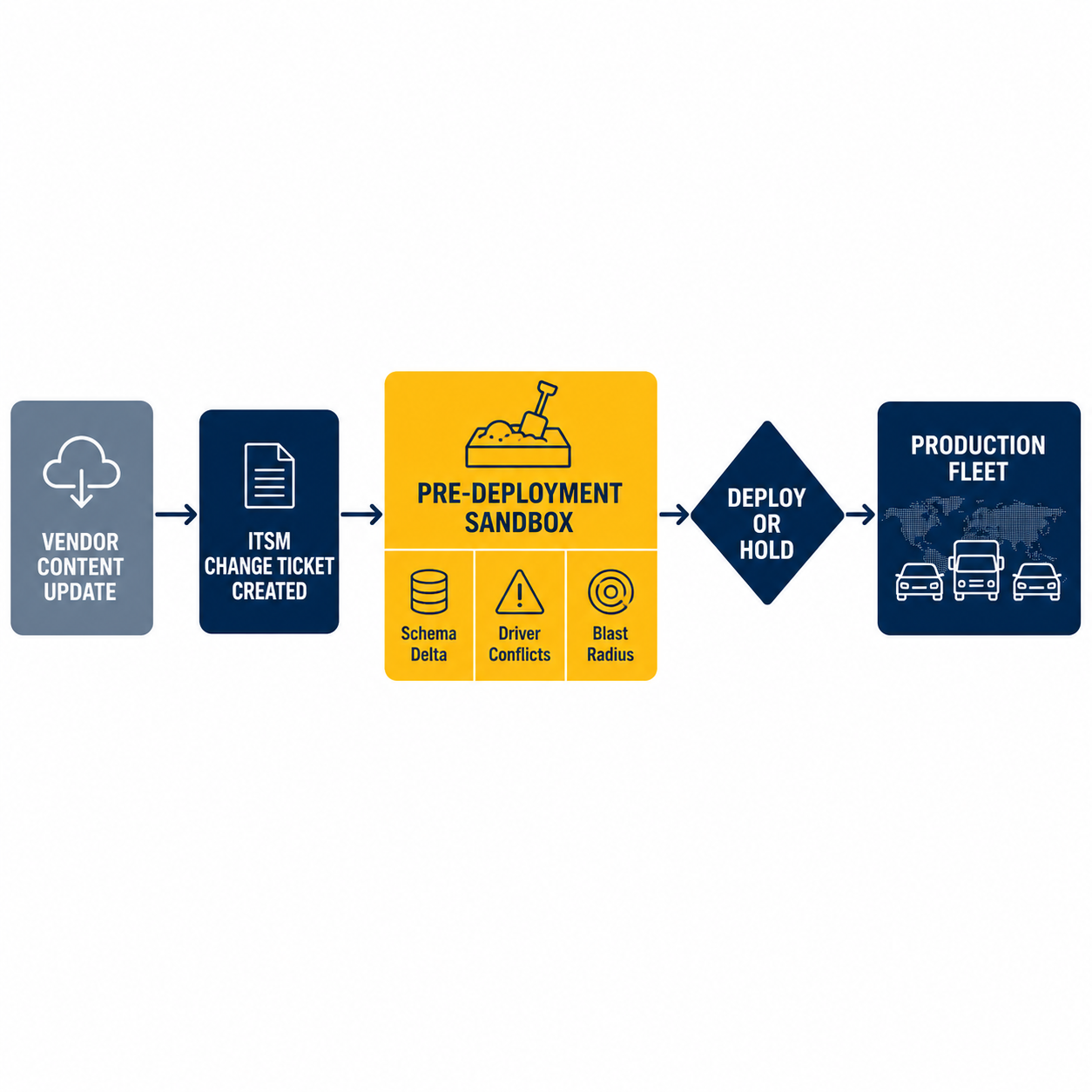
The architecture we built at Veriprajna — documented at the Software Update Deployment Integrity & IT Resilience page — treats vendor content updates as changes. Not a different category of change with a different process. Changes. The ITSM change record exists for every vendor push, regardless of how the vendor classifies the update.
The piece that was missing everywhere I looked is the pre-deployment sandbox: an isolated environment that mirrors the production kernel configuration, runs the update before it reaches any production endpoint, and produces the schema delta report, the driver conflict analysis, and the blast radius estimate. "Stage your rollout" is the current industry guidance. I think staging is useful — it contains the blast radius if something is wrong. Pre-deployment analysis is what informs the decision of whether to stage it at all, or hold it.
As Microsoft completes the kernel-to-user-mode migration for endpoint security products, the catastrophic-crash risk from kernel agents goes down structurally. I'm less worried about that over the medium term. The independent verification question doesn't go away: user-mode agents still push vendor-controlled content, the enterprise still needs a governance record, the regulatory environment is still moving toward treating software vendors as liable for their update behavior.
The CrowdStrike incident was unusual in scale — 8.5 million endpoints simultaneously because there was no staging and no independent inspection, and the blast radius was unbounded. The structural conditions that produced it are still present across the rest of the fleet. That's the thing the content-pinning announcement didn't change.
If you're working through what this governance architecture looks like for your own infrastructure, I'm at veriprajna.com/solutions/software-update-integrity — and I'd genuinely like to compare notes on how the pre-deployment validation workflow actually operates in different fleet configurations. The organizations further along on this are building institutional knowledge the rest of the field will eventually need. I'd rather build it collectively.