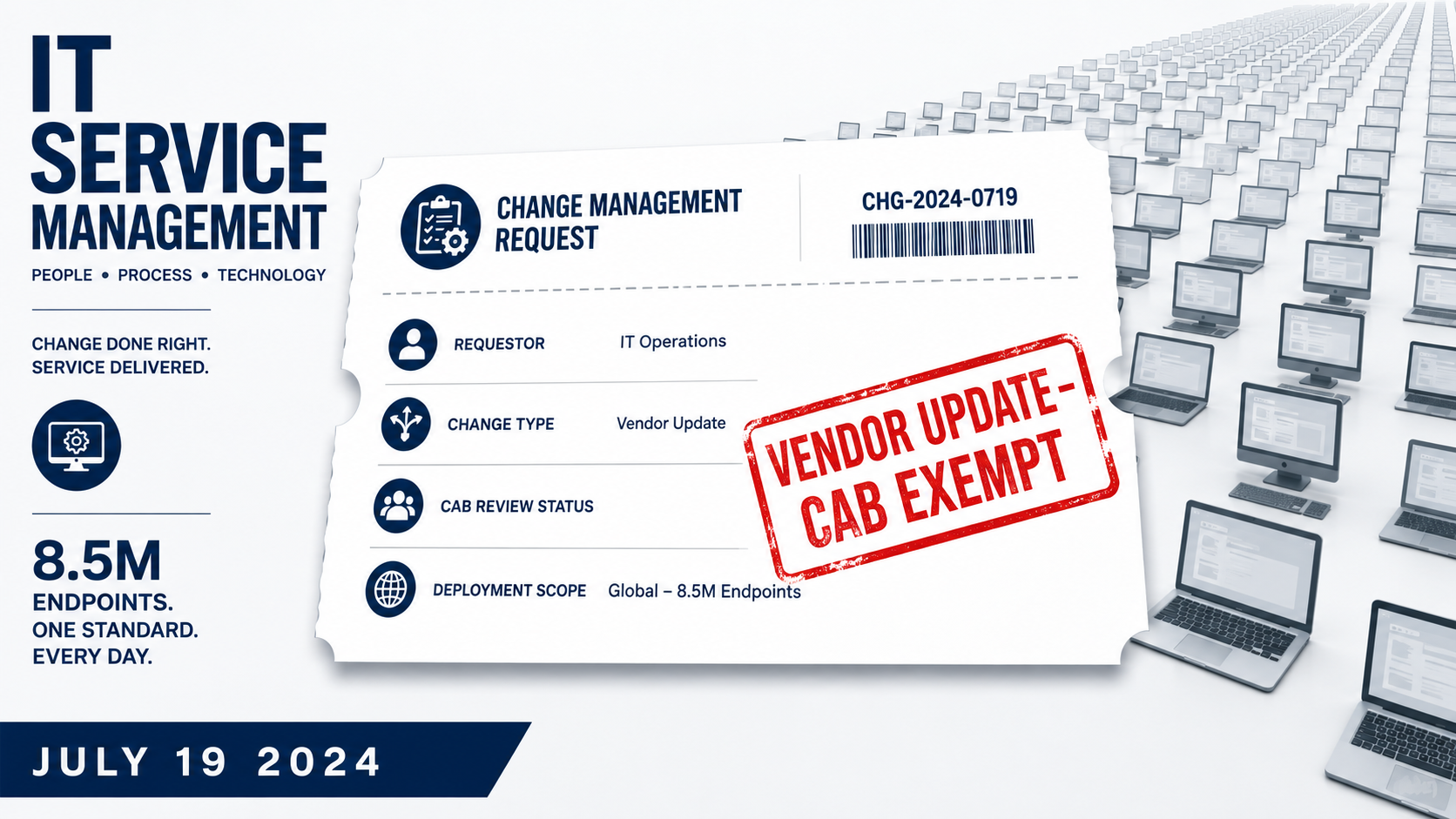
Most enterprise change advisory boards have never reviewed a vendor-pushed endpoint update — not because the process was skipped, but because vendor updates are categorically exempt from change control at most organizations. The CrowdStrike channel file that crashed 8.5 million Windows machines on July 19, 2024, didn't fail any organizational governance test. It was never subject to one.
That's the structural gap. CrowdStrike's remediation program, Microsoft's kernel access changes, and the Delta Air Lines lawsuit are all responses to the same incident. None of them closes it.
What CrowdStrike Fixed — and What Remains Vendor-Self-Policed
CrowdStrike's post-outage Resilient-by-Design framework introduced three changes: self-recovery mode for machines that can't boot after a bad update, content pinning for delayed channel-file delivery, and customer deployment gates that let IT teams stage rollouts. The company's Q3 2025 gross retention held above 97%, which the market appears to have read as sufficient remediation.
Content pinning lets an enterprise delay a channel file update. It doesn't enable inspection of what changed between content versions, what a schema delta implies for kernel behavior, or whether the blast radius of an unexpected update has been modeled before deployment. Customer deployment gates let teams stage a rollout; they don't provide independent analysis of the content before the staged rollout begins.
CrowdStrike's remediation is a better-scheduled version of the same vendor-trust model. The independent verification layer — something the enterprise controls, not the vendor — doesn't exist in any of it.
The Category Problem Behind One Vendor's Incident
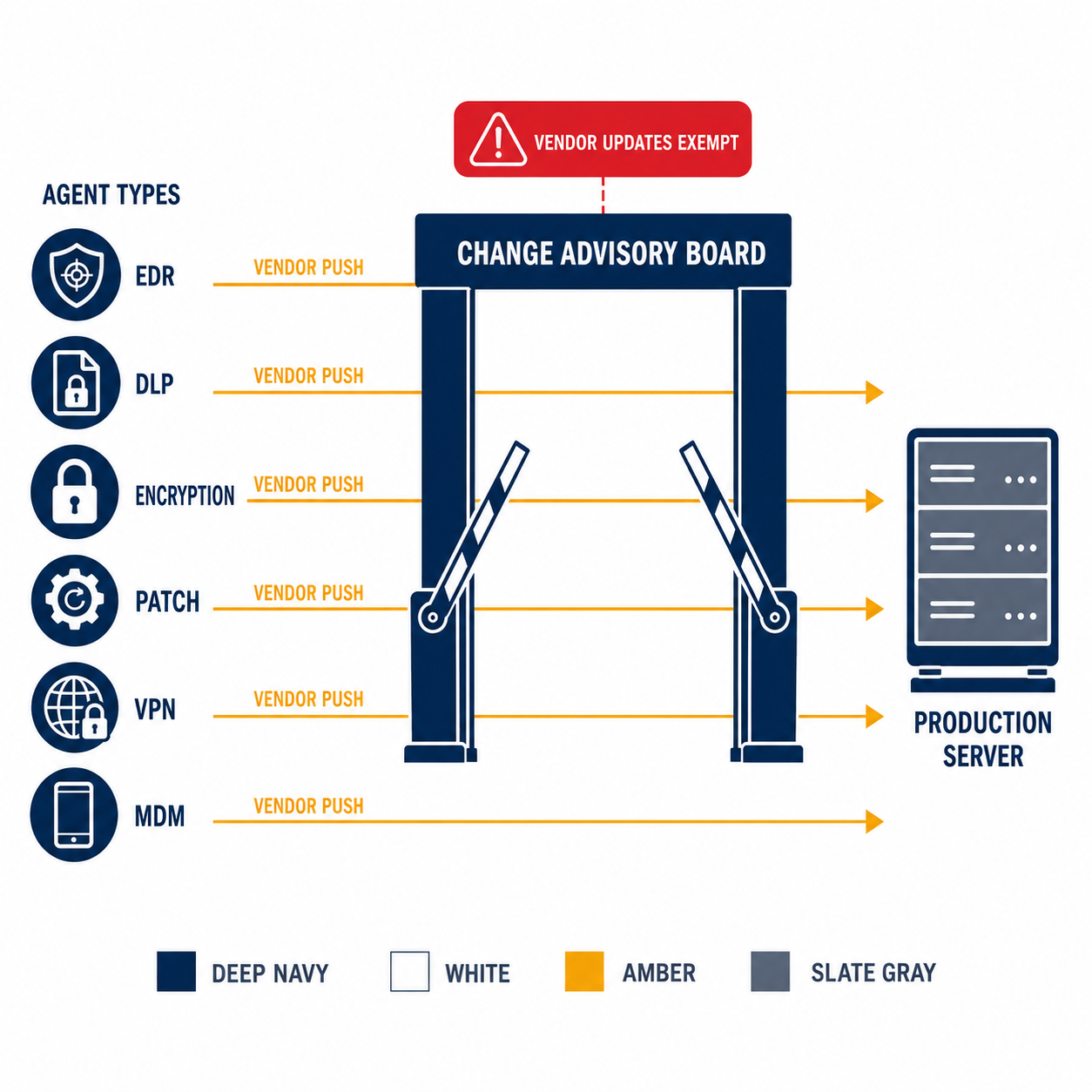
The CrowdStrike incident was one vendor's realization of a risk that's distributed across every endpoint agent in the enterprise fleet. In the organizations we've assessed — running between 8 and 12 kernel-level agents simultaneously — endpoint detection and response, data loss prevention, encryption management, patch orchestration, VPN, mobile device management — face the same governance gap across every one of those agents. Each has its own update cadence, its own content delivery channel, and its own contract language governing the vendor's right to push updates without advance enterprise approval.
None of those updates systematically appear in ITSM change queues. The change management process at most organizations treats vendor pushes as categorically different from internal changes. When something goes wrong — a BSOD cluster, a driver conflict, an application hang across several thousand endpoints simultaneously — the forensics require correlating crash timestamps against update logs across multiple vendor portals, because the enterprise change record doesn't capture it.
Recovery from the CrowdStrike incident required booting affected machines into Safe Mode, navigating to the Falcon driver directory, and manually deleting the faulty .sys file. At scale, Delta managed more than 7,000 flight cancellations and a claimed $550 million in losses before its systems were restored. The $10 billion in global damages cited in Parametrix's analysis reflects the same pattern replicated across 8.5 million endpoints simultaneously. New Relic's September 2025 study put the median cost of significant IT downtime at $2 million per hour; ITIC data from the same period found 41% of mid-to-large enterprises face between $1 million and $5 million per hour when systems go down.
Why the Existing Toolkit Doesn't Cover This Layer
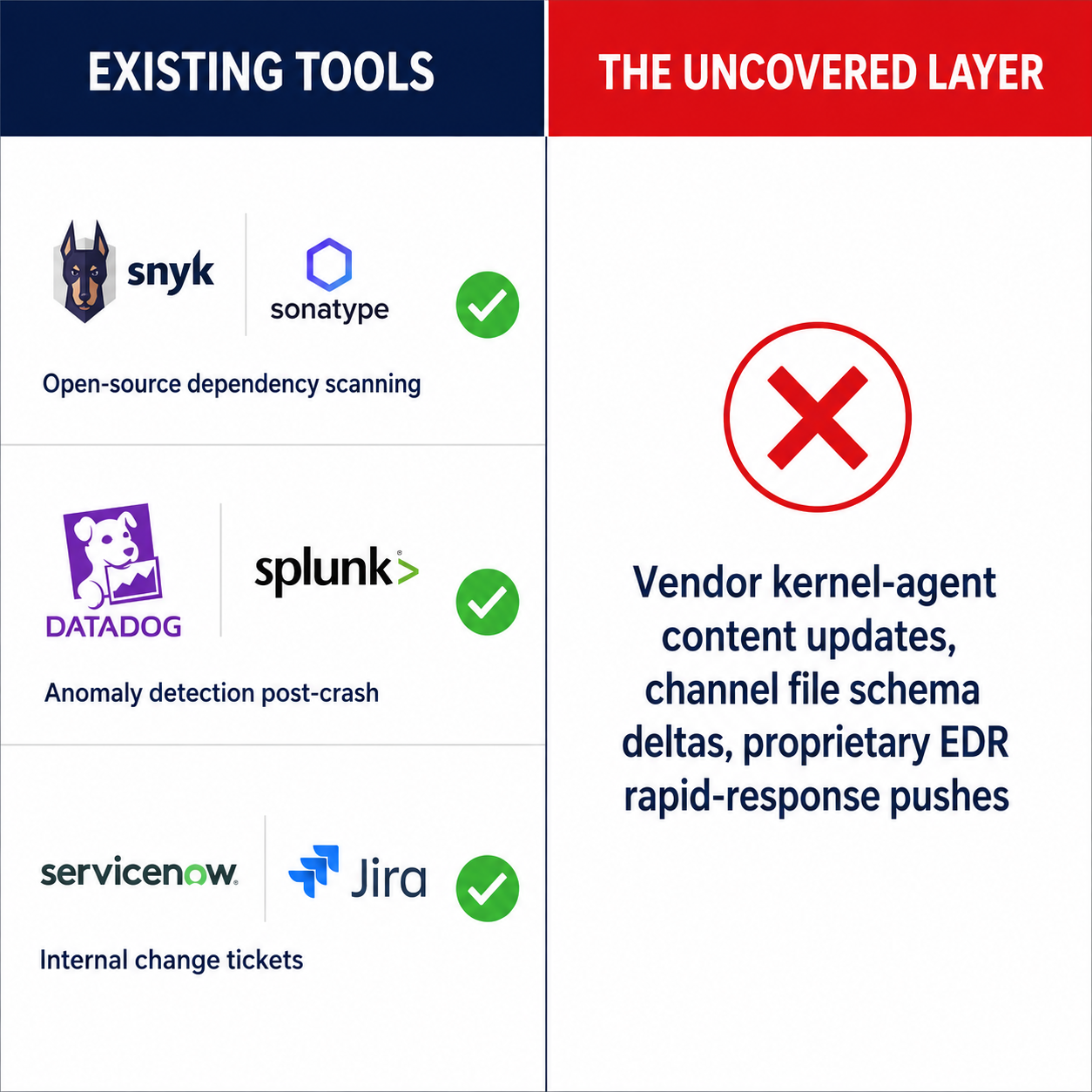
Software bill of materials (SBOM) scanning, software composition analysis, and vulnerability management platforms — the standard software supply chain risk tooling — are designed for open-source dependency tracking. Snyk, Sonatype, and their category peers are effective at the job they were built for: tracking which open-source library versions are embedded in the enterprise's own software. They don't inspect proprietary vendor content updates, channel files, rapid response payloads, or driver schema changes. That's a structurally different layer.
Observability platforms detect anomalies after a crash. Datadog, Dynatrace, and Splunk alert when endpoint behavior deviates from baseline. By design, they're reactive. ITSM platforms — ServiceNow, Jira — record internal changes and track what's been submitted for review. They don't pull in vendor update events that never entered the change queue in the first place.
The gap isn't a missing feature on any existing platform. It's a category gap: no tool currently provides independent pre-deployment inspection of vendor endpoint content at the kernel layer before that content reaches production.
What the Delta Ruling Changes About Vendor Contract Risk
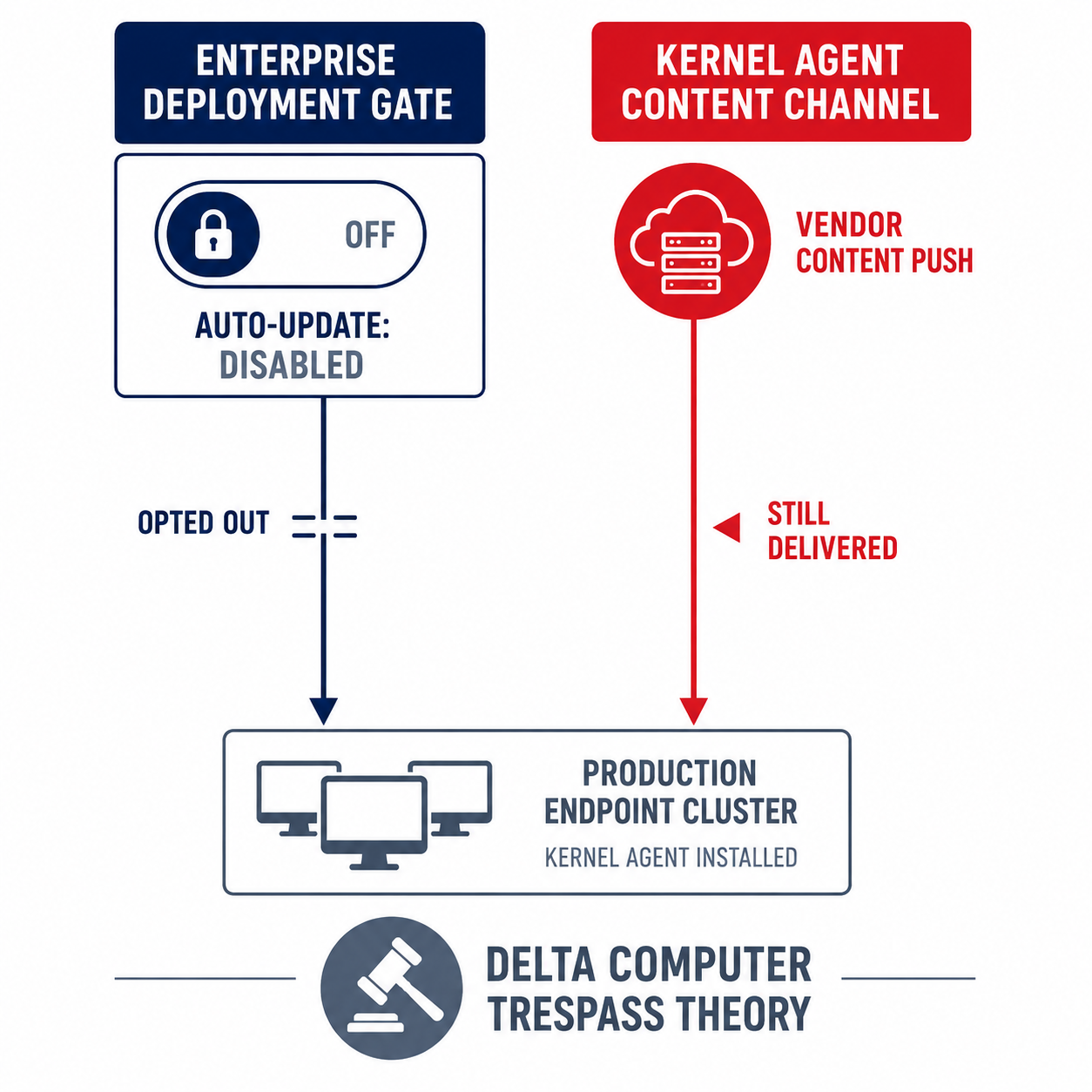
In May 2025, a court allowed Delta Air Lines' "computer trespass" claim against CrowdStrike to proceed alongside the negligence count. The theory: Delta had configured its systems to opt out of automatic updates. CrowdStrike's kernel agent still delivered the channel file because Delta's opt-out didn't reach the content-delivery mechanism. The update was forced through a layer the enterprise believed it had configured away.
The liability framing matters beyond the Delta fact pattern. Any enterprise running a kernel-mode endpoint agent with vendor-controlled content delivery faces the same architecture question: does the enterprise's staging configuration actually prevent a forced content push, or does the kernel agent deliver content independently of the deployment gate? The Delta ruling indicates courts are prepared to treat that gap as actionable harm.
CrowdStrike is arguing its software subscription agreement caps Delta's $500M claim at single-digit millions. The EU Product Liability Directive, effective 2026, prohibits vendors from contractually excluding liability for software defects. The two legal frameworks assume opposite positions about who bears the risk — and enterprises with EU exposure need to know which one their current contracts were written for.
The Regulatory Timelines Already Running
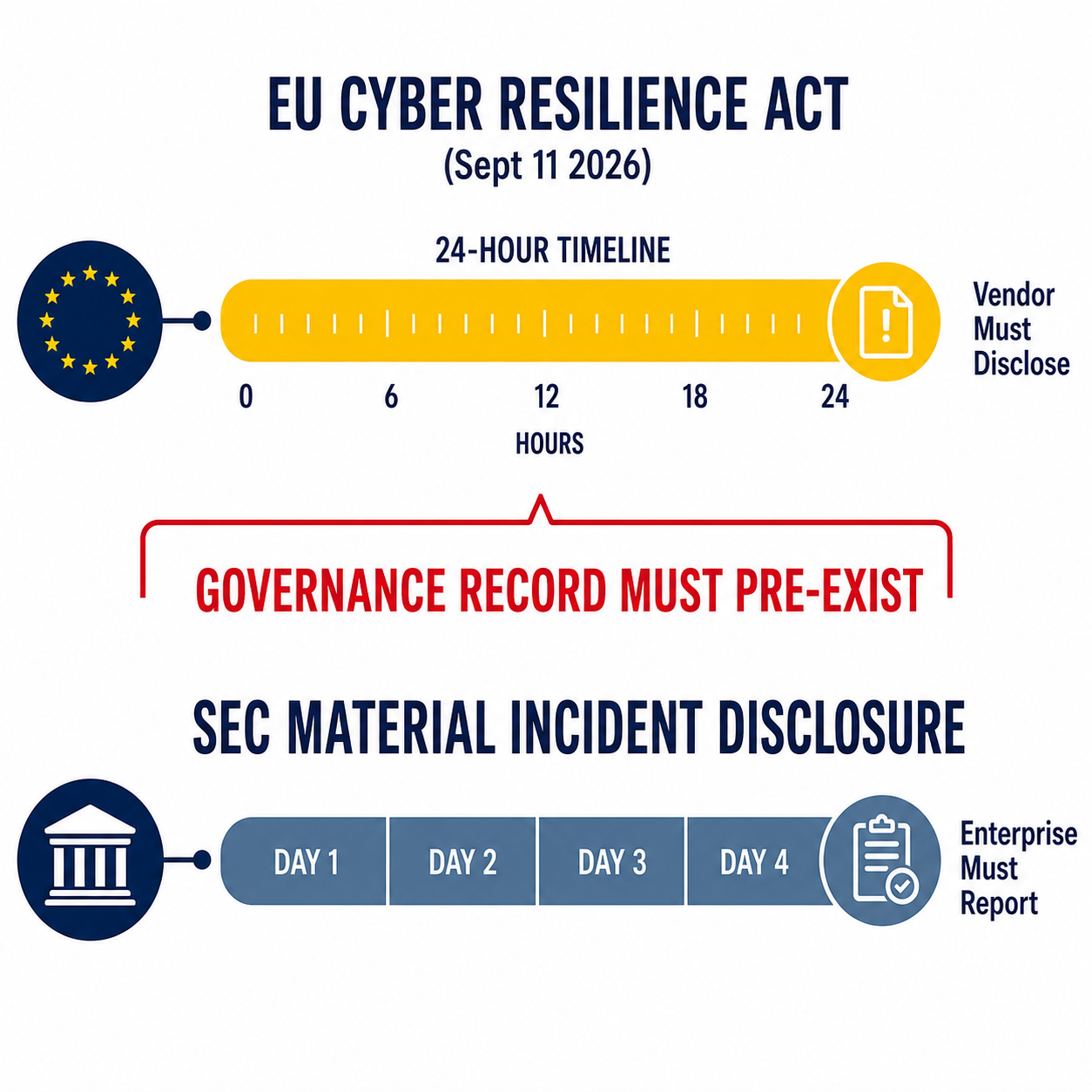
The EU Cyber Resilience Act requires vendors placing software with digital elements on the EU market to begin mandatory vulnerability reporting on September 11, 2026, with a 24-hour initial disclosure requirement. This creates a practical conflict with staged-rollout governance: the vendor's CRA disclosure obligation runs faster than the window an enterprise needs for independent pre-deployment validation. The staging gate the enterprise wants to run takes longer than the regulatory clock the vendor is subject to.
On the enterprise side, the SEC's cybersecurity disclosure rules require a four-business-day report for material incidents. For a public company, the documented governance trail — what was evaluated before deployment, what the analysis concluded, what decision was made — isn't just internal process hygiene. It's a disclosure artifact that needs to exist before the incident, not after.
IANS Research's March 2026 data found that only 29% of board directors consider CISO cybersecurity reports "very effective." The gap usually isn't about technical competence; it's about the absence of a structured framework that translates software update deployment risk into quantified terms the board can act on. CISOs have been asked, since July 2024, whether the CrowdStrike scenario could happen to their organization. Most don't yet have the tooling to answer that question with rigor.
The Missing Layer in Every Enterprise's Update Stack
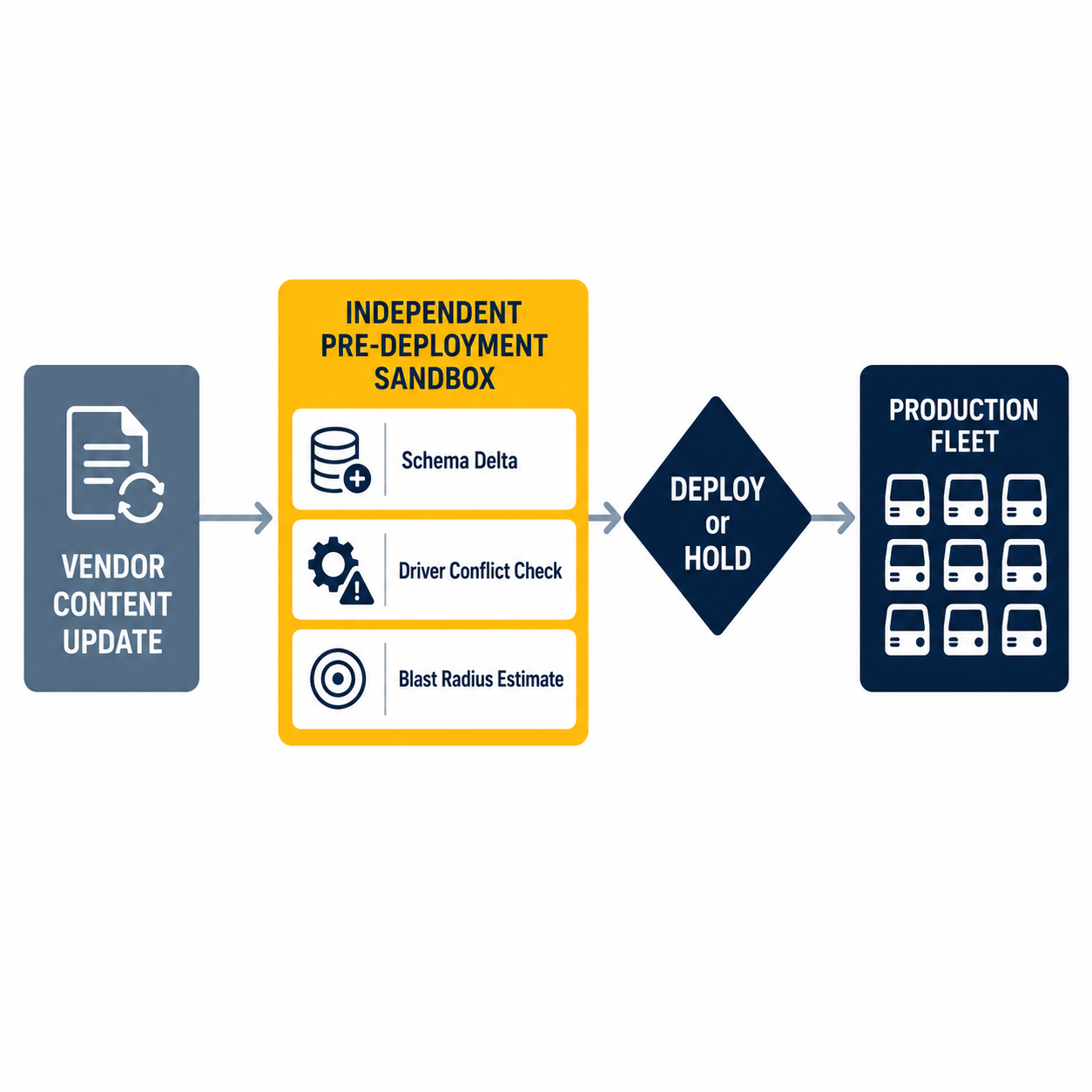
The architecture in Veriprajna's Software Update Deployment Integrity & IT Resilience solution starts from a different premise than the current industry response: vendor content updates are changes, and the change management process covers them regardless of vendor category exemptions.
Practically, that means the ITSM change record exists for every vendor push — not to add paperwork, but to give the enterprise a trace between any endpoint event and a specific update, across any agent, with timestamps. The pre-deployment step is what's currently missing almost everywhere: an isolated sandbox that mirrors the production kernel configuration, runs the update before it reaches any production endpoint, and produces a structured report on the content delta between the previous and current versions, any driver dependency conflicts, and a blast radius estimate. "Stage your rollout in phases" is the standard advice; that advice assumes the content is known-good and manages exposure if it isn't. Pre-deployment sandbox analysis is what decides whether to stage it at all.
Running this process consistently produces the board reporting artifact as a byproduct — a documented risk position on update deployment that supports both SEC disclosure timelines and EU CRA compliance. Building it retroactively after an incident is significantly harder than having it in place.
Microsoft's Windows Resiliency Initiative is moving endpoint security products out of kernel space and into user mode over 2026 and 2027. That transition reduces catastrophic-crash risk at the architecture level over a multi-year window. It doesn't address the independent verification question during the transition, and user-mode agents will still push vendor-controlled content updates once the migration completes.
The field is converging on the answer that other supply chain risk categories arrived at earlier: an independent inspection layer that the enterprise controls. If your organization is working through what that architecture looks like — the ITSM integration, the pre-deployment sandbox configuration, the board-reporting framework — we'd be glad to share how the approach at veriprajna.com/solutions/software-update-integrity has developed across different fleet configurations. More than the architecture itself, the contract renegotiation question is where most organizations we speak with are least prepared: the EU Product Liability timeline gives a concrete deadline, and the Delta precedent gives the leverage. The harder question is whether the governance infrastructure is in place to support a defensible position when the next event happens.
That's the question we'd encourage every CISO to answer before the next channel file ships.