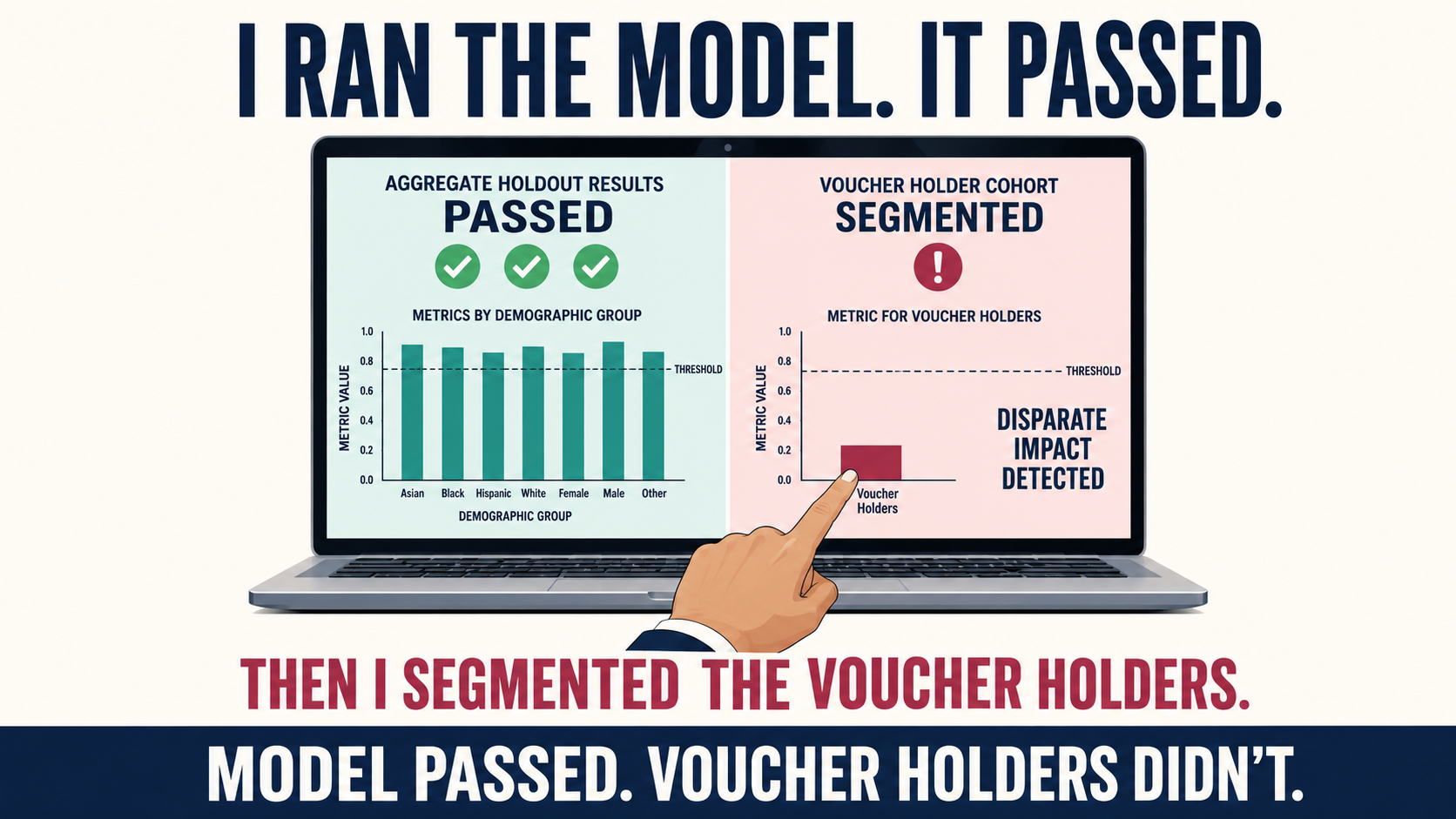
I was running a pre-deployment audit on a tenant screening algorithm. Aggregate accuracy metrics looked reasonable. The holdout test passed the four-fifths rule when I looked at the entire applicant pool — no protected group's approval rate falling below 80% of the highest group. And then a team member asked whether we'd segmented the voucher holders separately.
We hadn't. When we did, the disparate impact was immediately visible.
The algorithm weighted credit history heavily. Voucher holders have credit profiles that reflect decades of exclusion from traditional lending — the guaranteed income stream a voucher provides doesn't appear as a factor, but the median FICO gap between white households (727) and Black households (627, per CFPB data) does. The model was doing its job correctly. The job it was given produced a discriminatory outcome anyway. That's exactly what the court found in Louis et al. v. SafeRent Solutions — leading to a $2.275M settlement and a five-year injunction — and it's what SafeRent's "neutral vendor" defense couldn't answer. If a landlord relies primarily on your algorithm, you share Fair Housing Act liability for what that algorithm produces.
That moment in the audit changed the sequencing of how I approach pre-deployment screening evaluation. But it also introduced a question that took me longer to answer: what does the winning compliance architecture actually look like for the full stack — not just screening, but the pricing engine running alongside it?
What the Voucher Holder Test Shows You
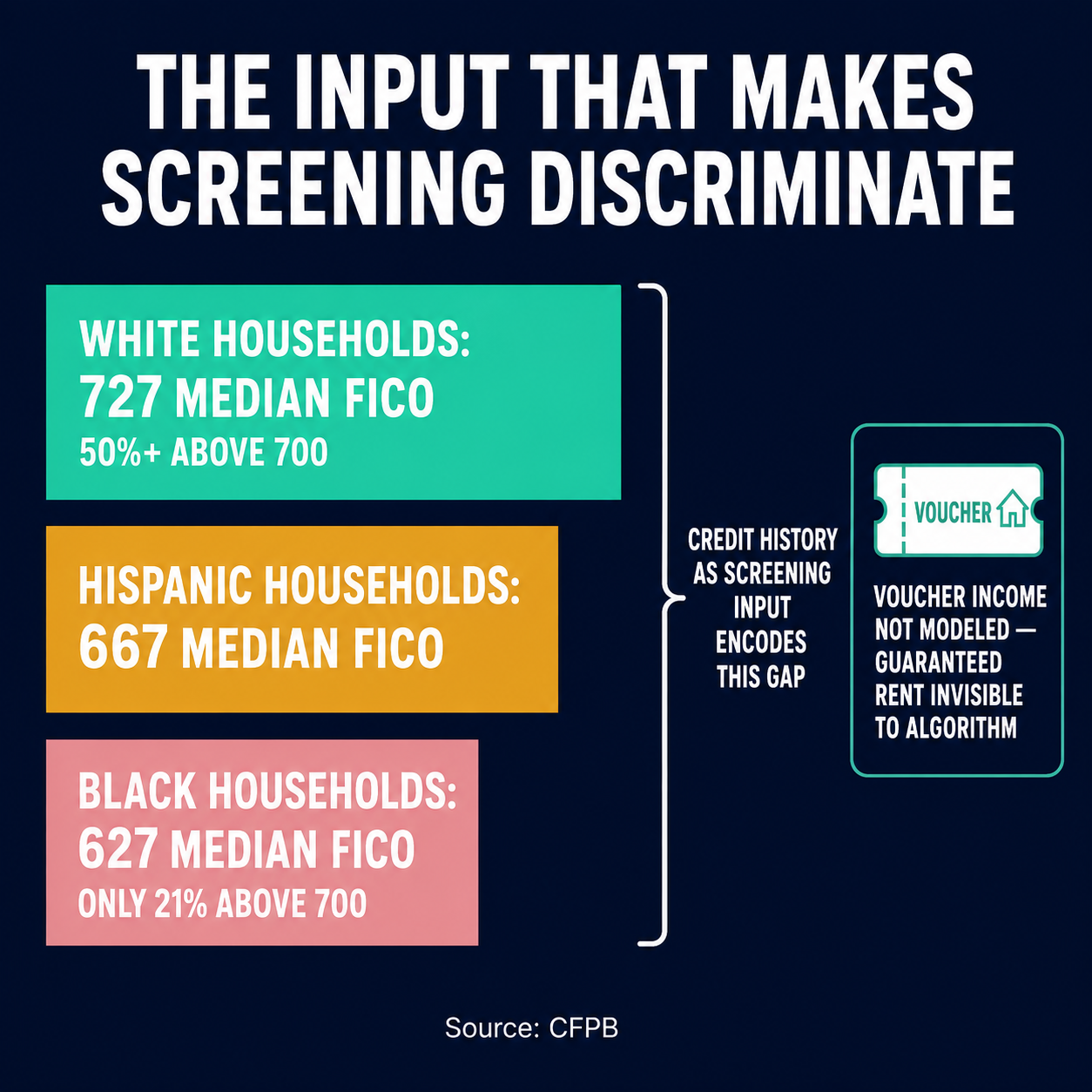
I've explained the voucher holder segmentation problem to property management teams many times, and the confusion is usually the same. The algorithm doesn't know anyone is a voucher holder. It sees credit scores.
That's the failure mode. Over half of white households score above 700; only 21% of Black households do (CFPB data). When a credit-heavy screening model is applied to applicants whose rent is guaranteed by a government subsidy, the model isn't predicting default risk for that subgroup — it's encoding a structural history of credit access into an approval decision.
The LDA search is the engineering answer: enumerate every model that achieves the same accuracy threshold as the production model, map the performance-fairness Pareto frontier, and identify the one that minimizes disparate impact without sacrificing predictive validity. This is an integer programming problem — the feasible model set is finite and enumerable with tools like CPLEX or Gurobi. The CFPB has asked explicitly for "regular testing for disparate impact, including searches for least discriminatory alternatives" in lending contexts. Housing is where that expectation lands next, and I don't think it arrives softly — the SafeRent ruling shows courts are willing to find liability in outcomes without requiring intent.
The four-fifths rule doesn't fail at model evaluation. It fails in live deployment, when someone counts the approval rates by cohort after the algorithm has been running for six months.
The GC Running Two Outside Counsel for One Algorithm Stack
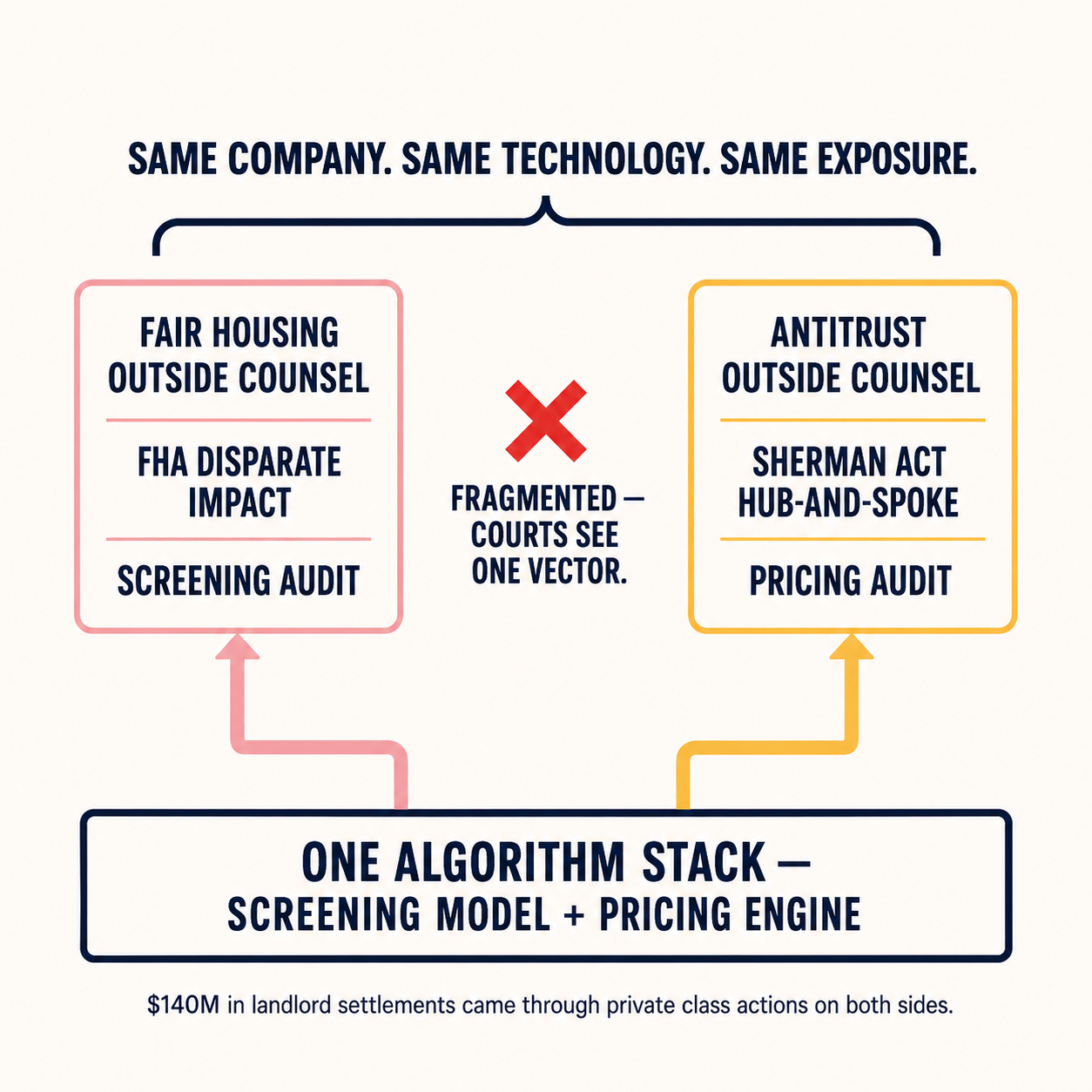
Early in building Veriprajna's housing compliance work, I was briefing a property management company's general counsel. They were using SafeRent for tenant screening and RealPage for revenue management. Two separate outside counsel — one antitrust, one fair housing. Two separate compliance audits, two separate tracks, two separate budgets.
I asked whether anyone had mapped the interaction between the DOJ's hub-and-spoke theory on the pricing side and the Fair Housing Act's disparate impact theory on the screening side. There was a pause. They were being treated as completely separate legal problems.
When I explained the RealPage mechanism — that AIRM defaulted to automatically accepting pricing recommendations within 3% daily and 8% weekly change, that most landlords never adjusted those settings, and that what looked like independent pricing decisions were algorithmic recommendations based on non-public data from competing properties — the general framing from the legal team was that the pricing exposure was the vendor's problem to manage. The SafeRent ruling had already established it isn't.
The thing is, courts and regulators treat them as one company with two vectors. The $140 million in landlord class action settlements that closed through 2025 came from both sides of that stack — Greystar ($50M), BH Management ($15M), Simpson Property Group ($6.5M), FPI Management ($2.8M for Yardi's algorithmic pricing) — and these came through private class actions, not government enforcement. Tenants and their attorneys noticed the patterns. The antitrust and fair housing theories are converging on the same technology because algorithmic decision-making at scale produces outcomes that are measurable, and measurements that fail legal tests become litigation.
What I kept coming back to was that the architecture question was the same for both: can the system demonstrate, not just assert, that it's doing the right thing?
What Yardi's Brief Changed About How I Think
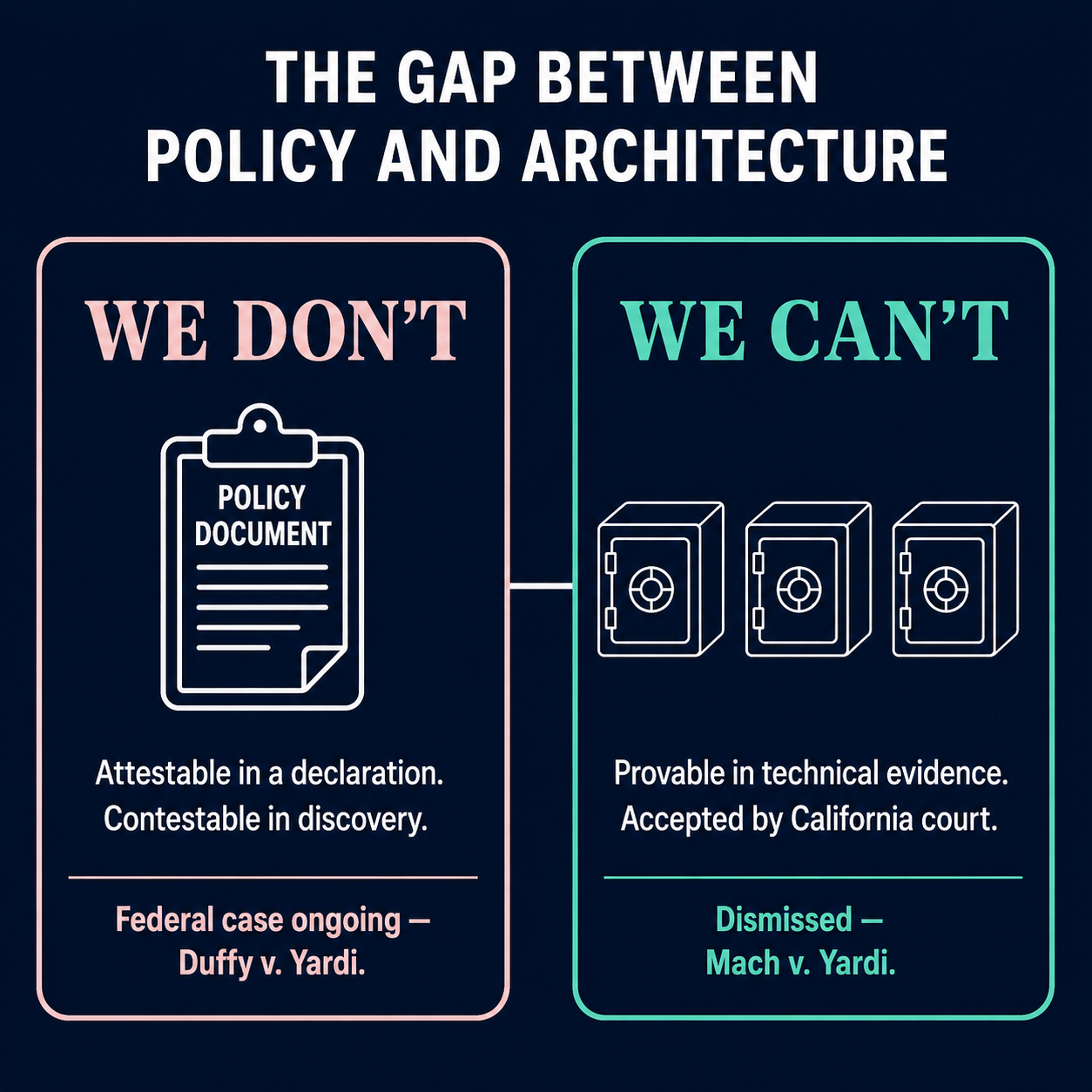
I read the California dismissal in Mach v. Yardi closely. Yardi's winning showing was that Revenue IQ "does not and by design cannot use any client's confidential pricing information for any other client."
I kept returning to "cannot." Every compliance policy document I'd seen in this space said "we don't." Policy. Attestation. Assertion. Yardi said "can't." An architectural constraint. Something that could be shown in discovery, not just stated in a declaration.
The contrast between that outcome and the ongoing federal case (Duffy v. Yardi, which survived a motion to dismiss) is the gap between a compliance proof and a compliance policy. The federal case is still active partly because that same architecture showing wasn't available on the same terms there. Same defendant, same product, different evidentiary basis — different outcomes so far.
When I design data isolation architecture for a pricing system now — a clean-room approach where each client's non-public pricing data is provably walled off from every other client's training and runtime pathways — I think of it as producing the "cannot" rather than the "don't." That's the difference Yardi's California outcome made concrete for me.
The Regulatory Combination Everyone Keeps Asking About
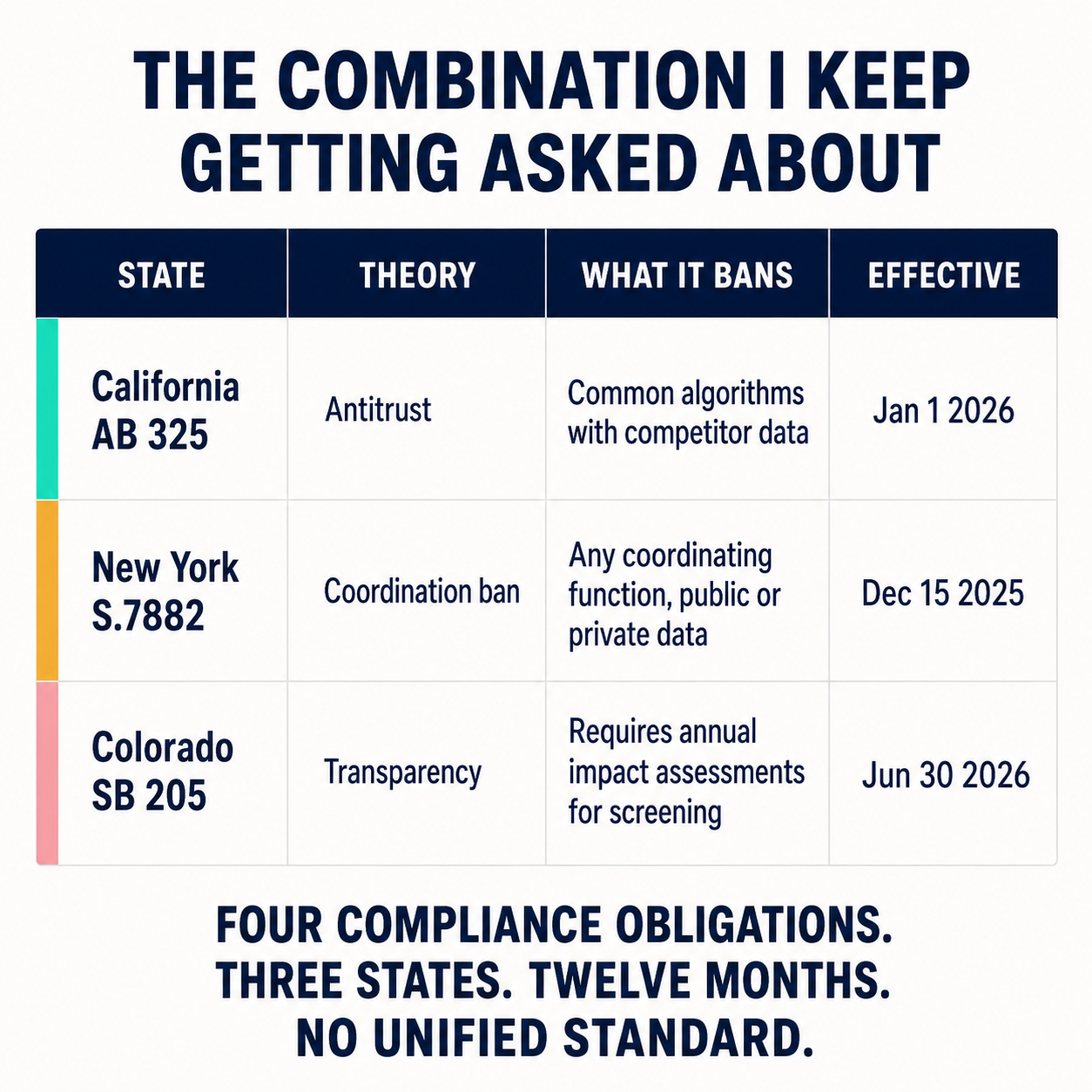
Property managers running operations across California, New York, and Colorado ask me about the state law combination more than anything else right now, so I'll walk through it briefly.
I find California's AB 325 (effective January 1, 2026) the most architecturally interesting of the three. It bans pricing algorithms used by two or more parties that incorporate competitor data — which creates a market incentive toward single-tenant deployments rather than just prohibiting specific practices. What I tell clients is: if your pricing vendor serves multiple competing landlords and its training or runtime pipeline uses anything from those competing clients, you're in the statute's scope. Bespoke, per-client pricing architecture is the lower-risk path not because the law requires it by name, but because the multi-tenant structure itself is the source of the antitrust exposure.
New York's S.7882, effective December 15, 2025, is the broadest of the three — a blanket ban on residential pricing tools with any "coordinating function" regardless of whether the data is public or private. The enforcement is stayed pending RealPage's First Amendment challenge, but the private right of action under the amended Donnelly Act doesn't require government initiative. Colorado's SB 205 (effective June 30, 2026) hits the screening side specifically: annual AI impact assessments, adverse action disclosures naming how AI contributed to each rejection and what data categories were used.
What I find myself explaining repeatedly is that each of these laws has a different legal theory — antitrust, coordination ban, transparency mandate — but the compliance answer points toward the same architecture in every case. Four distinct obligations from three states in twelve months, and none of them are waiting for federal law to catch up.
The Agentic Leasing Question I Don't Have a Full Answer to Yet
I don't have a complete answer for what compliant agentic leasing architecture looks like, and I'm skeptical of anyone who says they do. One autonomous leasing platform operating in roughly one out of every twelve U.S. multifamily units claims a 65% reduction in lead-to-lease timelines — the technology works, and adoption is accelerating. Every decision that system makes — inquiry response quality, property routing, application pre-screening, lease term negotiation — is a potential Fair Housing Act touchpoint at the scale of every interaction it handles, not the scale of a single adverse-action decision caught in an audit.
The current fair housing compliance frameworks were built around human decision-making with algorithmic inputs. The FCRA adverse action requirements, HUD's disparate impact doctrine, the four-fifths rule — all of these assume a human in the loop at the point where the consequential decision happens. An agentic leasing system that handles the entire tenant journey without human review at each step doesn't fit cleanly into any of those frameworks.
I don't have a complete answer for what compliant agentic leasing architecture looks like. My instinct is that it looks more like the data isolation argument than like a policy document — that the answer will be architectural, demonstrating by design that the system cannot make certain categories of decisions without triggering review. But I'm still working through that question, and I'd be genuinely interested in the perspective of anyone else who's thought seriously about it.
The solution page at Veriprajna covers the existing frameworks — screening fairness, pricing antitrust, the regulatory map. The agentic piece is the question at the edge of what those frameworks currently address.