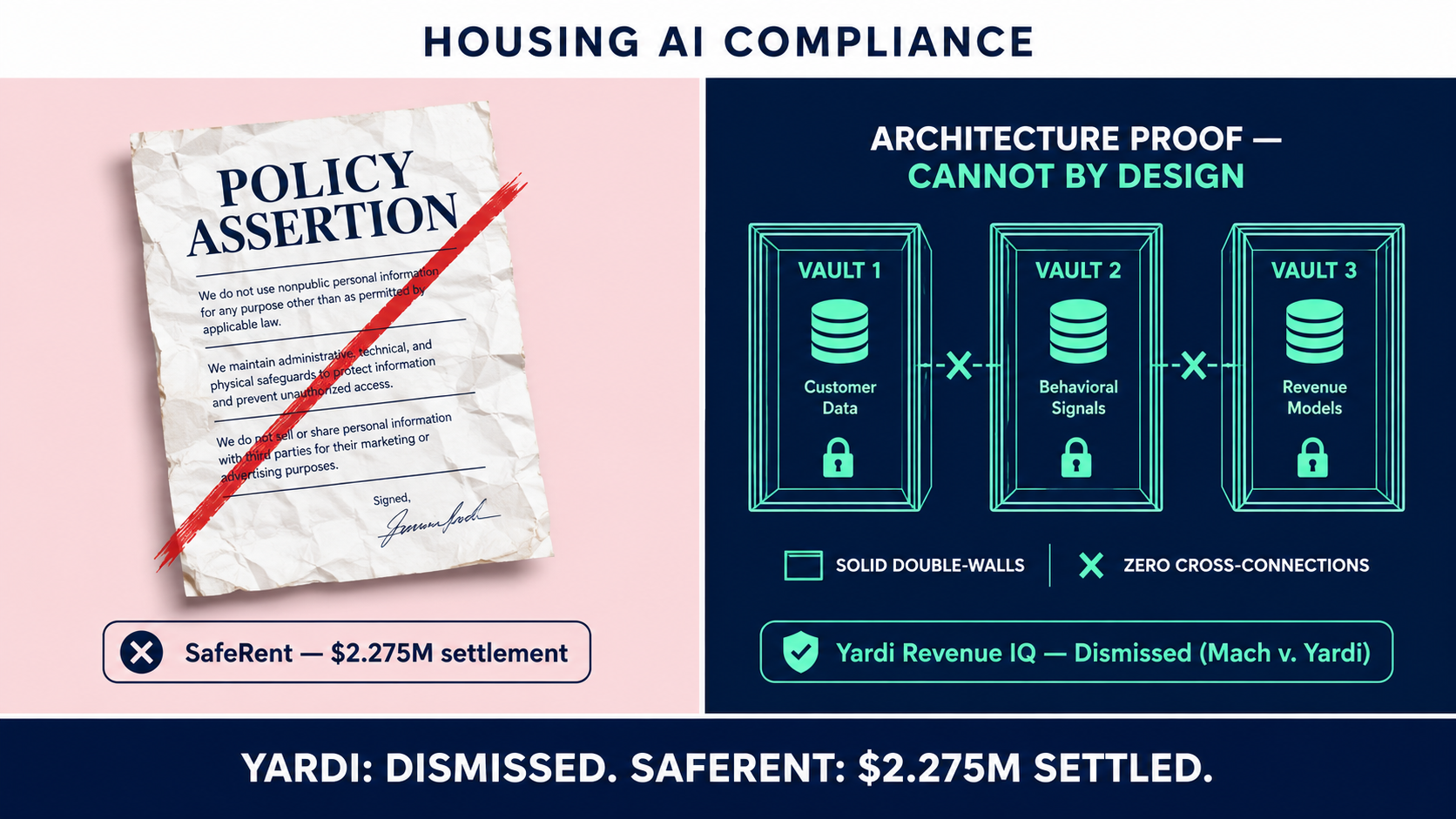
Property managers generally treat tenant screening compliance and pricing compliance as two separate legal problems. Courts and regulators do not. The $140 million in landlord class action settlements that closed in 2025 came from two distinct legal theories applied to the same algorithmic technology stack — Fair Housing Act disparate impact on the screening side, Sherman Act hub-and-spoke coordination on the pricing side. Same company, same compliance department, two exposure vectors that every governance platform on the market currently treats as separate product lines.
We mapped both at Veriprajna's Housing AI Compliance page, and the architecture question that underlies both turns out to be the same question.
The Four-Fifths Rule Fires Silently
Tenant screening algorithms are evaluated for discriminatory impact using the four-fifths rule: if any protected group's approval rate falls below 80% of the highest-approval group, the model has a presumptive Fair Housing Act violation. The SafeRent Registry ScorePLUS algorithm failed this test not because it was programmed to discriminate but because it weighted credit history heavily for voucher holders — applicants who carry guaranteed rent income but whose credit profiles reflect decades of lending discrimination.
The court in Louis et al. v. SafeRent Solutions rejected SafeRent's "neutral vendor" defense. If a landlord relies primarily on a third-party algorithm, the algorithm provider shares Fair Housing Act liability for discriminatory outcomes. SafeRent settled for $2.275M, accepted a five-year injunction requiring independent civil rights expert validation before any automated approve/decline on voucher holders, and mailed payments to the class through mid-2025.
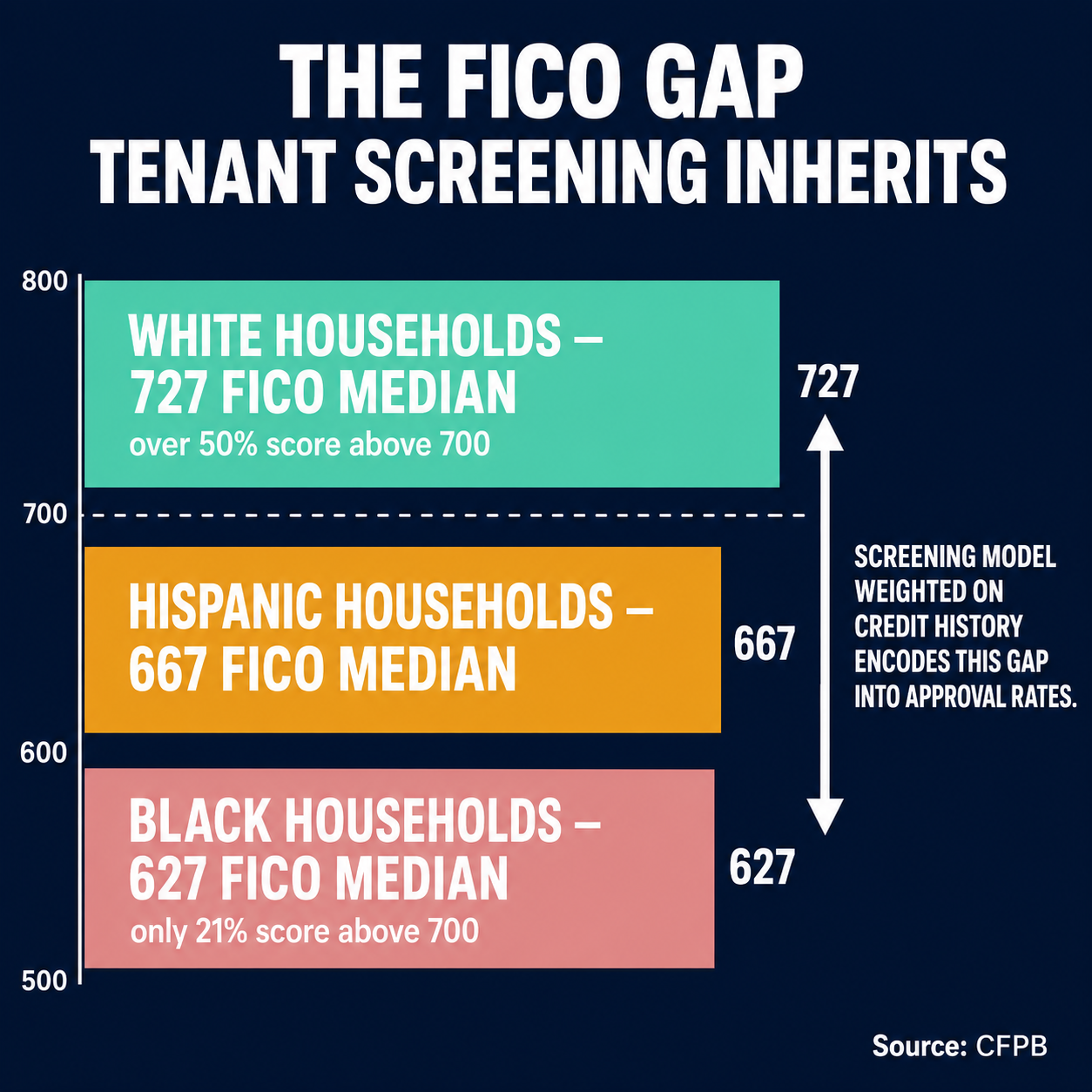
The mechanism was straightforward once the data was in front of a judge. Median FICO scores run 727 for white households, 667 for Hispanic households, and 627 for Black households (CFPB data). When the model used credit score as a primary feature for applicants whose income was already guaranteed by a subsidy voucher, it encoded those FICO disparities into approval rates without anyone in the design loop choosing to do that.
The four-fifths rule doesn't fire in aggregate model evaluation on holdout data. It fires in live deployment when someone counts the approval rates by population cohort.
The operational defense is LDA search run before deployment: enumerate every model that achieves the same accuracy threshold as the production model, map the performance-fairness Pareto frontier, and identify the one that minimizes disparate impact without sacrificing predictive validity. This is an integer programming problem — CPLEX or Gurobi can exhaustively search the feasible model set. The CFPB has said it expects "regular testing for disparate impact, including searches for least discriminatory alternatives." That expectation has been standard in fair lending for years. Housing is where it lands next.
How Auto-Accept Became the Center of the DOJ's Theory
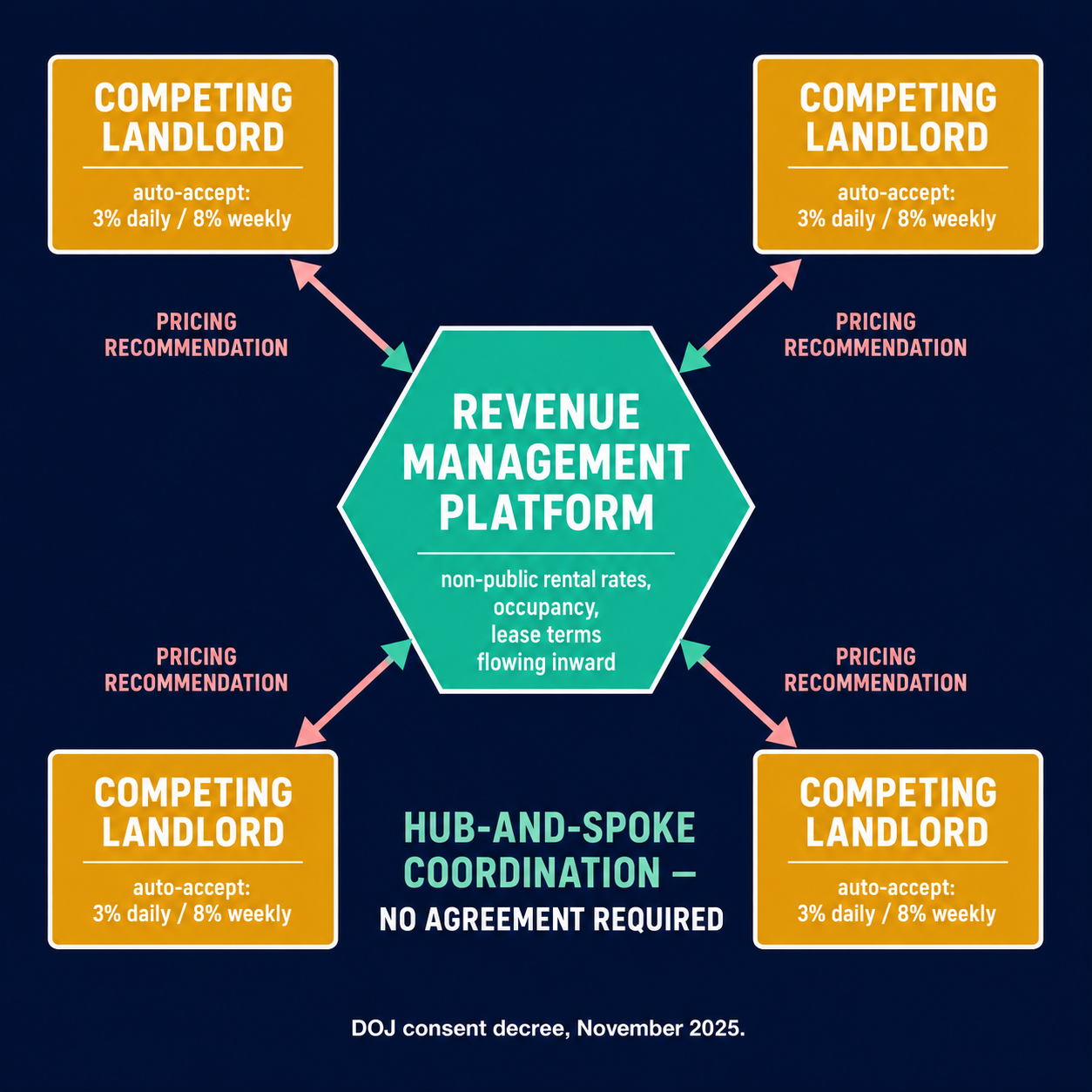
The antitrust case against RealPage turned less on the pricing algorithm itself and more on its default configuration. AIRM automatically accepted pricing recommendations within a 3% daily change and 8% weekly change. Most landlords never adjusted these settings. What appeared to be independent landlord pricing decisions were algorithmic recommendations based on non-public rental rates, lease terms, and occupancy statistics collected from competing properties — none of which the landlords would have shared with each other directly.
The DOJ's theory was hub-and-spoke: RealPage was the coordinating hub, and each participating landlord was a spoke, sharing non-public competitive data through the platform. No meeting, no call, no explicit agreement — just an algorithm with access to everyone's pricing data generating recommendations that moved prices across competing properties in the same direction.
The November 2025 consent decree required architectural changes, not just policy changes: model training restricted to data at least 12 months old, no runtime access to non-public competitor statistics, governor features with symmetric floors and ceilings, auto-accept functions requiring user-configured parameters before activating. Seven-year compliance term, 180-day implementation window. The landlords who were using RealPage during the relevant period separately paid more than $140 million in class action settlements — Greystar ($50M), BH Management ($15M), Simpson Property Group ($6.5M), FPI Management ($2.8M for using Yardi's algorithmic pricing in a separate proceeding). These came through private class actions, not government enforcement.
Why Yardi's Win Is the Most Instructive Data Point
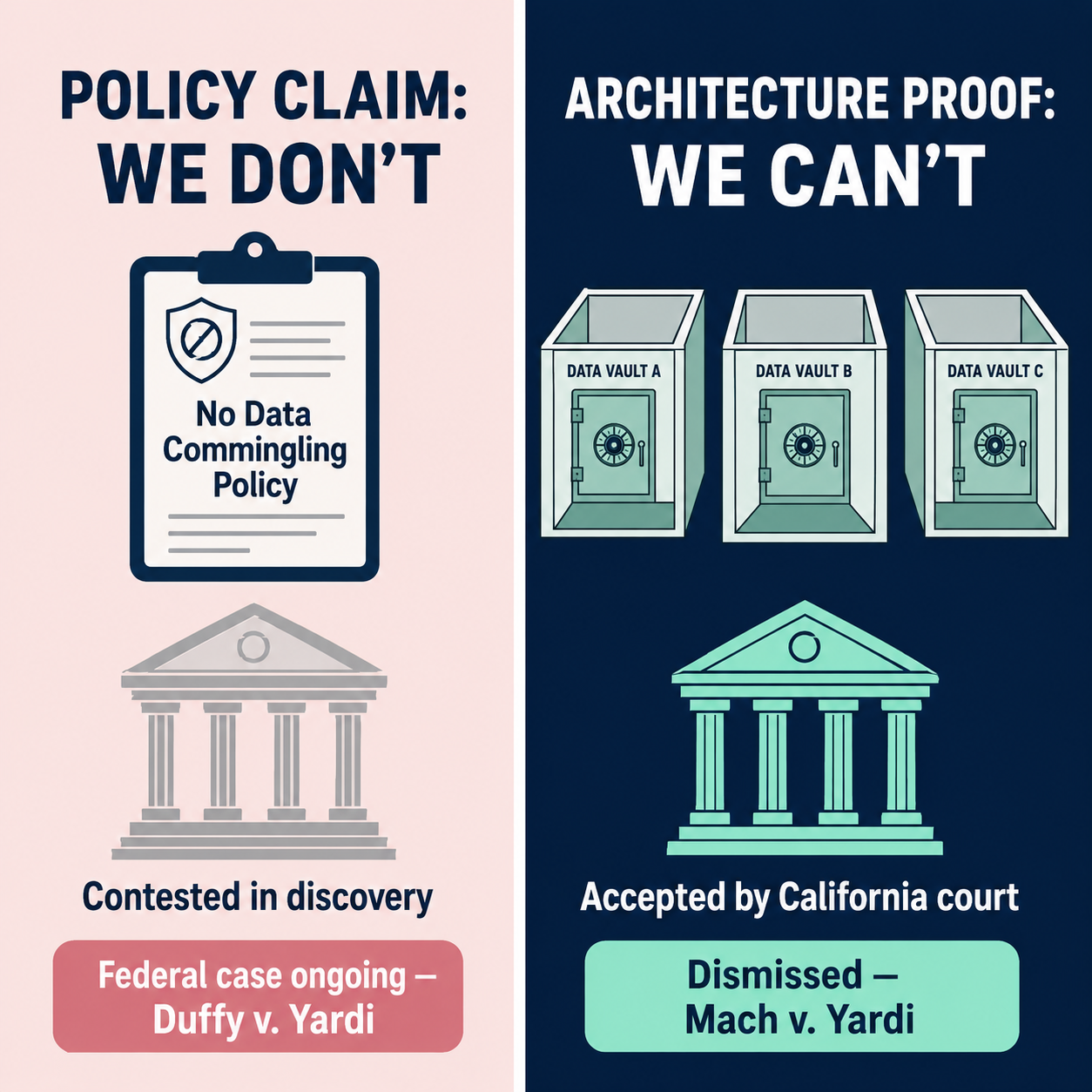
Yardi faced antitrust litigation over Revenue IQ in both California state court and federal court. The California case was dismissed on summary judgment. The federal case (Duffy v. Yardi) survived a motion to dismiss and remains active.
The California dismissal turned on one specific showing: Yardi demonstrated that Revenue IQ "does not and by design cannot use any client's confidential pricing information for any other client." The court accepted that as sufficient to defeat the plaintiff's theory. That's not a policy assertion. That's an architecture claim backed by technical evidence — the system cannot commingle data even if someone wanted it to.
The California court accepted Yardi's architecture argument. The federal case is still alive because that argument wasn't available on the same terms there. The gap between the two outcomes is the gap between a compliance policy and a compliance proof.
The federal case is still alive partly because that same showing wasn't available on the same terms in that proceeding. The contrast between the two outcomes tells you exactly what the compliance question is: can the system's design demonstrate isolation by construction, or does the company rely on policy assertions a plaintiff can contest?
Data isolation architecture — a clean-room design where each client's non-public pricing data is provably walled off from every other client's training and runtime pathways — is the engineering answer to the DOJ's core concern. It's also the defense that has actually worked in court.
The Regulatory Surface That Grew by Four Laws in Twelve Months
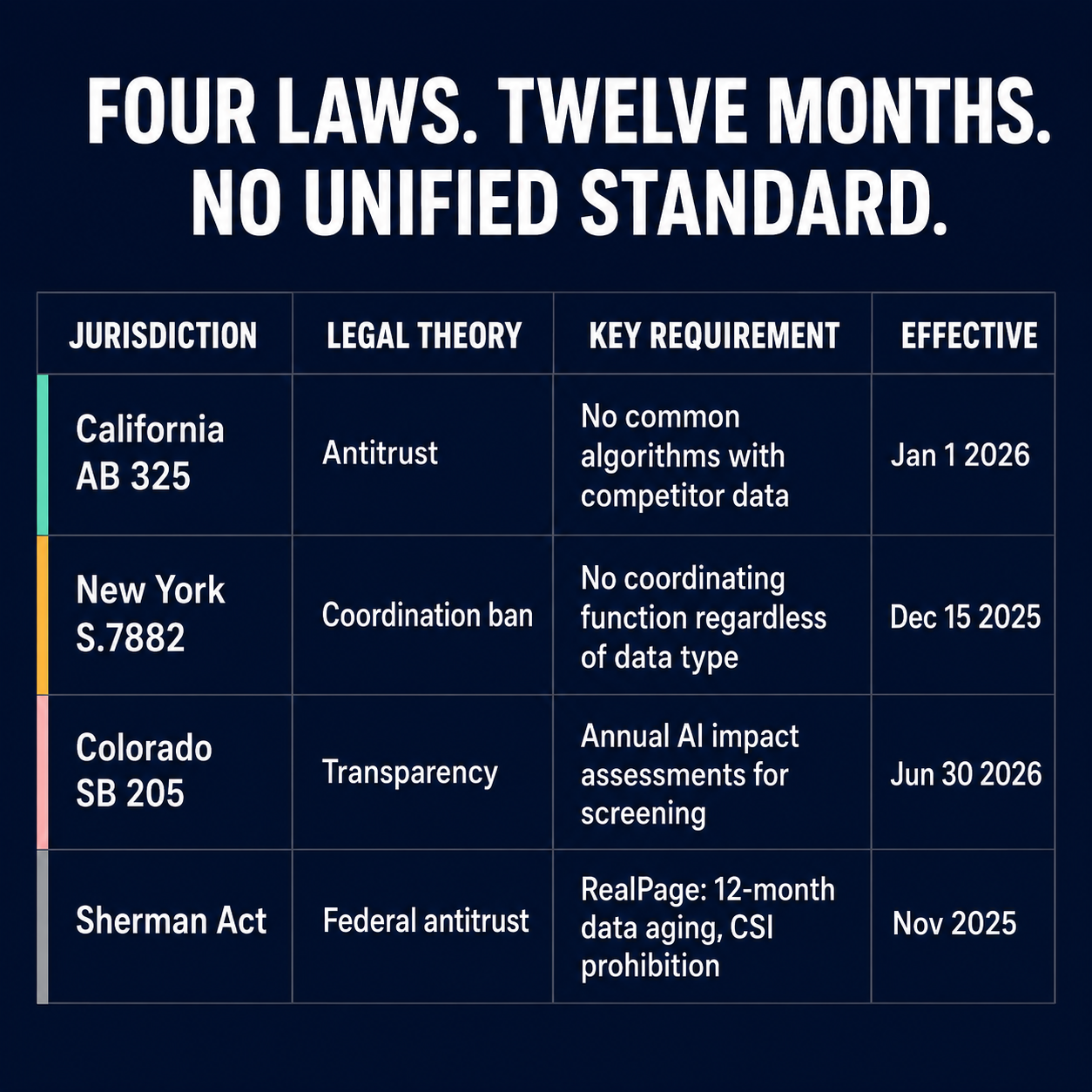
California's AB 325 (effective January 1, 2026) amends the Cartwright Act to prohibit pricing algorithms used by two or more parties that incorporate competitor data to influence prices. The statute applies only to tools with two or more users — a condition that creates a direct incentive toward bespoke single-tenant architectures, where each landlord's data pipeline is provably isolated from every other client on the platform. That incentive is also California's implicit answer to the data isolation question the DOJ raised federally: a pricing system that can only serve one client at a time cannot, by design, pool non-public competitor data.
New York's S.7882, effective December 15, 2025, goes further: a blanket ban on residential pricing tools with any "coordinating function," regardless of whether the data used is public or non-public. RealPage is challenging it on First Amendment grounds and enforcement is stayed pending a preliminary injunction ruling. But the private right of action it created under the amended Donnelly Act doesn't require government initiative — tenant plaintiffs can sue independently.
On the screening side specifically, Colorado's SB 205 (effective June 30, 2026) classifies tenant screening as a "consequential decision" requiring annual AI impact assessments. Each assessment must describe how AI contributed to an adverse decision, what data categories were used, and what appeal pathways exist for the applicant. It's a different legal theory from California's antitrust prohibition and New York's coordination ban — a transparency requirement rooted in consumer protection — but it hits the same algorithmic infrastructure.
A property management company operating across all three states is now managing four distinct compliance frameworks that emerged within a twelve-month window — each with different legal theories, different enforcement mechanisms, and different technical requirements.
Where the Agentic Leasing Layer Makes This Harder
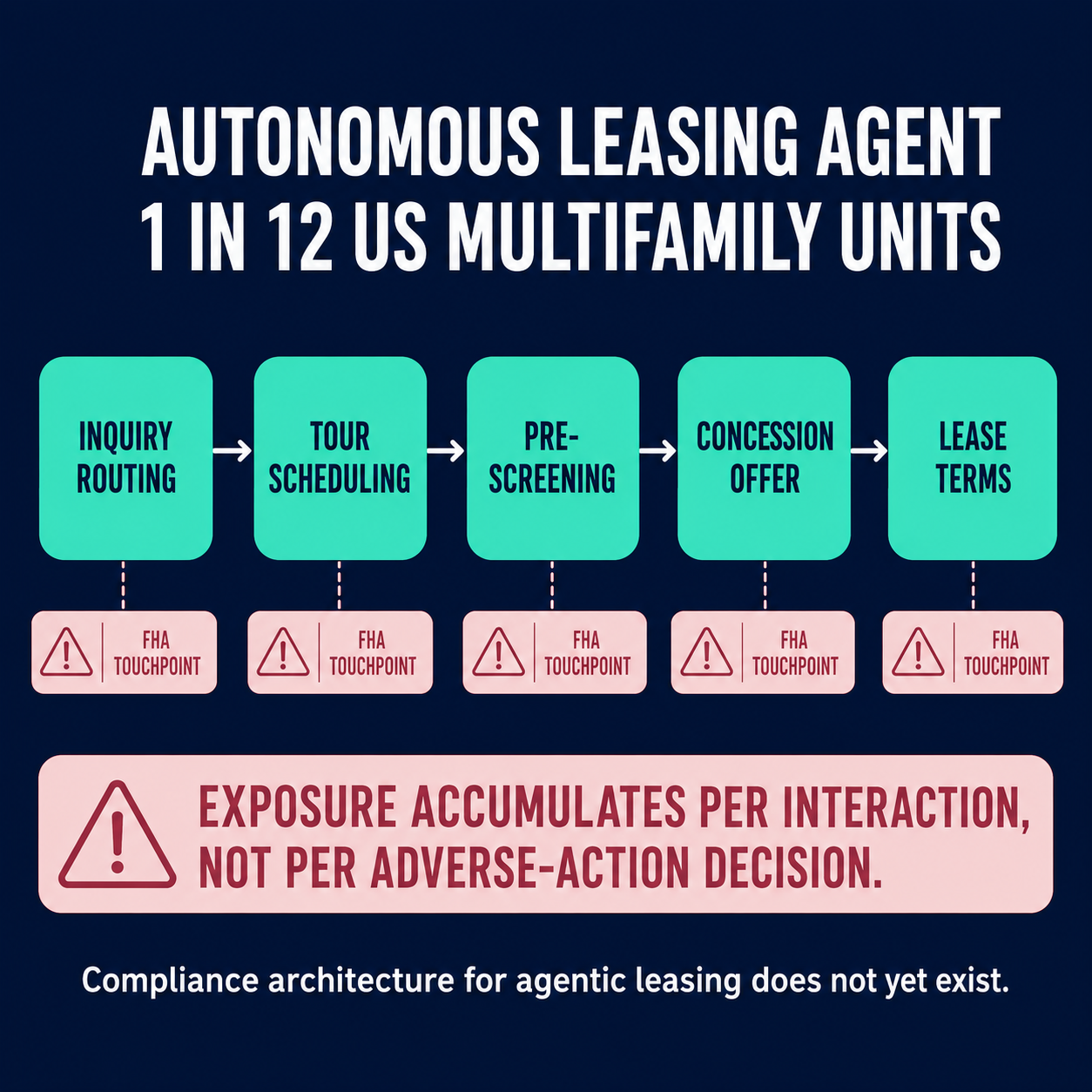
One autonomous leasing platform operating in roughly one out of every twelve U.S. multifamily units reported a 65% reduction in lead-to-lease timelines. The technology works, which is why adoption is accelerating. But every decision an autonomous leasing agent makes — response quality, property steering, application routing, concession offers — is a potential Fair Housing Act touchpoint. At the scale these systems operate, compliance exposure doesn't accumulate per adverse-action decision. It accumulates per interaction, across the full tenant journey.
The compliance architecture for agentic leasing systems doesn't exist as a commercial product yet. The cases documenting where these systems create disparate impact won't arrive for another two to three years. The exposure is accumulating now.
What No Existing Platform Delivers
Credo AI, Holistic AI, and FairNow all offer AI governance tooling. IBM's AIF360 has seventy-plus fairness metrics. None of them are housing-specific, none map simultaneously to HUD guidance and antitrust compliance requirements, none offer LDA search as a deliverable, and none offer data-isolation verification as a technical artifact.
The compliance gap for housing AI isn't a shortage of frameworks. It's that the frameworks were built horizontally — for general-purpose enterprise AI governance — and the housing-specific requirements (the four-fifths rule for voucher holders, the DOJ's CSI prohibition, California's single-tenant incentive, Colorado's impact assessment template) don't fit cleanly into horizontal governance products.
We built the combined tenant screening fairness and algorithmic pricing compliance package at Veriprajna specifically because no existing vendor addresses both simultaneously — and property managers using both types of AI can't manage them as separate compliance problems when courts have already ruled that the technology provider shares liability for what the algorithm produces.
If your team is working through what "defensible" actually means in a Fair Housing Act proceeding or a DOJ investigation — not just auditable on paper, but defensible when opposing counsel has the architecture diagrams — we'd be interested in the conversation. The set of arguments that have held up in court is small, and it's more specific than most compliance frameworks suggest.