The score I refused to treat as a verdict
I watched a synthetic Chicago facial-recognition alert arrive with a FaceFirst raw vendor score of 0.83, then watched the deterministic policy gate BLOCK it before anyone could treat that number as permission to act. The probe was low-light and only 80 pixels across. The gallery image was a 15-year-old booking photo. After calibration, 0.83 became a match probability of 0.50, with an interval of [0.217, 0.783] and a 93% conformal prediction set containing both mate and no_mate.
I built that case, LP-0834, to make one uncomfortable gap visible. A score can look decisive while the evidence remains unresolved. It can also be irrelevant to the first question that matters: was the collection lawful? In this seeded synthetic scenario, no consent was on file, so the deterministic policy gate returned BLOCK under the demo's BIPA rule.
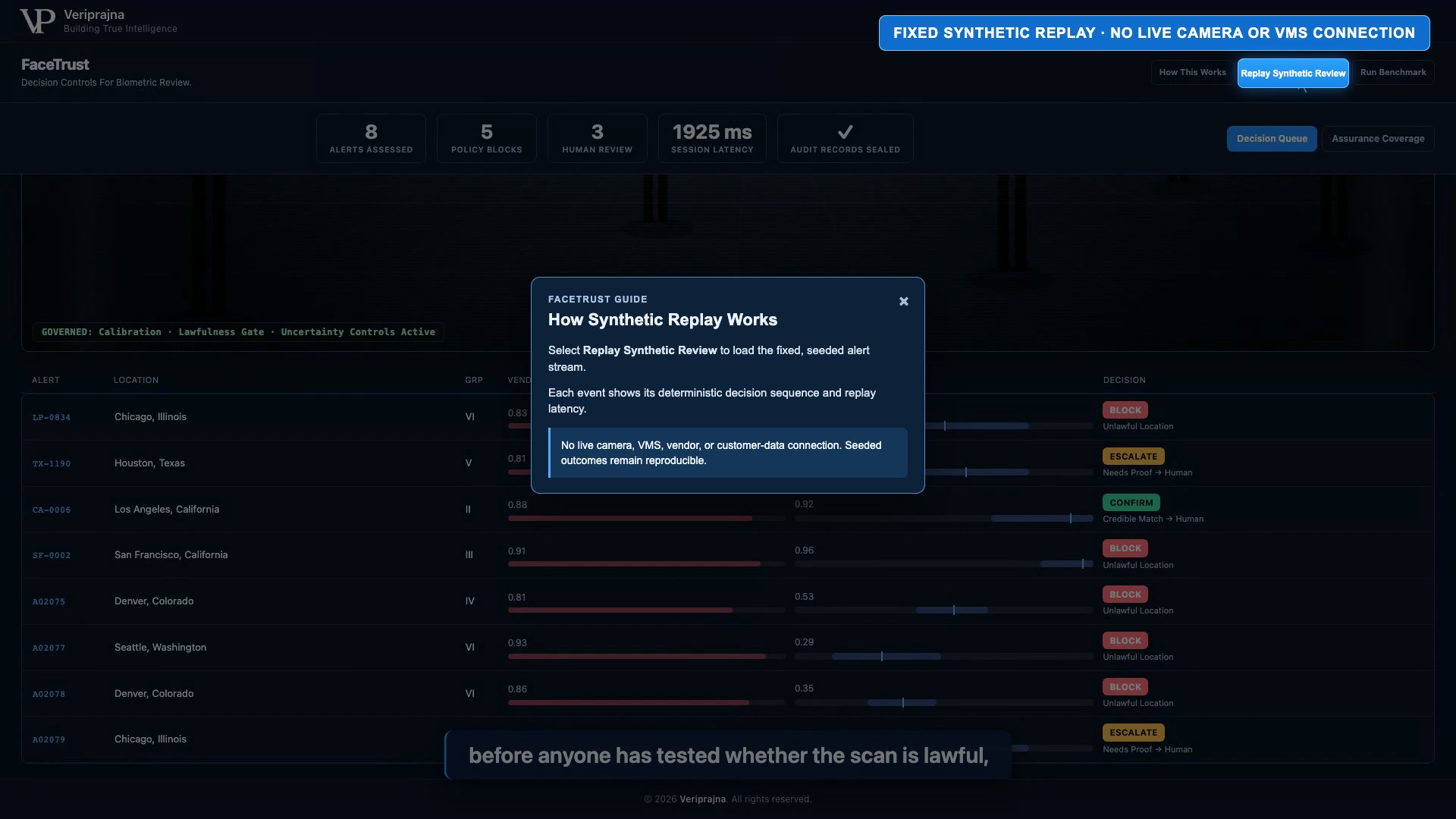
The guide puts the synthetic boundary on screen before the review begins: a seeded session keeps its outcomes reproducible.
I remember watching that seeded session populate the queue and realizing that a familiar interface habit had become dangerous. Scores naturally pull the eye from low to high. But the highest number on the screen is not necessarily the alert that deserves action. The synthetic San Francisco case makes the same point from another direction: its raw score is 0.91, yet the seeded jurisdiction table prohibits facial recognition there, so it is BLOCKED. Confidence cannot legalize a prohibited scan.
The screen where my explanation failed
I spent part of the build making the evidence dossier explain the score more clearly, and the clearer version still failed the test I actually cared about. It could tell me why the model leaned toward a match. It could not tell me whether the organization was entitled to collect and act on the faceprint.
I changed the order of operations around that failure. FaceTrust demonstrates the Biometric Decision Firewall: a vendor-agnostic control layer around facial-recognition alerts rather than another recognition model. A stubbed vendor adapter normalizes the raw alert. A local calibrator conditions on capture quality and group. Then deterministic controls check jurisdiction and consent, enforce a sub-72-pixel capture floor, and route on the calibrated 93% prediction-set outcome.
I kept the four routes deliberately narrow: BLOCK, SUPPRESS, ESCALATE, or CONFIRM. Even CONFIRM means a trained reviewer receives the case to action. It never authorizes an automatic confrontation, detention, or accusation. The Compliance Reviewer drafts a readable memo only after deterministic code has set the route; its explanation cannot rewrite the gate.
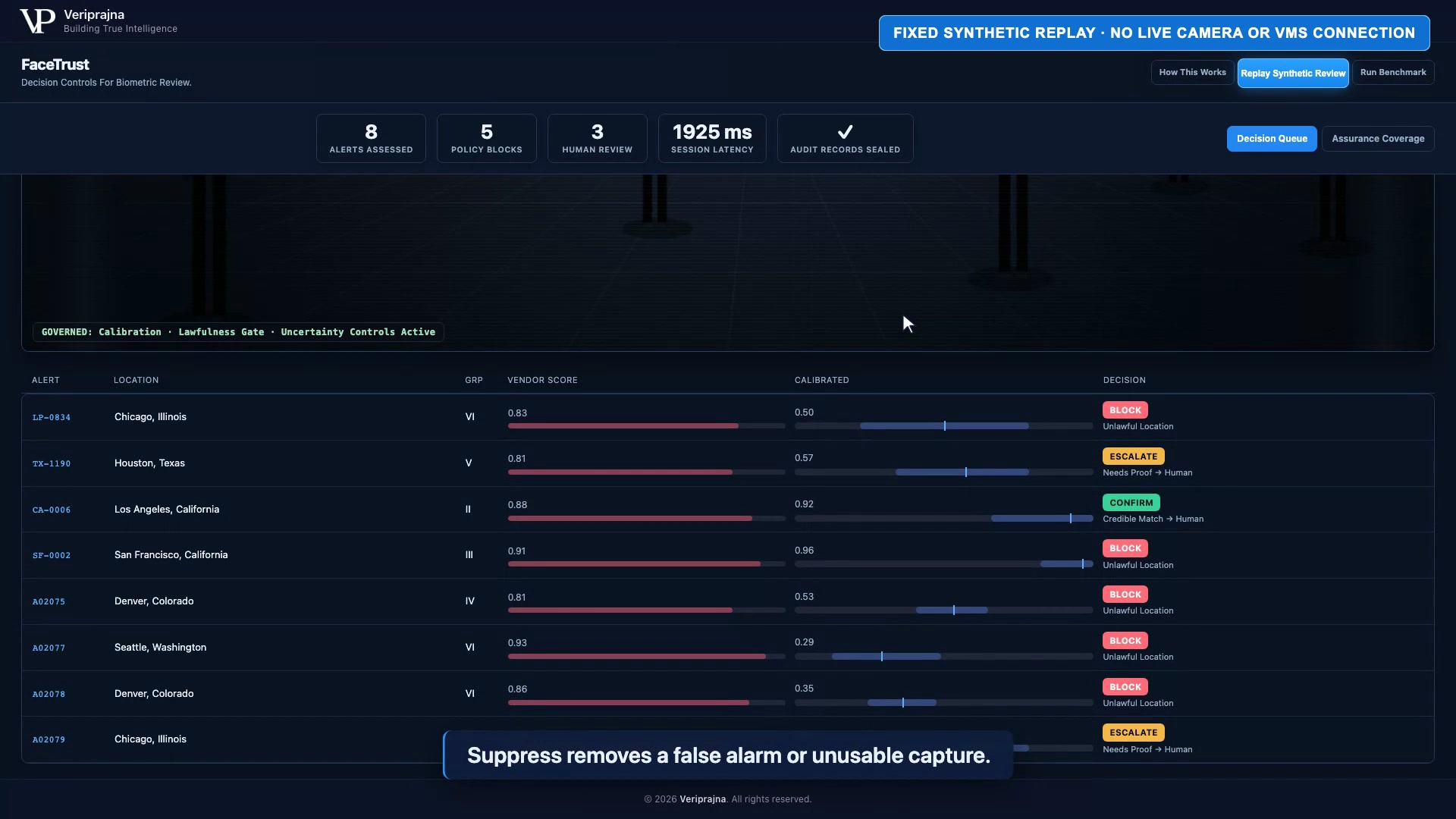
The Decision Guide fixes the meaning of all four routes, including the trained-reviewer boundary on ESCALATE and CONFIRM.
That separation changed how I read the word "review." Human review is weak if the reviewer inherits a high score stripped of capture quality, uncertainty, consent, and jurisdiction. I wanted the reviewer to receive a decision dossier with the facts required for judgment.
The average I would not let reassure me
I nearly summarized the calibration work with one aggregate coverage number. Then I opened the six-group view and saw why that would erase the useful part of the result. On the deterministic synthetic 3,000-alert held-out test set, the 93% nominal conformal sets reached minimum empirical coverage of 91.5% across the six evaluated Fitzpatrick groups. The raw baseline's minimum was 40.6%.
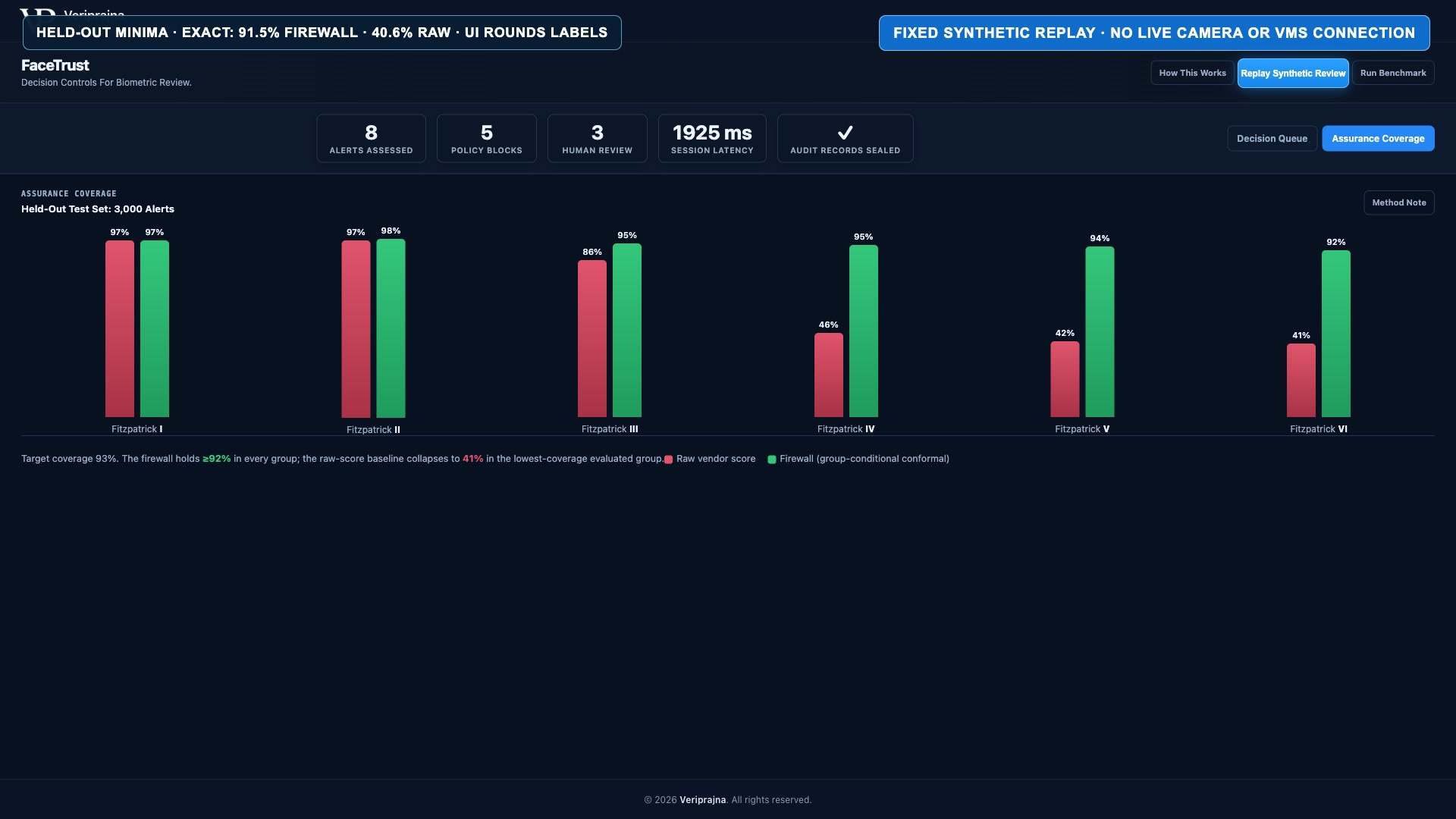
The six-group view keeps the weakest evaluated group in frame instead of hiding it inside one average.
I read this as a scope-limited diagnostic. The set is synthetic and seeded to model documented failure modes. Production calibration would require a client's adjudicated history. Still, the group floor tells me something the aggregate cannot: whether the uncertainty method is failing hardest where a single overall number might conceal it.
I also kept the cost of caution visible. Among 1,434 synthetic true-match alerts, a match remained in the firewall's prediction set 93.1% of the time, versus 99.3% for the raw-threshold baseline. Governance is not improved by quoting only the result that flatters the system. A reviewer needs to see what the control gains, what it gives up, and where its evidence came from.
The replay I used to pressure-test the route
I used the fixed synthetic 364-alert replay to pressure-test whether that control path still made sense at queue scale. The benchmark screen keeps the route and its evidence link visible while the recorded decisions are evaluated.
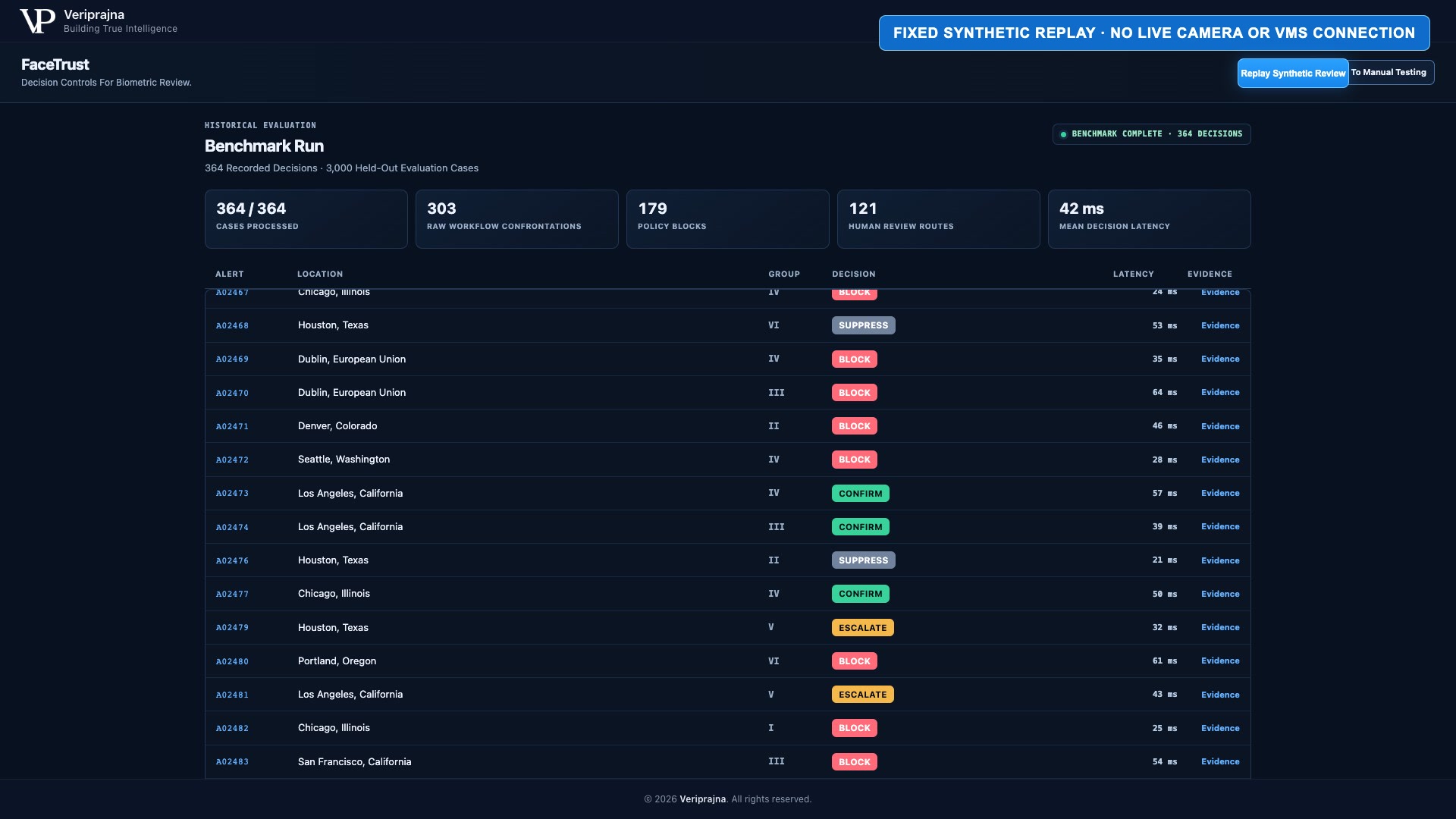
The completed synthetic benchmark view keeps the 364-decision replay totals and per-row evidence links in one inspection surface.
I waited for the replay to finish before reading its final counts. Under its counting method, 303 raw-threshold confrontations become 121 human-review routes while 179 alerts are blocked, a 60.1% reduction. The result belongs to that replay and shows what this specific mechanism does under fixed synthetic conditions.
I also wanted LP-0834 and every other route to leave a record that another person could inspect without trusting my narration. Each decision therefore creates a SHA-256 hash-chained audit record that can be exported as a printable HTML audit exhibit. The record sits beside the score, calibrated probability, prediction set, policy finding, and memo rather than appearing later as an exercise in documentation.
That boundary is why the product mapping matters to me. FaceTrust is the implemented interface. The Biometric Decision Firewall is the governance pattern it demonstrates. The demo has no live camera, VMS, vendor, NIST, consent, or customer-data connection, and the seeded legal table offers neither a legal opinion nor a compliance certification.
The question I now put before the score
I no longer begin a facial-recognition decision by asking whether the score is high enough. I begin by asking whether the capture was lawful, whether the evidence is sufficiently resolved, who reviews the case, and what record survives the decision.
I put the complete mechanism and its scope boundaries in the FaceTrust walkthrough. It shows how the raw alert moves through calibration, deterministic policy controls, trained review, and an audit exhibit without pretending the demo is a deployed surveillance system.
I built LP-0834 so 0.83 would stop looking like an answer. By the time that number reaches a person, lawfulness, uncertainty, and accountability should already be part of the decision.