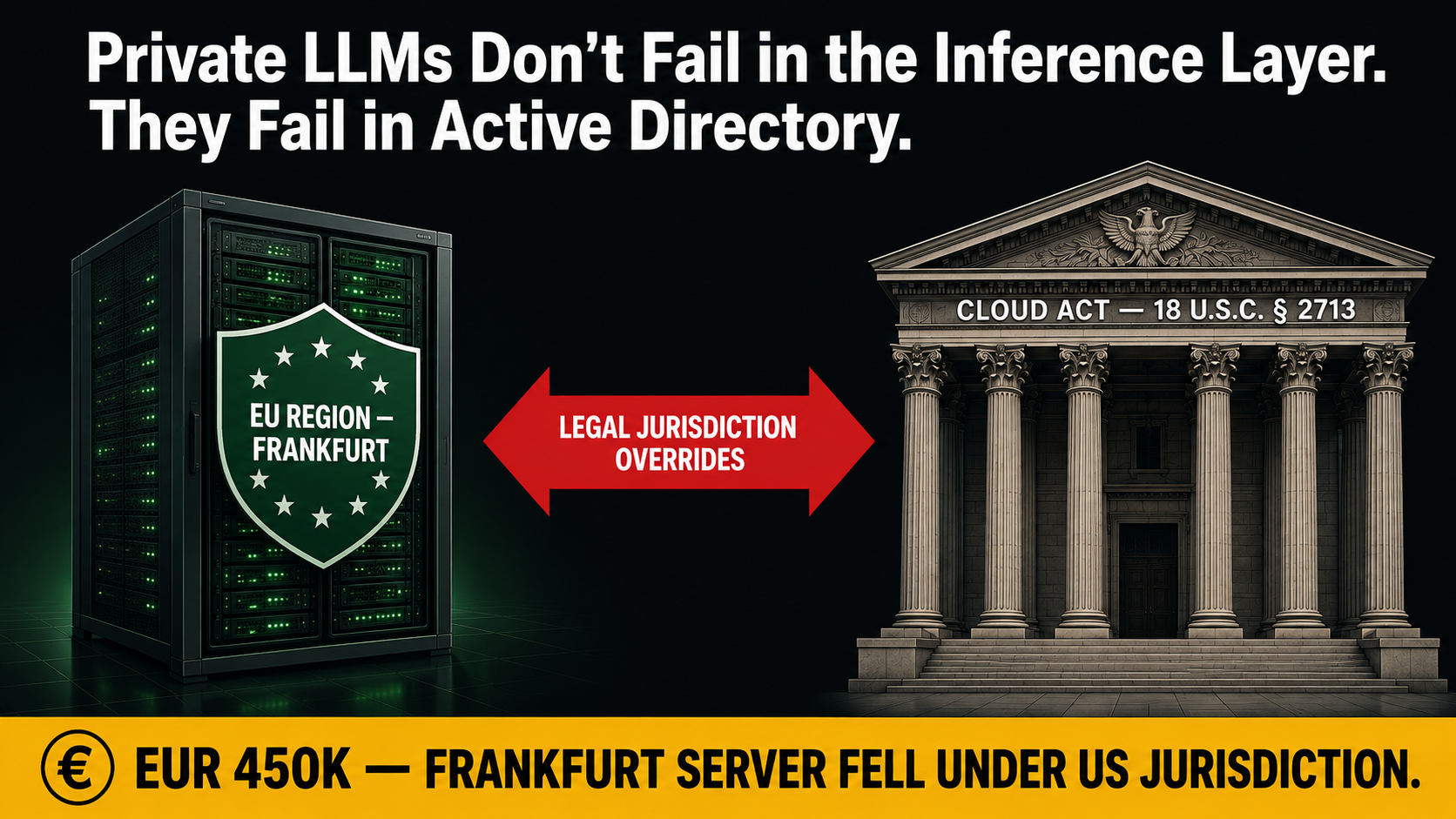
Your firewall blocked ChatGPT. Your highest performers switched to mobile data. That's not a security failure — it's a productivity-ban feedback loop, and IBM's 2025 Cost of a Data Breach report quantifies what happens when the ban loses: shadow AI incidents cost $670,000 more than traditional breaches and take 247 days on average to detect.
Every private LLM deployment we've worked on came after some version of that calculation. The question organizations reach us with isn't "should we build sovereign AI?" — the breach data makes that case on its own. It's "why do our deployments keep failing their security reviews?" The answer, in nearly every case, traces to one of three structural failure points that precede the inference layer entirely.
The Ban Never Had a Chance
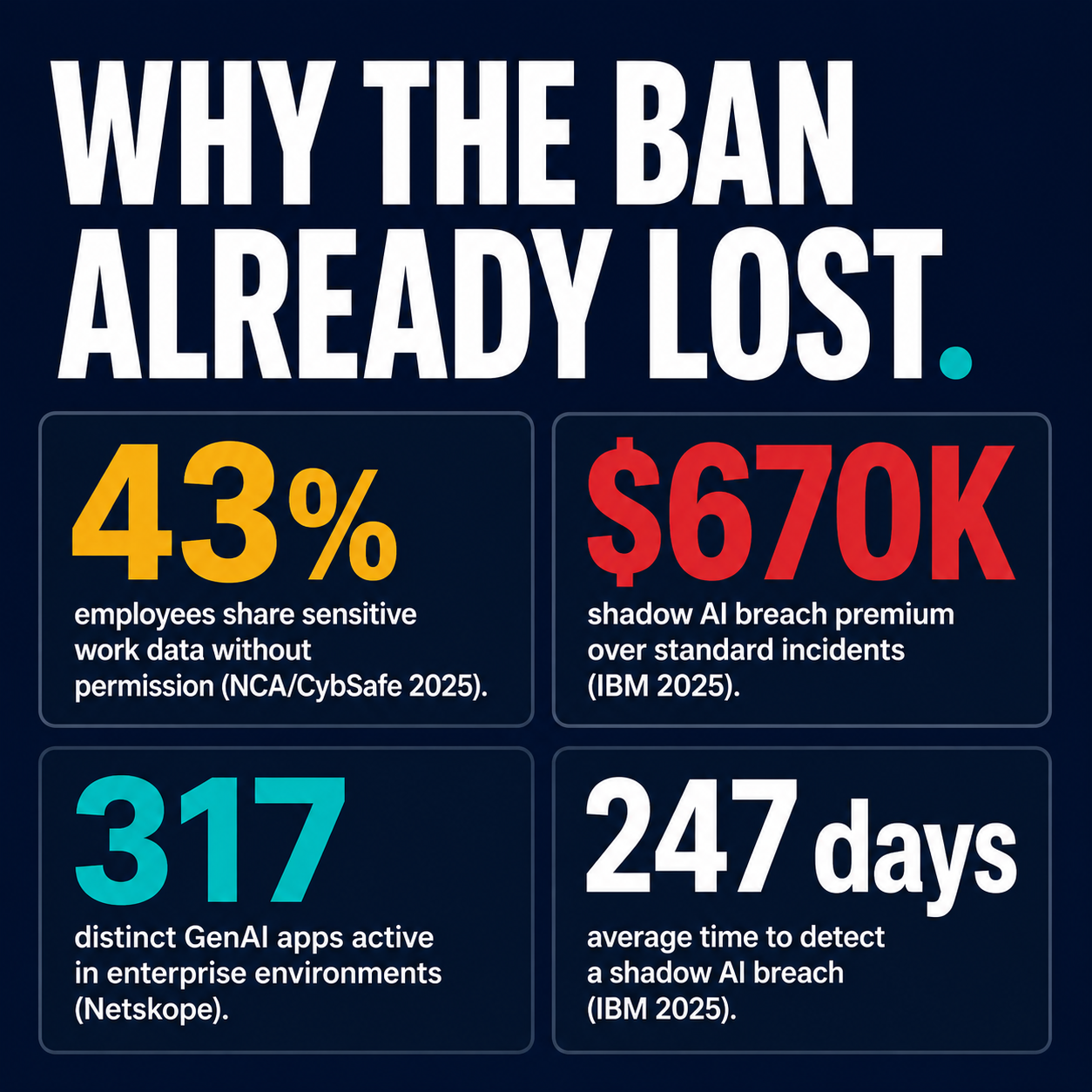
The psychology here is documented. NCA and CybSafe's 2025 research found that 43% of employees share sensitive work information with AI tools without employer permission — 33% shared enterprise research or datasets, 27% entered employee data, 23% input financial data. IBM's own data puts the figure at 46% of employees who state they will continue using AI tools regardless of a corporate ban. Netskope tracks 317 distinct GenAI applications active in enterprise environments at any given time.
Samsung's semiconductor code leak in 2023 was the incident that showed what was possible. Three years later the breach surface has expanded to match the tool proliferation. The 2026 OpenClaw crisis — 135,000 GitHub stars, over 21,000 exposed instances, malicious marketplace exploits — demonstrated that the shadow AI problem extends from consumer chatbots to autonomous agents operating inside enterprise perimeters.
Blocking one AI tool routes usage to the other 316. The security posture you get from a ban is the illusion of control, not control.
The productivity differential (3–5x for knowledge workers) means the policy has structural gravity working against it. The only answer that resolves the tension rather than just displacing it is deploying a sanctioned, controlled alternative that satisfies the demand inside the perimeter you can actually monitor.
Managed Private Isn't Sovereign
This is the failure point with the largest legal exposure attached to it, and the one enterprises most consistently misjudge.
Azure OpenAI and AWS Bedrock have serious compliance portfolios — FedRAMP High, HIPAA Business Associate Agreements, EU data residency options, SOC 2 Type II. They are legitimate enterprise-grade private AI deployments. For many organizations, this is the right answer. For regulated enterprises with GDPR obligations, it requires a legal analysis that most procurement processes skip.
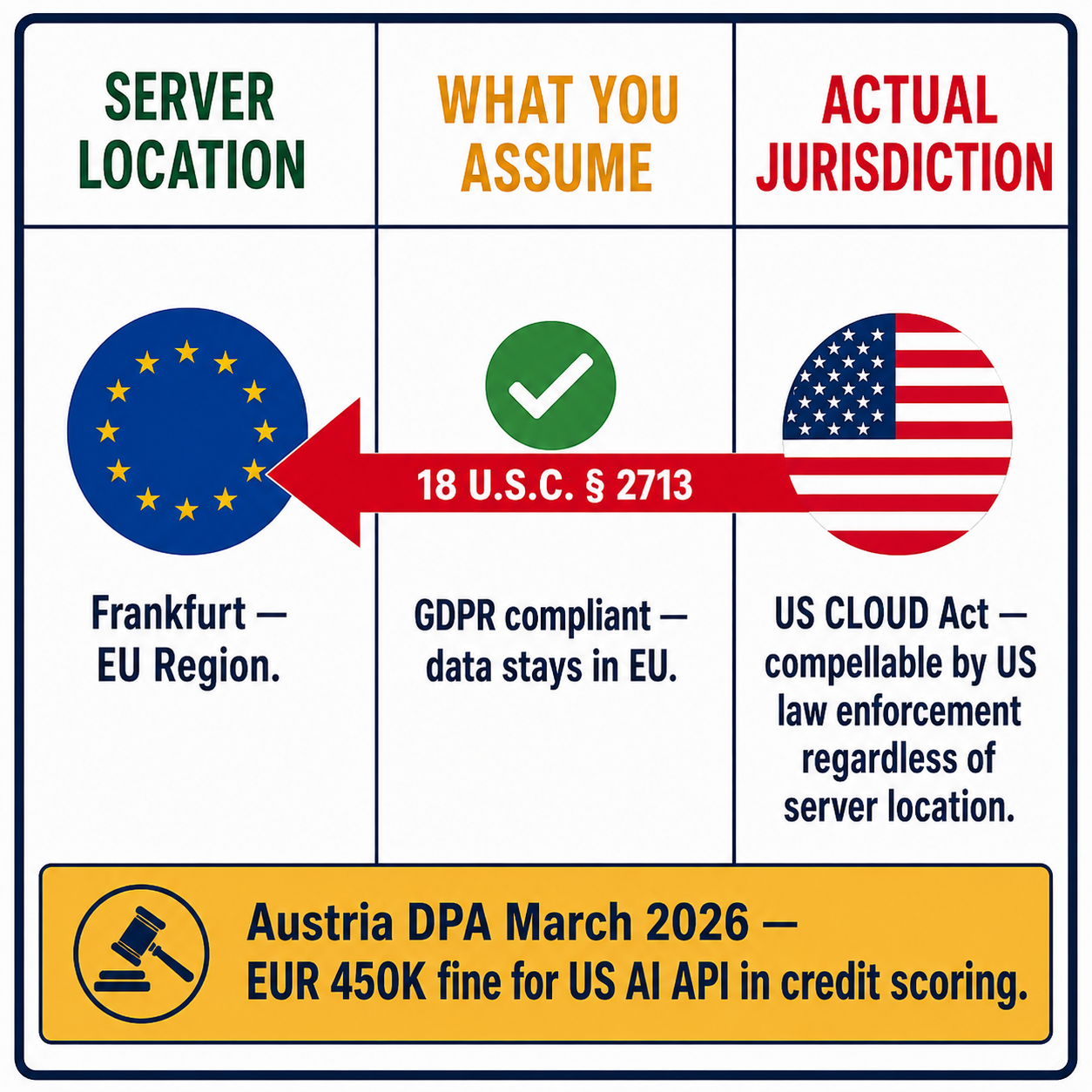
The CLOUD Act (18 U.S.C. § 2713) extends US jurisdiction to data held by US-headquartered companies regardless of where that data is physically stored. Microsoft and Amazon are both US parent companies. A Frankfurt AWS deployment is still a deployment managed by a subsidiary of a US entity with US CLOUD Act exposure. GDPR Article 48 requires an international agreement — not just a data processing addendum — to make a foreign court order valid. The two legal frameworks are in direct conflict.
That conflict moved from theoretical to operational in March 2026. Austria's Data Protection Authority fined a Vienna fintech EUR 450,000 for using a US-based AI API for credit scoring, explicitly calling it an unlawful transfer under GDPR — not because the data left the EU, but because it was processed through a US-headquartered entity subject to CLOUD Act compulsion. The combined GDPR and EU AI Act penalty ceiling is EUR 55 million per year (or 11% of global annual turnover). EU AI Act Article 50 transparency obligations become enforceable in August 2026.
For organizations where jurisdictional sovereignty is a hard legal requirement, the deployment paths that actually satisfy it are EU-headquartered sovereign cloud (OVHcloud, Scaleway — Scaleway now carries the first European availability of NVIDIA Blackwell B300 GPUs), or truly air-gapped on-premises infrastructure. Mistral AI — French-headquartered, EUR 830 million raised, with a Paris data center built around 18,000 NVIDIA Grace Blackwell Superchips and a France Ministry of Armies contract — positions explicitly for this case. Cohere's Model Vault (launched September 2025) offers VPC and on-prem deployment at $240M ARR, though Cohere is Canadian-headquartered, which may or may not satisfy European jurisdictional requirements depending on the specific regulatory context.
Where RAG Projects Die: The Active Directory Problem
The third failure point is where we've seen the most enterprise private LLM projects stop dead, and it has nothing to do with the model.
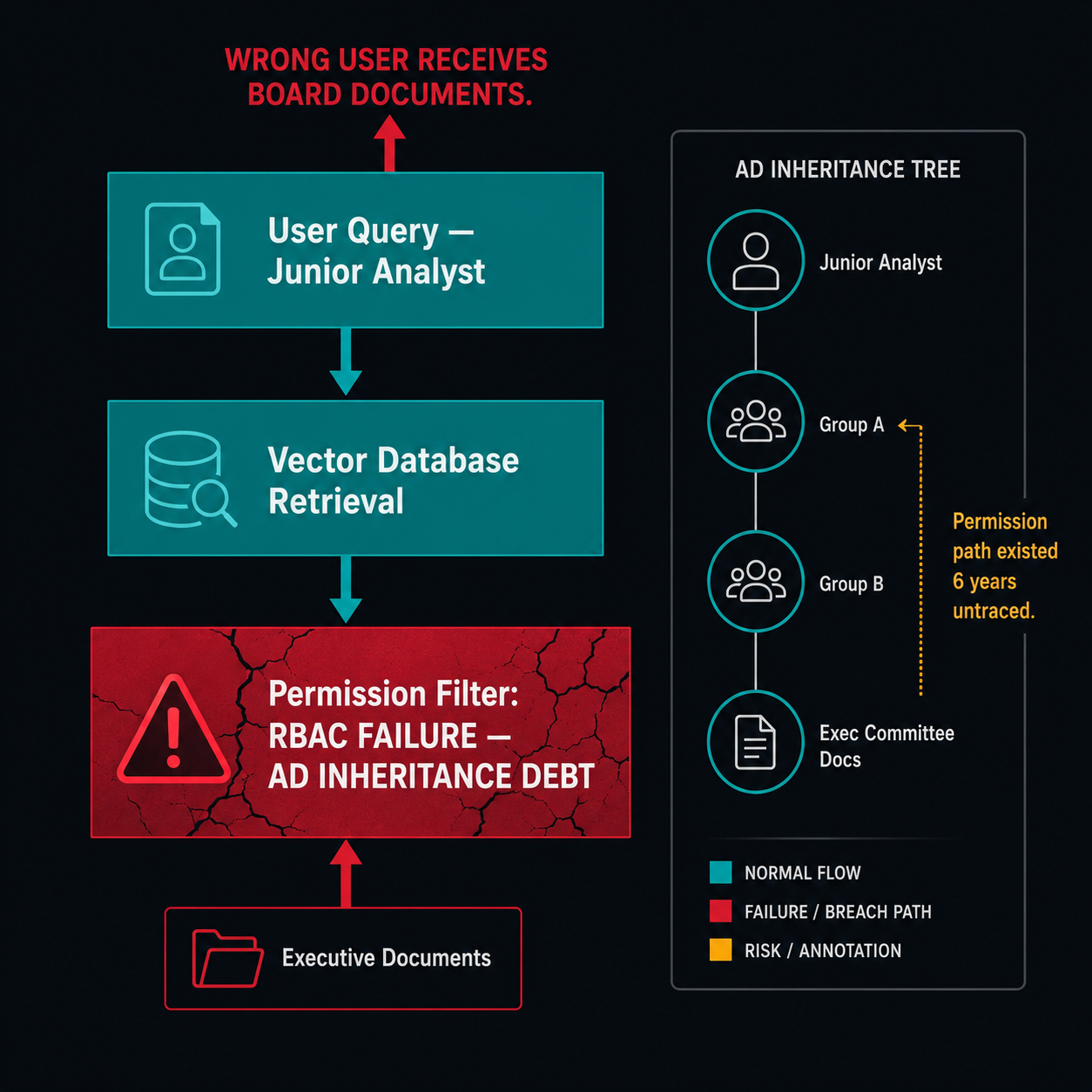
The scenario plays out consistently: a team deploys Llama 4 Maverick on a GPU cluster inside the VPC, connects it to a vector database, indexes the SharePoint document library, and runs the first test query. A junior analyst asks about quarterly financial projections. The retrieval system surfaces board-level documents.
This happens because Active Directory in large organizations carries fifteen-plus years of permission inheritance debt. Nested security groups. Orphaned distribution lists from projects that closed in 2018. Dynamic group memberships where the membership rules were last reviewed when someone set them up. Cross-OU inheritance chains that span organizational units that have since been reorganized. The naive approach — tag each document chunk with a flat ACL read from SharePoint — collapses under this complexity. Dynamic group membership changes faster than a vector database re-indexes. Time-based conditional access policies don't translate cleanly to Qdrant metadata filters. ABAC rules from Okta workflows don't have a straightforward mapping to vector similarity search.
No major platform solves this completely out of the box. TrueFoundry, Databricks, and Azure AI Search all have partial implementations of permission-aware retrieval — each handles a subset of AD's inheritance depth. The full solution requires building a permission synchronization layer that understands how your specific directory structure has evolved, that handles real-time group membership changes, and that enforces document-level access controls without introducing query latency that breaks the user experience.
Most enterprise RAG deployments fail their security review not because the model gave a wrong answer, but because the retrieval layer gave the right answer to the wrong user.
This is the component we spend the most time on in sovereign AI engagements. A clean three-year-old directory with consistent ABAC policies is an engineering problem with a known solution. A 15-year-old directory with nested inheritance across organizational units needs a dedicated permission mapping phase before RAG is production-safe — typically six to ten weeks, depending on directory size and complexity.
The Vendor Landscape, Without the Sales Pitch
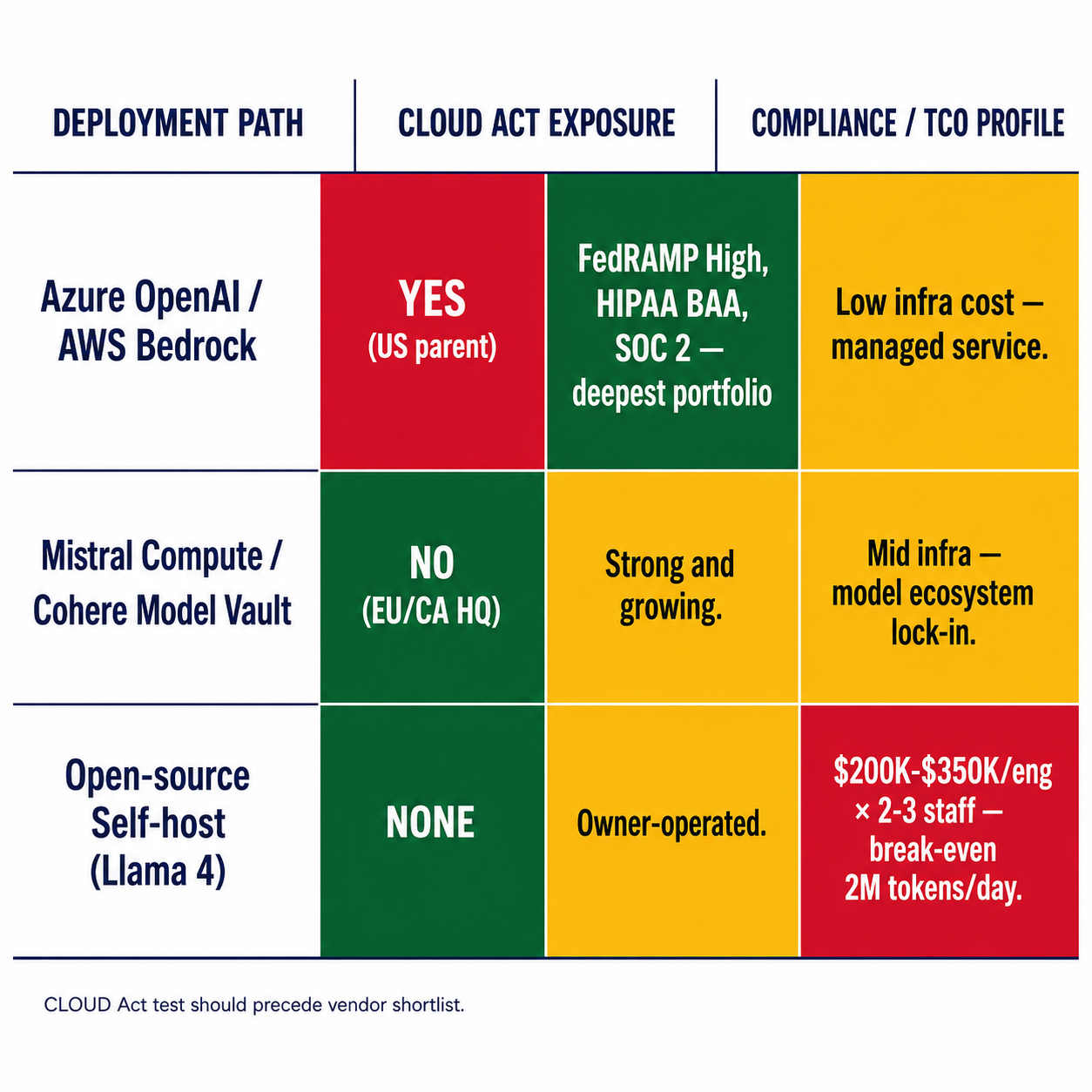
For enterprise buyers evaluating deployment paths, the honest comparison cuts across two axes that most vendor collateral treats separately: compliance portfolio depth and jurisdictional sovereignty.
Azure OpenAI and AWS Bedrock sit at the intersection of strongest compliance portfolio (FedRAMP High, HIPAA BAA, SOC 2 Type II are hard to match) and genuine CLOUD Act exposure. They're the right call when your legal team has determined that CLOUD Act risk is manageable in your specific context, you need frontier model access (GPT-4o, Claude), and you want the deepest enterprise compliance documentation available. That's a legitimate set of requirements, and the platforms meet them.
Cohere and Mistral occupy the sovereign-specialist position. Both are well-funded and production-grade. Both have limitations worth naming: Cohere locks you into its model ecosystem; Mistral's GPU fleet, while growing, is smaller than the hyperscaler managed services. For organizations that need true jurisdictional sovereignty and can accept those constraints, this is the realistic path.
Open-source self-hosting — Llama 4 Maverick (1,417 ELO on Chatbot Arena, outperforming GPT-4o on standard benchmarks) with vLLM on NVIDIA NIM microservices — provides maximum control and competitive inference cost at scale. A self-hosted 7B model runs at roughly $0.013 per 1,000 tokens versus $0.15–$0.60 for GPT-4o mini via API. The break-even point is around 2 million tokens per day when MLOps staffing is in the denominator — and 2–3 dedicated engineers at $200K–$350K each (loaded) is the minimum viable staffing level, meaning the infrastructure savings often get absorbed by personnel costs for organizations under that token volume. One fintech we're aware of brought monthly AI spend from $47,000 to $8,000 through hybrid self-hosting — but they were above the break-even threshold and already had the MLOps team.
The Sovereign AI & Private LLM Deployment page includes the full architecture decision matrix across all deployment paths, including Big-4 SI options.
Why Agentic AI Makes All Three Problems Harder
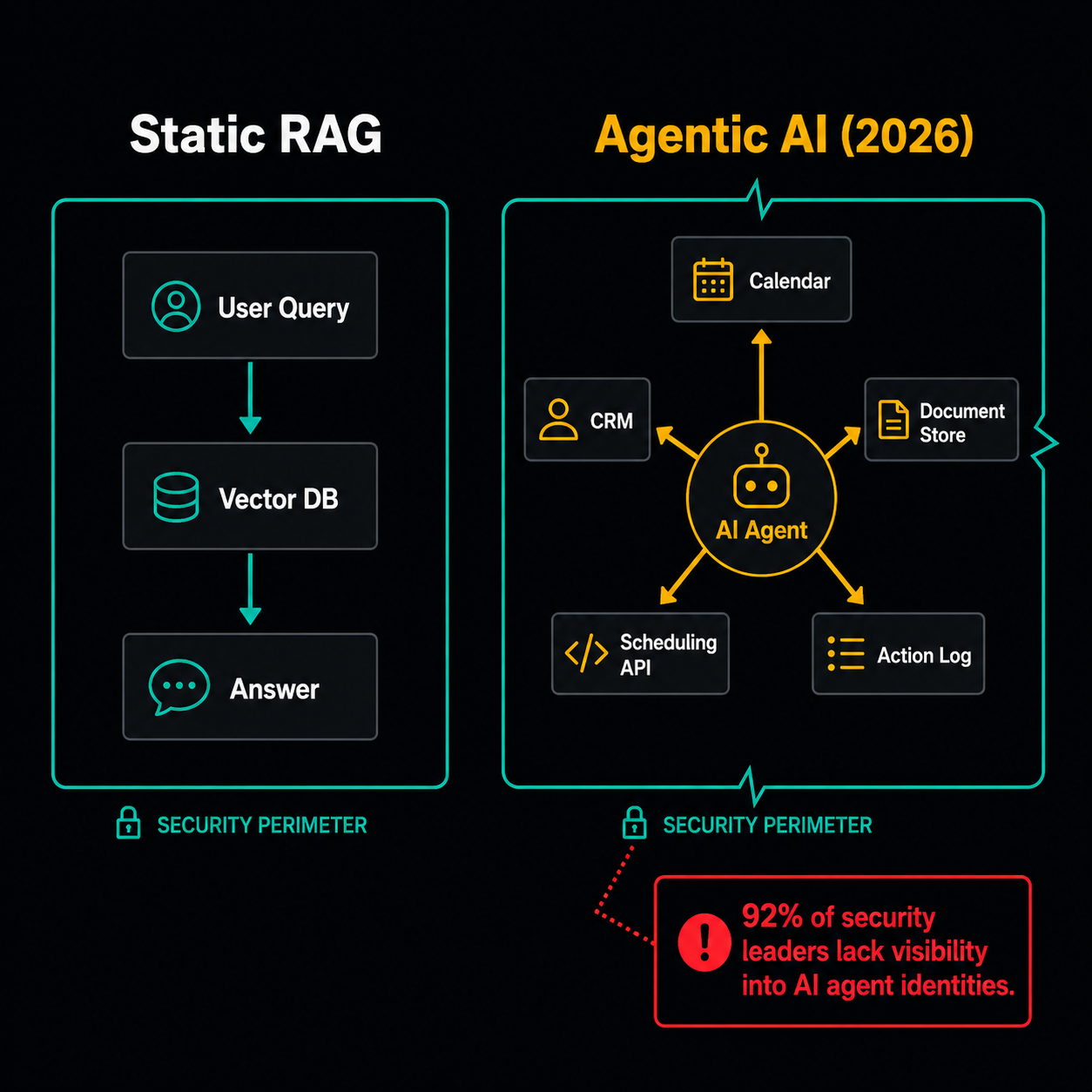
Each of the three failure points above — shadow AI governance, CLOUD Act exposure, AD permission debt — is getting harder to manage in 2026, not easier.
Gartner projects 40% of enterprise applications will embed AI agents by end of 2026, up from under 5% in 2025. An agent with legitimate access to a calendar, a CRM, and a document store doesn't need prompt injection to create data leakage — it can generate unauthorized data flows simply because its permission scope was never reviewed for what agents actually do. The identity security problem for AI agents is already recognized: 92% of security leaders report lacking full visibility into AI identities, and 86% don't enforce access policies for AI agents, according to current data. CrowdStrike's $740M acquisition of SGNL (January 2026) signals where the market believes the problem will land.
For private LLM deployments, the agentic expansion means that architectures designed for static RAG (query in, answer out, session ends) need to be re-evaluated for agents that maintain persistent state, schedule tasks, and execute actions across systems. The permission infrastructure built for the static case — a read-only permission filter on the retrieval layer — is insufficient for an agent that writes, schedules, and acts. The organizations that invested in the deep AD permission mapping for their RAG deployment are the ones whose architectures survive the agentic expansion without a rework.
What Runtime Guardrails Actually Cover
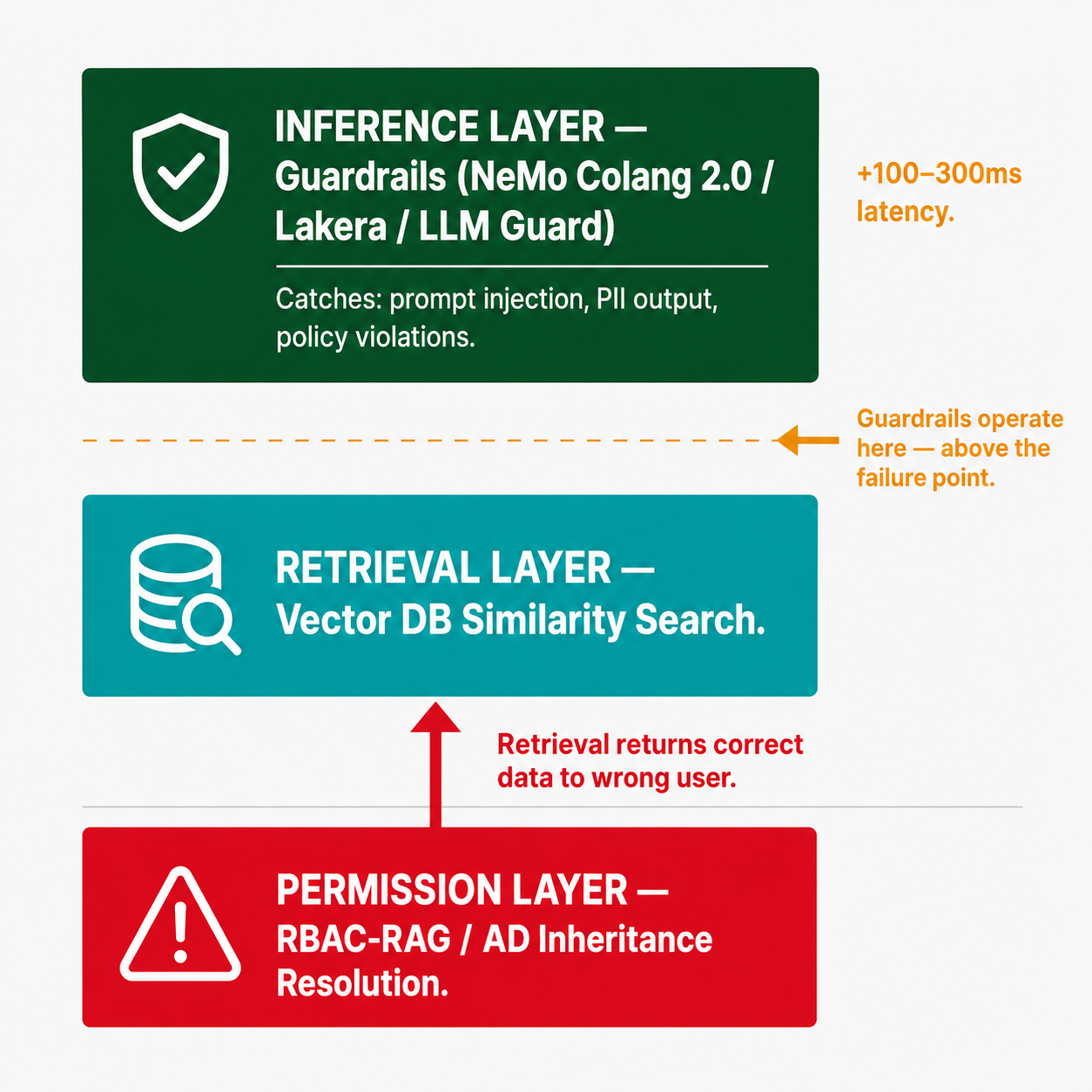
Guardrails tooling has matured significantly, but it operates at the inference layer — after retrieval has already run. It's a necessary layer, not a sufficient one.
NVIDIA NeMo Guardrails (Colang 2.0) adds 100–300ms latency per inference call, dropping to 50–150ms on NVIDIA-optimized infrastructure. The current v0.9 release has compatibility breaks with the Guardrails Library when running Colang 2.0 — organizations planning to run both need to fork the inference pipeline or stay on Colang 1.x. Lakera's prompt injection detection, now part of Check Point's enterprise firewall stack following its 2026 acquisition, addresses the most common runtime attack vectors. Protect AI's open-source LLM Guard (2,500 GitHub stars, 15 input scanners, 20 output scanners, MIT licensed) covers the same ground as an operator-owned solution.
These tools catch prompt injection, PII leakage in outputs, and model output policy violations. They don't catch retrieval-layer permission failures — the junior analyst's query that surfaces board documents doesn't look like an attack to a runtime guardrail. The guardrails question and the RBAC-RAG question are separate engineering problems with different solutions and different points of failure.
Where the Architecture Review Actually Starts
The question CISOs most often bring to an initial conversation isn't "which model?" — it's "how do we structure the security review so it doesn't kill the deployment?"
CLOUD Act exposure needs to be determined before any vendor is on the table. For EU-regulated organizations where GDPR-sensitive data will flow through AI workflows, the Austrian DPA ruling turned a legal theory into a precedent. The internal conversation that needs to happen first is with legal, not with IT: is US-hyperscaler managed private acceptable given the CLOUD Act exposure, or does the risk profile require EU-sovereign infrastructure? That single question determines which half of the vendor landscape is even in scope.
Daily token volume and team MLOps maturity determine whether self-hosting is actually cheaper — and the TCO model consistently surprises organizations that run the numbers carefully. Below roughly 2 million tokens per day, managed API pricing is competitive once staffing is in the denominator. Above that threshold, self-hosting payback is typically 6–12 months.
The AD permission audit is almost always the longest-running item and the most underscoped at kickoff. What looks like a six-week project in the proposal becomes a twelve-week project when the actual depth of the inheritance structure is mapped. Running a BloodHound CE export at the start of the engagement — before estimating timelines — is the single change that most improves project predictability.
For teams currently in the architecture evaluation, we'd find the conversation more useful than a pitch. The architectures that work are almost always shaped by the specific regulatory posture and identity infrastructure of the organization. What we're still refining is how to scope the AD phase faster — and that knowledge lives in case studies, not in whitepapers.