In MeritLens, our supplier-scoring review demo, synthetic Bridgepoint Components delivers on time at a rate of 98.1%, compared with 97.2% for Apex Fastener Industries. Bridgepoint still scores 70.9, below the 80-point shortlist floor. Apex scores 91.9.
I want a procurement review to state what evidence would change its judgment about an excluded supplier. A stronger delivery rate alone does not entitle a supplier to the contract. A lower score alone does not explain which purchase risk its exclusion protects against. All suppliers and events here are synthetic, and awards are simulated.
What the score rewards
In the original formula, delivery and quality are pulled toward an 80% prior according to transaction and audit counts. Bridgepoint has 180 transactions and nine audits; Apex has 4,200 transactions and 140 audits. Revenue also affects the financial score. These choices make the amount of history and the scale of the business matter alongside raw performance.
Certification and diversity labels are excluded from the scoring formulas. That does not remove the effects of history and revenue. The labels are used separately in the demo's fairness assessment and gate.
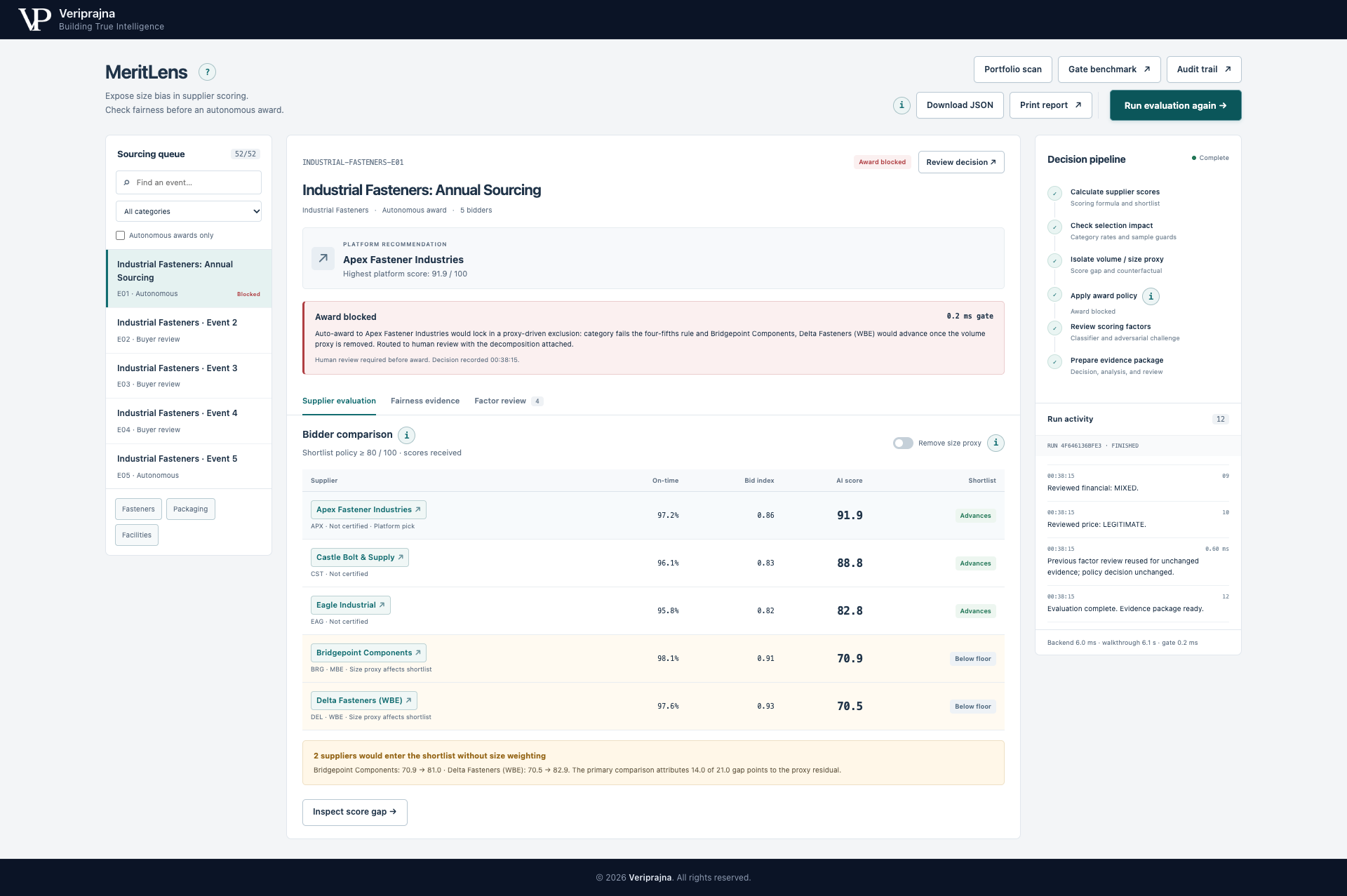 In this synthetic example, Bridgepoint misses the 80-point floor despite stronger raw delivery; the simulated award is held for human review.
Limited history can matter when assessing uncertainty. I do not consider that a sufficient explanation for an exclusion until the team specifies what is uncertain and why it matters for the purchase. Otherwise, business maturity can stand in for a risk assessment without anyone having to defend the substitution.
Change the assumption, then examine the result
MeritLens compares the original scores with a defined alternative: use raw delivery and quality rates without the history weighting, score financial health directly, and keep price and factor weights unchanged.
Apex's displayed lead over Bridgepoint shrinks from 21.0 points to 7.0. The comparison attributes 14.0 points, about two-thirds of the original gap, to the volume and revenue assumptions. Apex retains the stronger financial-health measure. This is a comparison of formulas under stated assumptions, not independent causal proof of discrimination.
Bridgepoint reaches 81.0 and enters the preview shortlist. Another excluded supplier, Delta Fasteners, also crosses the floor. Apex scores 88.0 and remains first. The alternative changes who is eligible for consideration without producing a new leader.
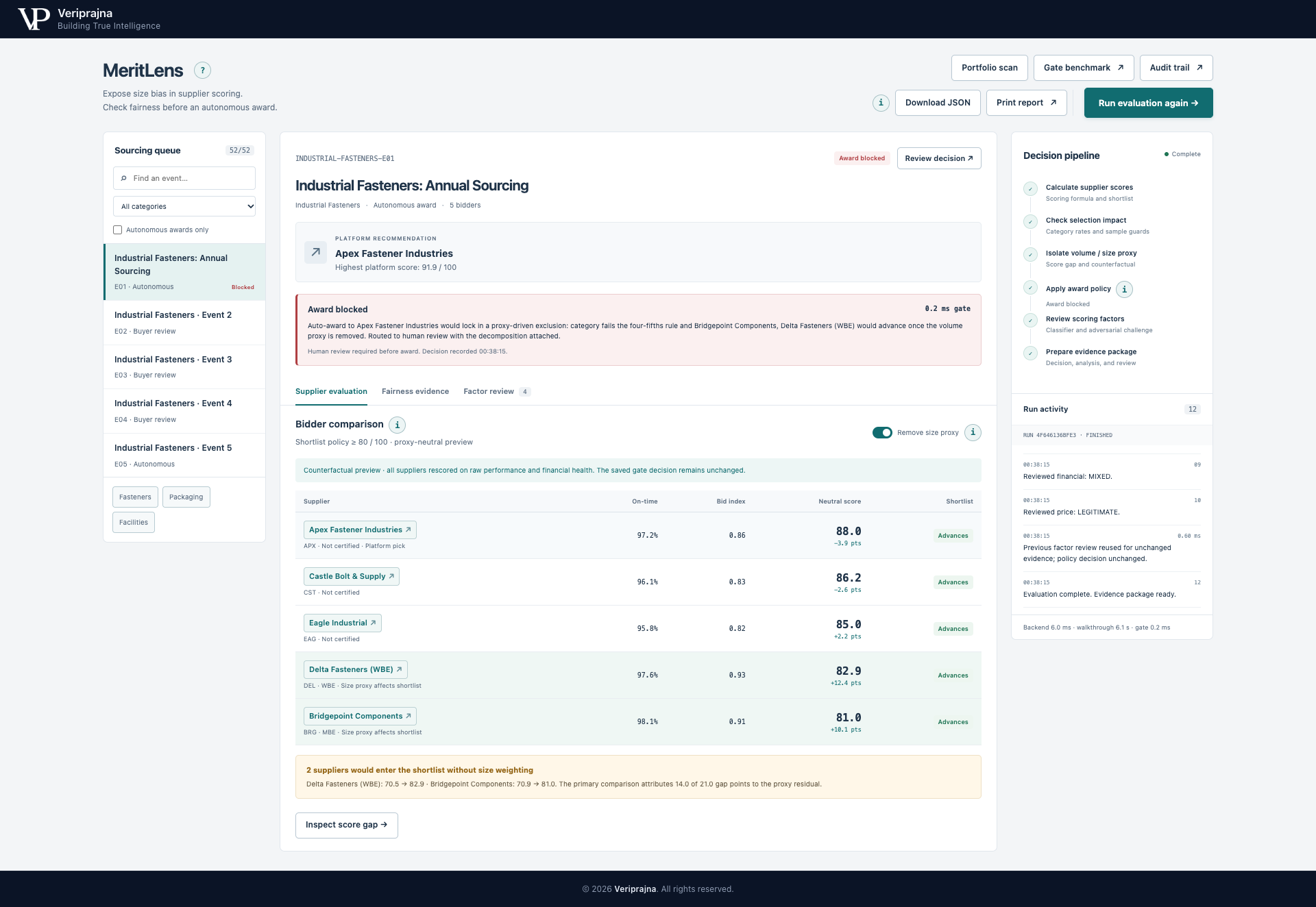 The alternative adds Bridgepoint and Delta to the synthetic shortlist. Apex remains first, and the saved BLOCK decision stays in place.
The saved decision in this event holds the simulated award for human review. Changing the preview cannot overwrite that hold or award a contract. AI factor explanations are advisory too: their prose cannot change the computed scores or gate result. The review still has work to do after the alternative becomes visible.
Give the review a decision to make
For a real procurement review, I would ask the team to define the uncertainty before defending either formula. Suppose a contract requires weekly deliveries at a specified volume. The useful evidence would concern meeting that cadence and capacity, including how those records were verified. A lifetime transaction count does not by itself describe those conditions; a small set of strong deliveries may also leave uncertainty about meeting them consistently.
The evidence should have a consequence. Verified delivery records at comparable volume and cadence could justify reopening consideration of a supplier excluded mainly by history weighting. Records that cover only much smaller orders could leave a capacity question unresolved. In that situation, I would keep the decision on hold and request evidence addressing the gap, rather than treat the higher alternative score as clearance.
This is a proposed human-review approach. MeritLens does not evaluate that contract-specific evidence. It demonstrates the scoring comparison using synthetic inputs, with no live procurement connector. The proposal makes the team say what would change its judgment, so an exclusion review can move beyond a debate over which score looks more acceptable.
The MeritLens breakdown shows the mechanism and its limits. I prefer a review that ends with a specific risk, the evidence considered and a justified next decision. A supplier becoming eligible under an alternative is the start of that work.