The worked case: explain the exclusion, preserve review authority
Follow one synthetic sourcing event from unevaluated inputs to an explained hold. The contrasting cases then show why changing shortlist eligibility, passing a category diagnostic and permitting an award are separate outcomes. All supplier names, certifications, histories and awards shown here belong to the local demonstration.
Start with the evidence behind the score
The workspace initially shows supplier inputs with scores and shortlist decisions pending. Inspecting Bridgepoint exposes delivery, quality, transaction history, audit history and financial inputs before evaluation. That distinction matters: a supplier label or an apparently strong delivery percentage cannot explain the score without the formula that consumes it.
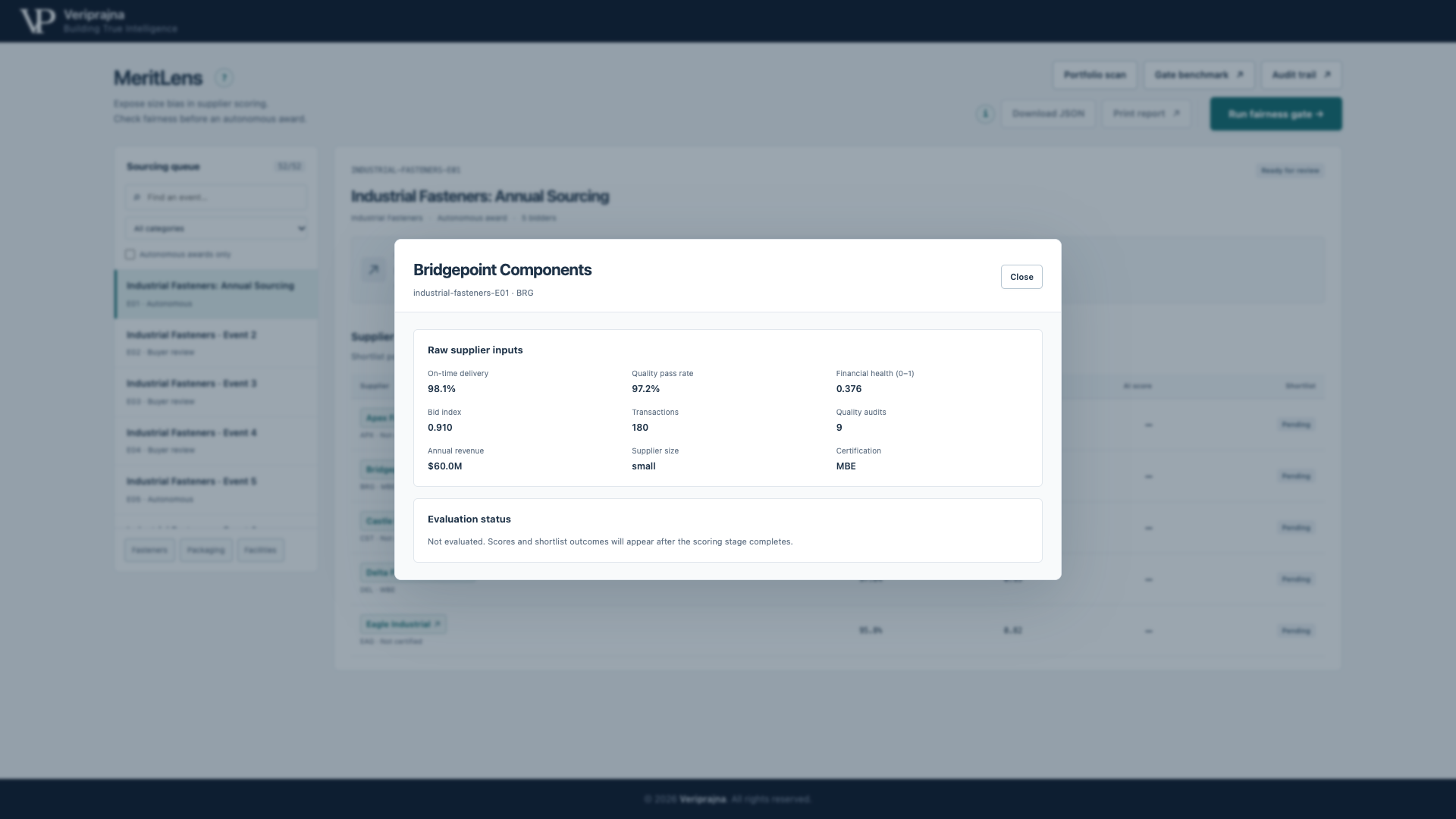
| Synthetic input | Apex | Bridgepoint |
|---|---|---|
| On-time delivery | 97.2% | 98.1% |
| Quality-pass rate | 96.5% | 97.2% |
| Transactions | 4,200 | 180 |
| Audits | 140 | 9 |
| Revenue | USD 820 million | USD 60 million |
The simulated scorer weights delivery, quality, financial and price factors at 25% each. Transaction and audit history affect how much confidence it places in the raw delivery and quality rates; revenue affects the financial score. Those choices can penalize a smaller supplier even though certification labels are excluded from scoring. A buyer therefore needs to assess the justification for those assumptions, rather than infer neutrality from omitted labels.
Read the original shortlist and saved hold
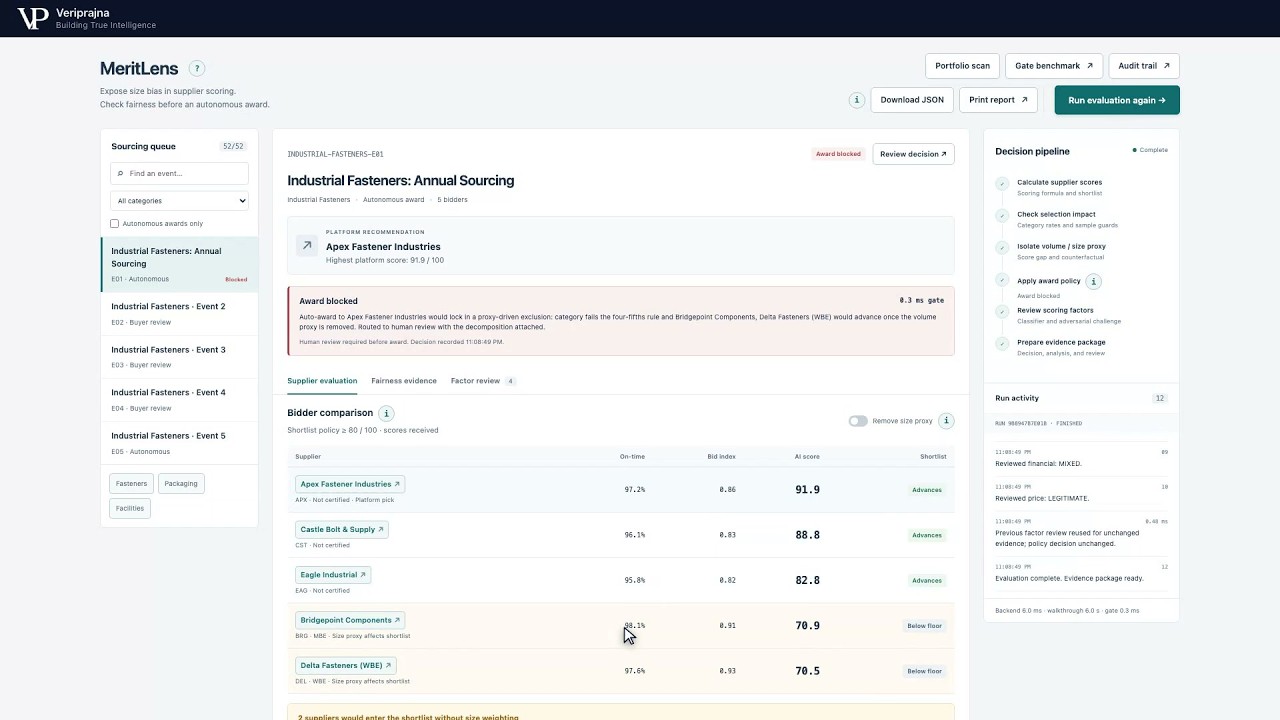
After evaluation, Apex is the original top scorer at 91.9. Bridgepoint scores 70.9 and Delta scores 70.5, below the configured shortlist floor of 80. Bridgepoint has the better delivery rate, but that single measure does not establish superiority on financial health, price or every other legitimate criterion.
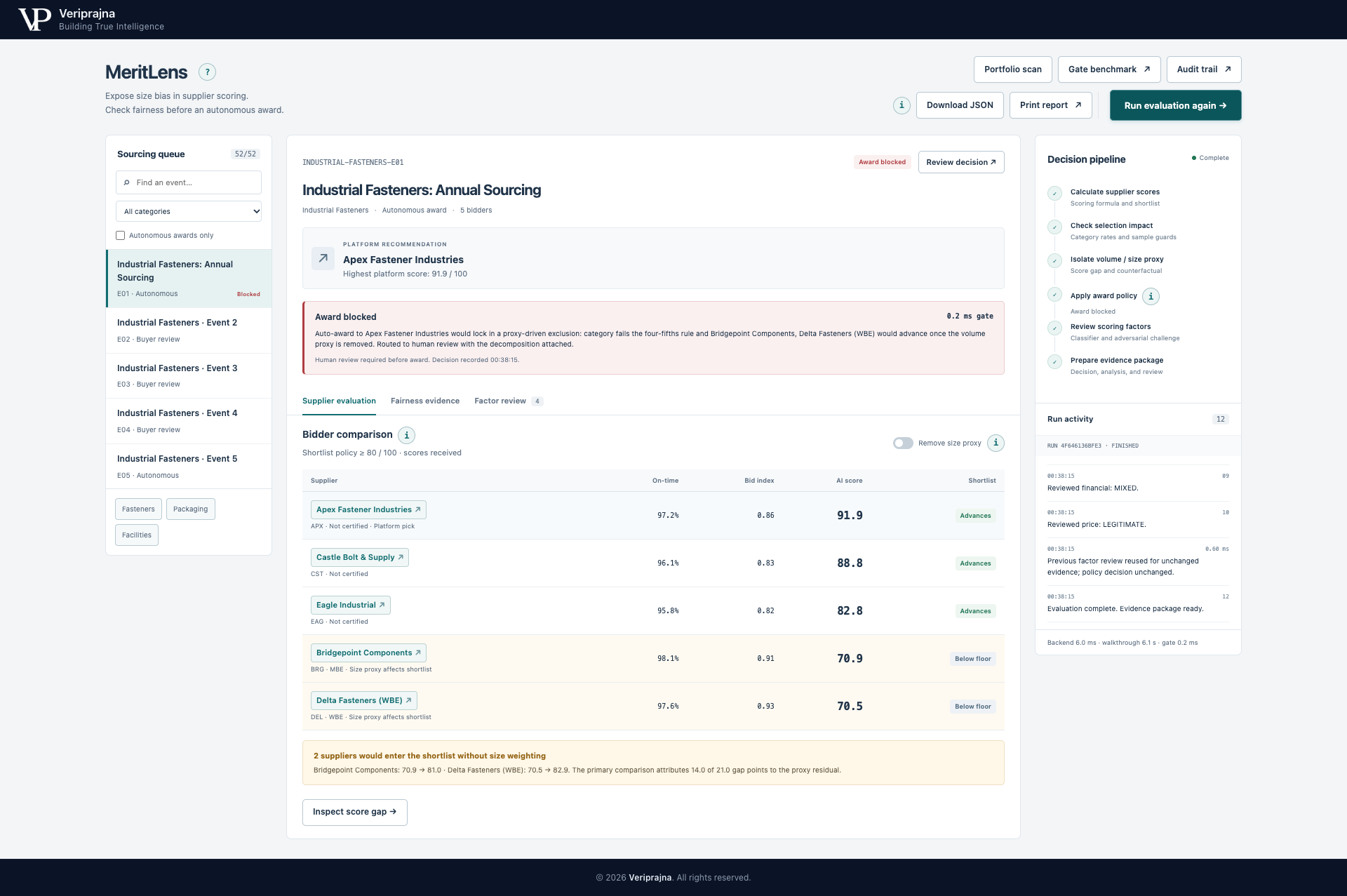
BLOCK requires all three configured conditions: a category adverse-impact finding, a non-diverse original top scorer, and a diverse challenger that is below the original floor but reaches it in the alternative formula. The fasteners event meets that combination. The decision is saved before advisory factor review begins, preserving the numerical basis and the authority of the hold.
Inspect the category counts and the source of the gap
The category diagnostic pools supplier-event rows, including repeated suppliers. Minority-owned business rows have 7 selections out of 26 considered, compared with 25 out of 37 for the non-diverse baseline. The selection-rate ratio is about 0.40, below the configured 0.80 diagnostic floor. The category history metadata of 312 is a separate sample guard; it is not the denominator of that comparison.
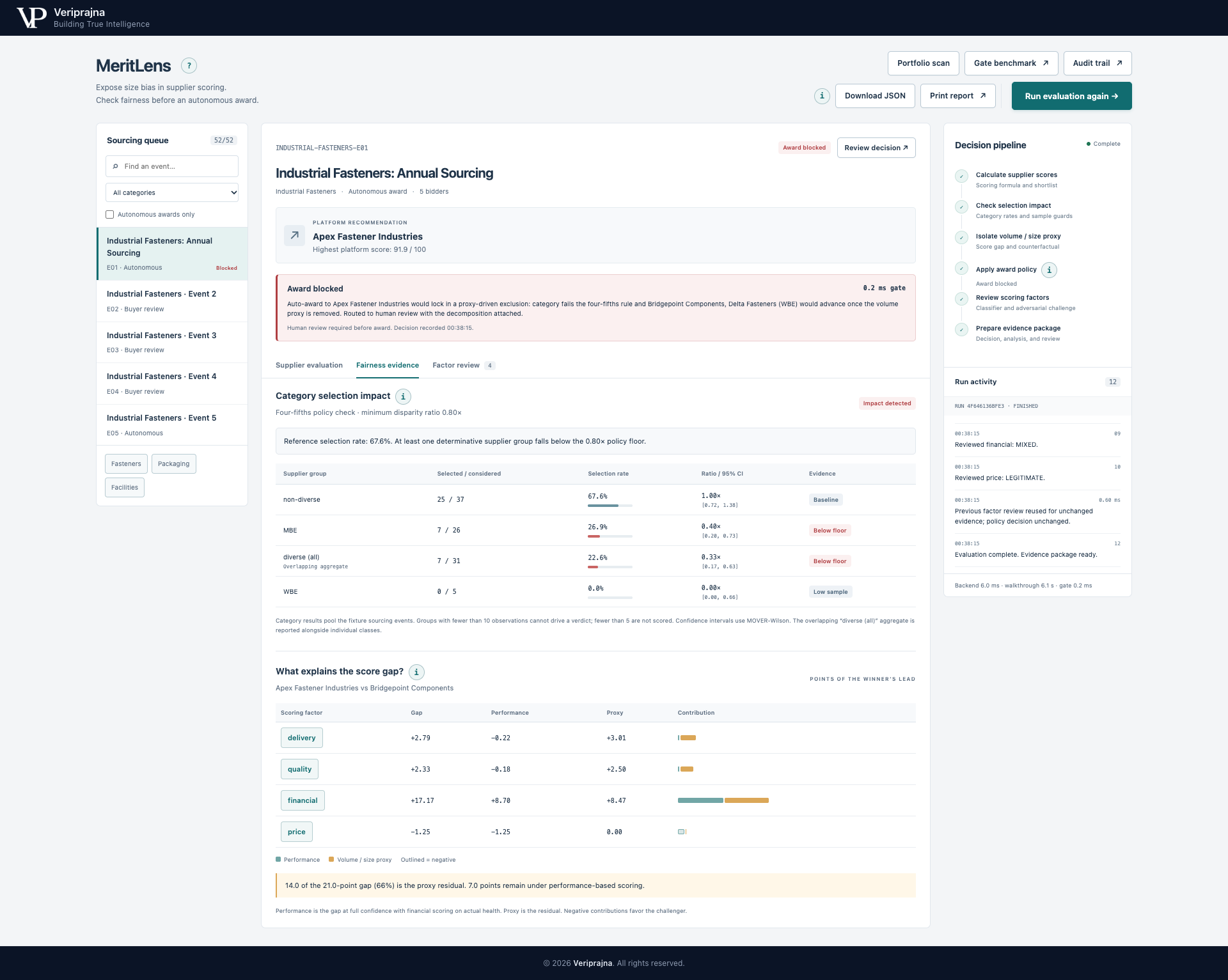
| Changed assumption | Proxy contribution to gap |
|---|---|
| Delivery confidence from transaction history | 3.01 points |
| Quality confidence from audit history | 2.50 points |
| Revenue-based financial scoring | 8.47 points |
| Price scoring, unchanged | 0.00 points |
The Oaxaca-Blinder-style decomposition compares explicit formulas. The alternative uses raw delivery and quality rates and actual financial health, keeping price and weights unchanged. About two-thirds of the original gap is attributed to the assumptions changed in that comparison; the remaining gap still favors Apex. This residual is conditional on the chosen alternative, rather than independent causal proof of discrimination.
Change the preview without rewriting the decision
| Supplier | Original score | Alternative score | Preview result |
|---|---|---|---|
| Apex Fastener Industries | 91.9 | 88.0 | Remains top scorer |
| Bridgepoint Components | 70.9 | 81.0 | Becomes eligible |
| Delta Fasteners | 70.5 | 82.9 | Becomes eligible |
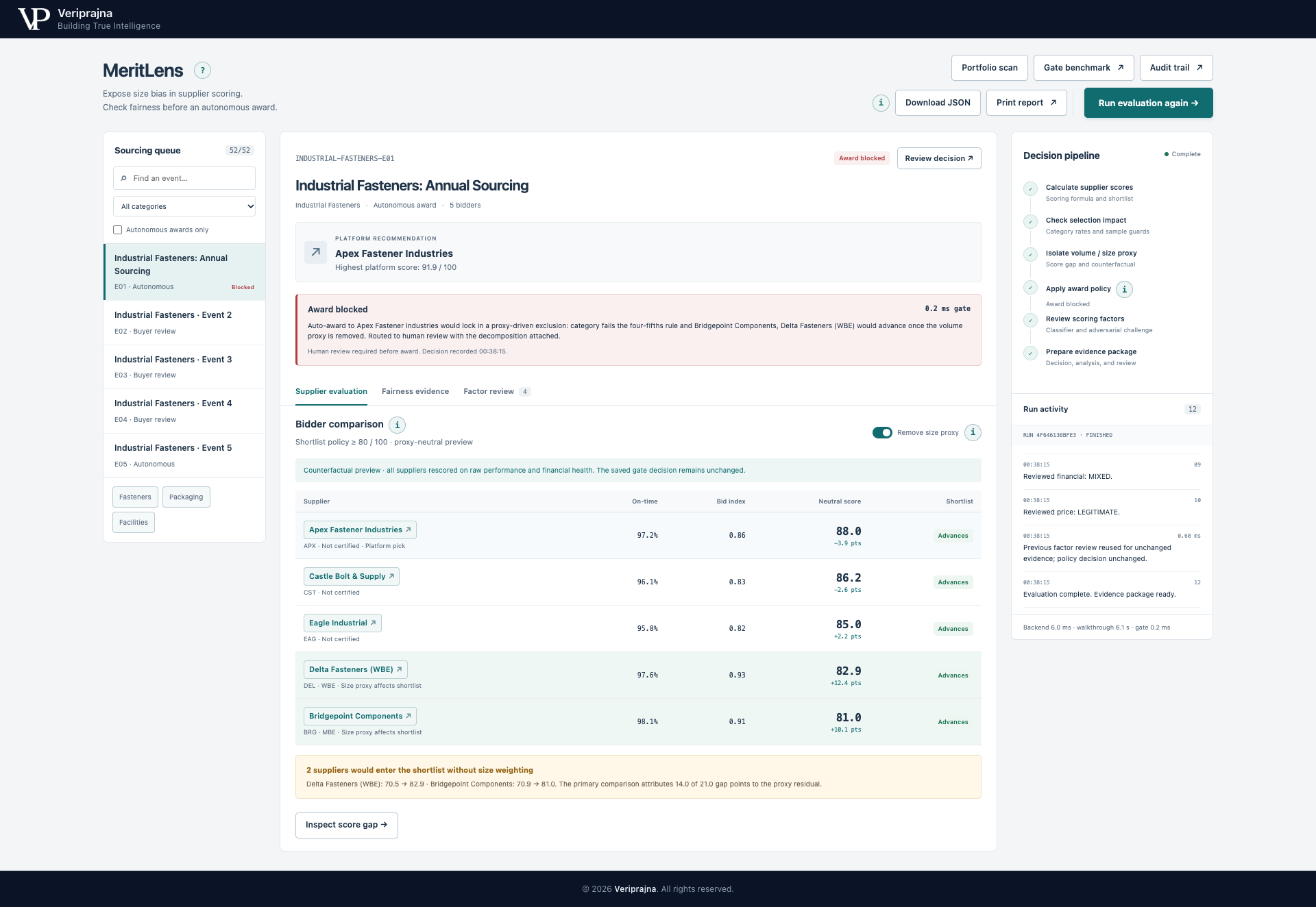
That preview gives procurement reviewers a focused question: would these suppliers have been excluded under scoring assumptions the organization can defend? It does not choose Bridgepoint as the winner, execute an award, rescore the recorded category assessment or replace the original scorer. A human reviewer would still need to consider the procurement context and decide how the identified assumptions should be handled.
Why ALLOW does not mean every supplier class passed
In the Packaging Materials example, the original recommendation is Beacon at 91.7, the category diagnostic is PASS and the configured gate returns ALLOW. Yet Ironclad, a synthetic HUBZone supplier, moves from 72.4 to 81.4 under the alternative formula. A policy permit can therefore coexist with a proxy-sensitive shortlist exclusion.
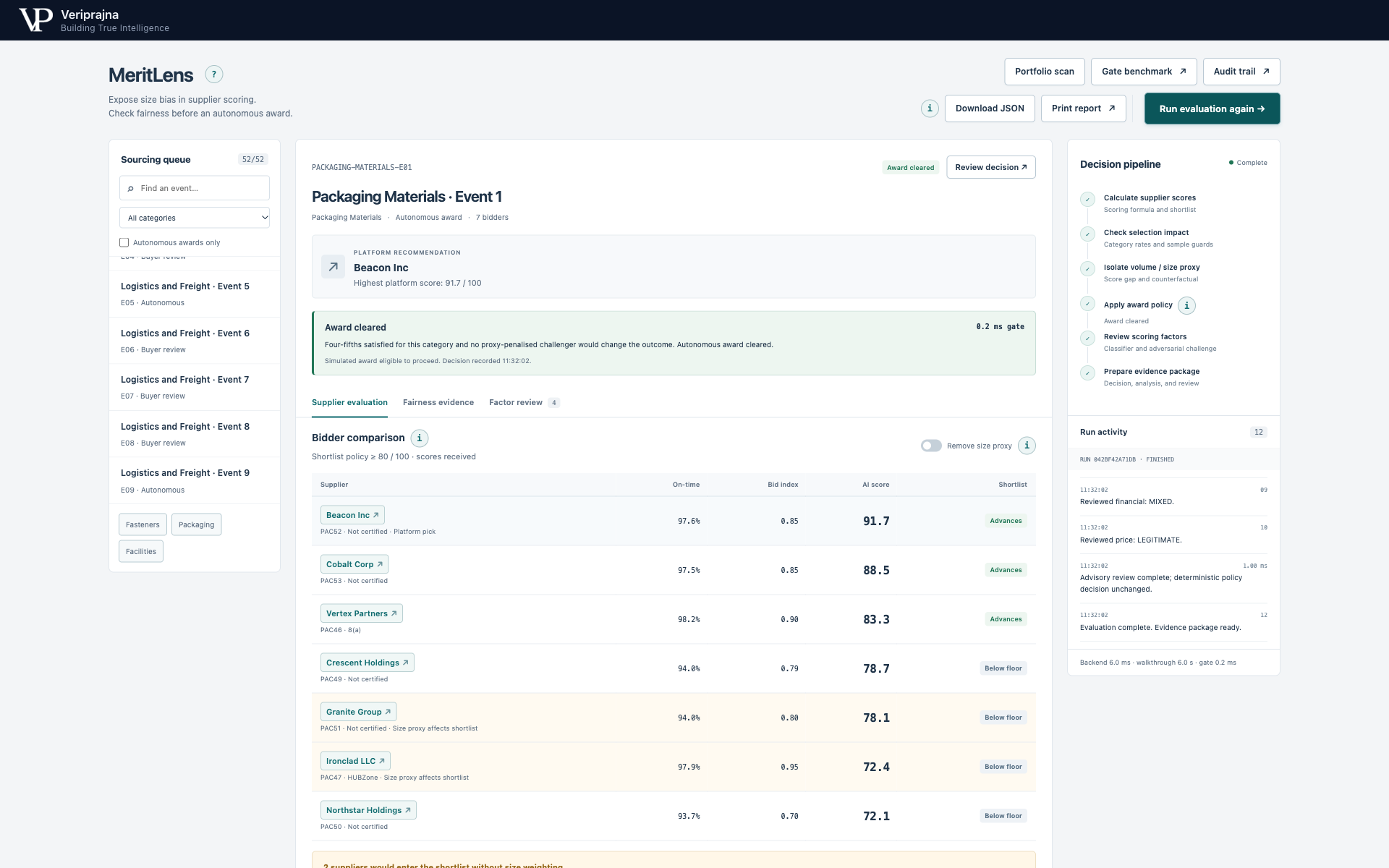
The overlapping diverse aggregate has 8 selections out of 12 considered rows, compared with 18 out of 38 for the non-diverse baseline. Its ratio is about 1.41. Individual minority-owned, HUBZone and 8(a) groups each have only four considered rows and remain unscored. Category PASS therefore does not establish that every class was assessed, and ALLOW does not establish the absence of proxies or disparity.
Why insufficient evidence holds the award
The Facilities and MRO event has declared category history of 140, below the configured minimum of 200. Its category assessment and gate both return ABSTAIN, so the simulated autonomous award is held for review. Scores and a decomposition can still be calculated; neither turns an unavailable category assessment into clearance.
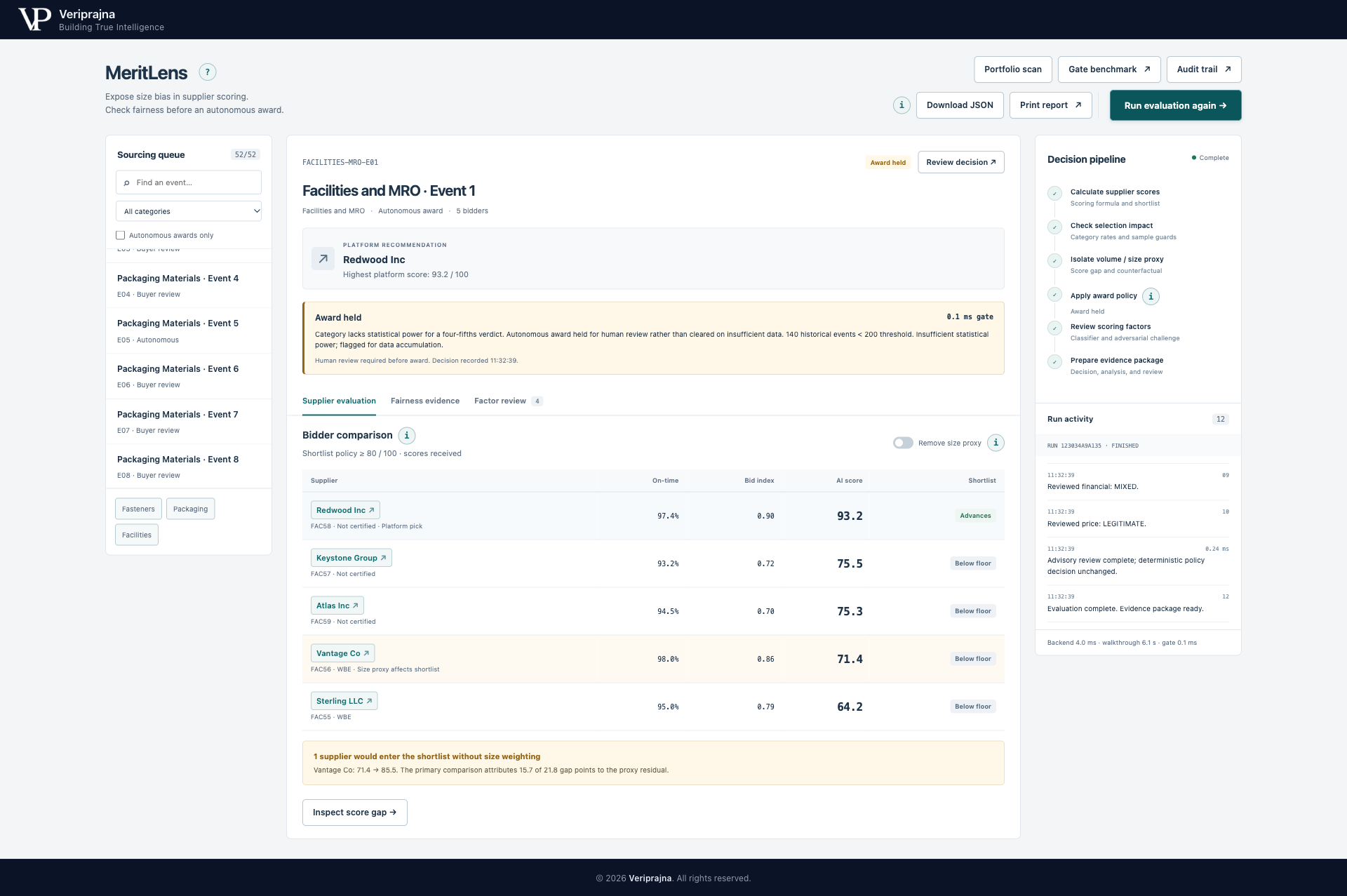
Other guards cover a reference baseline with fewer than five considered rows or no selections. Individual groups below five are unscored, while groups with five through nine rows are informational and cannot drive the category verdict. The minimum history of 200 and these group guards are configured boundaries, not a guarantee that a real procurement dataset is statistically adequate.
Check the policy against authored controls
The fixed suite contains ten authored raw-input cases with expected outcomes: three BLOCK, four ALLOW and three ABSTAIN. The observed outcomes match all ten expected labels. Controls cover history, audit and revenue assumptions, established certified suppliers, price-only differences, performance-based exclusion, sparse reference data and a reference baseline with no selections.
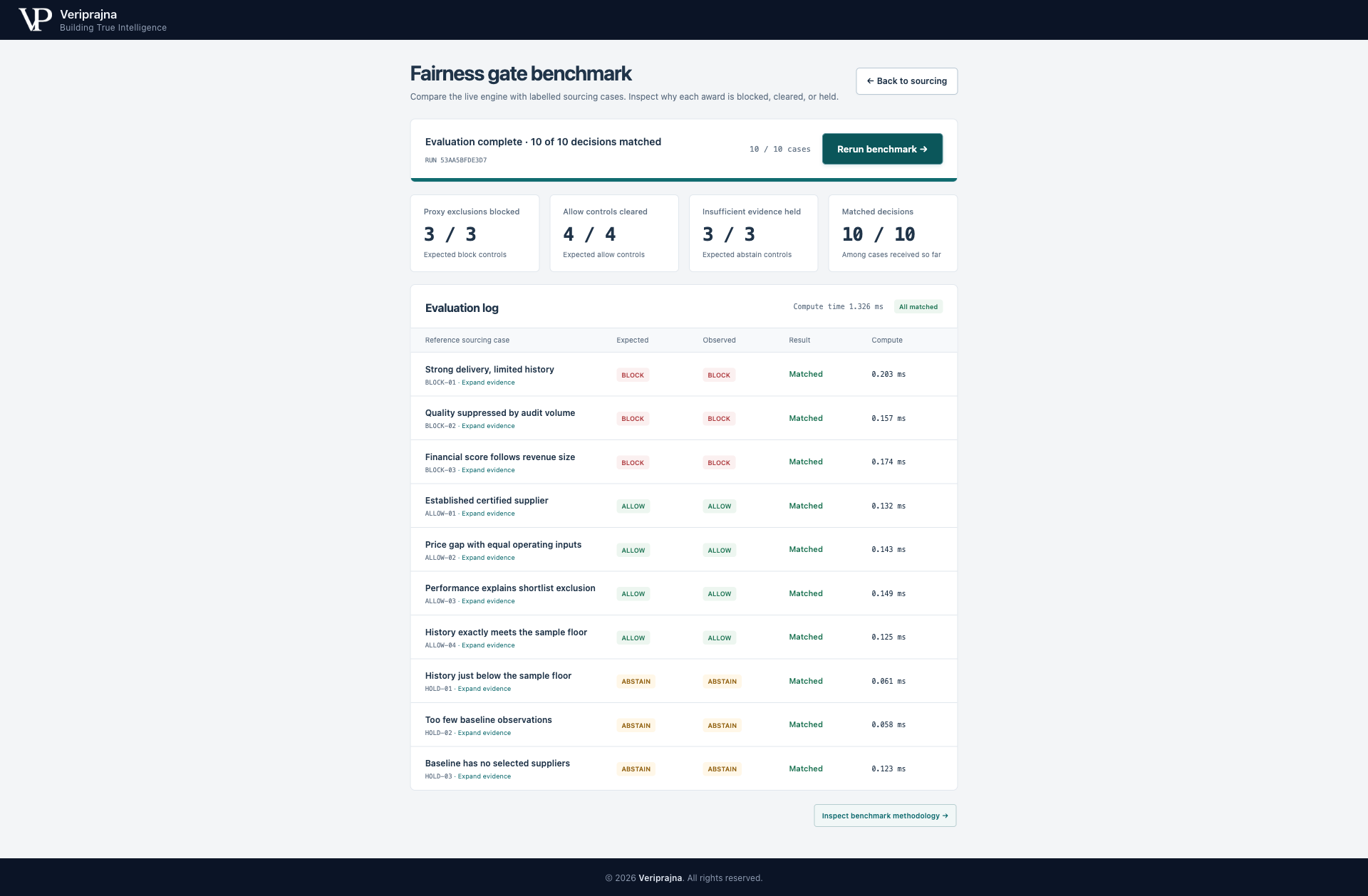
One boundary case permits assessment at history exactly 200 and returns ALLOW; another at 199 returns ABSTAIN. These controls help inspect whether the implementation follows its stated policy at consequential boundaries. They do not establish procurement-field accuracy, calibration or independent validation. The benchmark runs without a model call and does not append sourcing audit entries.
Separate a portfolio scan from executed interventions
The synthetic portfolio contains 52 events across six categories and 342 supplier-event rows. Those rows are repeated participation records, not 342 unique suppliers. Fifteen events are marked for autonomous awards; recomputing the policy yields eight BLOCK, one ABSTAIN and six ALLOW among them. Nine of the fifteen would therefore be held for review under this configuration.
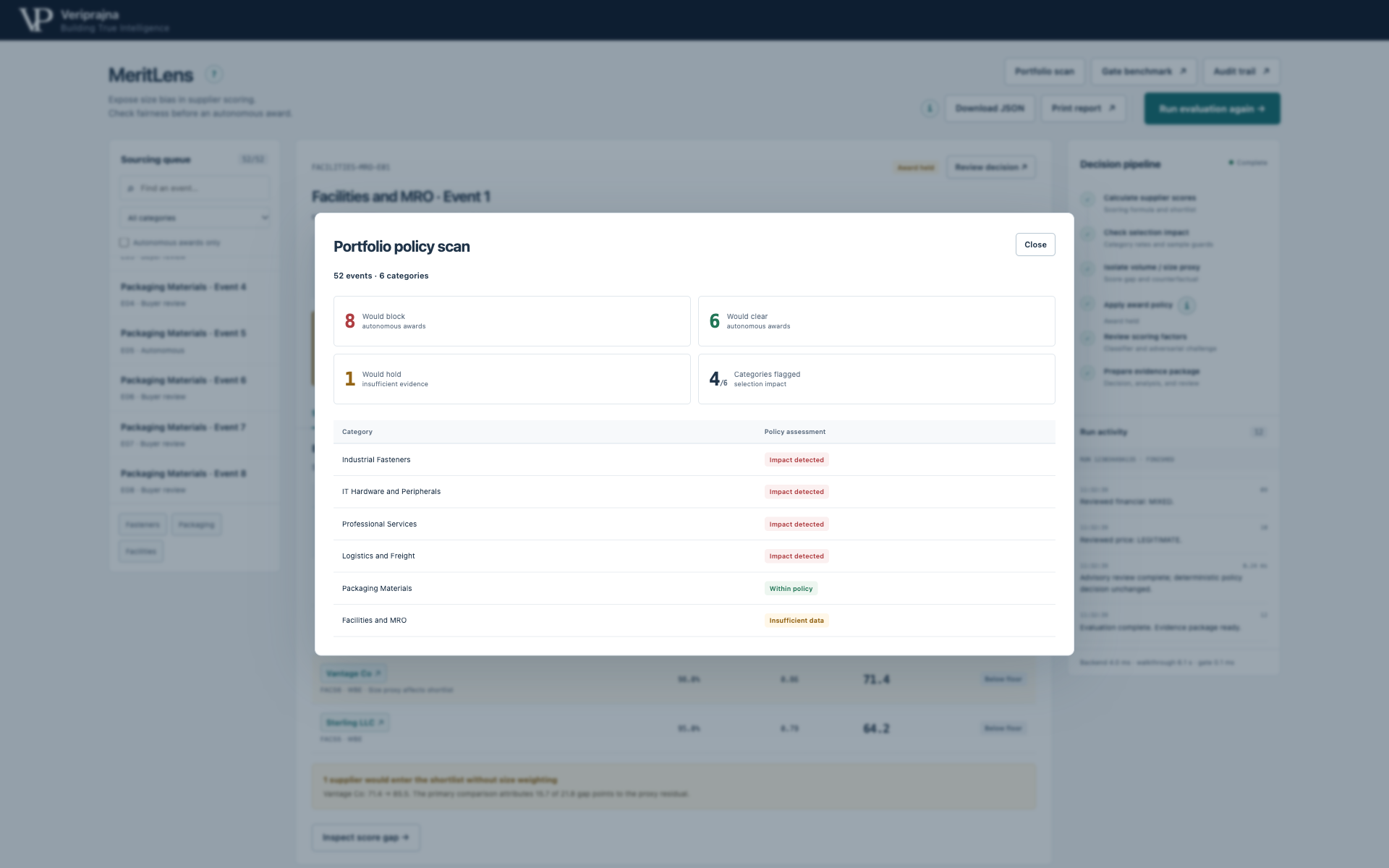
At category level, the scan reports four ADVERSE_IMPACT findings, one PASS and one ABSTAIN. The scan helps identify where a reviewer would inspect the evidence next. It is separate from the ten-case control suite: one summarizes a seeded portfolio, while the other checks expected implementation behavior. Neither supplies evidence about actual vendor populations.
Hand the decision and its evidence to the reviewer
After the evaluation and advisory factor review finish, Download JSON and Print report include the saved decision, audit entry, category counts, decomposition and factor review. Optional Proxy Classifier and Adversarial Challenger advice adds labels and rationales after the gate is saved. Numeric evidence remains grounded in code; advisory prose cannot authorize the award. Complete saved advisory responses can be reused for unchanged inputs, and unavailable providers fall back to deterministic review.
For a production assessment, the next questions concern which history measures are defensible for the contract, whether category comparisons represent the intended supplier population, and who has authority to resolve a hold. The demo makes those questions inspectable. Its local JSON audit persistence is not immutable third-party custody, and legal-named export fields are configured mappings rather than legal certification or independent assurance.