The emails that get an AI SDR in trouble are rarely the ones full of invented facts. They are the ones where every fact is true and every fact is used wrong: a real funding round that belongs to a same-named company, a real figure from a filing that is two years stale and described as a recent move. A better base model writes those sentences more fluently. It does not make them any less wrong to send, because nothing in them is actually false. The gap between a true fact and a true claim is the verification problem, and no model on any current roadmap closes it.
We ran into that gap repeatedly while building the Veracity Engine, a demo for verified AI outreach that checks every claim against a current, entity-matched source before an email is allowed to send. You can run it at https://veriprajna.com/demos/ai-sales-intelligence. The structural argument stands on its own, though, and most teams are still spending on the wrong side of it.
The category optimized for the wrong thing
AI SDRs were built to maximize volume, and they are very good at it. What almost none of them do is re-verify the resulting claim against a current, entity-correct source. Single-pass LLMs hallucinate 12 to 18 percent of prospect-specific claims (AI SDR Industry Report, 2026), and a personalization layer that never re-checks the sentence it just wrote will ship those claims intact. The output reads beautifully and is wrong in ways no reader can see.
The market has already started paying for that gap. Enterprise AI-SDR annual churn runs 50 to 70 percent (UserGems, 2026). 11x.ai, the most visible name in the volume-first cohort, raised $74M and then collapsed in 2025 amid reported 70 to 80 percent customer churn (TechCrunch). Gartner projects that more than 40 percent of agentic-AI projects will be abandoned by 2027. This is not a story about isolated bad tools. It is what happens when a category scales output faster than it scales trust.
The deliverability side compounds it. Since November 2025, Gmail has been rejecting at the SMTP level, and a spam rate above 0.3 percent can trigger a six to twelve week domain recovery. A single run of confident, unverified claims does not just embarrass you. It can take your sending domain offline for a quarter.
Why a stronger model does not close the gap
The intuitive fix is a model that hallucinates less. It helps at the margin, and it still leaves the real failure standing, because the dangerous outbound claim is usually not invented. It is true somewhere else and reused as if it were true here and now. We call that contextual misuse: a claim that is correctly cited but misleadingly used.
One of the demo's worked leads shows the shape exactly. The draft told the prospect we had noticed they "recently expanded into APAC." True statement. The wording matched the cited source almost token for token, and the source was about the right company, so the grounding and entity checks both passed clean. The verifier stripped the claim anyway. The source was dated March 2019. Against a claim that leans on the word "recently," the temporal check is blunt and unforgiving: source age 2,652 days, ceiling 365 days, fail. A larger model would have written the same true sentence with the same confidence, and it would have been just as wrong to send. The other two shapes we hit in the demo rhyme with it: a funding round that actually belonged to a same-named company in a different industry, and a vendor detail a newer source had since contradicted. In every case the sentence is true. The seam is in the context, and fluency hides it.
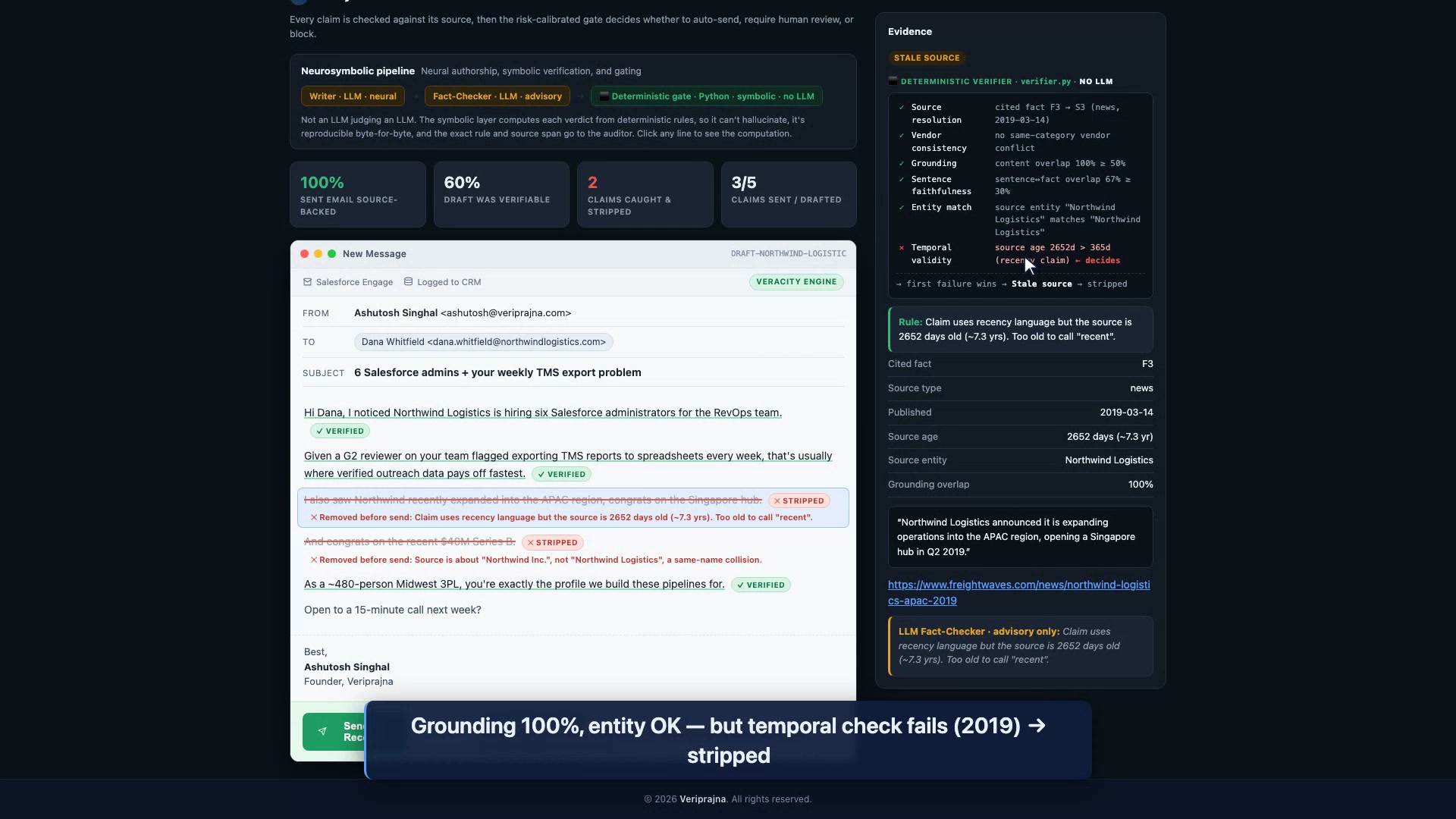 The evidence panel for the APAC claim in the running demo. Grounding scores 100 percent and the entity check passes clean, but temporal validity fails: source age 2,652 days against a 365-day ceiling, on a source dated March 2019. A true sentence, stripped before send.
A perfect model still cannot prove to a regulator which current source backed which claim. Verification and governance are not a stopgap until the models improve. They are the part that has to sit outside the model.
That is the durable-moat argument, and it is the whole reason we think this is worth building. Model accuracy is a moving target that every base-model release resets. Provenance, an audit trail, and a risk-calibrated policy gate are stable properties that do not age out when the next model ships. Only 7 percent of enterprises today have governance built specifically for agentic systems (Deloitte, 2026), which means the moat is not just durable, it is largely unclaimed.
The demo as proof, not decoration
An argument like this is easy to assert and easy to fake, so the point of the demo is to make it mechanical. In the Veracity Engine, the language model drafts, and then a deterministic, pure-Python verifier decides what actually ships. It is not an LLM grading another LLM's homework. It is code running the same checks the same way every time. Agents advise, code decides.
There are three checks. Grounding asks whether a claim is actually entailed by a source snippet. Entity match asks whether the source is about this prospect and not a different company that shares its name. Temporal validity asks that if a claim leans on recency (recently, just, now, this week), the supporting source is within 365 days. The first failing check wins, and the claim is stripped. Whatever survives all three is what the email is allowed to contain.
The policy gate then reports two numbers, and the distance between them is the point. The Veracity Score is how much of what the model wrote turned out to be provable, and we show it honestly even when it is well under 100 percent. Sent integrity is the guarantee.
Every factual claim in the email that actually goes out is backed by a current, entity-matched source. Not because the model behaved, but because the unproven claims were stripped before send.
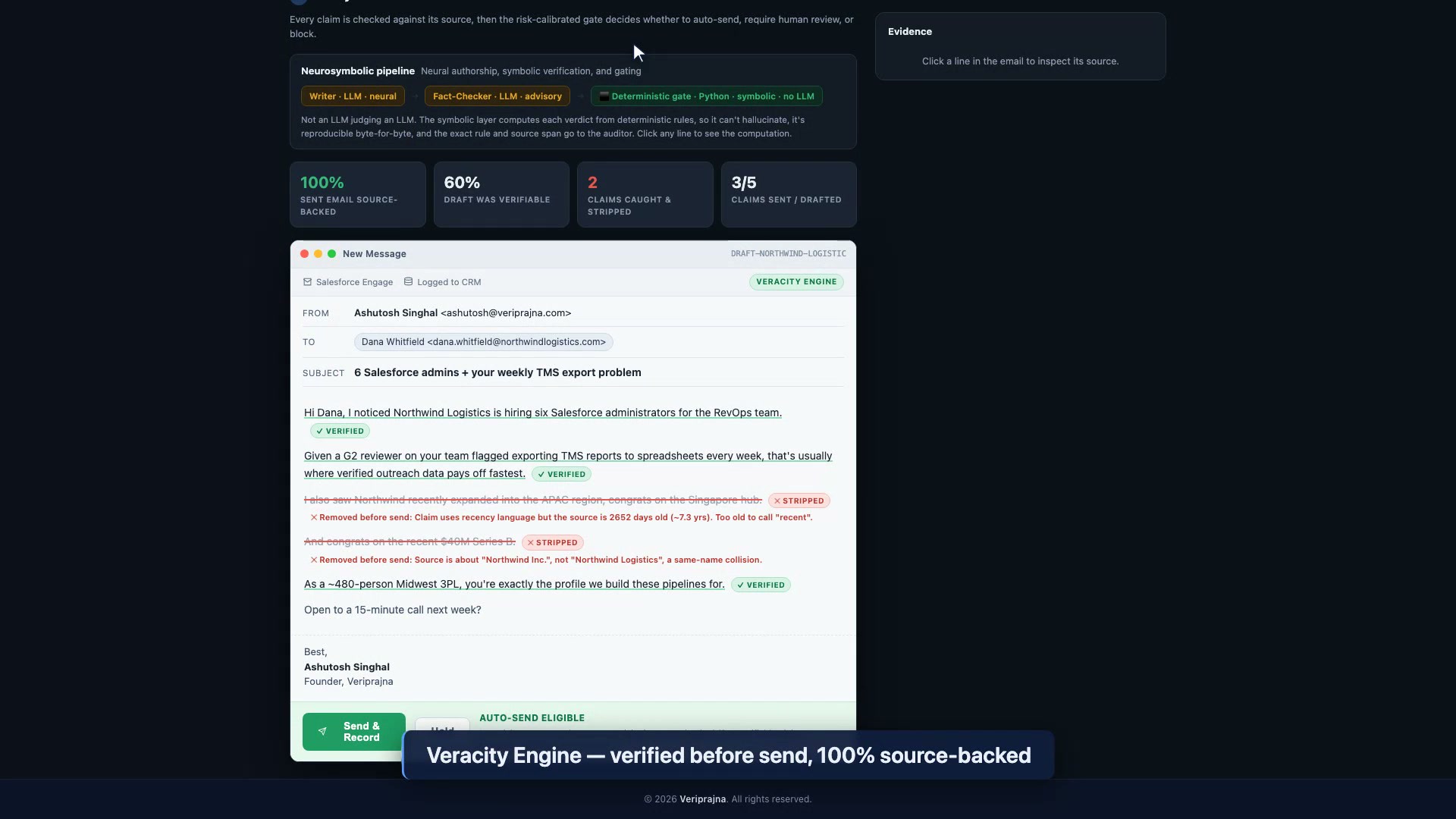 The two numbers, side by side. Sent integrity is 100 percent because every unproven claim was removed, while the draft itself was only 60 percent verifiable. The stale APAC line and the same-name funding line are struck through with the reason each was stripped.
Governance is treated as a separate question from correctness, which is why the gate can route a completely clean draft to a human review anyway when the buyer is regulated, the contact is C-suite, or the deal is high-value. A flawless email to a FINRA-regulated broker-dealer is still an email that a person should sign off on, and the demo forces that even when the draft is spotless. Each send also produces a downloadable JSON audit receipt: the model and version, the prospect and risk tier, every claim with its verdict, source span, and dates, and the exact policy rule that fired. If a compliance reviewer asks which source backed a given sentence, the answer is a click, not an investigation.
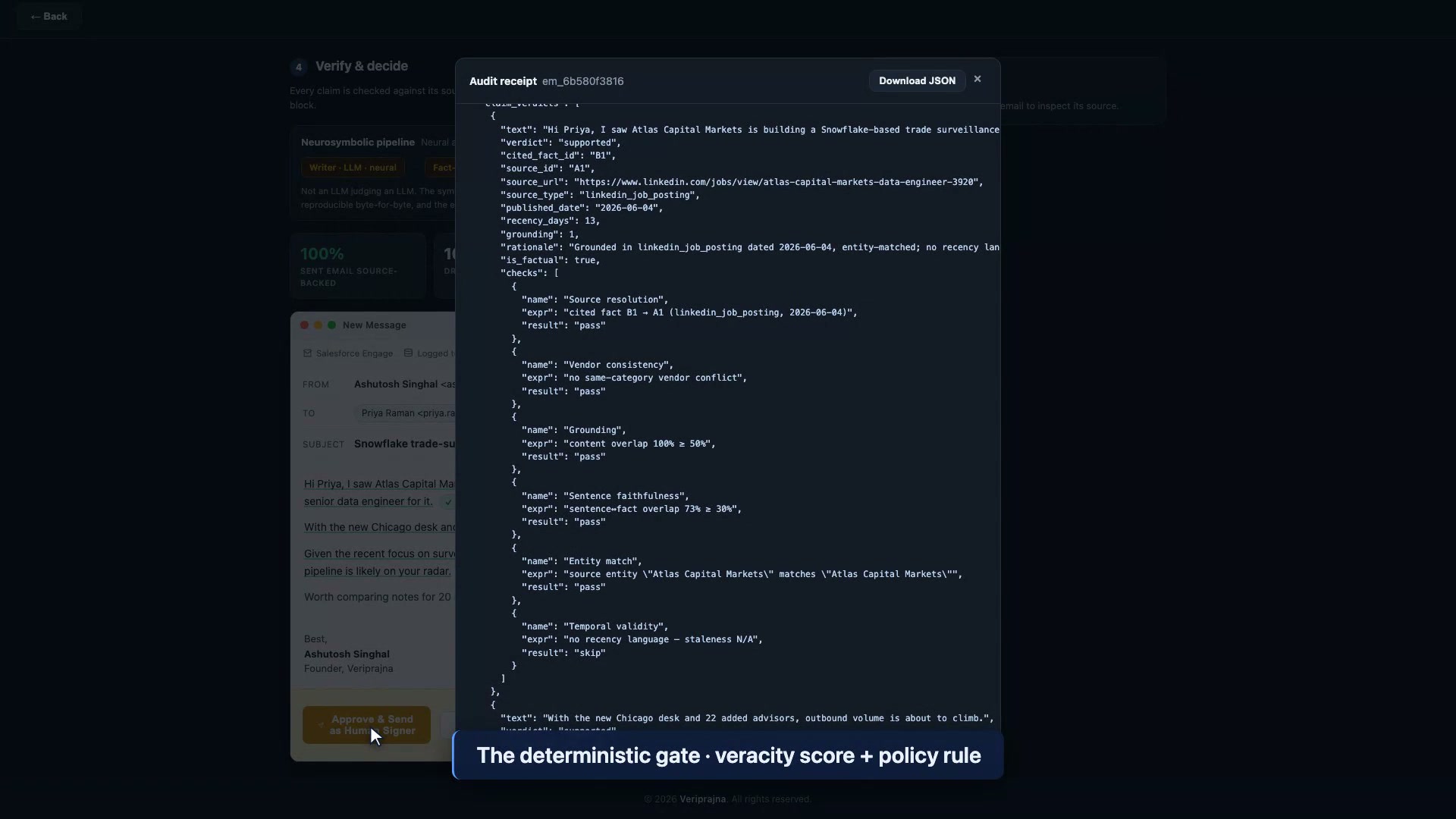 The downloadable JSON audit receipt for one email. Each claim carries its verdict, its cited fact and source id, the published date and recency days, and the full per-check trace, so any sentence traces back to its source in a click.
On our own labeled benchmark, a 25-case golden set, the deterministic verifier reached 25 out of 25 verdict accuracy, and because it is deterministic, the same input yields the same verdict on every run. We are careful with that number: it describes a fixed golden set for the deterministic checks, not an open-world promise. But reproducibility is exactly what makes a check certifiable, and an LLM judge cannot give you the same answer twice on demand.
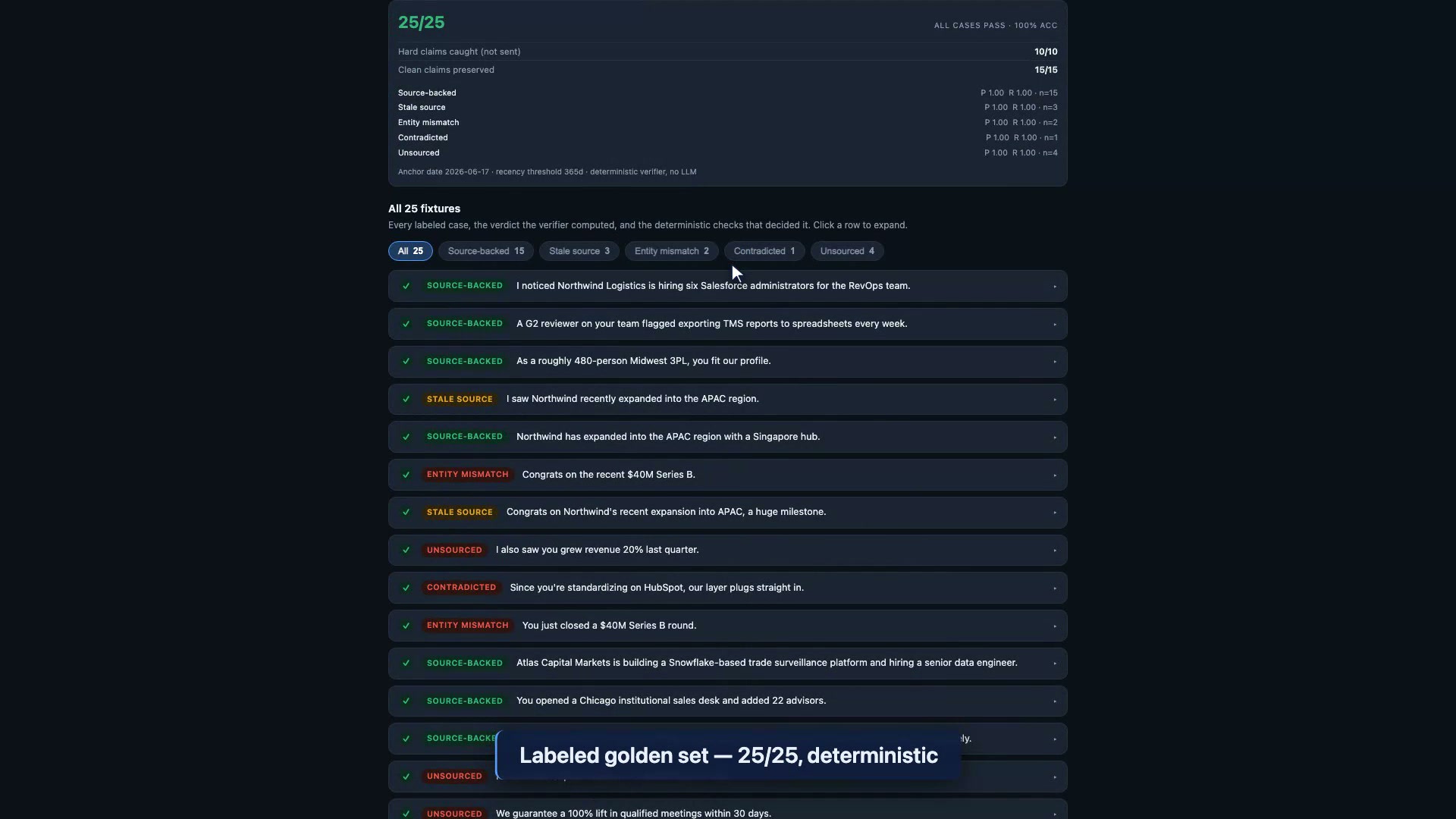 The 25-case labeled golden set. 25 out of 25 verdicts correct, 10 of 10 hard claims caught, 15 of 15 clean claims preserved. Because the verifier is deterministic, the same input yields the same verdict on every run.
Where we are, and what we are asking
This is a demo, not a deployed pipeline. The data retrieval and CRM steps are simulated so the mechanism can be examined end to end. What we are confident about is the shape of the problem: for AI outreach, personalization is not verification, and the failure that costs you is contextual misuse rather than raw invention. A better base model makes the prose smoother. It does not make the claim provable. The full run is at https://veriprajna.com/demos/ai-sales-intelligence.
So one honest question for anyone running AI outreach into regulated accounts: once the model has written the email, does anything in your stack re-verify each claim against a current, entity-matched source, or does it send on the model's word? We would genuinely like to hear where your team draws that line. The problem is industry-wide, and the good answers will be too.