A subscriber reaches the cancellation flow. A retention team can estimate the risk of losing that subscriber, but it still needs another answer before making an offer: what is this intervention expected to change?
That distinction belongs in the decision before an AI agent drafts persuasive copy. A discount can help someone stay. It can also reduce revenue from someone who would have stayed anyway, or accompany contact that makes retention less likely. Predicting a departure does not establish that a particular offer will improve the outcome.
We built Ethical Subscription Retention AI around that decision. Its Retention Assurance workspace uses synthetic subscribers and simulated billing inputs to examine estimated intervention benefit after discount cost. The useful lesson for retention and growth leaders is how to evaluate the offer policy, including the cases where the system should leave a subscriber alone.
Hold the contact budget constant
The clearest comparison in the demo comes from Northwind SaaS, a synthetic account with 6,000 current cancellation intents. Its predictive churn policy ranks subscribers by estimated churn risk. Its causal uplift policy selects subscribers with positive estimated net intervention benefit after the configured discount.
Both policies contact 2,239 subscribers. That shared budget matters: a comparison with different contact counts could mix the effect of targeting with the effect of reaching more people. Here, the two policies differ in whom they select under the same budget.
In the fixture evaluation, predictive churn targeting produces $144,162 in annual incremental revenue relative to leaving the cohort alone. Causal uplift produces $187,956 on the same basis. The $43,794 difference is synthetic policy value, not retained customer revenue, a deployment result or a forecast for the complete operational system. The evaluation uses hidden synthetic outcomes to score the policies; those outcomes are unavailable to the targeting models.
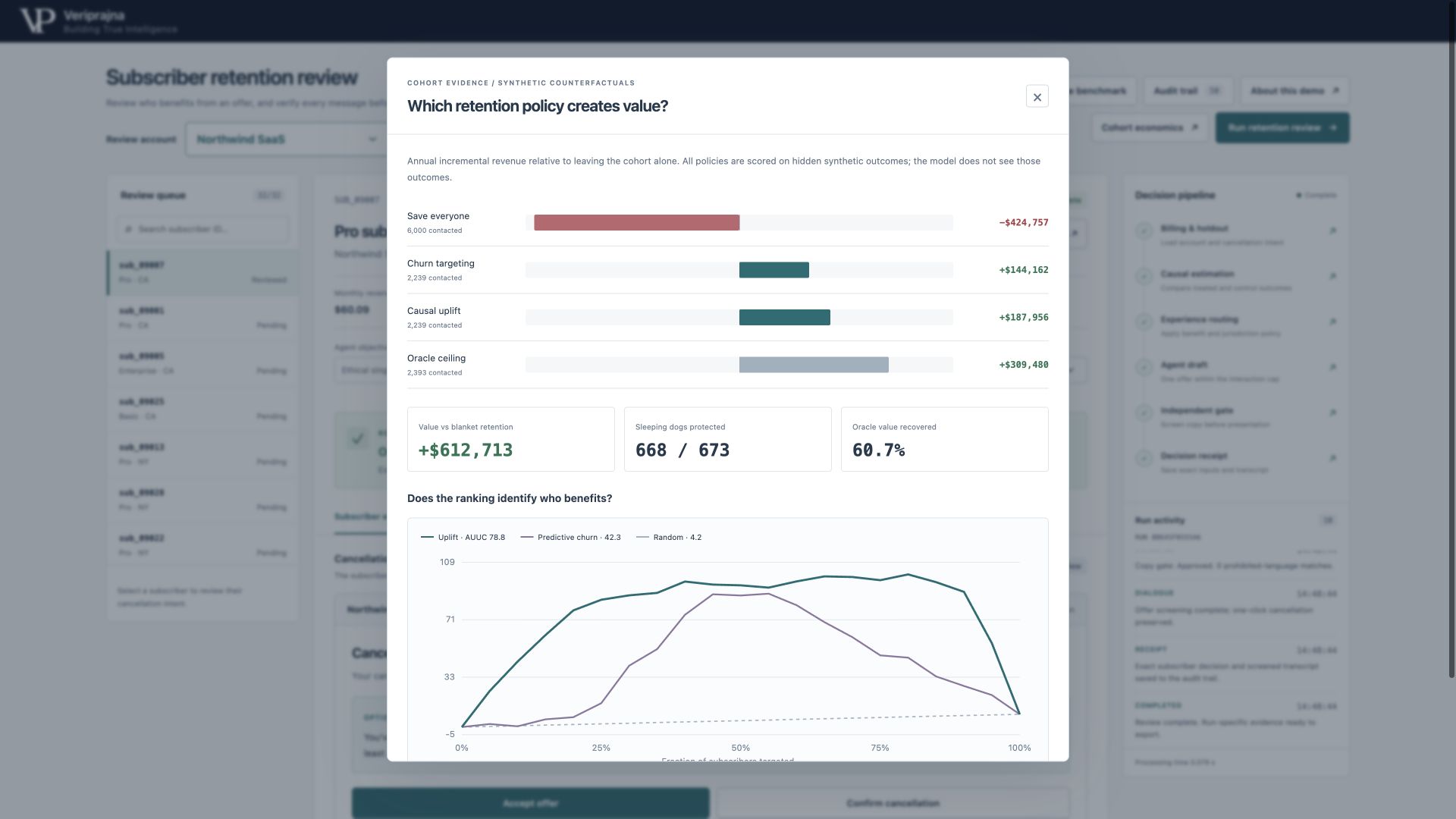 The synthetic policy comparison holds the contact budget constant. Its annual incremental values are measured against leaving the cohort alone, using hidden fixture outcomes for evaluation.
The screenshot also shows a perfect-information oracle ceiling. It is useful as a reference for what remains unrecovered, but it cannot be deployed: it selects with access to hidden outcomes. A buyer should not treat that ceiling as an available operating policy.
Our interpretation is narrower and more useful than a savings promise. Changing the selection question changes the policy being evaluated. A churn model helps identify risk. An intervention model attempts to identify where action will improve retention, and the economics must then account for what that action costs.
For a team evaluating retention automation, we would ask for a comparison that names the alternative, fixes the budget and states how value was measured. A headline lift without those details leaves the decision unclear. The baseline here is leaving the cohort alone, so the calculation asks whether the intervention adds value beyond what would happen without it.
Retention gain has to cover the discount
The demo estimates retention under treatment and under no treatment from separate models trained on randomized synthetic history. It then adjusts estimated treated retention for a configured 16.7% discount before comparing it with estimated retention without intervention.
This makes a practical boundary visible. An intervention can have a positive estimated retention effect while still failing to cover its discount cost. The selected-subscriber route therefore permits a save offer only when estimated gain covers that cost and the configured routing controls allow it. A stronger message cannot repair an offer whose expected economics fail that check.
The aggregate policy comparison and the selected-subscriber route also answer different questions. The cohort values compare targeting policies. They do not include every segment and jurisdiction constraint applied when the workspace decides what to show one subscriber. We would keep those results separate in an evaluation rather than presenting cohort value as proof of the complete workflow's performance.
A no-contact decision needs evidence too
Another synthetic Northwind subscriber makes the consequence concrete. The model estimates retention without intervention at 87.1%, and retention with intervention at 28.2%, a negative estimated difference of 58.9 percentage points. The workspace labels this case a Sleeping Dog, its term for a subscriber whose retention is estimated to be harmed by intervention.
The resulting route is Do Not Contact. The agent does not draft a save offer, and cancellation remains available in the subscriber preview. The screenshot exposes the estimates and the route together, so the absence of an offer has an inspectable reason. These are model estimates, not observed individual counterfactual outcomes. The preview has local UI effects only; it does not change a billing account.
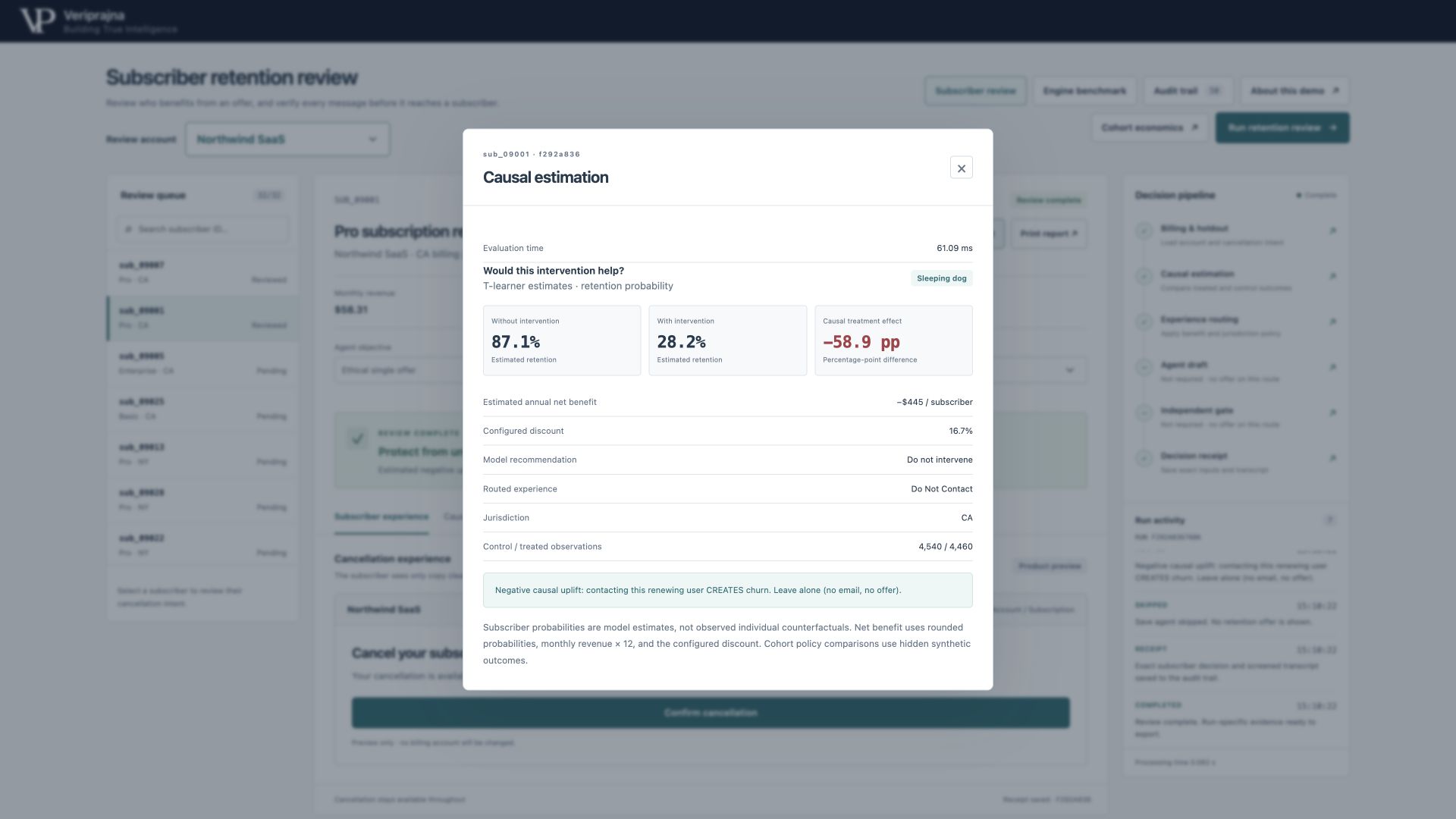 The synthetic subscriber's negative estimated intervention effect leads to a Do Not Contact route. The displayed retention values are model estimates, and cancellation remains available in the local preview.
That individual case does not establish perfect protection. In the aggregate uplift policy, 668 of 673 subscribers labeled Sleeping Dogs by the hidden synthetic ground truth remain uncontacted. Five are still contacted. The result gives an evaluator both a benefit and a residual error to inspect, rather than permission to claim that harmful contact has been eliminated.
It also changes what we would count as a useful system explanation. An offer needs a reason to proceed. A no-contact route needs a reason to stop. Both should be understandable to the operations team without treating the model's estimate as causal certainty.
The full product breakdown explains the local demonstration and its boundaries. For a retention team, the evaluation decision comes first: require evidence that the offer is expected to add value after cost, and inspect the errors alongside the gains. Persuasive copy should follow an eligible offer decision.