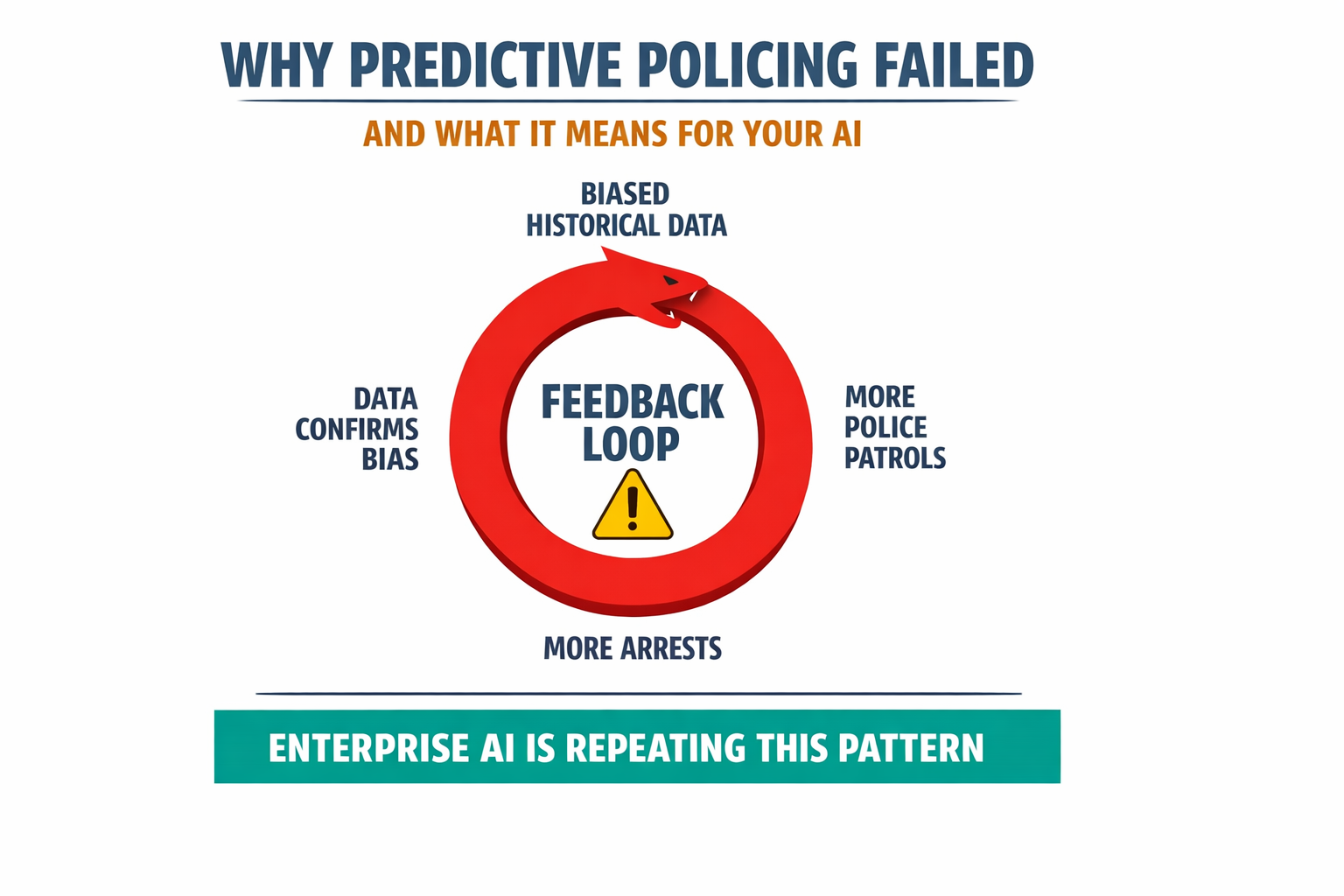
When the Los Angeles Police Department quietly ended its predictive policing contract in early 2024, it closed the book on a decade-long experiment in algorithmic integrity — or rather, the total absence of it. Enterprise AI is now repeating the same mistakes. Comparable jurisdictions reported prediction accuracy rates below 1%. Chicago's "heat list" — a system meant to flag individuals at risk of gun violence — had grown to include over 400,000 people, with 56% of Black men in the city between ages 20 and 29 swept into its net. Of those flagged as priority targets, 57% had never been arrested for a violent crime.
These were not edge cases. They were the direct, predictable outcomes of AI systems built on flawed data, deployed without governance, and left to run unchecked for years. And the same structural failures that brought down predictive policing are now embedded in how most enterprises are deploying generative AI.
Our team has spent considerable research effort examining these collapses — not as cautionary tales about law enforcement, but as a technical blueprint for what goes wrong when organizations treat AI as a plug-and-play tool rather than a system requiring deep algorithmic integrity. We documented our full findings in our interactive analysis.
How Did a Feedback Loop Eat Itself?
The core failure in predictive policing was not a bad algorithm. It was a self-reinforcing cycle that turned historical bias into mathematical certainty.
Look at how Geolitica (formerly PredPol) worked for the LAPD. The system ingested historical crime data — location, time, type of crime — and generated 500-by-500-foot "hotspot boxes" where officers should patrol. The underlying model was borrowed from seismology, originally designed to predict earthquake aftershocks.
When the algorithm flagged a neighborhood, more officers went there. More officers meant more stops. More stops meant more arrests for low-level offenses — jaywalking, minor possession — that would go unnoticed in other parts of the city. Those new arrests fed right back into the system as fresh evidence that the neighborhood was dangerous.
An algorithm that predicts where police will arrest people is not the same as one that predicts where crime occurs.
California's Racial and Identity Profiling Act (RIPA) data made the disparity concrete: Black individuals were stopped 126% more frequently than expected based on population share. Yet searches of Black and Latino individuals were consistently less likely to discover contraband than searches of white individuals. The data was telling officers where to look based on where they had already been looking.
What Did Chicago's "Heat List" Reveal About Black-Box AI?
Chicago took a different approach — instead of predicting locations, the Strategic Subject List tried to predict people. The algorithm analyzed social networks and arrest records to identify individuals most likely to be involved in gun violence.
The list ballooned. At its peak, 96% of suspected gang members flagged by the system were Black or Latino. In the West Garfield Park neighborhood, 73% of Black males between ages 10 and 29 appeared on the list. The algorithm over-relied on arrest records, including misdemeanors with no statistical connection to future gun violence, creating a "suspect" status for people who had never been convicted of anything violent.
Chicago's heat list operated for nearly a decade, impacting hundreds of thousands of lives, before independent audits documented that it was biased along racial lines and largely ineffective at reducing murder rates.
The Chicago Office of Inspector General found that Black motorists were searched at rates 3.3 times higher than white motorists — again, with lower contraband discovery rates. The system was decommissioned in late 2019, but not before it had demonstrated how an opaque algorithm can institutionalize discrimination at scale.
Why Have Over 40 Cities Drawn the Line?
The regulatory response has been swift. San Francisco became the first major city to ban police use of facial recognition in 2019. Boston, Portland, and Santa Cruz followed. Over 40 cities have now moved to ban or strictly limit predictive policing and related surveillance technologies.
At the federal level, the White House and Office of Management and Budget issued a landmark policy in March 2024 requiring independent testing and mandatory impact assessments for any rights-impacting AI systems deployed by federal agencies. California's new 2025 AI transparency laws add another layer of compliance obligation.
This regulatory wave is not limited to law enforcement. Any organization deploying AI in high-stakes decision-making — legal review, financial underwriting, medical triage, hiring — is now operating in a legal environment that demands transparency, auditability, and demonstrable fairness.
Why Most Enterprise AI Carries the Same Risks
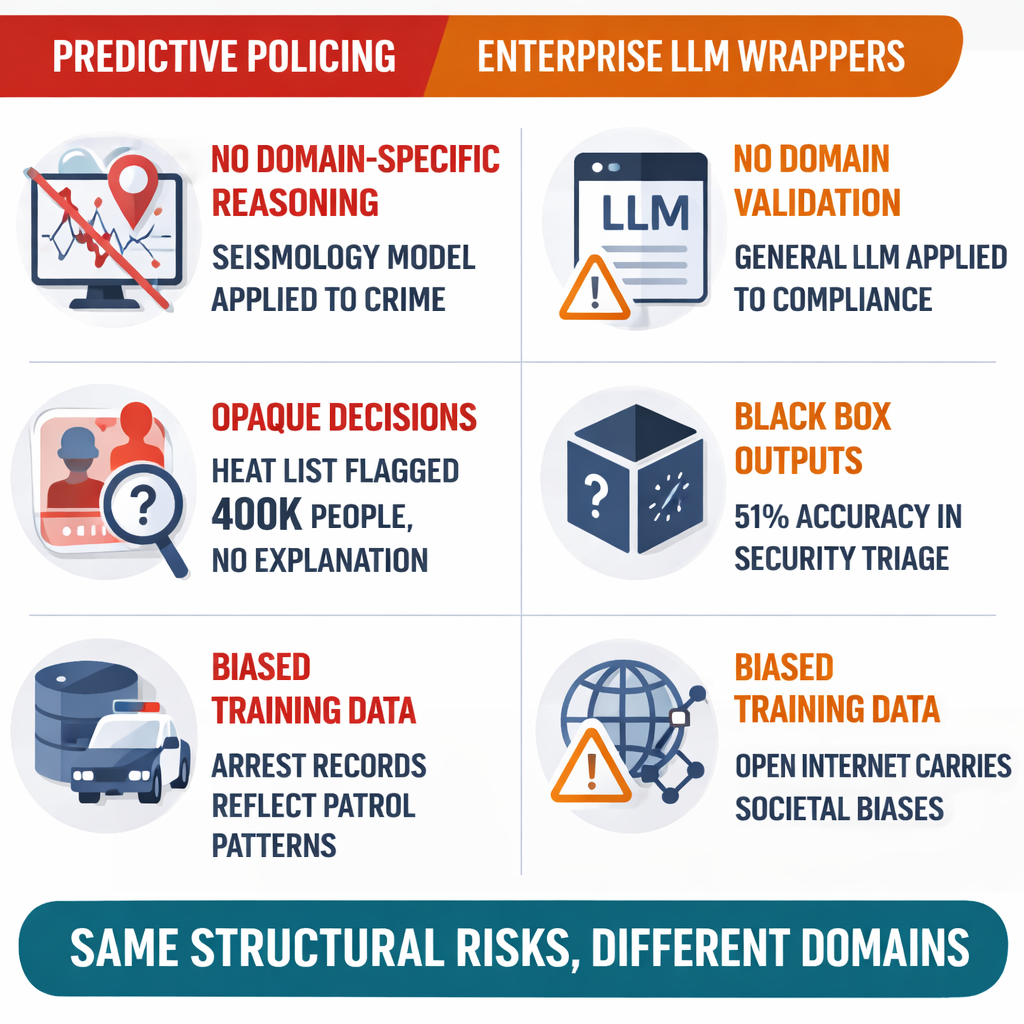
The corporate world's rush toward generative AI has produced a familiar pattern. Most enterprise AI deployments today are what our research identifies as "LLM wrappers" — simple API integrations that layer a user interface or minor prompt engineering over foundational models. In our analysis across multiple enterprise sectors, over 80% of deployed generative AI tools fell into this category, with no domain-specific validation layer and no bias auditing. They provide quick wins, but they inherit the same structural risks that destroyed predictive policing: no domain-specific reasoning, opaque decision logic, and training data that carries the biases of the open internet.
In security vulnerability triage, for example, naive wrapper agents achieve roughly 51% accuracy — essentially a coin flip when distinguishing a minor bug from a critical exploit. Standard foundational models also carry safety alignments that prevent them from taking firm positions in ambiguous scenarios. In enterprise contexts like compliance or risk assessment, an AI that hedges on every answer is not a tool — it is a liability.
Simple wrappers ship fast. They also fail fast — and silently.
Building AI That Can Withstand Scrutiny
Our approach at Veriprajna starts from a different premise: enterprise AI must be auditable, explainable, and mathematically fair from day one — not retrofitted after a crisis.
This means unified data foundations where data assets are audited for quality, accessibility, and historical bias before any model touches them. It means specialized reasoning layers — composable agents that perform deep research through both inductive and deductive reasoning, rather than relying on single-shot LLM calls. And it means continuous oversight: real-time monitoring for model drift, shadow modeling against established baselines, and red-teaming to surface vulnerabilities before they reach production.
We apply fairness metrics directly in the development lifecycle. Demographic parity — ensuring outcomes are independent of protected attributes like race or gender — is a starting point. But our research demonstrates that demographic parity alone is insufficient. We also measure equalized odds, requiring that true positive and false positive rates are consistent across demographic groups. Bias mitigation runs across the full pipeline: re-weighting training data before training, incorporating fairness constraints during training, and calibrating decision thresholds after training.
For the complete technical methodology behind our governance framework and its alignment with the NIST AI Risk Management Framework, see our detailed research.
"But Our Use Case Is Low-Risk"
We hear this frequently. The predictive policing failures involved life-and-liberty decisions — surely a recommendation engine or a document classifier does not carry the same weight.
Think about it this way: AI-driven cyberattacks increased by 300% between 2020 and 2023. Microsoft found in 2024 that 78% of AI users in organizations were using unauthorized external AI tools — what the industry calls "Shadow AI." The risk is not always in the model you built. It is in the models your employees are already using without governance, feeding proprietary data into systems you do not control.
The lesson from predictive policing is not that AI is dangerous. It is that ungoverned AI accumulates harm silently. Feedback loops do not announce themselves. Bias does not send alerts. By the time an independent audit catches the problem, the damage — to communities, to customers, to trust — may already be irreversible.
What Should Your Organization Do Differently?
Audit your data before you build anything. If you cannot explain what biases live in your training data, your AI cannot be trusted with decisions that affect people.
Demand explainability. If your AI vendor cannot show you which features drive a specific prediction — not in general terms, but for a specific decision — you are operating a black box. The same epistemic opacity — the inability to see inside a system and understand why it made a particular choice — that let Chicago's heat list run unchecked for a decade is present in most commercial AI systems today.
Build governance into the architecture, not around it. Compliance bolted on after deployment is the enterprise equivalent of auditing a predictive policing system ten years too late.
In a market where trust is the ultimate currency, neglecting algorithmic integrity is the most expensive bias an enterprise can carry.
If your organization is wrestling with how to move from AI experimentation to AI governance, we would welcome that conversation. The hard part is not building AI systems that work. It is building AI systems that work fairly — and can prove it.