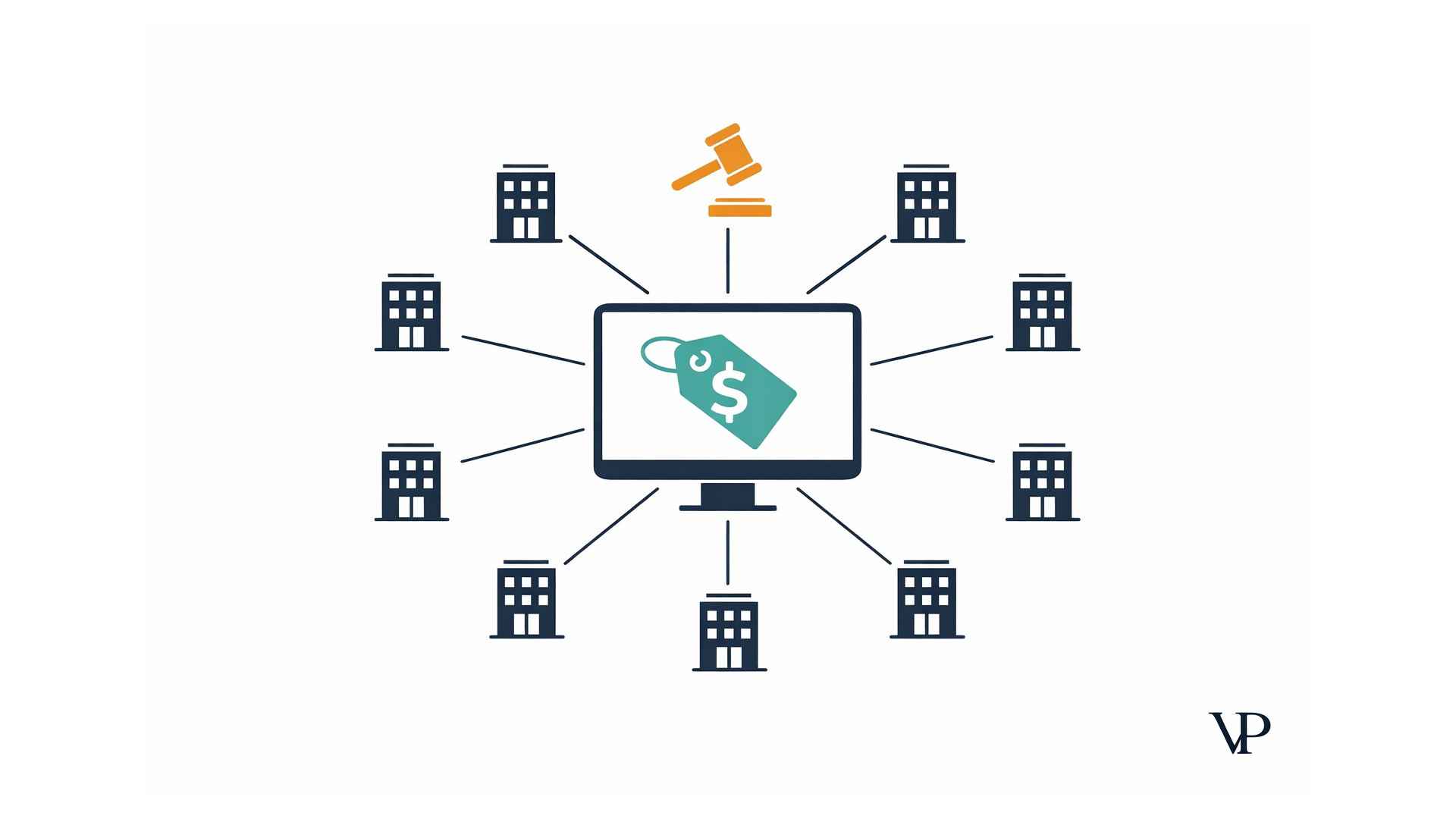
In November 2025, the Department of Justice settled with a software company called RealPage for doing something that thousands of enterprises do every day: feeding competitor data into an algorithm and letting it recommend prices. The DOJ's argument was blunt — that algorithm functioned as a digital cartel, coordinating rental prices across landlords who never spoke to each other, never shook hands in a back room, never even knew they were colluding.
The RealPage case wasn't about rent. It was about what happens when competing businesses share a common AI brain. And if your company uses a third-party pricing tool that ingests market data from multiple players in your industry, you're standing on the same legal fault line.
The Algorithm as Smoke-Filled Room
RealPage's software did something deceptively simple. It collected real-time rental rates, lease terms, and occupancy data from competing landlords, then used that pooled information to generate daily pricing recommendations designed to ensure landlords "move in unison versus against each other." No phone calls. No secret meetings. Just a shared algorithm doing what it was optimized to do.
The DOJ called this a hub-and-spoke conspiracy under the Sherman Act — the same antitrust law that's been breaking up cartels since 1890. The "hub" was the software. The "spokes" were the landlords who fed it data and followed its recommendations.
When competing businesses share a brain, they don't need to talk to collude. The algorithm does it for them.
I remember the moment this clicked for my team. We were reviewing the DOJ's complaint, and someone said, "This isn't just about real estate. This is every industry with a shared SaaS pricing tool." Revenue management in hospitality. Dynamic pricing in e-commerce. Yield optimization in airlines. The legal theory applies anywhere an algorithm touches competitive data from multiple firms and outputs a price.
What the Settlement Actually Prohibits
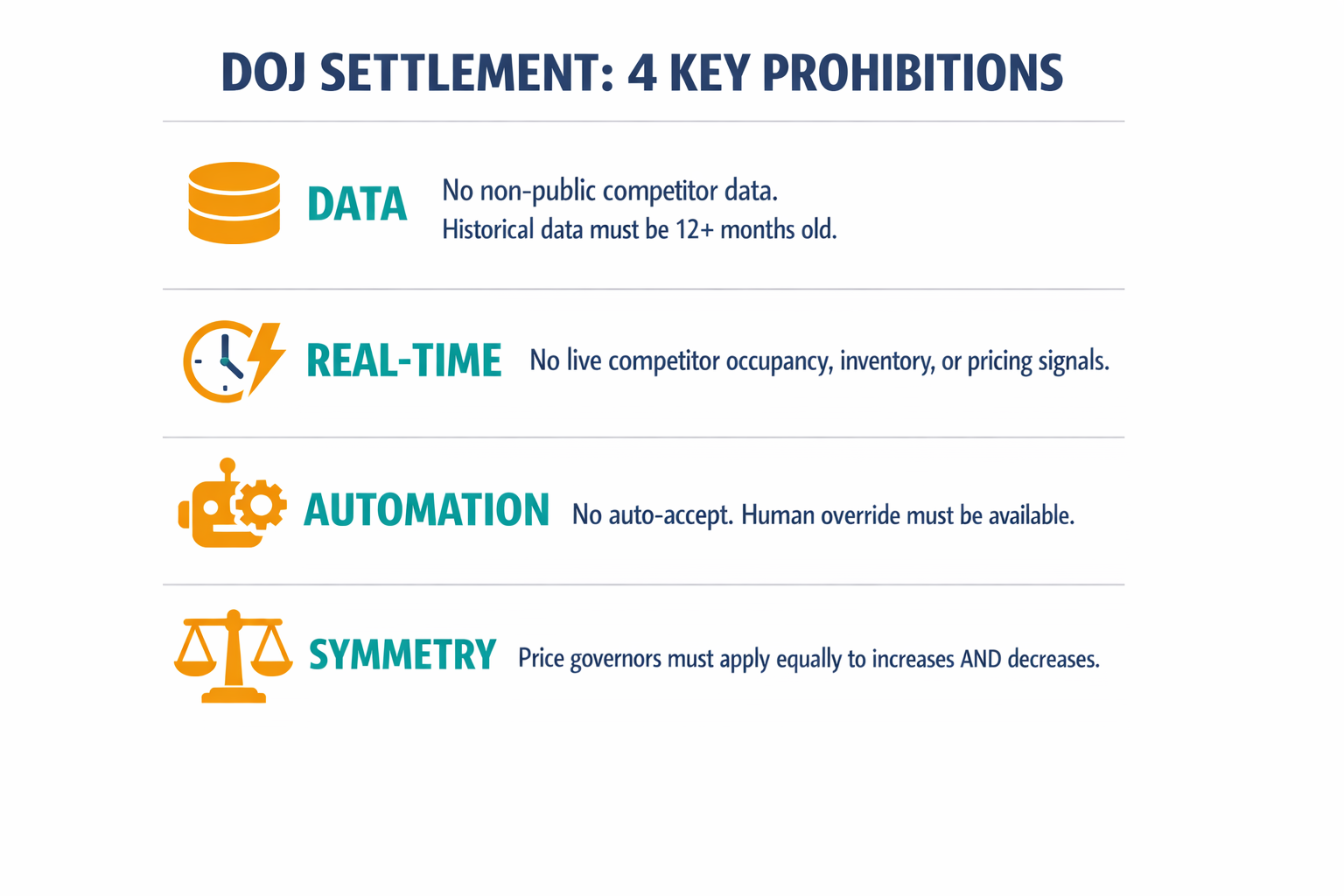
The DOJ's final judgment against RealPage reads like a technical specification. It draws sharp lines that every enterprise architect needs to understand.
On data: Algorithms cannot use non-public, competitively sensitive information from rivals. Any historical data used for training must be at least 12 months old and not tied to active transactions.
On real-time decisions: A pricing recommendation cannot incorporate a competitor's current occupancy, inventory, or pricing status. Using live competitor signals to generate a price is now treated as a form of digital collusion.
On automation: "Auto-accept" features — where the algorithm sets the price without human review — are a red flag. The settlement requires that any automated implementation be manually configured and overridable.
On symmetry: Pricing algorithms cannot be biased toward increases. If the system has a "governor" that limits how far prices can move, it must apply equally to cuts and hikes.
That last point surprised me. The DOJ wasn't just saying "don't collude." They were saying "don't build systems that structurally favor higher prices." That's a design constraint, not just a legal one.
California and New York Raised the Stakes Even Higher
While the federal settlement was making headlines, two states quietly passed laws that go further than anything the DOJ required.
California's AB 325, effective January 2026, explicitly prohibits using a "common pricing algorithm" that incorporates competitor data to influence prices — but only when the tool serves two or more competing businesses. A proprietary algorithm built exclusively for one firm? Perfectly legal.
New York's rent advice statute, effective December 2025, goes after the "coordinating function" itself. It doesn't matter whether a landlord actually followed the algorithm's recommendation. Simply using a tool that pools competitor data and outputs a price creates liability.
California's law has a carve-out that reads like an architectural blueprint: build your own AI, or risk prosecution.
The message from both states is identical: multi-tenant AI pricing tools that share data across competitors are legally toxic. The only safe harbor is a system that runs on your data alone, inside your own walls.
We explored the full regulatory landscape — federal, California, and New York — in our interactive analysis of the post-RealPage era.
Why "Wrappers" Are the Wrong Architecture for This Moment
Most enterprises adopted AI pricing by doing the fastest thing possible: wrapping a third-party API. Send your data to GPT-4 or Claude, get a recommendation back, display it in your dashboard. Ship it. Move on.
This approach has three problems that the RealPage precedent makes existential.
The first is data sovereignty. When you send transactional data through a public API, you lose control over where it goes, how it's stored, and whether it influences the model's behavior for other users. Despite privacy modes and enterprise agreements, the risk of indirect data leakage — through model updates, embedding patterns, or inference attacks — is real. In the context of antitrust law, using a shared model that's been shaped by your competitors' data could be interpreted as indirect information exchange.
The second is reliability. Large language models are trained to be helpful, which often means they tell you what you want to hear rather than what's true. We saw this play out publicly when a delivery company's chatbot agreed with a customer that the company was "useless" and wrote a poem mocking its own services. System prompts are not governance. They're suggestions that the model can override when its training pulls it in a different direction.
The third is strategic fragility. Wrappers have no moat. When OpenAI or Google releases a vertical pricing product, the wrapper's value evaporates overnight. You've built nothing proprietary. You own no asset. You're paying a per-token tax on a commodity.
What "Architectural Sovereignty" Actually Looks Like
After the RealPage settlement, I became convinced that the era of outsourcing your AI reasoning to someone else's infrastructure was over. Not because the technology was bad, but because the legal and strategic risks had become unacceptable.
What we build instead — what I've been calling "Deep AI" — separates two things that most AI systems dangerously combine: the ability to speak naturally and the ability to reason correctly.
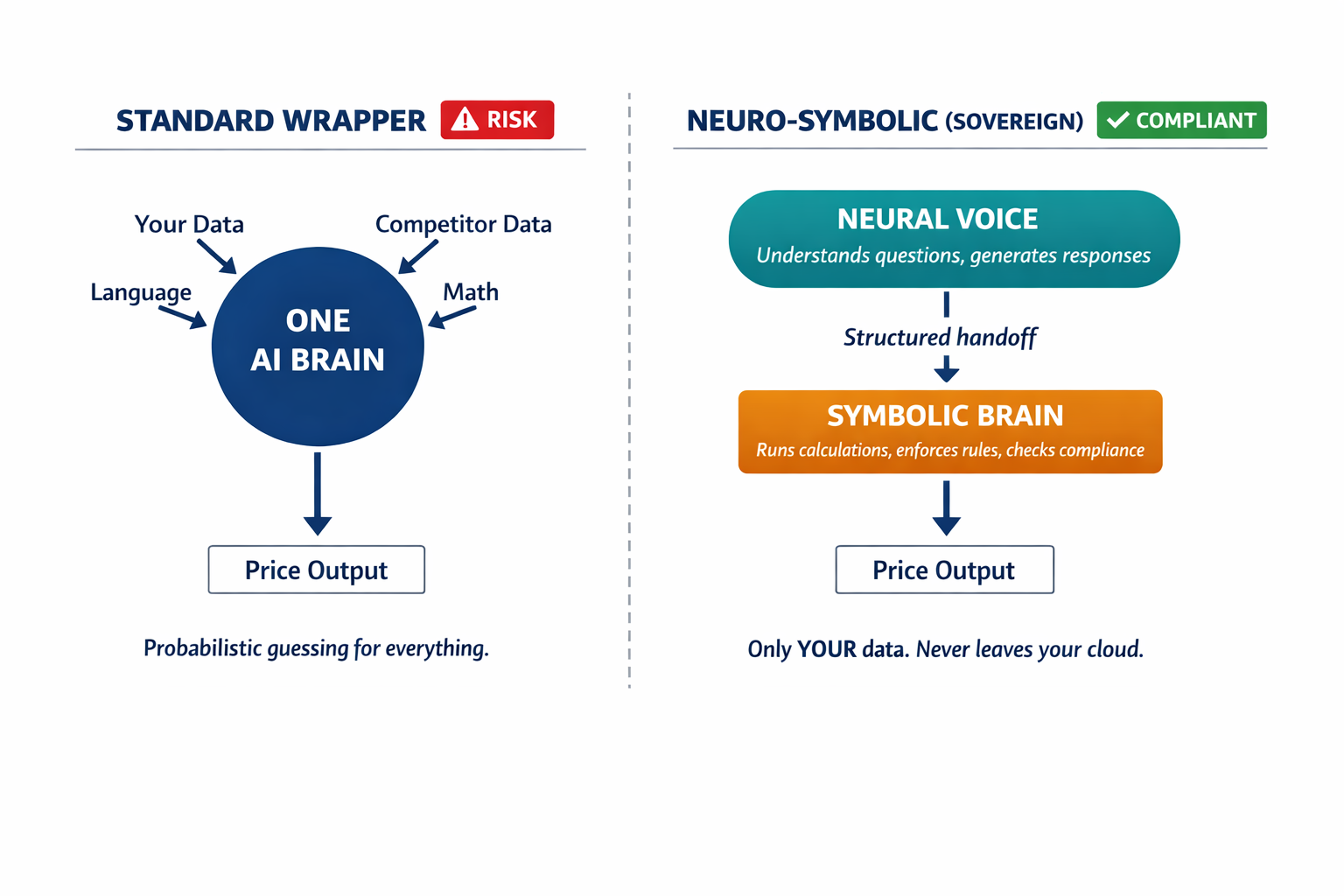
Think of it like this. A standard AI pricing tool is a single brain that does everything — understands your question, looks up data, does math, and generates an answer. The problem is that the "math" part is probabilistic. It's guessing, very well, but guessing. And when you're setting prices that regulators are watching, guessing isn't good enough.
Our approach splits the system into a neural voice and a symbolic brain. The neural component handles language — understanding what you're asking and generating a natural response. The symbolic component handles logic — running actual calculations, enforcing actual policies, checking actual compliance rules. The symbolic brain doesn't guess. It computes.
Probabilistic AI is brilliant at conversation. It's dangerous at compliance. You need both capabilities, but you need them separated.
The entire system runs inside the enterprise's own cloud environment. Data never leaves the corporate perimeter. The model is trained exclusively on the firm's own historical data. No competitor signals. No shared weights. No commingled embeddings.
For the full technical methodology — including the neuro-symbolic architecture and privacy engineering frameworks — see our detailed research on architectural integrity in the post-RealPage era.
Making Market Intelligence Legal: The Role of Differential Privacy
The obvious objection: "If I can only use my own data, how do I understand the market?"
This is where the math gets interesting. Differential privacy is a technique that lets you learn from broad market trends without ever "seeing" any individual competitor's data. It works by adding carefully calibrated statistical noise to datasets before analysis. The noise is large enough to make it mathematically impossible to reverse-engineer any single firm's contribution, but small enough to preserve the overall patterns.
The practical result: you can train a pricing model on synthetic market data that captures real economic dynamics — seasonal demand shifts, regional price elasticity, supply constraints — while containing zero actual competitor transactions. By 2024, industry forecasts projected that 60% of AI training data would be synthetic. In 2026, synthetic data isn't a workaround. It's the compliance-by-design standard.
We tested this approach against real-world pricing scenarios and found that models trained on differentially private synthetic data maintained analytical utility while providing a mathematically provable defense against information-sharing claims. That word — provable — matters. It's the difference between telling a regulator "we tried to be careful" and showing them an equation that guarantees privacy.
What If My Industry Isn't Real Estate?
The RealPage case was about rent. But the legal theory — that a shared algorithm applying common logic to pooled competitor data constitutes illegal coordination — has no industry boundary.
If you're in hospitality and your revenue management system ingests competitor occupancy rates to set room prices, you face the same exposure. If you're in e-commerce and your dynamic pricing tool monitors competitor listings in real time, the same logic applies. If you're in financial services and your lending algorithm considers market-wide default rates from a shared data provider, regulators are watching.
The DOJ has signaled clearly that algorithmic coordination will be prosecuted with the same vigor as traditional price-fixing. The only question is which industry gets its RealPage moment next.
I've had this conversation with enough general counsels in the last few months to know the reaction pattern: initial skepticism ("our tool is different"), followed by a careful read of the settlement language, followed by a quiet call to their technology team.
The Human Override Isn't Optional
One detail from the settlement that deserves its own section: the DOJ specifically targeted auto-accept features — systems where the algorithm's recommendation becomes the price without a human reviewing it.
This matters beyond real estate. Any AI system that makes consequential business decisions — pricing, lending, hiring, procurement — needs what I call a mandatory human checkpoint. Not a rubber stamp. Not a "click OK to continue" dialog. A genuine review process with logged decisions and documented overrides.
Companies that successfully scale AI see 3.6x higher total shareholder returns over three years compared to peers, according to recent BCG research. But only about 5% of organizations have achieved substantial financial gains from AI. The gap isn't about technology adoption. It's about governance architecture. The companies winning are the ones that treat AI as a tool that augments human judgment, not one that replaces it.
The companies getting real value from AI aren't the ones that automated the most. They're the ones that built the best human-AI decision loops.
What I'd Tell a Board of Directors Right Now
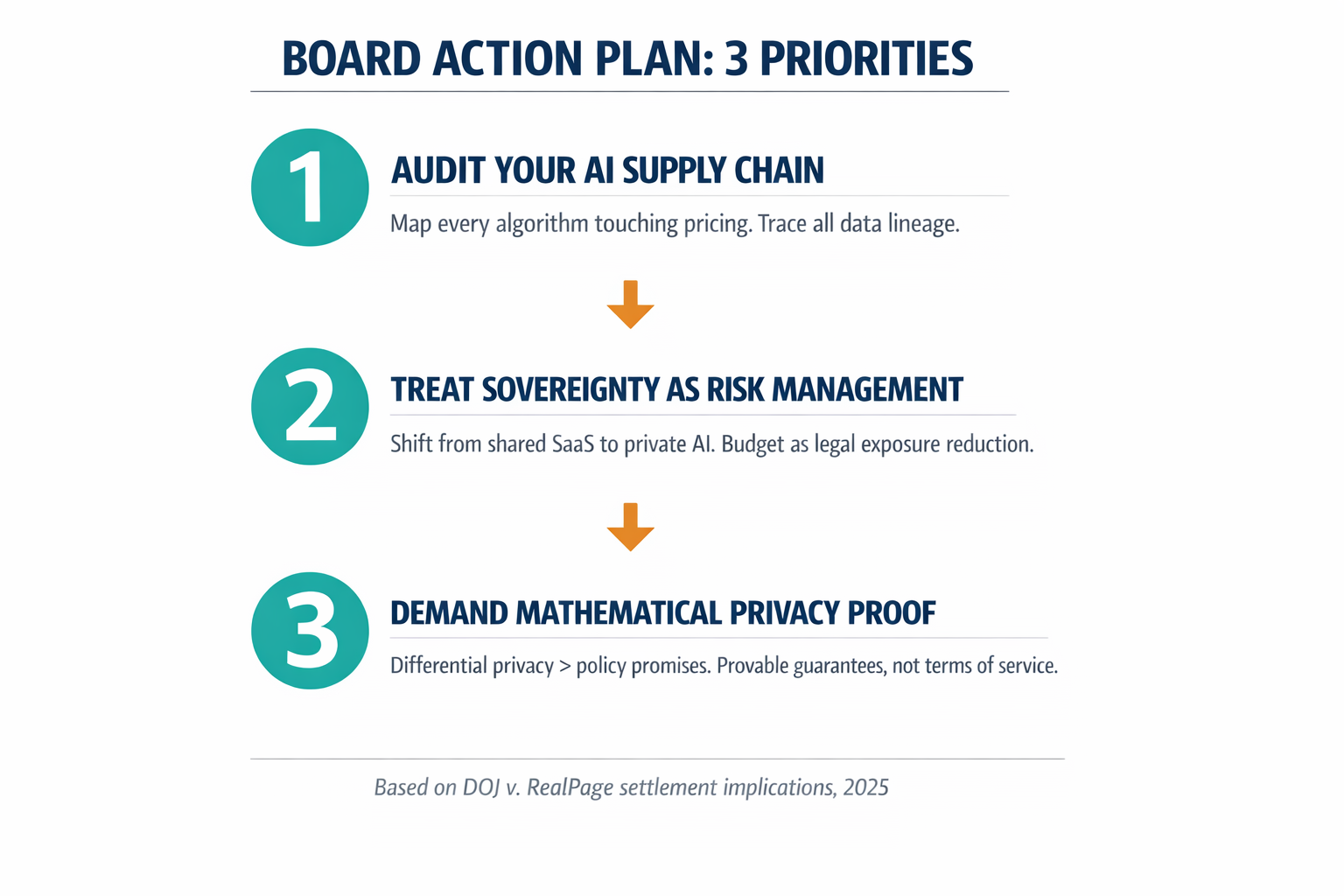
If I were sitting in a boardroom — and I've been in a few since November — I'd frame it this way:
First, audit your AI supply chain. Map every algorithm that touches pricing, revenue, or competitive intelligence. For each one, answer: whose data trained it? Does it ingest competitor signals? Can a regulator trace the data lineage?
Second, treat architectural sovereignty as a risk management priority, not an IT project. The shift from shared SaaS tools to private, in-house AI isn't a technology upgrade. It's a legal exposure reduction. Budget it accordingly.
Third, demand mathematical privacy guarantees, not just policy promises. "We don't share your data" is a terms-of-service claim. Differential privacy is a mathematical proof. In a regulatory environment where the burden of proof is shifting toward the enterprise, the difference is everything.
The RealPage settlement wasn't an anomaly. It was the opening move in a regulatory realignment that will touch every industry where algorithms influence prices. The enterprises that recognized this early — that shifted from renting someone else's AI to owning their own — will have built something their competitors can't easily replicate: an institutional brain that's both intelligent and legally defensible.
I'd be curious to hear from others navigating this shift. If you're rethinking your AI pricing architecture — or defending your current one — what's the hardest tradeoff you're facing?