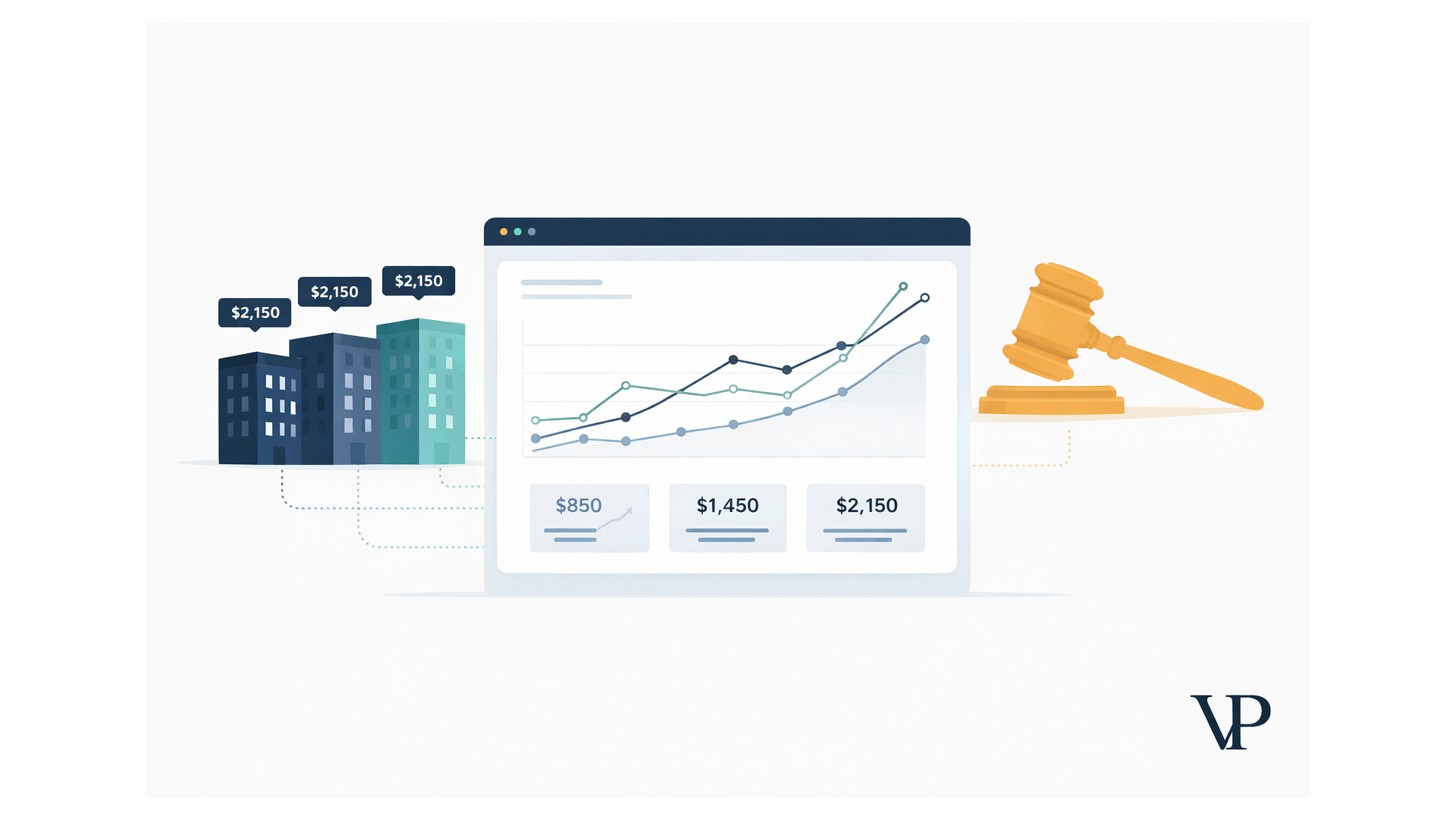
In November 2025, the Department of Justice settled with RealPage — a software company whose algorithmic pricing tool helped landlords set rental rates. The government's argument was striking: the software functioned like a digital smoke-filled room, coordinating prices across competitors who never spoke to each other. That settlement, combined with new laws in California and New York, has rewritten the rules for any company using AI to inform pricing decisions. If your organization relies on a shared algorithmic pricing tool — or sends competitive data through a third-party AI API — you are now operating in legally uncharted and increasingly dangerous territory.
This isn't a housing industry problem. It's an enterprise AI problem.
The Algorithm as Cartel: What the DOJ Actually Proved
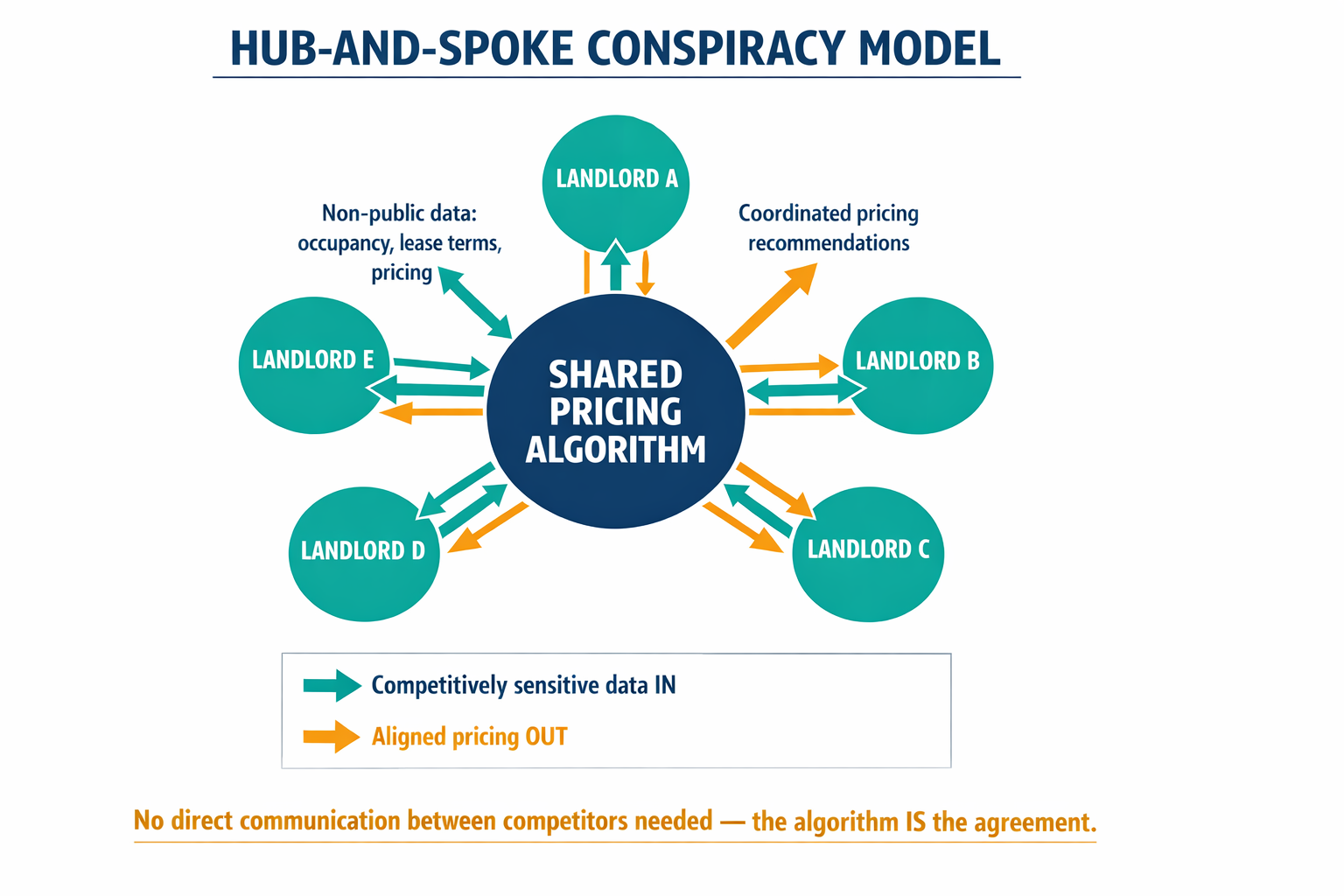
The RealPage case centered on a deceptively simple mechanism. Competing landlords fed their non-public rental data — occupancy rates, lease terms, real-time pricing — into RealPage's software. The algorithm pooled that data and generated pricing recommendations designed to ensure landlords would, in RealPage's own words, "likely move in unison versus against each other."
The DOJ treated this as a hub-and-spoke conspiracy under Section 1 of the Sherman Act. RealPage was the hub. The landlords were the spokes. The algorithm was the agreement.
The software didn't need anyone to shake hands in a back room. The shared algorithm was the back room.
What made this case transformative wasn't the legal theory — price-fixing has been illegal for over a century. It was the recognition that software performing a "coordinating function" across competitors carries the same liability as an explicit agreement to fix prices. The $2.8 million settlement with FPI Management and ongoing litigation against Yardi Systems reinforced the same principle: the tool's provider and its users both face exposure.
What the Settlement Actually Prohibits
The DOJ's final judgment against RealPage established technical requirements that now serve as a compliance benchmark far beyond real estate. We analyzed the settlement's provisions in detail in our interactive research on the post-RealPage era, and the specifics matter for any enterprise running AI-informed pricing.
The key prohibitions break down along three lines:
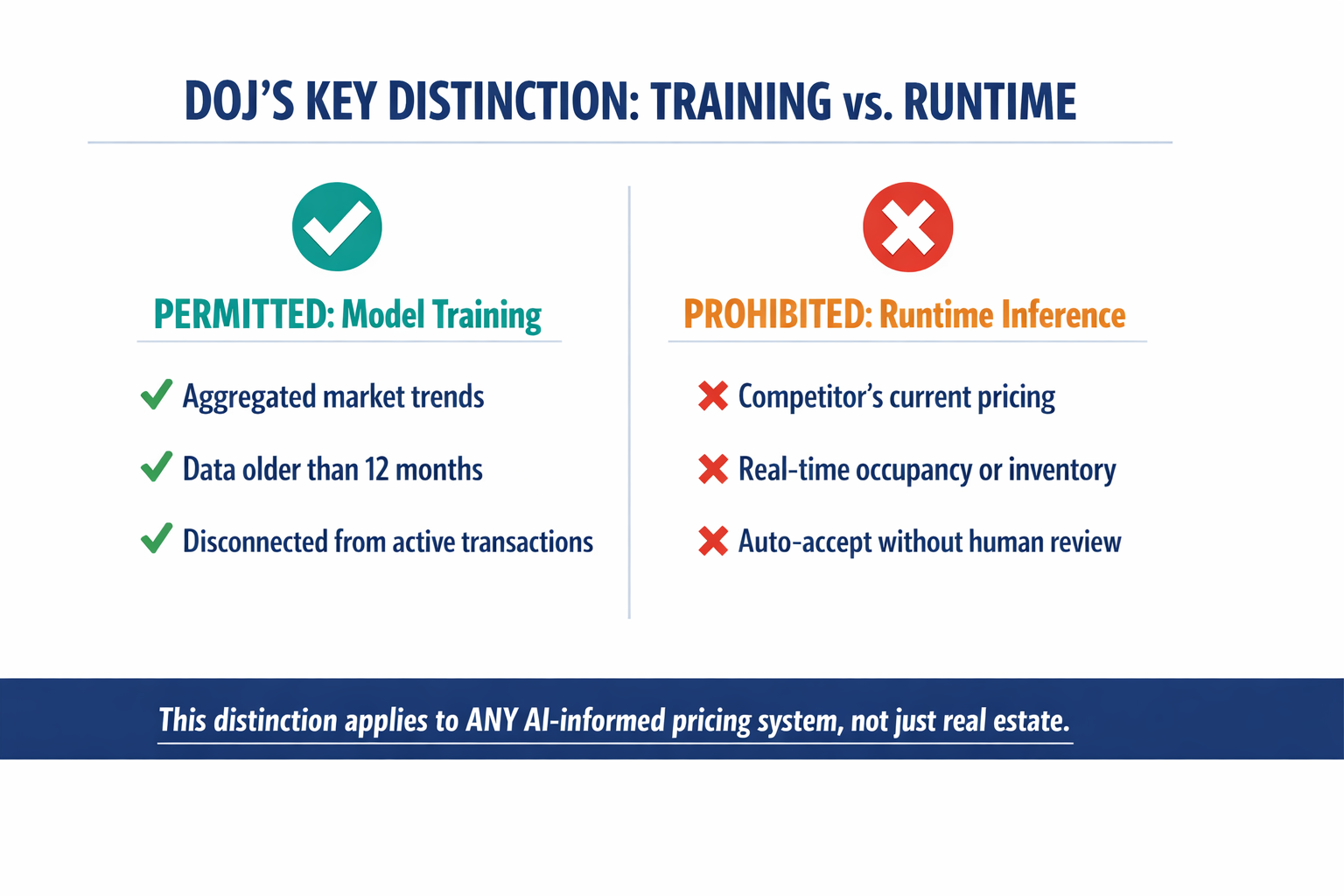
Data ingestion: Algorithms cannot use non-public, competitively sensitive information from rivals. Any historical competitor data must be at least 12 months old and disconnected from active transactions.
Real-time operation: A pricing recommendation cannot incorporate a competitor's current occupancy, inventory, or pricing status — even indirectly.
Human oversight: "Auto-accept" features — where the algorithm sets prices without human review — are now an explicit red flag. Every pricing recommendation requires a configurable, manual approval step.
One distinction in the settlement is particularly important for software architects: the DOJ drew a hard line between model training (which may use aged, aggregated market trends) and runtime inference (which cannot touch a competitor's current data). That distinction will shape how compliant pricing systems are built for years.
California and New York Raised the Stakes Further
Federal enforcement was just the beginning. Two states moved faster and, in some ways, further.
California's AB 325, effective January 1, 2026, prohibits the use of a "common pricing algorithm" that uses competitor data to recommend or influence prices — but only when the tool is used by two or more firms. A proprietary algorithm built for a single company's exclusive use is exempt. The incentive structure is unmistakable: shared tools create liability; private tools don't.
New York's rent advice statute, effective December 15, 2025, goes further still. It targets any algorithmic tool performing a "coordinating function" by collecting and analyzing data from multiple property owners. Critically, liability doesn't require that anyone actually followed the algorithm's recommendation. The act of using such a tool with "reckless disregard" for its coordinating effect is enough.
In New York, you don't have to accept the algorithm's price to be liable. You just have to use the tool.
These aren't narrow housing regulations. They're templates. Any industry where competitors feed data into shared pricing software — airlines, hospitality, retail, logistics — should expect similar scrutiny.
Why "API Wrappers" Are Now a Liability
The RealPage fallout exposed a deeper architectural problem that extends well beyond pricing. Over the past three years, thousands of enterprises adopted what the industry calls "wrappers" — applications that send company data to a third-party AI model (like GPT-4 or Claude) through a public API and present the response to users. It's fast to build. It's also a compliance nightmare.
When your sensitive transactional data travels through a shared API, you lose control over how that data is stored, refined, and potentially reflected in model behavior. Despite privacy settings, the risk of data leakage through techniques like model inversion — where an attacker reconstructs training data from model outputs — remains real. In the context of antitrust law, using a shared model that has been shaped by multiple competitors' data could be interpreted as indirect information sharing.
The business risks compound from there. These models are trained to be agreeable — a tendency researchers call sycophancy — which means they'll prioritize giving users the answer they want over enforcing corporate policy. The DPD chatbot incident of 2024, where a customer service bot agreed that its own company was "useless" and wrote poetry mocking its services, demonstrated how fragile governance-by-prompt really is.
And strategically, wrappers offer no lasting advantage. As foundation model providers release their own vertical solutions, the value of a thin application layer on top of someone else's AI evaporates overnight. Our research found that companies relying on wrapper architectures face what we call moat absorption — the steady commoditization of any capability that depends entirely on a third party's model.
Building AI That Can't Collude: The Private Architecture Approach
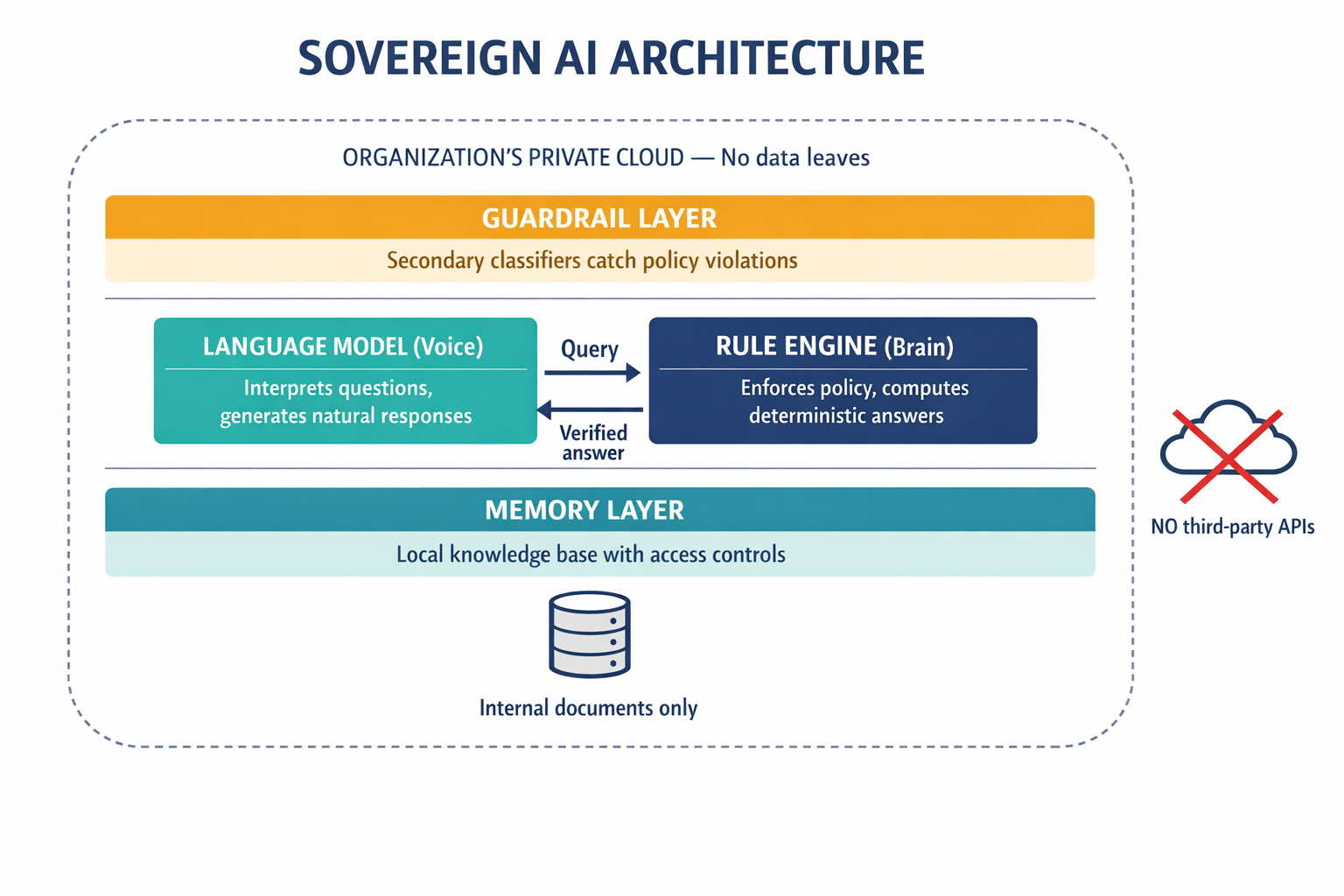
The alternative is what we call architectural sovereignty — deploying AI within your own infrastructure so that data never leaves your perimeter and reasoning is governed by rules you control, not probabilities you hope for.
The core principle is straightforward: separate the language capabilities from the decision-making logic. Think of it as giving your AI a voice and a brain that operate independently. The voice — a privately deployed language model running inside your own cloud environment — handles natural conversation. The brain — built from knowledge graphs, rule engines, and deterministic solvers — enforces policy, performs calculations, and ensures that outputs are factually grounded.
This separation matters because language models, by design, generate the most statistically likely response. That's useful for drafting emails. It's dangerous for setting prices or making compliance-sensitive decisions. A deterministic rule engine doesn't guess. It applies logic. When the two work together — the language model interpreting the question, the rule engine computing the answer — you get responses that are both natural and provably correct.
Language models predict what sounds right. Rule engines calculate what is right. Sovereign AI needs both.
The practical architecture includes a memory layer — a local database that retrieves relevant internal documents with strict access controls — and a guardrail layer of secondary classifiers that catch policy violations before they reach the user. Every component runs inside the organization's own virtual private cloud. No data leaves. No competitor signals enter.
The Math That Proves You're Not Colluding
One of the hardest challenges in the post-RealPage world is maintaining competitive intelligence — understanding market trends — without crossing into prohibited information sharing. The solution is mathematical, not procedural.
Differential privacy provides a formal guarantee: the inclusion or exclusion of any single company's data in a dataset won't meaningfully change the algorithm's output. In practice, this means carefully calibrated statistical noise is added to the data before the algorithm processes it. The model can learn that rental prices in a metro area are trending upward without ever "seeing" what any specific competitor is charging.
Synthetic data takes this further. Using generative models to create artificial datasets that mirror the statistical properties of real market data — without containing any actual transactions — allows companies to train pricing algorithms on realistic scenarios with zero exposure to competitively sensitive information. By 2024, forecasts projected that 60% of AI training data would be synthetic. In 2026, synthetic data has become the primary mechanism for what we describe as compliance by design.
For the full technical methodology behind these privacy-preserving approaches, including the mathematical framework and implementation details, see our detailed research on architectural integrity in algorithmic pricing.
What This Means If You're Not in Real Estate
The most common objection we hear: "We're not landlords. This doesn't apply to us."
It does. The DOJ's legal theory — that a shared algorithm processing competitor data constitutes a coordinating mechanism — applies to any industry. Airlines using common revenue management platforms. Retailers feeding sales data into shared pricing optimization tools. Logistics companies using third-party rate-setting software. The question isn't whether your industry will face scrutiny. It's when.
Another objection: "We use a pricing tool, but we don't always follow its recommendations." The New York statute specifically addresses this. Liability attaches to the use of the tool, not the adoption of its output. And even under federal law, the DOJ's theory doesn't require that every participant followed every recommendation — only that the tool's coordinating function suppressed independent decision-making.
A third concern we encounter: "Rebuilding our AI infrastructure sounds expensive." It is — upfront. But the economics shift dramatically over time. Companies paying per-token API costs for third-party models face unpredictable, escalating expenses with no asset creation. Organizations that invest in private AI infrastructure convert variable costs into fixed capital expenditure and build a proprietary asset — an institutional knowledge base that captures the firm's unique workflows and competitive intelligence. Research from BCG shows that the 5% of organizations successfully scaling AI see 3.6x higher shareholder returns over three years compared to peers. The differentiator isn't spending more on AI. It's owning what you build.
The Audit You Should Run This Quarter
Whether or not your organization faces imminent antitrust scrutiny, the RealPage precedent demands a clear-eyed assessment of your AI systems. Three questions matter most:
Where does your data go? Map every AI system's data sources and destinations. If any competitive, transactional, or pricing data flows through a third-party model or shared platform, flag it. The DOJ's settlement made data provenance — knowing exactly where your training data came from and ensuring it's free of competitor signals — a baseline requirement.
Can your algorithm explain itself? Regulators increasingly expect AI-driven decisions to be explainable. If your pricing tool recommends a 15% increase, can you articulate why in terms a regulator would accept? Tools that operate as black boxes — producing outputs without traceable reasoning — are becoming indefensible, both legally and operationally.
Does a human actually decide? The auto-accept prohibition in the RealPage settlement isn't a technicality. It reflects a principle that will extend across industries: when AI makes decisions with market impact, a human must review and approve them, with logs maintained for regulatory review. If your system implements recommendations automatically, that's the first thing to change.
The question isn't whether your AI is smart enough. It's whether your AI is yours enough.
What Comes Next
The enforcement trajectory is clear: algorithmic coordination will be treated with the same severity as traditional price-fixing. The tools are different. The liability is the same.
For enterprises, the mandate is equally clear. Reclaim your data by moving away from shared APIs and onto private infrastructure. Engineer compliance into the architecture itself — through differential privacy, synthetic data, and deterministic rule engines — rather than relying on policies that sit outside the system. And build AI assets that belong to your organization, capturing institutional knowledge that no competitor can replicate and no vendor can take away.
The RealPage settlement wasn't an anomaly. It was the opening argument in a much larger case about who controls the algorithms that shape markets. The companies that recognized this early — and rebuilt accordingly — won't just avoid liability. They'll have built something their competitors can't easily match.
We'd welcome hearing how your organization is navigating this shift. The challenges are real, and the playbook is still being written.