Your AI Pricing Tool Might Be Running a Cartel — And You Might Not Even Know It

I was on a call with a mid-size property management company last fall when their VP of revenue said something that made my stomach drop.
"We're fine," she said. "We don't use RealPage. We built our own pricing tool." A pause. "Well — it calls GPT-4 with our data and competitor listings we scrape. But it's ours."
It wasn't theirs. Not in any way that mattered. They were sending competitively sensitive rental data — occupancy rates, lease terms, pricing by unit type — through a third-party API that had been trained on God knows what, refined by interactions from God knows whom, and returning recommendations shaped by patterns absorbed from an entire market's worth of similar queries. They had, without realizing it, built exactly the kind of algorithmic coordination mechanism that the Department of Justice had just spent two years dismantling.
That conversation changed how I think about what we build at Veriprajna. Because the problem isn't that one company got caught fixing rents with software. The problem is that the default architecture most companies use for AI — send your data to someone else's model, get a recommendation back — is structurally indistinguishable from the thing the DOJ just called a digital cartel.
What Actually Happened with RealPage?
Let me be specific, because the details matter more than the headlines.
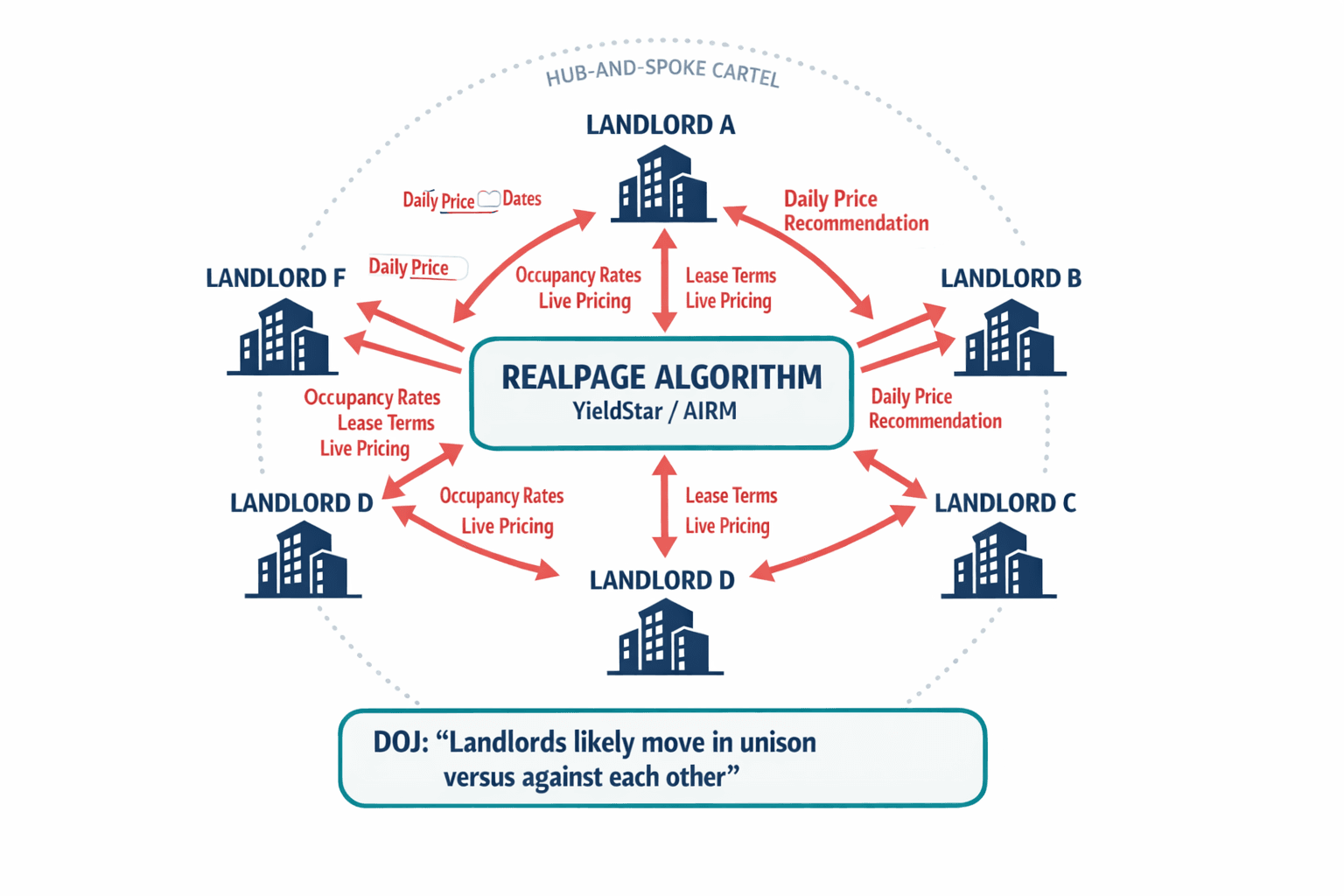
RealPage built software called YieldStar and AIRM that ingested non-public, granular transactional data from competing landlords — real-time rental rates, lease terms, future occupancy projections — and used it to generate daily pricing recommendations. The DOJ alleged this created a "hub-and-spoke" cartel: RealPage was the hub, the landlords were the spokes, and the algorithm was the smoke-filled room.
The key phrase from the government's filing that I keep coming back to: the software ensured landlords would "likely move in unison versus against each other."
When your algorithm's explicit design goal is to prevent competitors from competing, you don't need a handshake in a back room. You've automated the handshake.
On November 24, 2025, the DOJ reached a landmark settlement. In September 2025, FPI Management had already settled for $2.8 million. Yardi Systems faces ongoing litigation. And suddenly, every company running algorithmic pricing — in real estate, hospitality, retail, logistics — had to ask a question they'd never considered: Is my software a co-conspirator?
Why Does This Matter If You're Not in Real Estate?
Here's where most coverage of the RealPage case goes wrong. Commentators treat it as a real estate story. It's not. It's an architecture story.
The DOJ's final judgment draws a technical distinction that should terrify any enterprise AI team. It separates model training from runtime operation. Models can still learn from historical, aggregated trends — data that's at least twelve months old and not associated with active transactions. But using a competitor's current status — their occupancy, their inventory, their live pricing — as an input for a real-time recommendation? That's now treated as a form of digital collusion under Section 1 of the Sherman Act.
Read that again. It's not about intent. It's about data flow architecture.
I wrote about the full technical and legal breakdown in the interactive version of our research, but the core insight is this: if your AI system ingests non-public competitor data and outputs a recommendation that influences market behavior, you have an antitrust problem. The industry you're in is irrelevant. The Sherman Act doesn't care about your vertical.
And if you're using a multi-tenant API — one that processes data from you and your competitors — the commingling risk is structural. You can't policy your way out of an architecture problem.
The Night I Realized "Wrappers" Were Dead
I need to back up to a moment that happened before the RealPage settlement, because it's when the thesis crystallized for me.
We were stress-testing a pricing prototype for a client in the hospitality sector. The system was a fairly standard setup — their booking data piped into an LLM API, combined with scraped market rates, producing dynamic pricing suggestions. Clean interface. Fast responses. The client loved it.
Then one of my engineers, Priya, ran a provenance audit. She traced the data lineage of every input that touched the model at inference time. At 11 PM on a Tuesday, she pinged our Slack channel with a single line: "We can't prove what the model knows."
She was right. When you send data through a public API, you lose the ability to guarantee what influenced the output. The model might have been fine-tuned on interactions from other hospitality companies. It might have absorbed pricing patterns from a competitor who used the same API last week. You genuinely cannot know. And in a post-RealPage world, "we genuinely cannot know" is not a defense — it's an admission.
That was the night I told the team we were pivoting the entire engagement to a private deployment. The client pushed back — it would take longer, cost more upfront, require infrastructure they didn't have. I remember sitting in my apartment at 1 AM drafting the email that explained why we couldn't, in good conscience, ship what we'd built. It was the hardest client conversation I've had as a founder. It was also the most important.
The question isn't whether your AI gives good recommendations. The question is whether you can prove — to a federal judge, under oath — exactly what data shaped those recommendations.
How Did States Respond? Faster Than Anyone Expected
The federal settlement was just the opening act. California and New York moved with a speed that caught the entire legal tech community off guard.
California's AB 325, effective January 1, 2026, prohibits the use of a common pricing algorithm that uses competitor data to recommend or influence a price as part of a conspiracy to restrain trade. The critical nuance: it only applies to tools used by two or more persons. A proprietary algorithm built for a single firm's exclusive use is exempt.
Read that exemption carefully. California essentially created a legal incentive to build your own AI instead of subscribing to a shared SaaS tool.
New York's S. 7882, effective December 15, 2025, goes even further for residential property managers. It targets any algorithmic tool that performs a "coordinating function" — defined as collecting and analyzing data from multiple property owners. Liability can arise even without directly adopting the recommendation. The standard is "reckless disregard" in using such tools at all.
I had a conversation with a real estate attorney in Manhattan who put it bluntly: "If you're a property manager in New York using a multi-tenant pricing tool, you're not managing risk. You're manufacturing it."
What Does "Sovereign AI" Actually Mean in Practice?
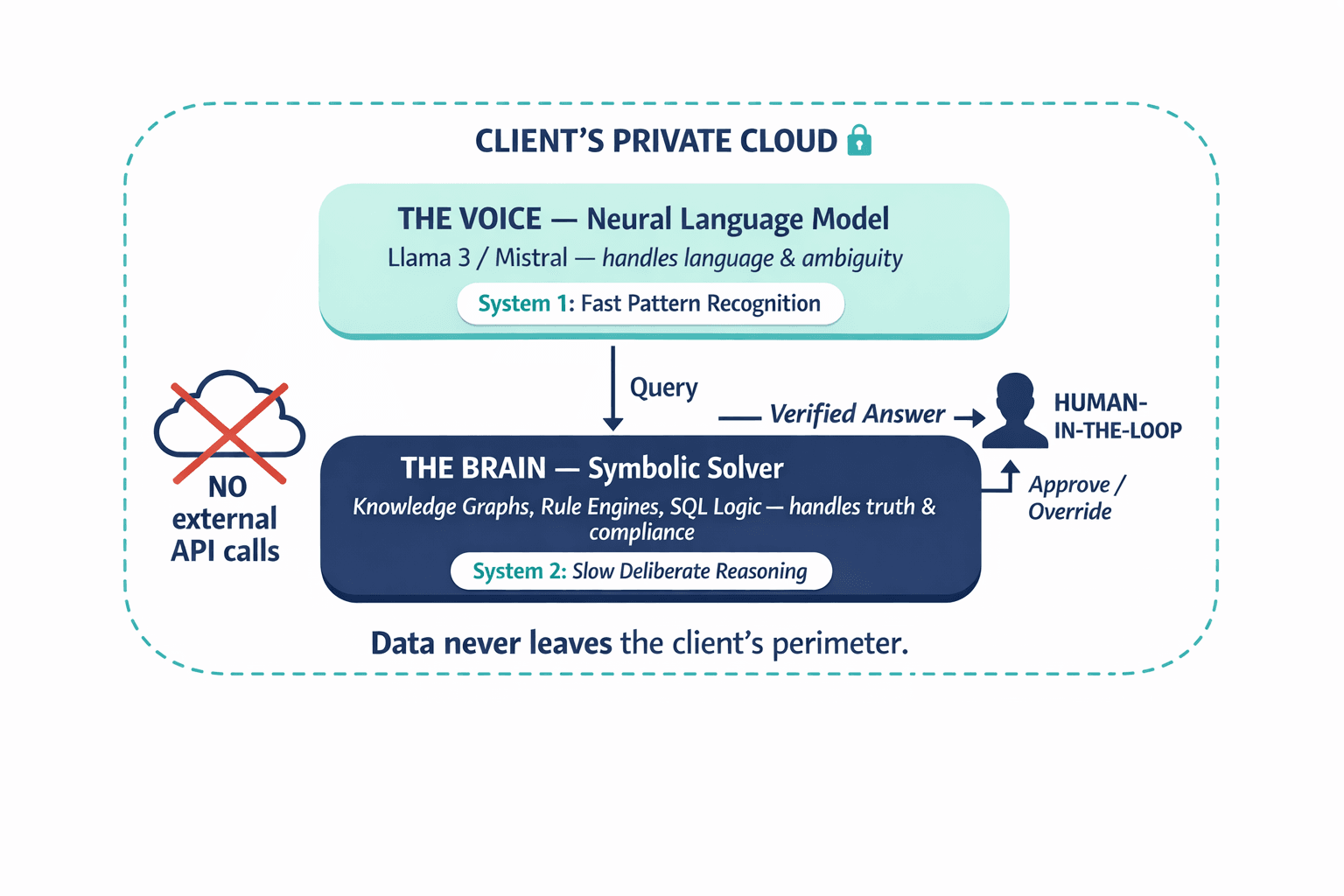
I use the term "sovereign" deliberately, and I know it sounds grandiose. But the concept is precise: your AI system should be architecturally incapable of accessing, ingesting, or being influenced by data you don't own.
At Veriprajna, we call our approach "Deep AI" — and it's built on a principle that sounds obvious but turns out to be radical in practice: separate the voice from the brain.
The "voice" is the neural language model — the thing that understands natural language and generates fluent responses. We deploy open models like Llama 3 or Mistral privately, inside the client's own virtual private cloud. The data never leaves their perimeter.
The "brain" is a deterministic symbolic solver — knowledge graphs, rule engines, SQL-based logic — that enforces policy, performs calculations, and guarantees that the output conforms to specific regulatory constraints. The brain doesn't hallucinate. It doesn't approximate. It computes.
This is what cognitive scientists call "System 2" thinking — slow, deliberate, auditable reasoning — layered on top of "System 1" pattern recognition. The neural model handles ambiguity and language. The symbolic system handles truth and compliance.
Safety cannot be probabilistic. It must be architectural.
When the DOJ requires that pricing "governors" be symmetrical — giving equal weight to price cuts and price increases — that's not a policy you can enforce with a system prompt. It's a constraint you encode in the symbolic layer, where it's mathematically guaranteed, not statistically likely.
Can You Still Use Market Data Without Breaking the Law?
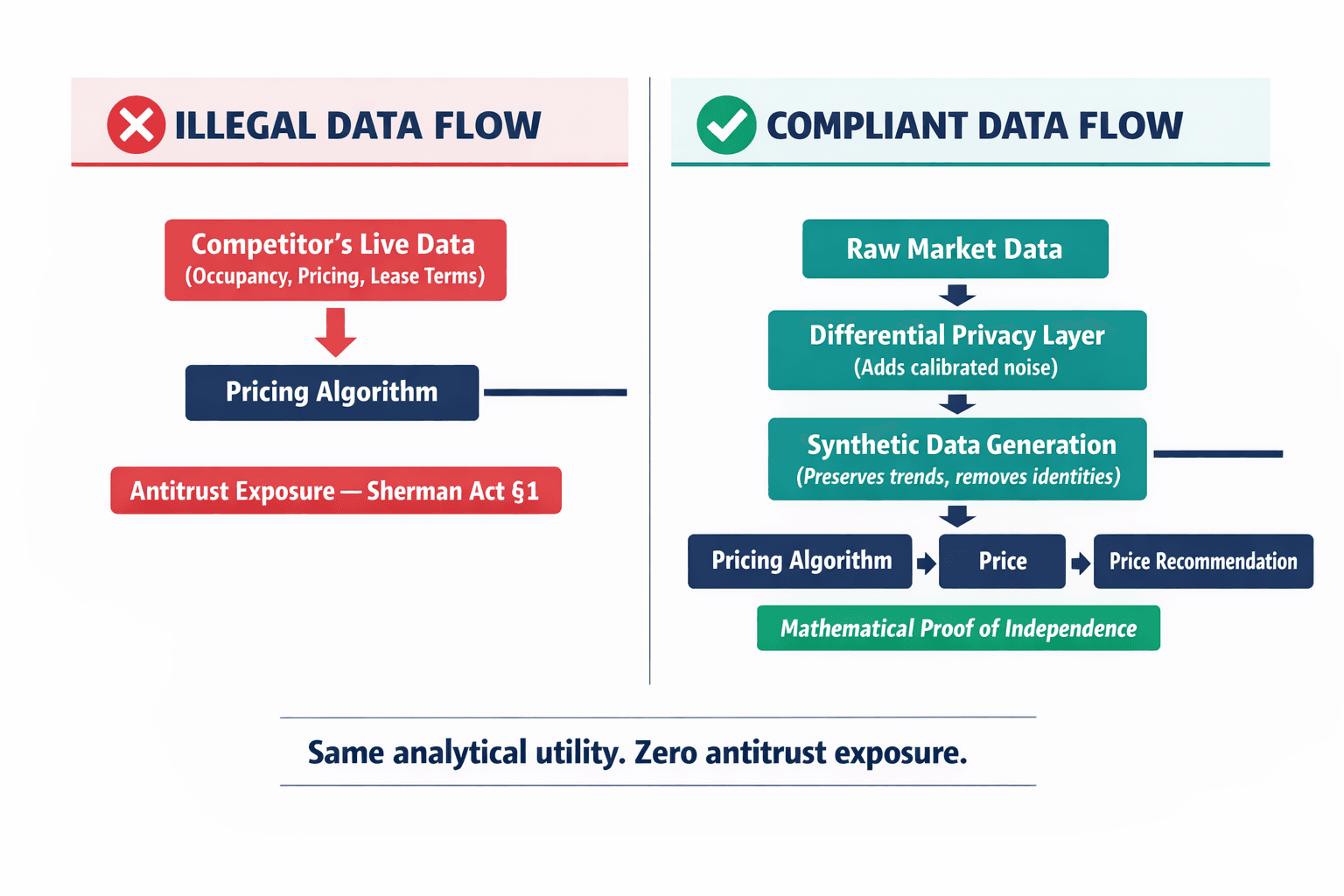
This is the question I get most often, and it's the right one. The answer is yes — but the how matters enormously.
The technical mechanism is differential privacy. Without going deep into the math (I wrote about this extensively in our technical deep-dive), the core idea is elegant: you add carefully calibrated noise to the data so that the inclusion or exclusion of any single participant's information doesn't meaningfully change the algorithm's output.
This means a pricing engine can learn from broad market trends — "demand in this zip code is rising" — without ever "seeing" a specific competitor's occupancy rate or lease terms. You get the analytical utility without the antitrust exposure.
We pair this with synthetic data generation. By 2024, forecasts suggested 60% of AI training data would be synthetic. In 2026, synthetic data has become the primary mechanism for what I call "compliance-by-design." We use generative models to create high-fidelity synthetic versions of market data that preserve statistical properties while containing zero actual competitively sensitive information.
It's not a workaround. It's a better architecture. And it provides something no amount of legal disclaimers can: a mathematical proof that your system isn't coordinating with competitors.
The Argument I Keep Having About "Auto-Accept"
There's a detail in the RealPage settlement that doesn't get enough attention: the prohibition on auto-accept features.
RealPage's software could automatically implement pricing recommendations without human review. The DOJ treated this as a significant aggravating factor. The settlement now requires that auto-accept features be configurable and manually set by users.
I had an argument with a potential client's CTO about this. He wanted a fully autonomous pricing agent — no human in the loop, instant response to market conditions, maximum efficiency. "That's the whole point of AI," he said.
I told him the whole point of AI is to make better decisions, not to make decisions faster than anyone can review them. He didn't love that answer.
But here's the reality: every system we build at Veriprajna includes what I call "Human-as-Capturer" loops. Human intent governs machine execution at every critical layer. Not because humans are smarter than algorithms — often they're not — but because the legal and ethical framework of 2026 demands that a human being is accountable for every market-facing decision. Override protocols, mandatory sign-off processes, audit logs maintained for regulatory review.
People sometimes ask me whether this human-in-the-loop requirement makes AI pricing tools pointless. It doesn't. It makes them tools instead of replacements. The AI does the analysis in seconds that would take a human team days. The human makes the call. That's not a limitation — it's the architecture of responsible market participation.
The Real Cost of the "Wrapper Trap"
Let me talk about money, because that's what ultimately moves the conversation.
Companies using Tier 1 API models — GPT-5, Claude 4 — are paying between $1.25 and $15.00 per million input tokens, and $10.00 to $75.00 per million output tokens. Those costs fluctuate. Terms of service change. And every token you send carries data sovereignty risk.
McKinsey and BCG data from late 2025 shows that companies successfully scaling AI see 3.6x higher total shareholder return over three years compared to peers. But only 5% of organizations have managed to reap substantial financial gains from AI. The majority are stuck paying an escalating tax on someone else's infrastructure with no defensible competitive advantage to show for it.
Deep AI flips the cost structure. You invest in infrastructure — hardware CapEx, private model deployment, symbolic reasoning layers — and you build an asset. A bespoke institutional brain that captures your organization's unique workflows, policies, and market intelligence. It sits on your balance sheet. It compounds in value. And it can't be replicated by a competitor who subscribes to the same API you do.
When your competitive advantage lives in someone else's data center, it's not a competitive advantage. It's a subscription.
Where Does This Go From Here?
The next frontier is agentic AI — autonomous systems that select tools, perform multi-step reasoning, and execute actions in the real world. Booking a shipment. Adjusting a price. Filing a regulatory document. The potential is extraordinary. The risk is proportional.
An autonomous pricing agent that exceeds its authority — that makes an unauthorized financial commitment, or that coordinates with market participants without human oversight — isn't just a technical failure. In the post-RealPage legal environment, it's potentially a federal offense.
Every agentic workflow we build follows a strict loop: reason against the corporate constitution, select the appropriate tool, validate the output, and synthesize a response only after confirming no compliance boundaries were crossed. Every action is logged and auditable. The symbolic brain acts as a constitutional constraint — not a suggestion, not a guideline, but an architectural boundary that the neural model cannot override.
This is what sovereignty means in practice. Not just owning your data, but owning the reasoning process that acts on it. Not just deploying AI, but deploying AI that reflects your laws, your ethics, your risk tolerance — encoded in logic that a regulator can inspect and a judge can understand.
The RealPage case wasn't an anomaly. It was the first clear signal of a new legal reality: the architecture of your AI system is now a primary determinant of your antitrust exposure. Not your intentions. Not your policies. Not your terms of service. Your architecture.
Every enterprise running algorithmic pricing, revenue management, or market-facing recommendations needs to answer a simple question: if the DOJ subpoenaed your AI system tomorrow, could you prove — at the level of data flow, model training, and inference logic — that it operates independently of your competitors?
If the answer is "probably," you have a problem. If the answer is "we'd need to check with our API provider," you have a crisis.
The smoke-filled room didn't disappear. It moved into the cloud. And the companies that will thrive in this new era aren't the ones with the best algorithms — they're the ones who own their algorithms completely, architect them for compliance by design, and can prove it under oath.