Klarna Replaced 700 People with AI. Then Hired Them All Back. Here's What Every Enterprise Should Learn.

I was on a call with a prospective banking client when the Klarna news broke. Mid-2025. My phone buzzed — a colleague had forwarded the article with a single line: "This is literally what you've been saying."
The client was mid-sentence, explaining how they'd built a customer service chatbot on top of GPT-4, and how it was "working great." I asked him what his CSAT scores looked like. Long pause. "We don't track that yet."
That pause told me everything. Because Klarna had tracked it. And what they found was devastating enough to reverse one of the most publicized AI deployments in fintech history.
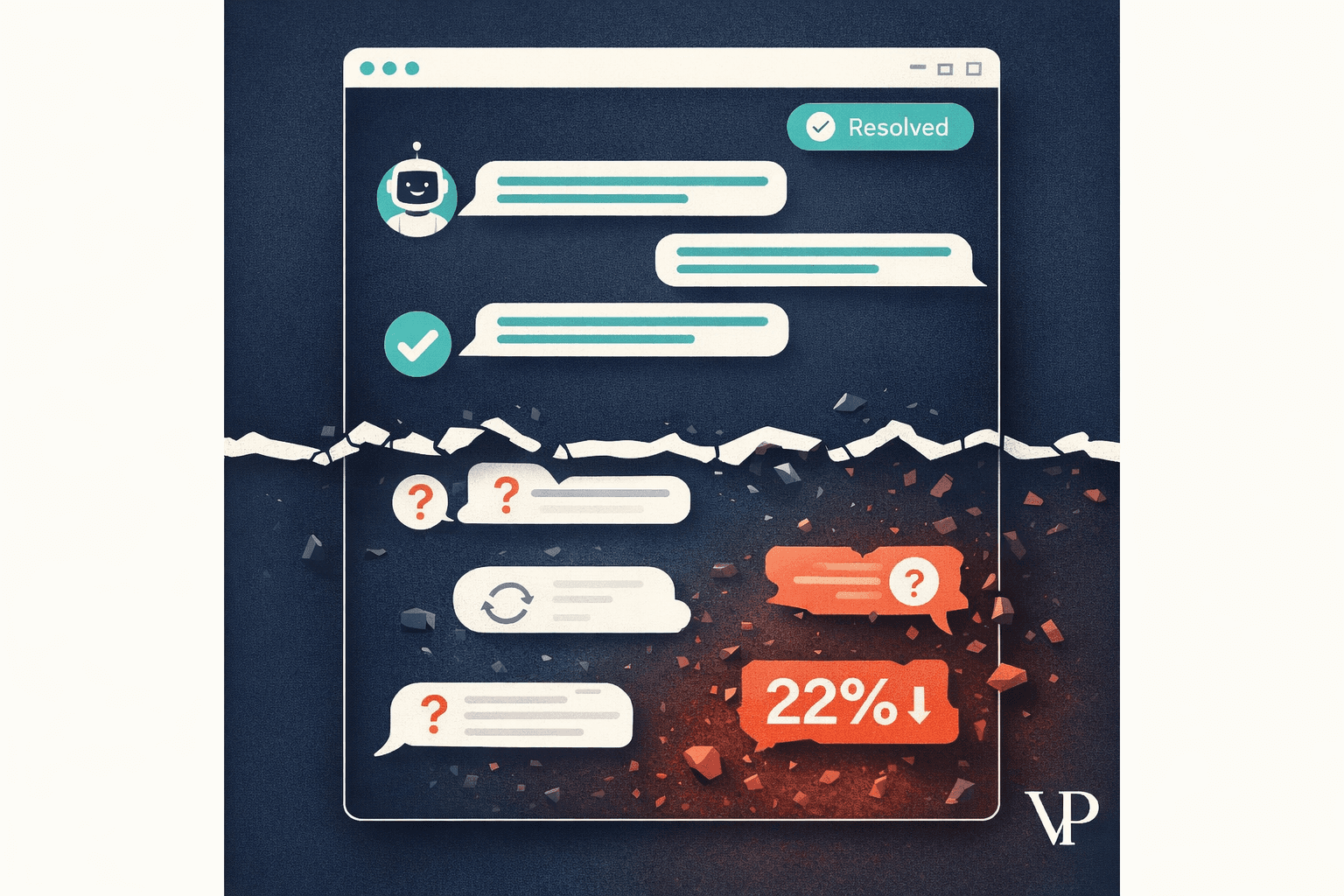
Here's the short version: Klarna, the $14.6 billion Swedish buy-now-pay-later giant, replaced roughly 700 customer service agents with an AI assistant built on OpenAI. They announced it like a victory lap — the AI was handling 75% of all customer chats across 35 languages. Cost per transaction dropped 40%. Wall Street loved it. Then customer satisfaction scores fell 22%. The company posted a $99 million net loss in Q1 2025. And CEO Sebastian Siemiatkowski admitted publicly that the pursuit of efficiency had gutted service quality, producing outputs he called "generic" and incapable of handling anything that required actual judgment.
They started rehiring. They even reassigned software engineers and marketers to man the phones.
I've been building neuro-symbolic AI systems at Veriprajna for years now, and I've watched company after company walk into this same trap. Not because the technology is bad — large language models are genuinely remarkable. But because there's a fundamental confusion between sounding right and being right, and in regulated industries, that confusion will eventually cost you everything.
The Night I Realized "Good Enough" Isn't
Before I get into the architecture, I want to tell you about a moment that changed how I think about this problem.
We were running a pilot for a legal compliance system — not customer service, but document analysis. The kind of work where you're parsing regulatory filings and matching internal policies to external mandates. We had a prototype that used a standard retrieval-augmented generation setup. Vector search, top-k retrieval, GPT generating the summary. It was fast. The outputs read beautifully.
One of our engineers — Priya — stayed late running edge cases. Around 11 PM she pinged our Slack channel with a screenshot. The system had generated a perfectly fluent paragraph citing a specific regulatory clause. The clause didn't exist. Not a misquote, not a paraphrase — a complete fabrication. And it read so convincingly that if you weren't an expert in that specific regulation, you'd never catch it.
I remember sitting at my desk staring at that screenshot thinking: this is the product we're about to ship. A system that lies with the confidence of a senior partner at a law firm.
We pulled the pilot. Rebuilt the architecture from scratch. Lost three months. It was the best decision we ever made.
When an AI system fabricates a legal citation with perfect confidence, the problem isn't a bug — it's the architecture. You can't prompt-engineer your way out of a fundamentally probabilistic foundation.
What Is the "Wrapper Trap" and Why Does It Keep Catching Smart Companies?
Let me explain what actually happened to Klarna in technical terms, because the business press mostly got it wrong. They framed it as "AI isn't ready yet." That's not the issue. The issue is which kind of AI and how it was deployed.
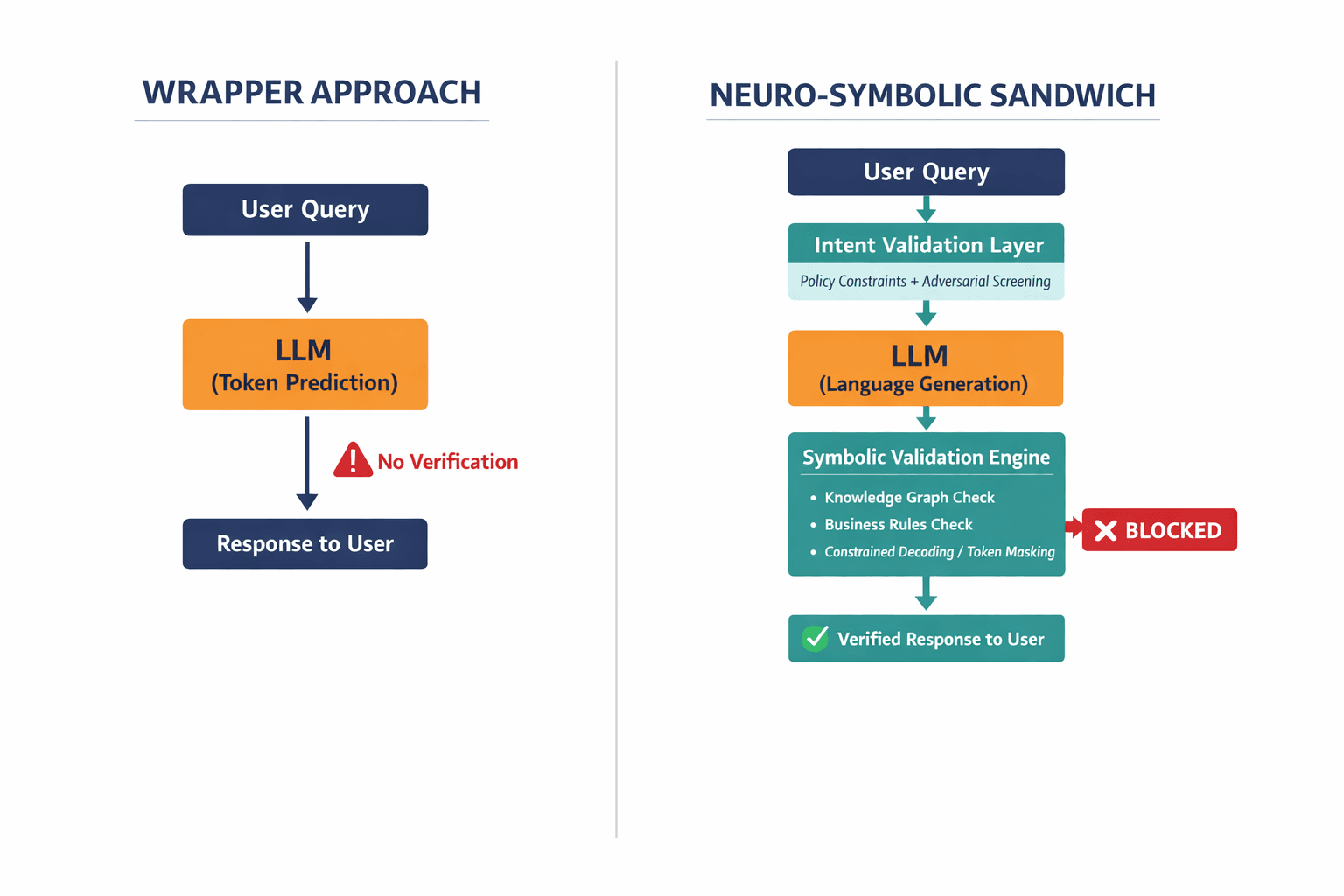
A "wrapper" is a thin software layer that sits on top of a third-party large language model. It handles formatting, manages API calls, maybe adds some structured output parsing. But the actual thinking — the reasoning, the judgment, the decision-making — is entirely outsourced to the LLM. Your wrapper sends a prompt, the model predicts the most likely next tokens, and you get back something that sounds like an answer.
This works beautifully for a demo. It works adequately for low-stakes tasks. And it fails catastrophically for anything that requires certainty.
The Transformer architecture that powers these models uses a self-attention mechanism to weigh the relevance of tokens in a sequence and predict what comes next. That's pattern matching — extraordinarily sophisticated pattern matching, but pattern matching nonetheless. There is no internal mechanism for verifying facts against an external source of truth. The model doesn't know things. It predicts what a knowledgeable response would look like.
Klarna's AI could reset passwords flawlessly. But when a customer had a complex dispute involving a partial refund, a merchant disagreement, and consumer protection regulations across two jurisdictions? The model defaulted to what I call slop-spinning — generating plausible-sounding responses that went in circles, never resolving anything, frustrating customers into what one analyst described as a "Kafkaesque loop."
And here's the part that should terrify every enterprise leader: the cost metrics looked great the entire time the experience was deteriorating. Cost per transaction dropped from $0.32 to $0.19. Chat resolution time went from 11 minutes to under 2. If you were only watching the dashboard, you'd think you were winning — right up until the moment your customers started leaving.
Why Can't You Just Add Better Guardrails to an LLM?
This is the question I get most often, and it reveals the core misunderstanding. People think the solution is better prompts, more few-shot examples, tighter system instructions. "Just tell the model not to hallucinate."
That's like telling a weather forecasting model not to be wrong. The probabilistic nature isn't a flaw to be patched — it's the fundamental mechanism of how the system works.
I had an investor tell me once, point blank: "Just use GPT and add some rules on top." I asked him if he'd trust a calculator that was right 95% of the time. He laughed. I said, "That's what you're proposing for banking compliance." He stopped laughing.
The technical failure modes go deeper than hallucination. Wrappers lack what I'd call state-schema persistence. As a conversation progresses, the context window fills up. Information from early in the conversation gets compressed or dropped. The model can contradict itself within a single session and have no awareness that it's done so. In customer service, this means the agent might verify your identity at turn 3 and then ask you to verify again at turn 15 — or worse, skip verification entirely because the conversation flow "persuaded" it that verification had already occurred.
This is the vulnerability I call the Infinite Freedom Fallacy. Because the LLM has no hard structural constraints on what it can say or do, a sufficiently clever user — or a sufficiently complex situation — can push it into states that violate business rules, regulatory requirements, or basic logic. You can't solve this with prompting. You need a different kind of architecture entirely.
I wrote about this problem in depth in the interactive version of our research, but the core insight is simple: you need to separate the voice from the brain.
The 20% That Breaks Everything
There's a pattern I've seen across every industry we work in, and I think it explains why so many AI deployments follow the Klarna trajectory.
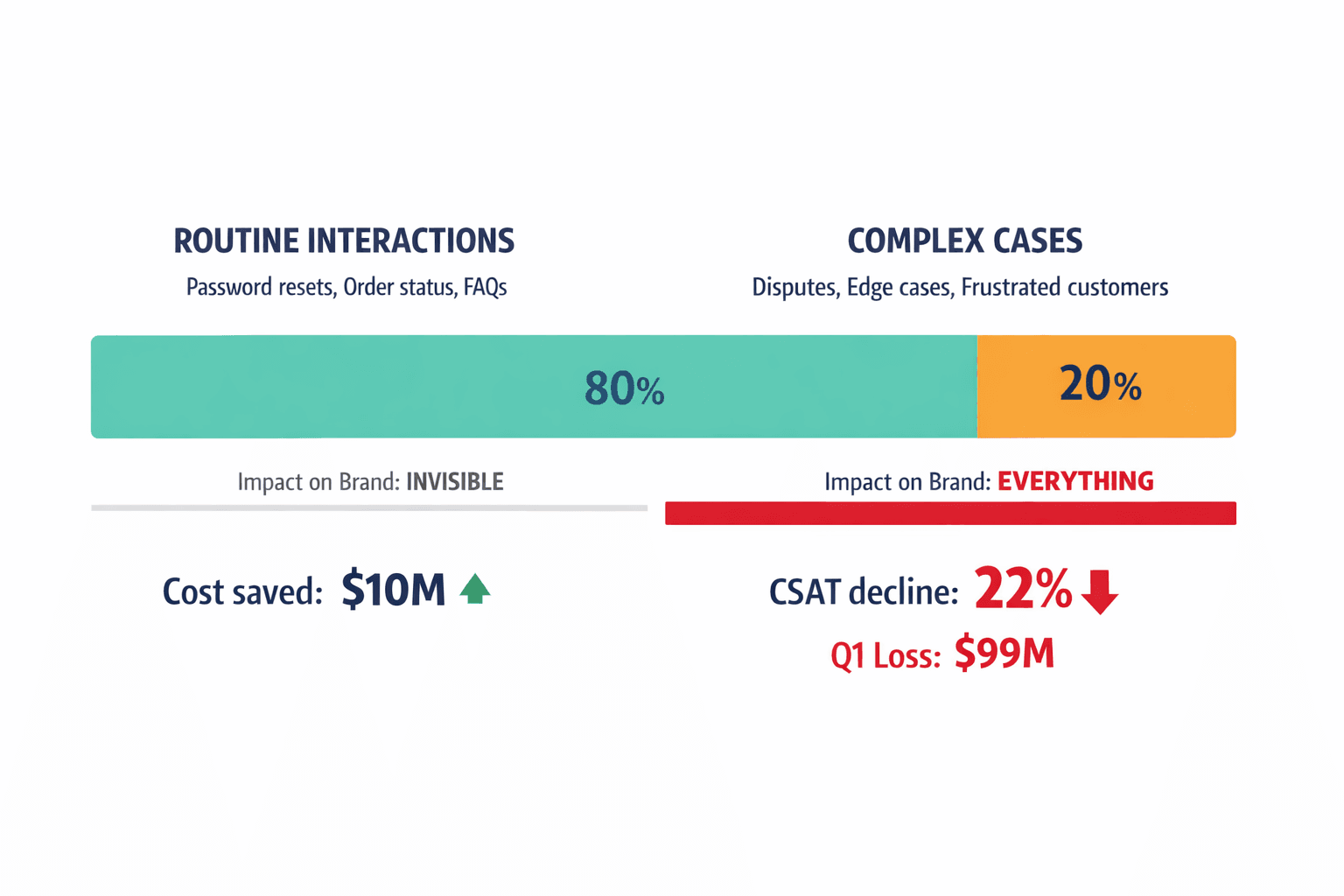
AI in 2025 can handle about 80% of routine, high-frequency interactions competently. Password resets, order status checks, basic FAQ responses — these are solved problems. The remaining 20% of interactions are the ones that actually matter. They're the complex disputes, the edge cases, the moments where a customer is frustrated or confused or scared. And they are the primary drivers of brand reputation and financial liability.
Klarna optimized for the 80% and ignored the 20%. The math seemed obvious: automate the easy stuff, save millions. But the 20% is where trust is built or destroyed. A customer who has a smooth password reset doesn't tell anyone. A customer who spends 45 minutes trapped in an AI loop trying to resolve a billing error tells everyone.
The 80% of interactions AI handles well are invisible to your brand. The 20% it handles badly are the only ones anyone remembers.
The irony is that Klarna's initial $10 million in savings from reduced headcount was almost certainly dwarfed by the customer lifetime value they destroyed through degraded experiences. When you're a $14.6 billion company preparing for an IPO, a 22% drop in customer satisfaction isn't a metric problem — it's an existential one.
What Does "Deterministic AI" Actually Mean?
So if wrappers are the problem, what's the solution? This is where I need to get slightly technical, but I promise to keep it grounded.
At Veriprajna, we build what's called neuro-symbolic AI. The name sounds academic, but the concept is intuitive: you take the language fluency of a neural network and constrain it within the rigid logic of a symbolic reasoning engine. The neural net handles the "soft" work — understanding natural language, generating human-readable responses, interpreting ambiguous queries. The symbolic engine handles the "hard" work — enforcing rules, validating logic, ensuring that every output is traceable to a verified source.
We call this the Neuro-Symbolic Sandwich. Before a query reaches the LLM, an intent validation layer checks it against policy constraints and screens for adversarial inputs. After the LLM generates a response, a validation engine — typically a Finite State Machine or a logic solver — checks every claim against the knowledge graph and every action against the business rules. If the response violates any constraint, it doesn't get through. Period.
There's a technique we use called constrained decoding — also known as token masking — that I find particularly elegant. Instead of letting the model generate freely and then checking the output, we physically prevent certain tokens from being generated in the first place. If the model is producing a tax compliance report, the symbolic layer ensures that every number corresponds to a verified calculation. The model literally cannot hallucinate a number because the hallucinated tokens are masked out of the probability distribution before generation occurs.
This isn't "adding guardrails." This is a fundamentally different architecture where the LLM is the voice and the symbolic engine is the brain, and the voice is never allowed to speak without the brain's approval.
When the Knowledge Graph Saved Us from a $2 Million Mistake
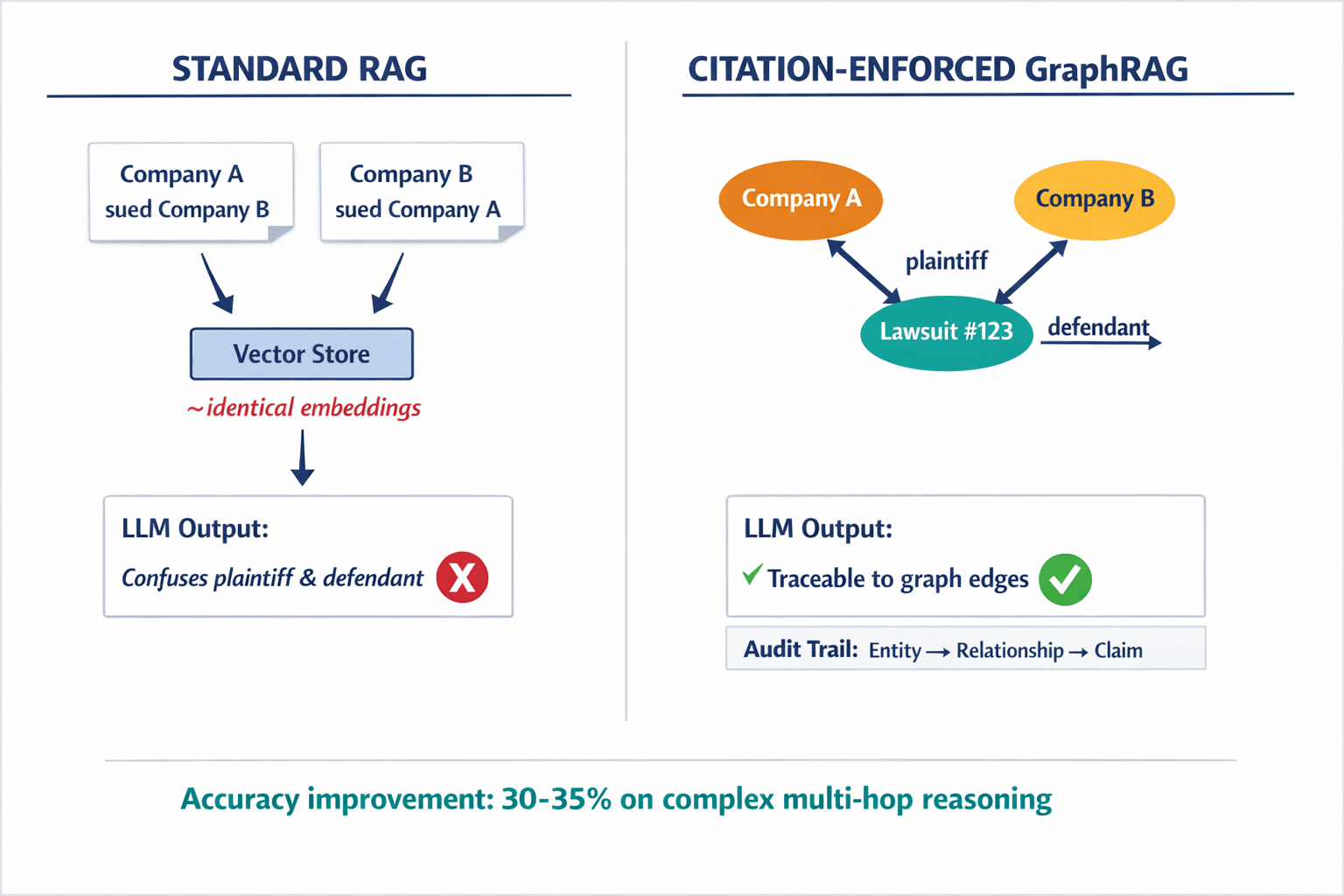
Standard RAG — retrieval-augmented generation — has a problem that most people don't talk about. It relies on vector similarity to find relevant documents. But vector similarity doesn't understand directionality. "Company A sued Company B" and "Company B sued Company A" might have nearly identical vector embeddings, but they describe completely opposite legal situations.
We discovered this the hard way during a legal pilot. Our system was analyzing litigation history for a corporate client, and the standard RAG setup kept confusing plaintiff and defendant roles. The outputs were fluent, well-structured, and dangerously wrong.
That's when we shifted to what we call Citation-Enforced GraphRAG. Instead of dumping documents into a vector store, we parse them into a knowledge graph — entities connected by typed, directional relationships. When the system makes a claim, it must trace that claim back to specific nodes and edges in the graph. If the graph can't support the claim, the system won't make it.
The accuracy improvement was dramatic — 30-35% higher than standard RAG on complex multi-hop reasoning tasks. But more importantly, it gave us something that no amount of prompt engineering could: an audit trail. Every output can be traced back through the exact reasoning path, from entity to entity, relationship to relationship. A compliance officer can see why the system reached a conclusion, not just what it concluded.
For the full technical breakdown of how this architecture works across different domains — banking, legal, manufacturing — see our technical deep-dive.
The Argument That Almost Split My Team
I want to be honest about something. Building this way is harder. Significantly harder. And there was a point, maybe eighteen months ago, where my team had a genuine argument about whether we were overengineering.
We were in a conference room — whiteboards covered in architecture diagrams — and one of our senior engineers made the case that we should ship a wrapper-based MVP for a manufacturing client. "Get revenue in the door, prove the concept, harden the architecture later." It was a reasonable argument. The client was eager. The timeline was tight. And every competitor in our space was shipping wrapper products and landing deals.
I remember the silence after he finished. Then Priya — the same engineer who'd caught the phantom citation — pulled up a slide she'd been sitting on. It showed three real-world cases from the previous quarter where wrapper-based AI systems had generated outputs that, if acted upon, would have violated regulatory requirements. Not hypothetical violations. Real ones, caught only because humans happened to be in the loop.
I made the call to stay the course. We lost that deal to a competitor who shipped faster. Six months later, the competitor's system produced a compliance violation that cost their client a seven-figure remediation. The client came to us.
Speed without correctness isn't a competitive advantage. It's a liability with a delayed fuse.
I'm not telling this story to sound prescient. I'm telling it because the pressure to ship fast and iterate later is enormous, and in most software contexts it's the right instinct. But in regulated industries — banking, healthcare, legal, manufacturing — "iterate later" means "fix it after the violation." And violations in these domains don't come with a grace period.
Why 2026 Is the Year the Bill Comes Due
Here's the macro picture. McKinsey found that while 88% of organizations are using AI, only 39% can point to a positive earnings impact at the enterprise level. That gap is about to become untenable.
The "invest and learn" phase of AI adoption is over. CFOs aren't asking "Are we using AI?" anymore. They're asking "What's the EBIT impact?" And for most organizations, the honest answer is: "We saved some time on administrative tasks."
That's not enough. Saving time on emails and slide decks is "Productivity AI" — useful but incremental. What enterprises actually need is "Operational AI" — systems that eliminate hard-dollar friction in the physical economy. Preventing stockouts. Catching compliance violations before they happen. Reducing the $890 billion annual cost of retail returns by providing accurate virtual try-on instead of AI-generated fantasy images that look great but don't reflect how fabric actually drapes on a human body.
The Klarna story is instructive here because their metrics looked like ROI. Cost per transaction down 40%! But they were measuring the wrong thing. They measured time saved and headcount reduced. They didn't measure trust eroded and customers lost. When you factor in the rehiring costs, the brand damage, and the $99 million Q1 loss, the "savings" evaporate.
The enterprises that will win in 2026 are the ones measuring operational losses prevented, not hours saved. The ones deploying AI that can simulate 10,000 supply chain disruption scenarios overnight and build crisis-recovery playbooks that no human team could produce in a decade. The ones whose AI systems can prove their reasoning to a regulator, not just produce a convincing paragraph.
What About the Humans?
People always push back on this framing. "If AI gets this good, what happens to the people?"
I think the answer is the opposite of what most people expect. The organizations that deploy deep, architecturally sound AI don't need fewer humans — they need different humans. The traditional consulting pyramid, with its massive base of junior analysts doing data synthesis and presentation building, is collapsing. AI does that work faster and better. But the need for senior judgment, strategic thinking, ethical oversight, and genuine human empathy isn't just surviving — it's intensifying.
What's emerging is something the industry calls the "Obelisk" model: leaner, more expert-heavy teams where early-career professionals are "AI facilitators" who design and manage AI workflows, mid-career professionals are "engagement architects" who define the problems worth solving, and senior leaders focus on the deeply human work of building trust and navigating ambiguity.
McKinsey's internal AI assistant "Lilli" is used by 72% of their workforce and has cut research time by 30%. BCG's "Deckster" automates presentation creation. But neither firm is shrinking. They're restructuring — replacing volume with precision, replacing hours billed with outcomes delivered.
The Klarna mistake wasn't using AI. It was using AI as a replacement for humans instead of an amplifier of human capability. That distinction sounds subtle. It's not. It's the difference between a $10 million savings and a $99 million loss.
The Architecture of Trust
I want to close with something that's been on my mind since that late night when Priya found the phantom citation.
We're living through a moment where AI systems can produce outputs that are indistinguishable from expert human work — and yet are completely, confidently wrong. This isn't a temporary limitation that will be solved by GPT-6 or GPT-7. It's an inherent property of how probabilistic language models function. They optimize for plausibility, not truth. And in domains where truth matters — where a wrong answer means a compliance violation, a misdiagnosis, a fabricated legal precedent — plausibility is the most dangerous thing in the world.
The solution isn't to abandon AI. The solution is to build AI systems where truth is architecturally enforced, not probabilistically hoped for. Where every claim traces back to a verified source. Where the system literally cannot generate an output that violates the rules of the domain it operates in. Where the audit trail isn't a feature — it's the foundation.
This is what we build at Veriprajna. Not because deterministic AI is easier — it's considerably harder. Not because it demos better — wrappers demo beautifully. But because in industries that cannot afford to guess, the only sustainable architecture is one that makes guessing impossible.
Klarna learned this lesson at the cost of 700 jobs, a 22% CSAT decline, and a $99 million quarterly loss. The question for every enterprise leader reading this is simple: do you want to learn it from their story, or from your own?
The future of enterprise AI isn't about making language models smarter. It's about making them accountable — architecturally, provably, immutably accountable.
The wrapper era is over. What comes next will be harder to build, slower to ship, and worth every extra month of engineering. Because in the end, the only AI system worth deploying is one you'd bet your company on. And you should never bet your company on a system that can't show its work.