The $890 Billion Lie: Why AI "Virtual Try-On" Makes Fashion Returns Worse

Last November, a VP of e-commerce at a mid-sized fashion brand pulled up a demo on her laptop during a call with my team. "Look at this," she said, rotating her screen to show us a generative AI virtual try-on tool her company had just licensed. A customer's selfie, a floral wrap dress digitally painted onto her body. The image was gorgeous — studio-quality lighting, fabric that seemed to catch the light, a fit that looked like it was tailored for her.
"Conversions are up 14% since we launched it," she said.
I asked her what had happened to returns.
Silence. Then: "They're up too."
That moment crystallized something I'd been wrestling with for months while building Veriprajna's physics-based AI pipeline. The fashion industry had fallen in love with a technology that was making its most expensive problem worse — and the images were so convincing that nobody wanted to admit it.
The returns crisis in fashion e-commerce isn't a logistics problem. It isn't a customer service problem. It's a physics problem disguised as a pretty picture. And the industry's most popular AI solution — generative virtual try-on — is a $890 billion magic mirror.
The Number That Should Terrify Every Fashion CEO
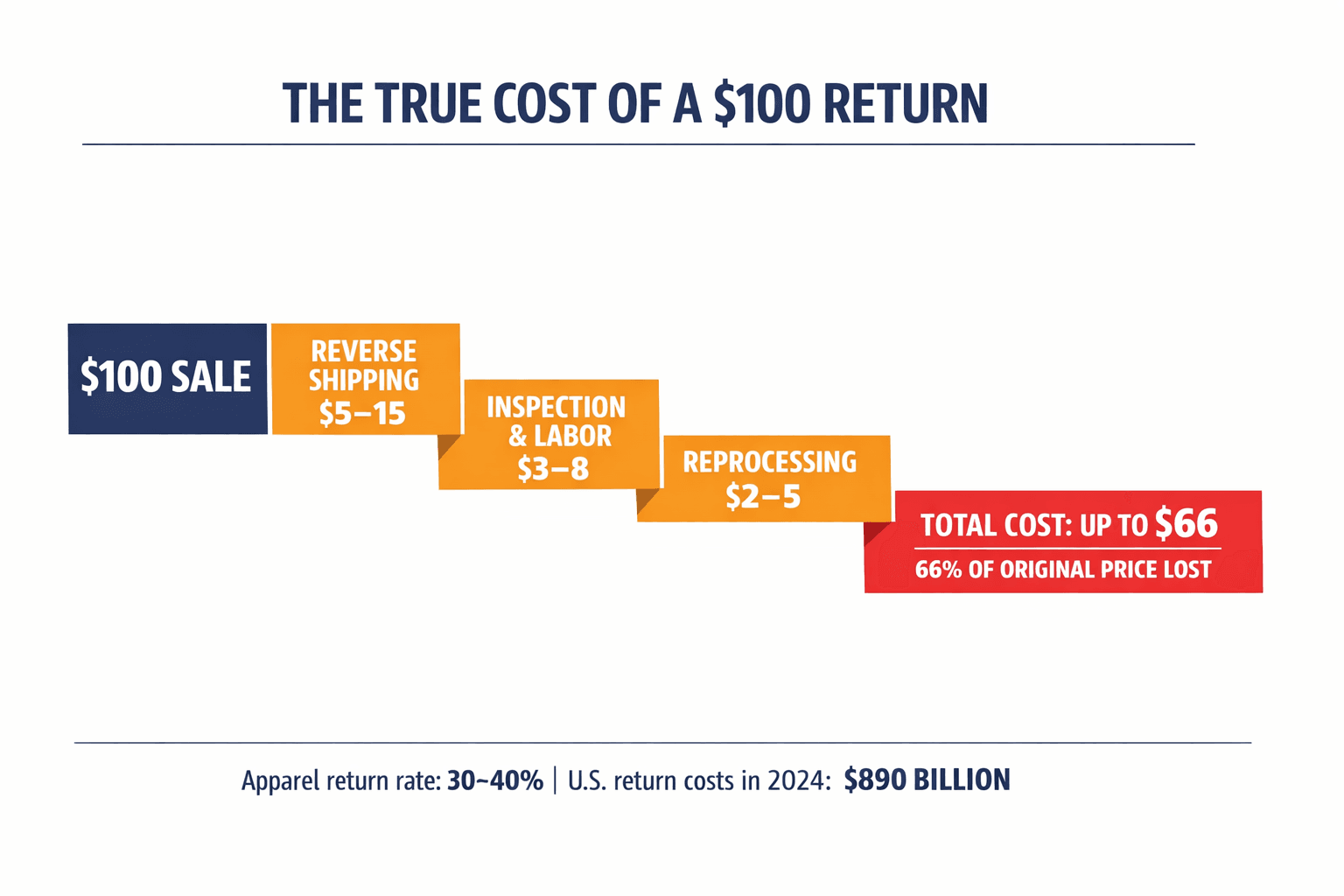
Here's the figure that keeps me up at night: U.S. retailers absorbed nearly $890 billion in return-related costs in 2024, according to the National Retail Federation. That's not a typo. That's a number that rivals the GDP of entire countries, and fashion is the worst offender.
While electronics hover around 8-10% return rates and beauty products sit at 4-10%, apparel consistently lands between 30% and 40%. During promotional surges like Black Friday, some categories spike past 50%. I've seen internal data from brands where denim return rates hit 88% during a flash sale. Eighty-eight percent. For every ten pairs of jeans shipped, nearly nine came back.
The instinct is to treat this as a cost of doing business. But the math is brutal. When a $100 garment comes back, the retailer doesn't just lose $100 in revenue. They eat $5-15 in reverse shipping (sporadic, decentralized, impossible to optimize like outbound). They pay $3-8 in manual inspection labor — someone has to open the package, check for stains, verify the SKU. They spend $2-5 on steaming, refolding, retagging. And then the real killer: by the time that garment is back on the shelf two to four weeks later, the trend window may have closed, forcing a 30-50% markdown.
The total cost of a single return can consume 66% of the item's original price. For every three items sold, if one comes back, the profit from the other two often vanishes just covering the loss.
This is what I call "profitless prosperity" — growing revenue, shrinking margins, and an executive team that can't figure out why.
Why Do Customers Return Clothes? (It's Not What You Think)
I assumed, when we first started digging into this data, that the top reason would be buyer's remorse or impulse purchases. I was wrong.
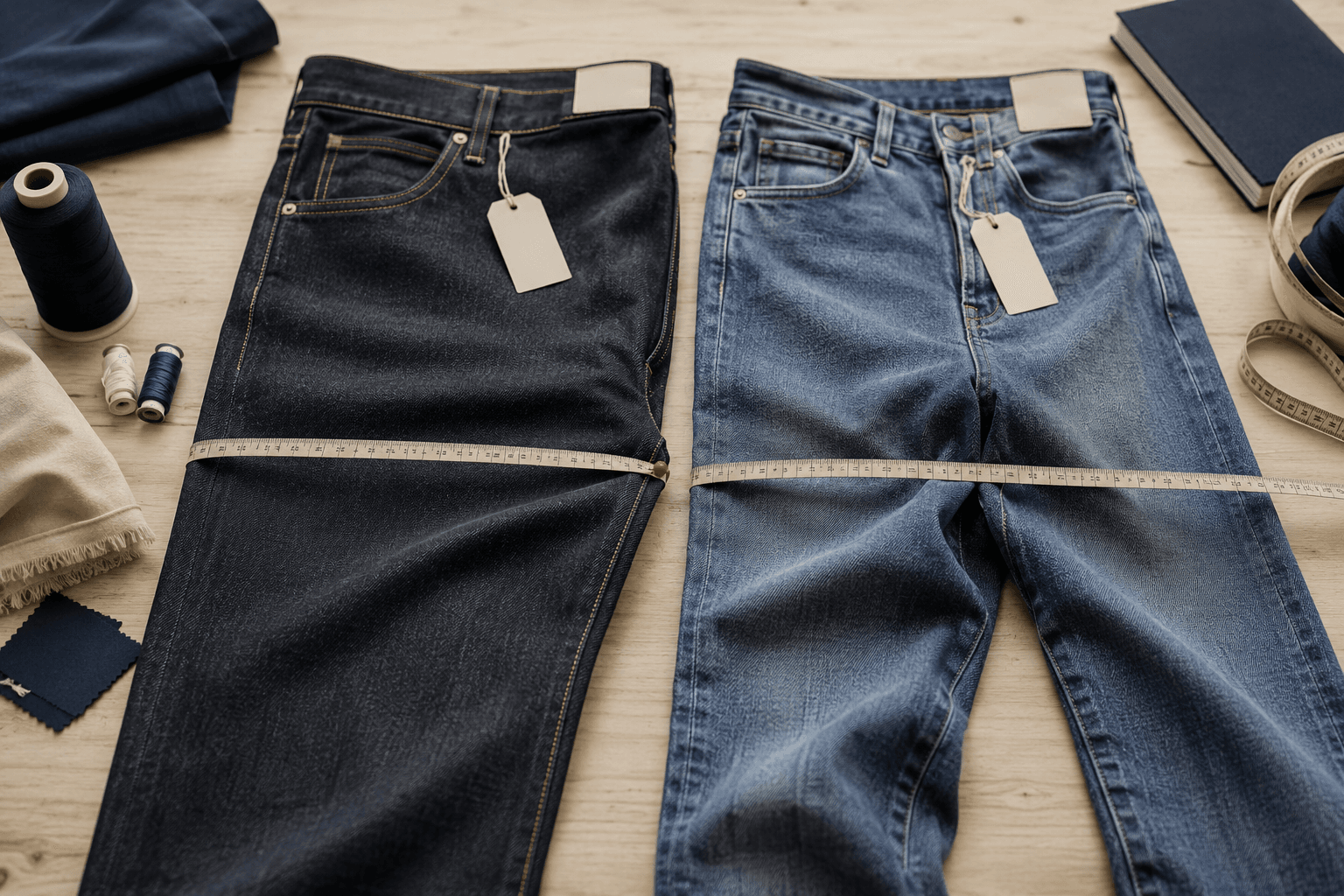
Fit and sizing issues drive 53% to 67% of all apparel returns. Not "I changed my mind." Not "the color looked different." The garment physically did not fit the human body it was purchased for.
And here's where it gets interesting: consumers aren't stupid. They know the fit information online is garbage. A "Medium" at Zara is an "Extra Small" at a luxury label. Size charts give you bust and waist circumference — two one-dimensional numbers trying to describe a three-dimensional, curved, biomechanically complex surface.
So they've adapted. They bracket.
Bracketing means ordering the same dress in a Small, Medium, and Large with the explicit plan to keep one and return two. It's perfectly rational behavior when you have zero reliable fit information. And 51% of Gen Z shoppers admit to doing it regularly. From the customer's perspective, it's smart. From the retailer's perspective, it's catastrophic — triple the outbound shipping, double the return shipping, three units locked out of inventory while sitting in someone's apartment.
I remember explaining this to an investor early on. He shrugged and said, "So just give them better size charts." I pulled up two size charts from two brands we were analyzing. Same "Medium" label. One had a bust measurement of 88cm, the other 96cm. An 8cm difference — that's not a rounding error, that's a completely different body.
Size charts aren't the solution. They're part of the problem.
The Seduction of Generative AI
So the industry went looking for a technological fix, and it found one that felt like magic: generative AI virtual try-on.
The pitch is intoxicating. A customer uploads a selfie. A diffusion model — the same family of technology behind Stable Diffusion and Midjourney — "paints" the garment onto their body. The result looks photorealistic. The customer sees themselves in the dress, feels confident, clicks buy.
Every major e-commerce platform is either building this or licensing it. The startups in this space have raised hundreds of millions. And I understand the appeal — I really do. The first time I saw a well-executed generative try-on demo, my gut reaction was this changes everything.
Then we started testing.
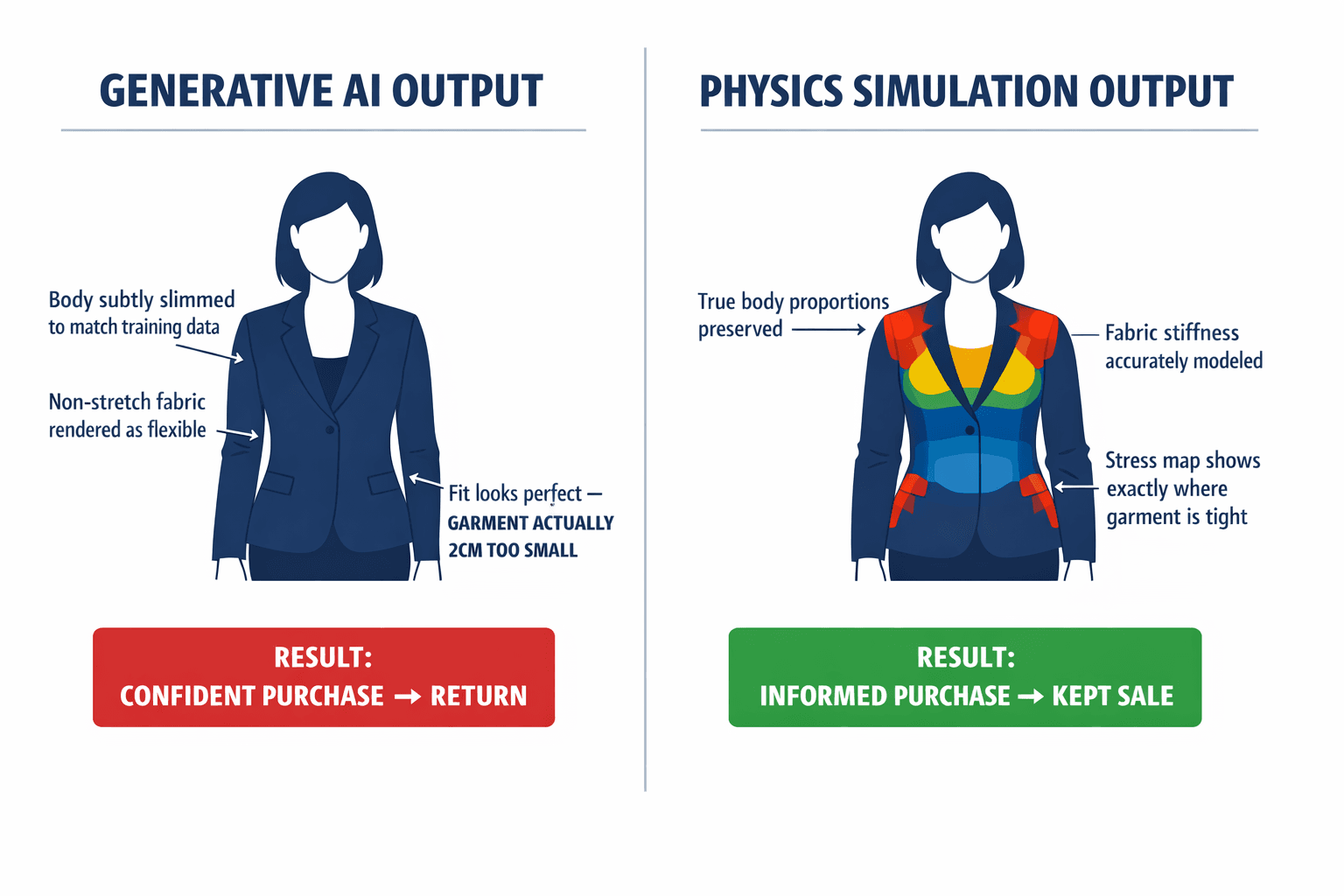
My team ran a series of experiments where we took the same garment — a structured blazer with minimal stretch — and fed it through three leading generative VTON systems alongside photos of bodies we had already measured with tape and 3D scanning. We knew the ground truth. We knew this blazer would be physically too tight across the shoulders for several of our test subjects.
Every single generative model showed the blazer fitting perfectly.
Not "slightly off." Not "a little tight." Perfectly. The AI had subtly slimmed the shoulders, softened the fabric's apparent stiffness, and produced an image that looked like a magazine editorial. It was beautiful. It was also a lie.
How Does a Diffusion Model "Hallucinate" Fit?
I need to get slightly technical here, because the failure mode isn't obvious and it matters enormously.
Diffusion models are probabilistic. They learn the statistical distribution of pixel arrangements from millions of images. When generating a virtual try-on, they're not calculating whether fabric stretches enough to accommodate a hip curve. They're predicting which pixels are most statistically likely to appear next to each other based on their training data.
The training data is overwhelmingly professional fashion photography — tall, slender models in perfectly styled garments. So when a real customer with a different body type uploads a photo, the model does something insidious: it interpolates toward what it "knows."
Generative AI doesn't calculate fit. It hallucinates fit — prioritizing visual plausibility over physical truth.
Research into diffusion model hallucinations reveals that these models inevitably assign non-zero probability to "gap regions" outside the true data distribution. In plain English: they confidently generate images of things that cannot physically exist. A non-stretch denim texture rendered as if it were spandex. A structured bodice draping like silk. Sleeves that merge into torsos in geometrically impossible ways.
The most dangerous manifestation is what I call the "slimming bias." The model doesn't just hallucinate the garment — it subtly warps the body, pulling the waist in, elongating the legs, because that's what "a person wearing clothes" looks like in its training data. The customer sees a version of themselves that looks amazing. They buy with high confidence. The physical garment arrives and doesn't zip up.
You've now converted a browser into a buyer and a returner — the worst possible outcome. You paid for the acquisition, paid for outbound shipping, and you're about to pay for the return. The generative AI didn't reduce returns. It manufactured them.
I wrote about this failure mode in more technical depth in the interactive version of our research, where we break down exactly how inpainting architectures like VITON-HD and IDM-VTON lose texture fidelity and geometric consistency.
What If We Stopped Guessing and Started Calculating?
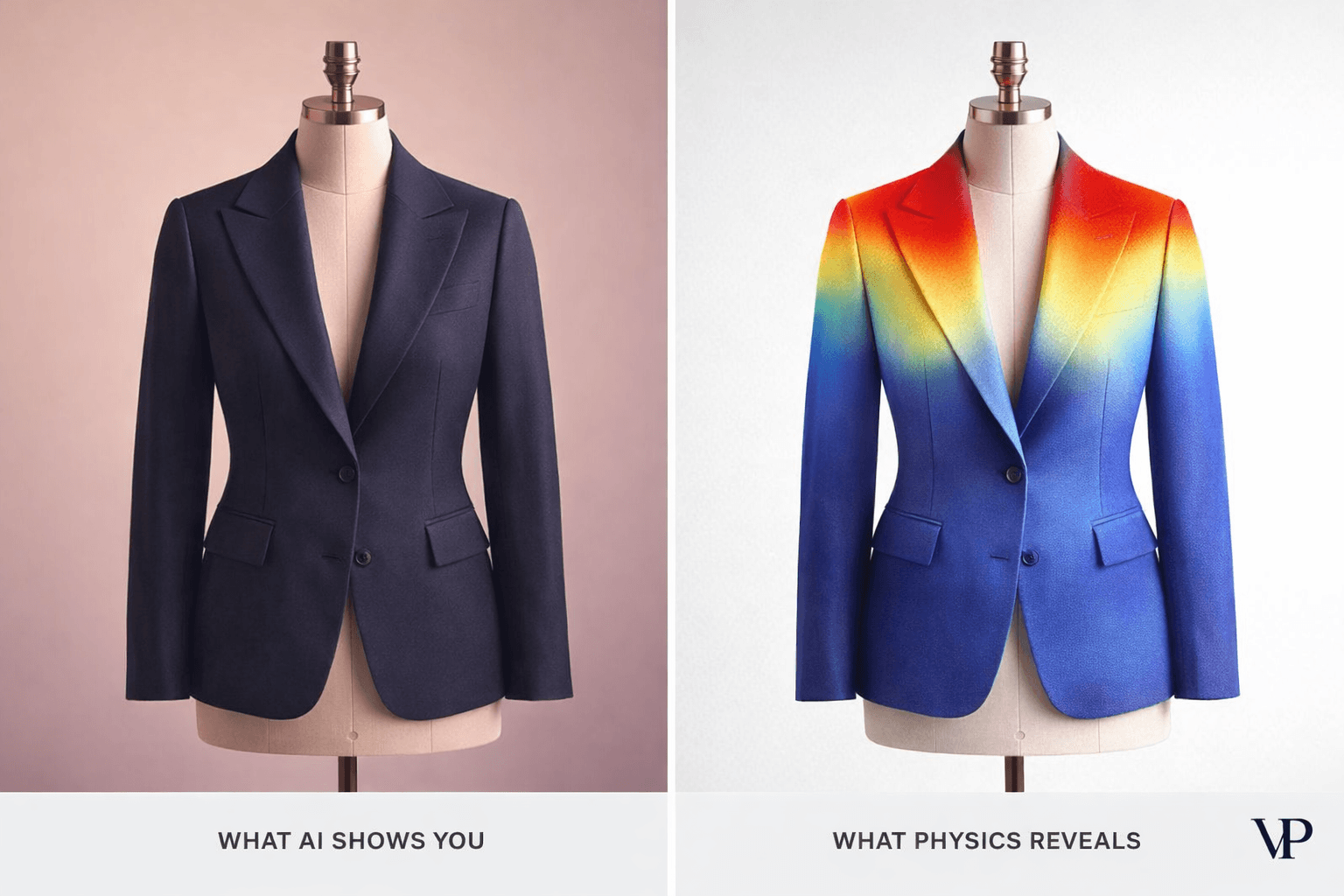
There was a night — I think it was a Tuesday, sometime around 2 AM — when I was staring at a side-by-side comparison on my monitor. On the left, a generative try-on render. On the right, the output from our physics simulation of the same garment on the same body. The generative version looked better. Smoother skin, more flattering light, the kind of image you'd double-tap on Instagram.
But the physics version had something the other didn't: a heat map. Red at the hips. Yellow across the bust. Blue where the fabric hung loose at the waist. It was telling the truth. It was saying, this garment is 2cm too small at the hip for this body, and here's exactly where it will pull.
That's the moment I stopped thinking of our approach as an alternative to generative AI and started thinking of it as a completely different category.
The core idea behind Veriprajna's approach is deceptively simple: don't paint clothes onto a photo — simulate them onto a body.
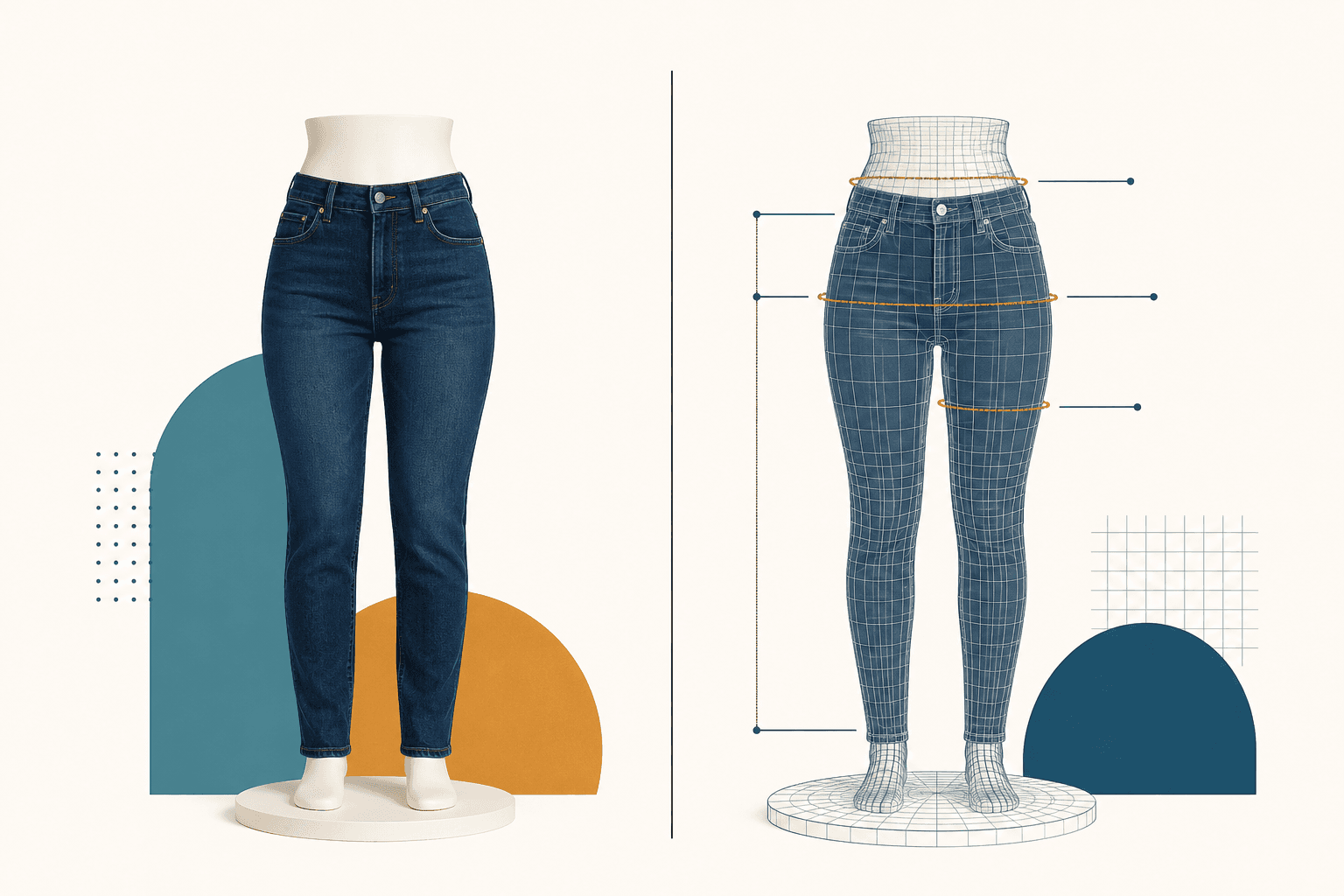
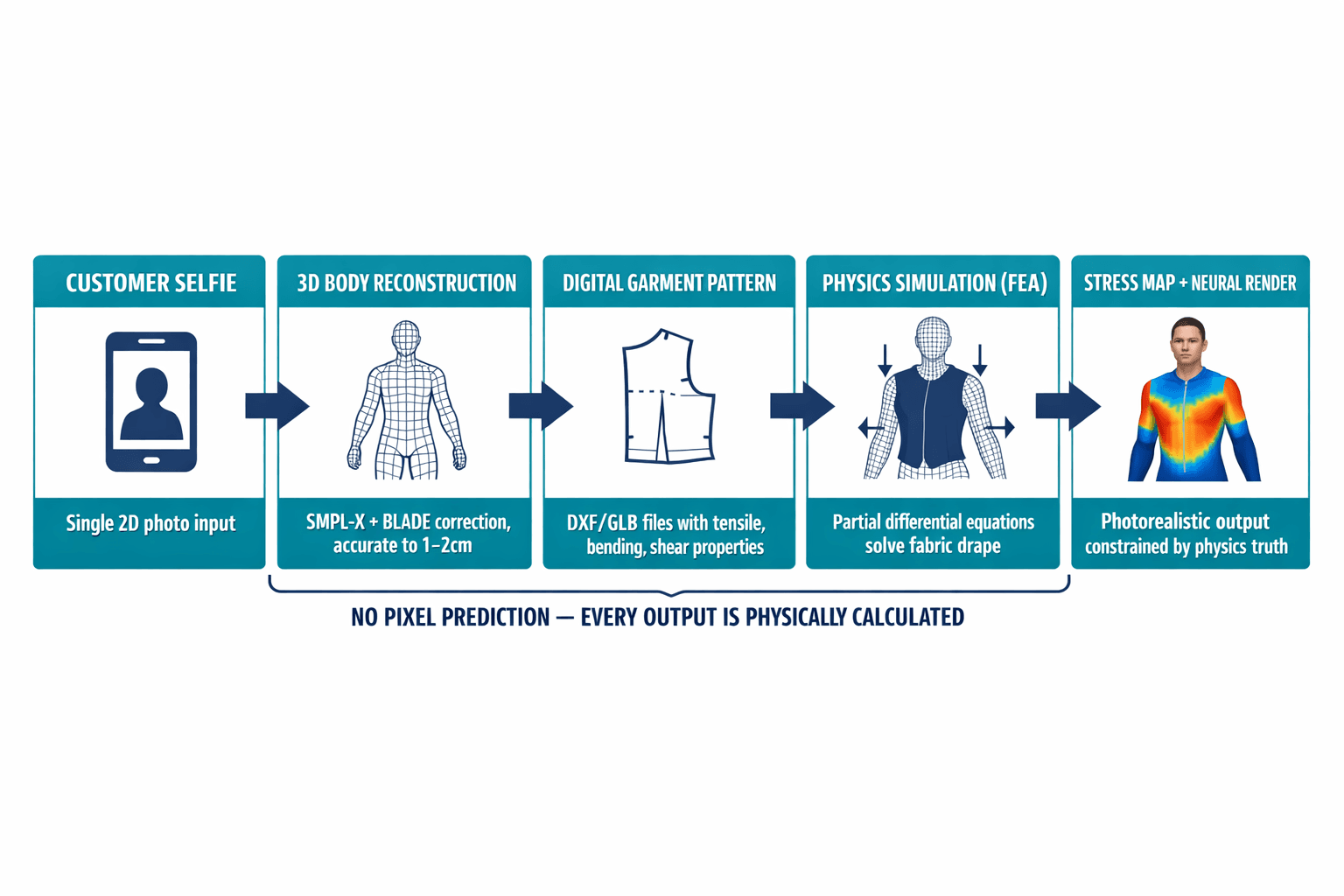
We start with the same input everyone else uses: a customer's selfie. But instead of feeding it to a diffusion model, we reconstruct the customer's body in three dimensions. We use Transformer-based architectures — the same attention mechanisms powering the best language models, but applied to human geometry — to recover a metrically accurate 3D mesh from that single 2D image.
This is called Human Mesh Recovery, or HMR, and the precision matters enormously. We use advanced parametric body models like SMPL-X (which includes articulated hands and expressive proportions) and SKEL (which incorporates an actual skeletal rig with biomechanically accurate joint limits derived from medical data). The result isn't a mannequin. It's a digital twin of the customer's actual body, accurate to within 1-2 centimeters of a physical tape measurement.
Why Does a Selfie Distort Your Body? (And How We Fix It)
Here's a problem most people never think about. Hold your phone at arm's length and take a selfie. Your face looks slightly wider. Your body looks slightly compressed. That's perspective distortion — the camera's focal length warps proportions.
Most AI body reconstruction models ignore this. They assume an "orthographic" projection, as if the camera were infinitely far away. For a fashion application where centimeters matter, this is a disaster.
We integrate an algorithm called BLADE — Body Limb Alignment and Depth Estimation — that explicitly recovers the camera's focal length and the subject's depth from the image features. It inverts the perspective distortion to recover true proportions. This sounds like a minor technical detail. It's not. It's the difference between recommending a Medium and recommending a Large. It's the difference between a kept sale and a return.
The Fabric Is Not a Texture — It's a Material
Once we have the customer's 3D body, we don't "paint" clothes onto it. We drape them using Finite Element Analysis — the same computational physics used to simulate airplane wings and bridge loads.
We take the actual digital pattern files (DXF or GLB) that brands use to manufacture their garments — not a photograph of the garment, but its engineering blueprint. We treat the fabric not as a flat image but as a physical mesh of nodes connected by springs, each governed by three measurable mechanical properties: tensile stiffness (how much it stretches), bending rigidity (how it drapes), and shear stiffness (how it conforms to curves).
The simulation solves partial differential equations to calculate where every point of fabric lands on the body under gravity, collision, and material constraints. The output isn't a pretty picture. It's a stress map — a color-coded visualization showing exactly where the garment is tight (red), snug (yellow), loose (blue), or not touching the body at all (transparent).
You can't ask a diffusion model if the buttons will pull when the customer sits down. That's a physics question, and it demands a physics answer.
A customer who sees red zones at the hip on a Medium but yellow zones on a Large doesn't need to bracket. They buy the Large. One shipment out, zero shipments back.
For the full technical breakdown of our simulation pipeline — including how we handle differentiable physics layers for GPU-accelerated deployment — see our detailed research paper.
"But Does It Actually Look Good?"
This is the question I get from every product leader, and it's fair. Physics simulations have a reputation for looking like video game renders from 2008. If the output looks clinical, customers won't engage with it, no matter how accurate it is.
We spent months on this problem. The answer is neural rendering — specifically, techniques like Gaussian Splatting that produce photorealistic output. But here's the critical difference from generative AI: our renders are constrained by the underlying physics simulation. The image looks beautiful, but it can't hallucinate. The fabric can't stretch where it wouldn't stretch. The body can't slim where it isn't slim. The visual layer is a skin over a skeleton of truth.
I had an argument with a member of my team about this — he wanted to add a "beauty filter" mode that would smooth out the stress map for a more flattering look. I vetoed it. The entire point is that we're not in the flattery business. We're in the accuracy business. Flattery drives conversions. Accuracy drives kept conversions. The P&L only cares about the second one.
What Does This Mean for the Bottom Line?
Let me make this concrete. Take a mid-sized fashion retailer doing $200 million in annual gross sales with a 30% return rate. That's $60 million in returns. At an operational cost of roughly 20% of return value (logistics, labor, depreciation, markdowns), they're burning $12 million a year just processing returns.
Industry data suggests that advanced virtual try-on with real fit verification can reduce return rates by 20-30%. If we cut that 30% return rate to 22.5% — a conservative 25% reduction — the math changes dramatically:
- $3 million in direct operational savings from processing fewer returns
- $7.5 million in revenue recovery (half of prevented returns convert to kept sales)
- $10.5 million in total annual P&L impact
That's not a technology cost. That's a margin recovery program.
And there's a sustainability dimension that's becoming impossible to ignore. Reverse logistics is a carbon bomb. Every returned package means another truck, another warehouse touch, another garment that might end up in a landfill. The EU's Ecodesign for Sustainable Products Regulation is moving to ban the destruction of unsold textiles. Reducing return volume by 25% gives brands a quantifiable ESG metric — not greenwashing, but measured reduction in unnecessary shipments.
"Why Not Just Use Both?"
People ask me this constantly — why not use generative AI for the visual appeal and physics for the accuracy? Layer them together?
I understand the instinct, but it misses the point. The generative layer actively undermines the physics layer. If you show a customer a flattering, hallucinated image alongside an honest stress map, which one do they believe? The pretty one. Every time. The generative image becomes the promise, and the physics becomes the fine print nobody reads.
The ultimate luxury in the age of AI is truth — mathematical, geometric, physical truth. Not a more convincing illusion.
The harder question — and I'll be honest about this — is that our approach requires something generative AI doesn't: digital garment assets. Brands need to create 3D digital twins of their inventory using tools like CLO3D or Browzwear. This is a real investment. It's a change in workflow. It means the digital pattern used for simulation must match the factory pattern used for production, or the whole system is meaningless.
We consult on this transition. It's not trivial. But brands that have already adopted Digital Product Creation for design and sampling are halfway there. And the ones that haven't? The returns crisis will eventually force their hand. The question is whether they invest proactively or reactively.
The Fork in the Road
The fashion industry is choosing right now between two futures.
In one, generative AI gets better at flattery. The images become indistinguishable from photographs. Conversion rates climb. Returns climb faster. Margins erode. Brands compete on who can produce the most convincing illusion while drowning in reverse logistics costs and landfill guilt.
In the other, the industry treats fit as what it actually is — a mechanical compatibility problem between a material and a body — and builds the geometric infrastructure to solve it. This path is harder. It requires real engineering, not API wrappers. It requires brands to invest in digital assets, not just digital marketing. It requires choosing accuracy over aesthetics when the two conflict.
I know which future I'm building for. The diffusion model doesn't know that a waistline is 72 centimeters. It doesn't know that a fabric weighs 200 grams per square meter. It doesn't know anything — it predicts pixels. And prediction, no matter how photorealistic, is not understanding.
Physics is understanding. And understanding is the only thing that has ever actually solved a problem.