The $400,000 Fine That Should Terrify Every AI Company — And What I'm Building Instead

I was on a call with a potential banking client when the SEC dropped the Delphia and Global Predictions enforcement actions. March 18, 2024. The client's compliance officer literally interrupted our conversation to read the press release out loud. When she finished, there was this long silence. Then she said: "So basically, the SEC just told us that everything our current AI vendor promised us is a lawsuit waiting to happen."
She wasn't wrong. The SEC had just fined two investment advisory firms a combined $400,000 for what regulators formally called AI washing — making false and misleading claims about their use of artificial intelligence. One firm, Delphia, had been telling clients since 2019 that it used machine learning to analyze their spending patterns and social media activity to "predict which companies and trends are about to make it big." The reality? They had never actually integrated any of that data into their investment process. Not once. They were marketing a capability that literally did not exist.
That phone call changed the trajectory of my company. Not because the enforcement actions surprised me — I'd been watching this collision between AI hype and regulatory reality for months. What changed was the urgency. Suddenly, every bank, every healthcare system, every law firm I talked to wasn't asking "how do we adopt AI?" They were asking "how do we prove our AI actually does what we say it does?"
That question — how do you engineer provable truth into an AI system — is what I've spent the time since obsessively trying to answer.
What Exactly Is AI Washing, and Why Should You Care?
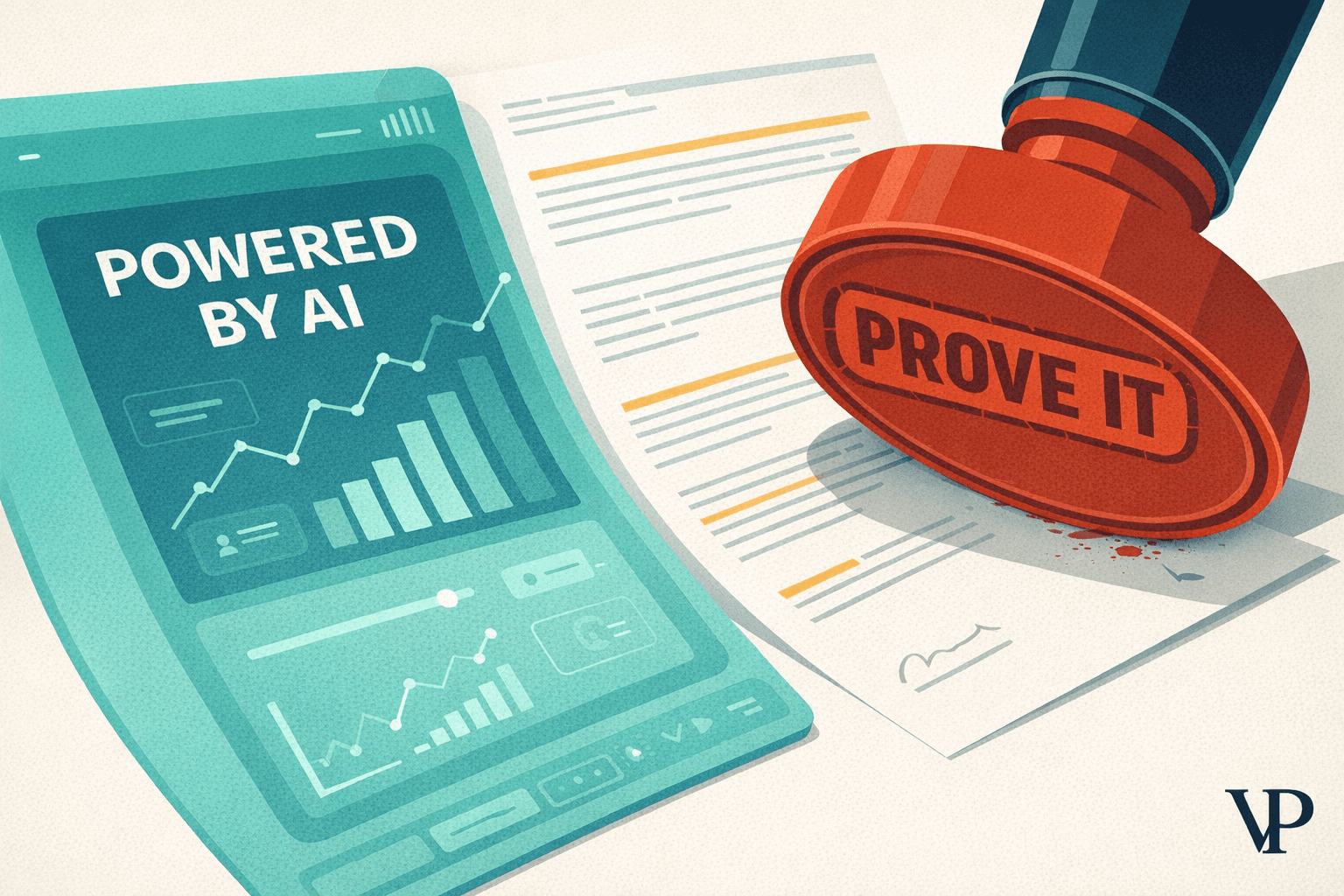
Think of greenwashing, but for algorithms. A company slaps "powered by AI" on its marketing materials, watches the stock price tick up or the client pipeline fill, and nobody asks whether the technology underneath actually works as advertised. The SEC borrowed the term deliberately — the deception mechanics are identical.
Delphia claimed to use a "predictive algorithmic model" powered by machine learning. The SEC examined them, told them to stop lying in 2021, and they kept doing it for two more years. That earned them a $225,000 penalty and a censure. Global Predictions, meanwhile, called itself "the first regulated AI financial advisor" and promised "expert AI-driven forecasts." When regulators asked for the technical documentation to back those claims, the firm couldn't produce it. Another $175,000 gone.
The SEC didn't need new AI-specific legislation to prosecute these cases. They used the same antifraud statutes that have existed for decades. If you lie about what your technology does, you're committing fraud. The "AI" part is irrelevant.
Here's what makes this different from a typical regulatory slap on the wrist: SEC Chair Gary Gensler made clear that this was the beginning, not a one-off. And the SEC isn't alone. The FTC launched "Operation AI Comply" and went after DoNotPay — the company that marketed itself as "the world's first robot lawyer" — because it couldn't substantiate its claims that its AI could replace a human attorney. The Department of Justice announced it would evaluate AI risk management as part of corporate compliance assessments and seek harsher penalties for crimes facilitated by AI misuse.
Three federal agencies, all converging on the same message: prove it or pay for it.
The Night I Realized Most Enterprise AI Is Built on Sand
I remember a specific evening — my team and I were benchmarking a competitor's "AI-powered legal research tool" that a client was considering. We fed it a straightforward question about a recent circuit court ruling. The tool returned a beautifully formatted answer with three case citations. Confident tone. Professional language. One problem: one of the citations was completely fabricated. The case didn't exist. The other two existed but said the opposite of what the tool claimed.
My co-founder looked at me and said, "This thing writes like a lawyer and reasons like a parrot."
That's the core technical problem, and it's not a bug — it's the architecture. Most Large Language Models work through next-token prediction. They calculate the probability of what word should come next given everything that came before. The math is elegant: a softmax function over the model's output scores, selecting the most likely continuation. But "most likely" and "true" are fundamentally different things. The model has no internal concept of truth. It has never read a statute and understood it. It has processed billions of tokens and learned which words tend to appear near other words.
For generating marketing copy or summarizing meeting notes, this is fine. For telling a bank whether a transaction complies with anti-money laundering regulations, or telling a doctor whether a drug interaction is dangerous, "statistically plausible" is legally identical to "wrong."
In regulated environments, "mostly correct" isn't a quality tier — it's a liability category.
And yet the vast majority of "AI solutions" being sold to enterprises right now are what the industry euphemistically calls "wrappers." They take a public API from OpenAI or Anthropic, add some prompt engineering and a nice user interface, and ship it. The wrapper has no way to verify its own reasoning. It can't prove where its answers came from. It simply relays whatever the base model generates, hallucinations and all.
I wrote about this problem in depth in the interactive version of our research — the gap between what these systems claim and what they architecturally can do is staggering.
Why Does RAG Fail for High-Stakes Decisions?
When I explain this problem to technical audiences, someone inevitably says: "But what about RAG?" Retrieval-Augmented Generation — the approach where you give the model access to a database of documents so it can look things up instead of making things up. It's the industry's favorite band-aid.
Here's the problem. Standard Vector RAG works by converting your question and your documents into mathematical representations (vectors), then finding the documents that are "closest" to your question in that abstract space. It's a semantic similarity search. And for many applications, it works reasonably well.
But "reasonably well" collapses in domains where relationships between pieces of information matter as much as the information itself. Take legal research. A court case doesn't just exist — it cites other cases, overrules some, affirms others, and operates within a specific jurisdictional hierarchy. When you ask a legal AI "is this precedent still good law?", a vector search might surface the case because the words match. But it has no way to tell you that the case was overruled by a higher court six months later. It can't distinguish between a citation and a repudiation.
My team argued about this for weeks. One engineer wanted to keep improving our vector retrieval — better embeddings, better chunking strategies, more sophisticated reranking. Another kept insisting that the problem wasn't retrieval quality, it was retrieval architecture. That the entire paradigm of "find the closest document" was wrong for domains where the relationships between documents carry the meaning.
She was right. And that argument is what pushed us toward GraphRAG.
What Happens When You Build AI That Can Prove Its Reasoning?
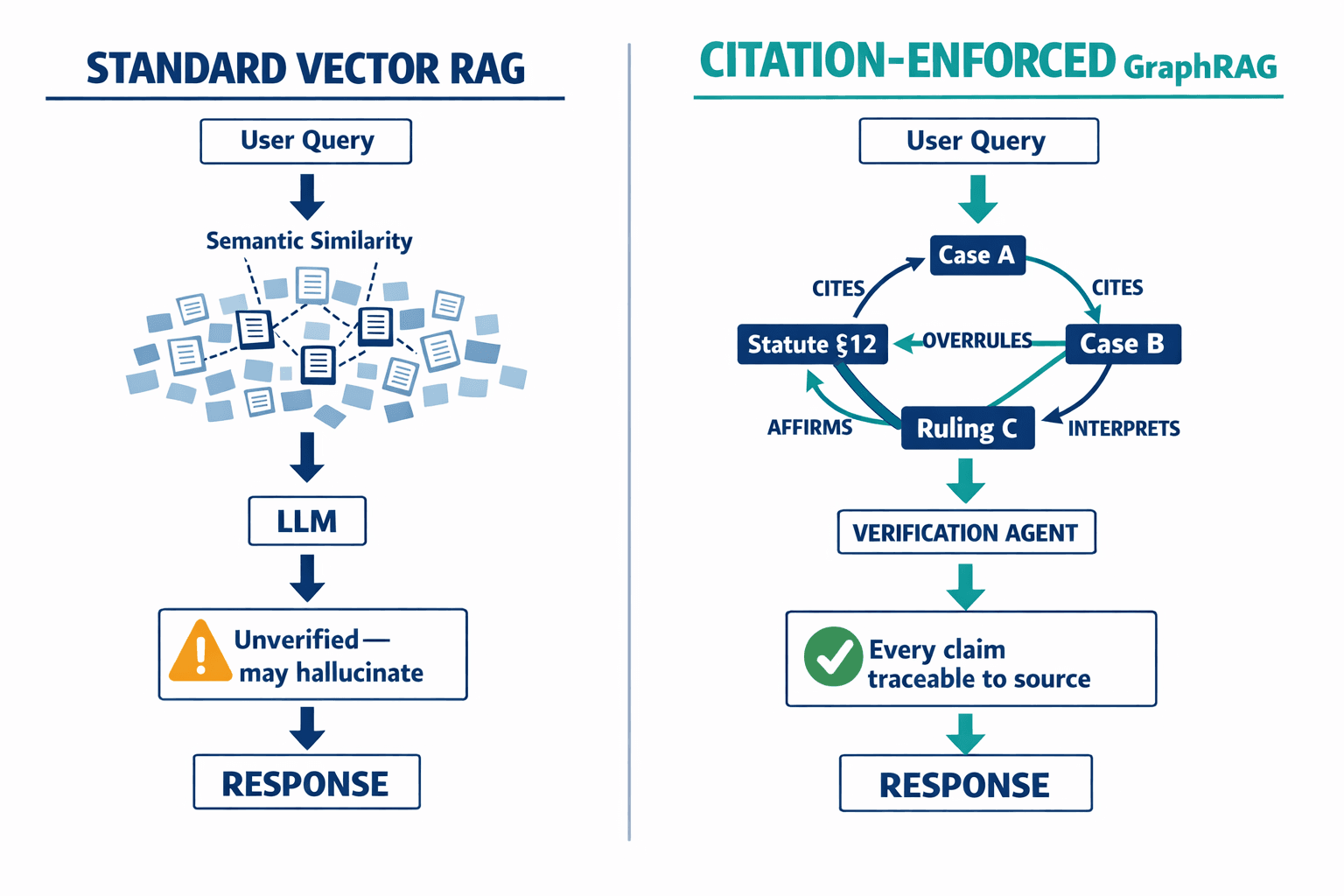
GraphRAG — specifically what we call Citation-Enforced GraphRAG — replaces the fuzzy semantic search with a structured knowledge graph. Instead of floating vectors in abstract space, you build an explicit map of how information connects. In a legal knowledge graph, a judicial opinion is a node. Its relationship to other opinions is an edge — CITES, OVERRULES, AFFIRMS, INTERPRETS. Statutes connect to the cases that interpret them. Jurisdictional hierarchies are encoded directly.
When the AI generates a response, it doesn't just find "similar" text. It traverses verified paths in the graph. If it claims Case A supports Proposition B, there must be an actual, auditable link in the graph connecting them. We use graph-constrained decoding to physically prevent the model from outputting a citation it can't verify. The model literally cannot hallucinate a citation because the architecture won't let it.
This is what I mean by deterministic AI. Not "probably right." Provably grounded.
The difference between Vector RAG and GraphRAG isn't incremental improvement — it's the difference between guessing which book is relevant and actually reading the footnotes.
We pair this with multi-agent orchestration. Instead of one model doing everything — research, verification, writing — we use specialized agents. A Research Agent retrieves the raw information. A Verification Agent cross-references it against the knowledge graph. A Writer Agent produces the output using only verified facts. These agents run through what we call a Cyclic Reflection Pattern, iteratively reviewing drafts for hallucinations before any human ever sees the result.
It's slower than a wrapper. It costs more to build. And it's the only architecture I'd trust with a decision that could end up in front of a regulator.
The Data Sovereignty Problem Nobody Wants to Talk About
There's another dimension to this that the AI washing conversation mostly ignores: where the data lives.
A healthcare client once asked me point-blank: "If we use your system, where does our patient data go?" When I told them it never leaves their infrastructure, they looked relieved. Then they told me their previous vendor — a well-known AI company — couldn't answer that question clearly. The data went to the vendor's cloud, was processed on shared infrastructure, and the vendor's terms of service technically allowed using it to improve their models.
For a company handling data governed by HIPAA, GDPR, or the CCPA, that's not a gray area. That's a violation.
We deploy on sovereign infrastructure — fully self-hosted on the client's premises, or within their own private cloud (VPC) where the AI instances are isolated from the public internet. It requires more upfront investment. The client needs GPUs and specialized infrastructure. But they get something no public API can offer: zero data leakage and complete auditability. Every query, every response, every model version — all within their governance framework.
For the full technical architecture of how we build this — including the knowledge graph schema, the multi-agent orchestration framework, and our approach to sovereign deployment — see our technical deep-dive.
How Do You Actually Govern AI Without Drowning in Compliance?
I've sat in boardrooms where executives treat AI governance like a checkbox exercise. Pick a framework, fill out the forms, move on. That approach will get you fined.
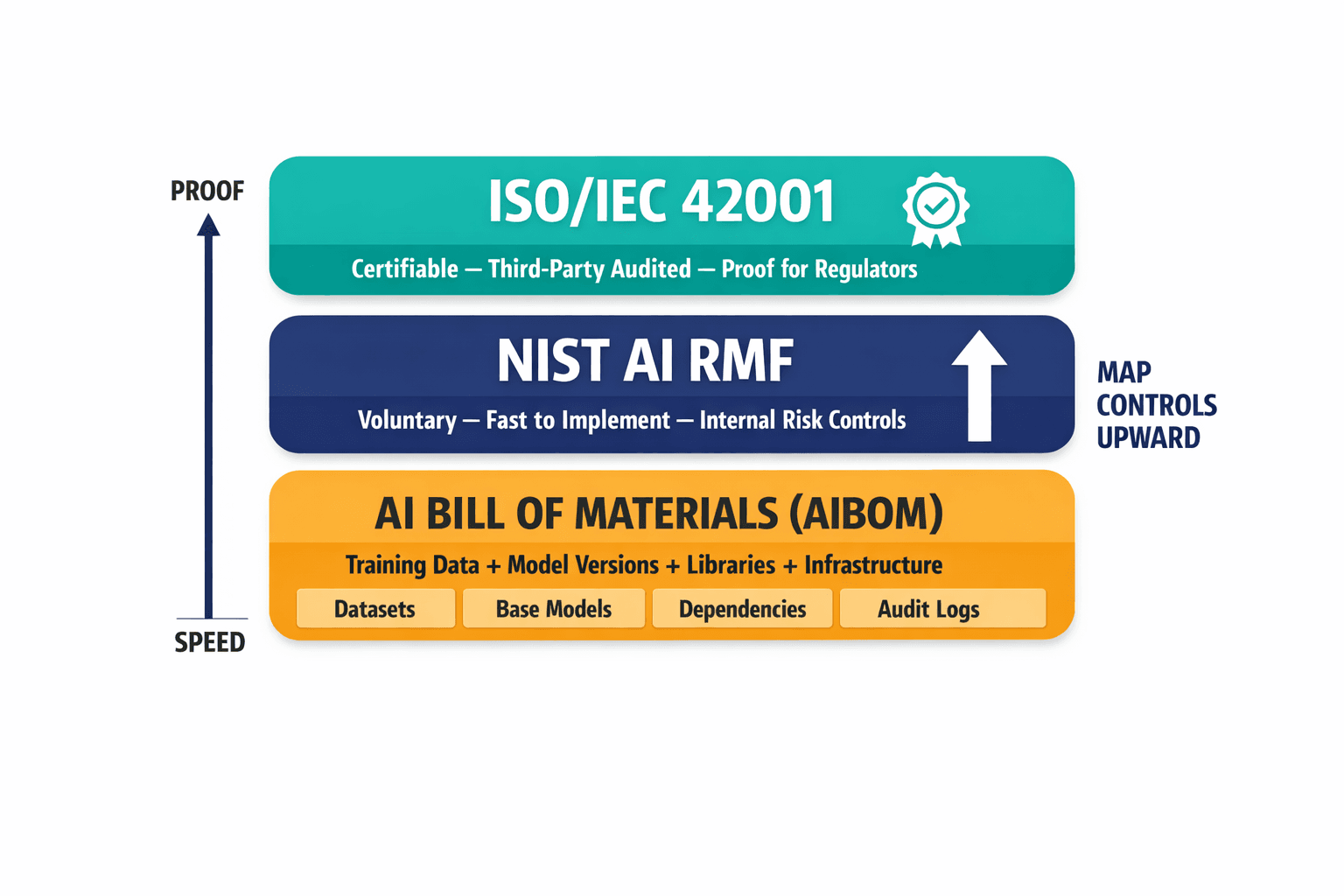
Two frameworks have emerged as the industry standards, and they serve different purposes. The NIST AI Risk Management Framework is a voluntary tactical guide — it helps you identify risks, measure them, and build internal processes. It's fast to implement and great for building what I call "AI risk muscles" within your organization. But it's self-attested. Nobody verifies you actually did what you said.
ISO/IEC 42001 is the certifiable international standard. A third-party auditor examines your AI management system and either certifies you or doesn't. That certification matters when a regulator, a client, or an acquirer asks "prove your AI governance is real."
The smart play is sequencing both: use NIST to build agile internal controls quickly, then map those controls to ISO 42001's requirements for formal certification. One gives you speed, the other gives you proof.
And underneath both frameworks, there's an emerging requirement that most companies haven't even heard of yet: the AI Bill of Materials (AIBOM). Think of it like a nutritional label for your AI system. It's a machine-readable record of everything that went into building it — training datasets, base models, third-party libraries, infrastructure dependencies. When an auditor asks "what data trained this model?" or "what version of PyTorch was running when this decision was made?", the AIBOM answers instantly.
We generate AIBOMs automatically as part of our deployment pipeline. Every model version traces back to exact code and dataset versions. It's not glamorous work. But it's the difference between passing an audit and scrambling to reconstruct documentation that should have existed from day one.
The Investor Who Told Me to "Just Use GPT"
I have to tell this story because it captures the exact mindset that AI washing enforcement is designed to punish.
Early in Veriprajna's life, I was pitching an investor. I explained our architecture — the knowledge graphs, the multi-agent verification, the sovereign deployment model. He listened politely, then said: "Why don't you just wrap GPT-4, charge less, and scale faster? Nobody's going to audit the backend."
I told him that the SEC had just fined two companies for exactly that logic. He shrugged.
Six months later, one of his portfolio companies — an "AI-powered" fintech — received a regulatory inquiry about its marketing claims. They couldn't produce documentation showing their AI actually did what their pitch deck said it did. The last I heard, they were scrambling to hire compliance consultants at emergency rates.
People always ask me whether the enforcement environment will soften — whether a new administration or shifting priorities might make AI washing less risky. My honest answer: it doesn't matter. The SEC used existing antifraud law. The FTC used Section 5 of the FTC Act, which has been on the books since 1914. State attorneys general have their own consumer protection statutes. Even if federal enforcement priorities shift, the legal infrastructure for prosecuting AI deception is permanent and multi-layered.
AI washing isn't a regulatory fad. It's fraud dressed in a lab coat, and every level of government now has the tools and the appetite to prosecute it.
The more important question is what happens to the market. When companies succeed based on fabricated AI capabilities, they distort competition and erode the trust that legitimate AI companies need to operate. Every wrapper sold as "advanced AI" makes it harder for companies doing genuine engineering to explain why their solutions cost more and take longer to build.
What Does a Trustworthy AI System Actually Look Like?
If you strip away the frameworks and the acronyms, building AI that can survive regulatory scrutiny comes down to four things.
Engineer determinism. Move beyond probabilistic outputs to architectures — neuro-symbolic systems, knowledge graphs, graph-constrained decoding — that can prove their reasoning. If your AI can't show its work, it's not ready for regulated environments.
Architect sovereignty. Deploy within infrastructure you control. If your client's sensitive data touches shared public infrastructure, you've created a compliance liability that no amount of prompt engineering can fix.
Standardize governance. Adopt certifiable frameworks. Maintain AI Bills of Materials. Make documentation a continuous, automated process, not an annual scramble.
Validate continuously. Implement adversarial red-teaming, track hallucination rates and grounding rates as KPIs, and keep humans in the loop for high-stakes decisions. The model that was accurate at deployment will drift. Monitor it like you'd monitor a trading algorithm — because the consequences of failure are comparable.
The SEC's $400,000 in fines was a rounding error for the financial industry. The message behind those fines was not. We've exited the era where you could market AI capabilities you didn't possess, deploy black boxes into regulated workflows, and assume nobody would check. Every enterprise AI system now operates under an implicit burden of proof: can you demonstrate that this does what you claim?
I built Veriprajna — the name combines "Veri" (truth) and "Prajna" (wisdom) — because I believe the AI industry's credibility crisis is fundamentally an architecture crisis. You can't solve a truth problem with a system that was never designed to care about truth. You have to engineer it in, from the knowledge graph up, through every agent, every verification loop, every deployment decision.
The companies that understand this will build AI that actually works. The ones that don't will keep wrapping APIs, writing impressive pitch decks, and hoping nobody looks under the hood. The regulators are looking now. And they're not going to stop.