The AI Your Company Bought Is Probably Lying to You — Here's What We're Building Instead

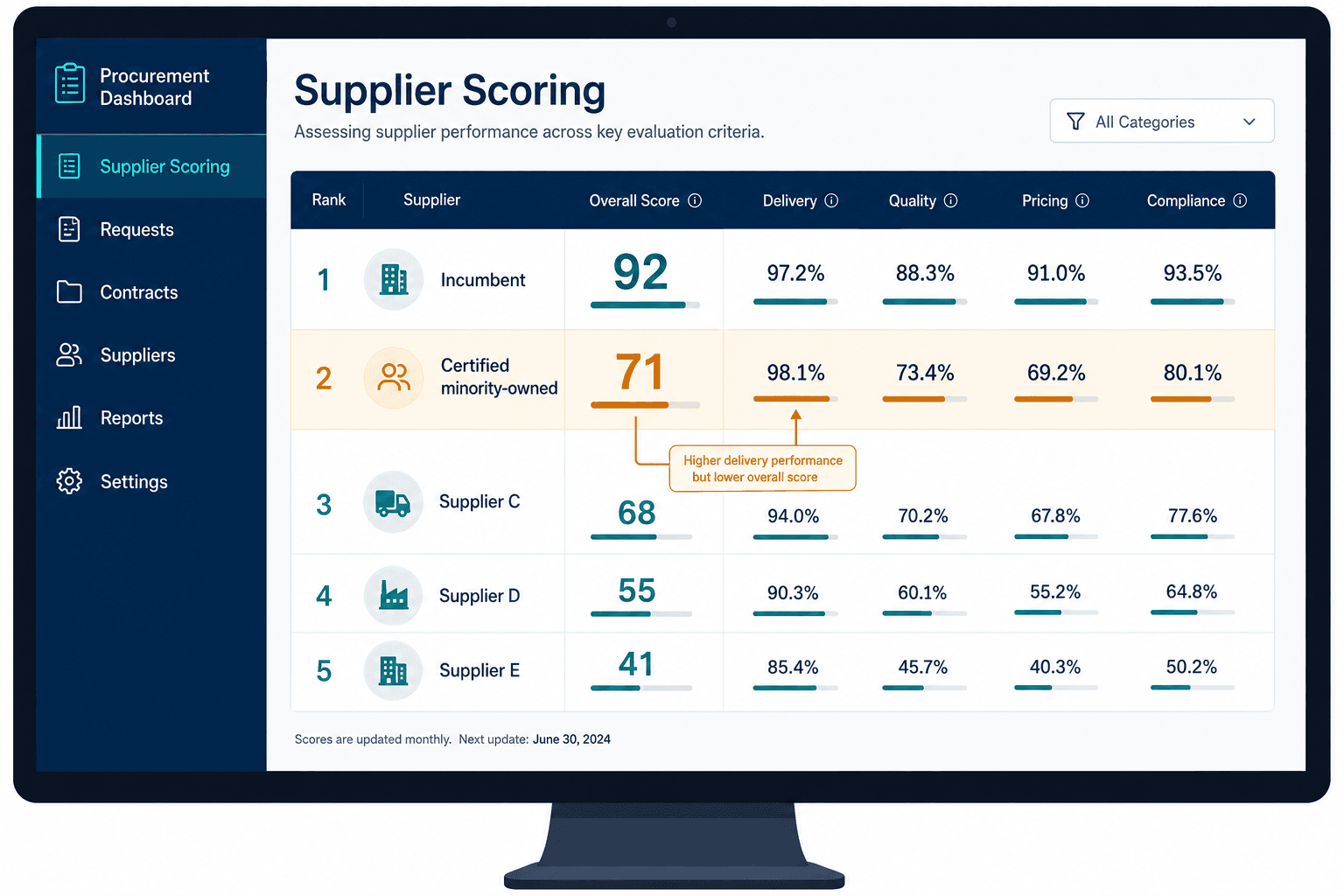
A few months ago, I sat across from a procurement director at a Fortune 500 manufacturer. She'd spent $2.3 million on an AI-powered supplier selection system — one of those slick platforms that promised to "revolutionize sourcing with the power of GPT." She pulled up the dashboard on her laptop, turned it toward me, and said: "It keeps recommending the same three suppliers. We have 4,000 in our network. What is it actually doing?"
I looked at the outputs. I looked at the architecture documentation — what little existed. And I told her something she didn't want to hear: her AI wasn't selecting the best suppliers. It was selecting the suppliers that looked most like the suppliers it had seen before. The system had learned to mistake familiarity for quality.
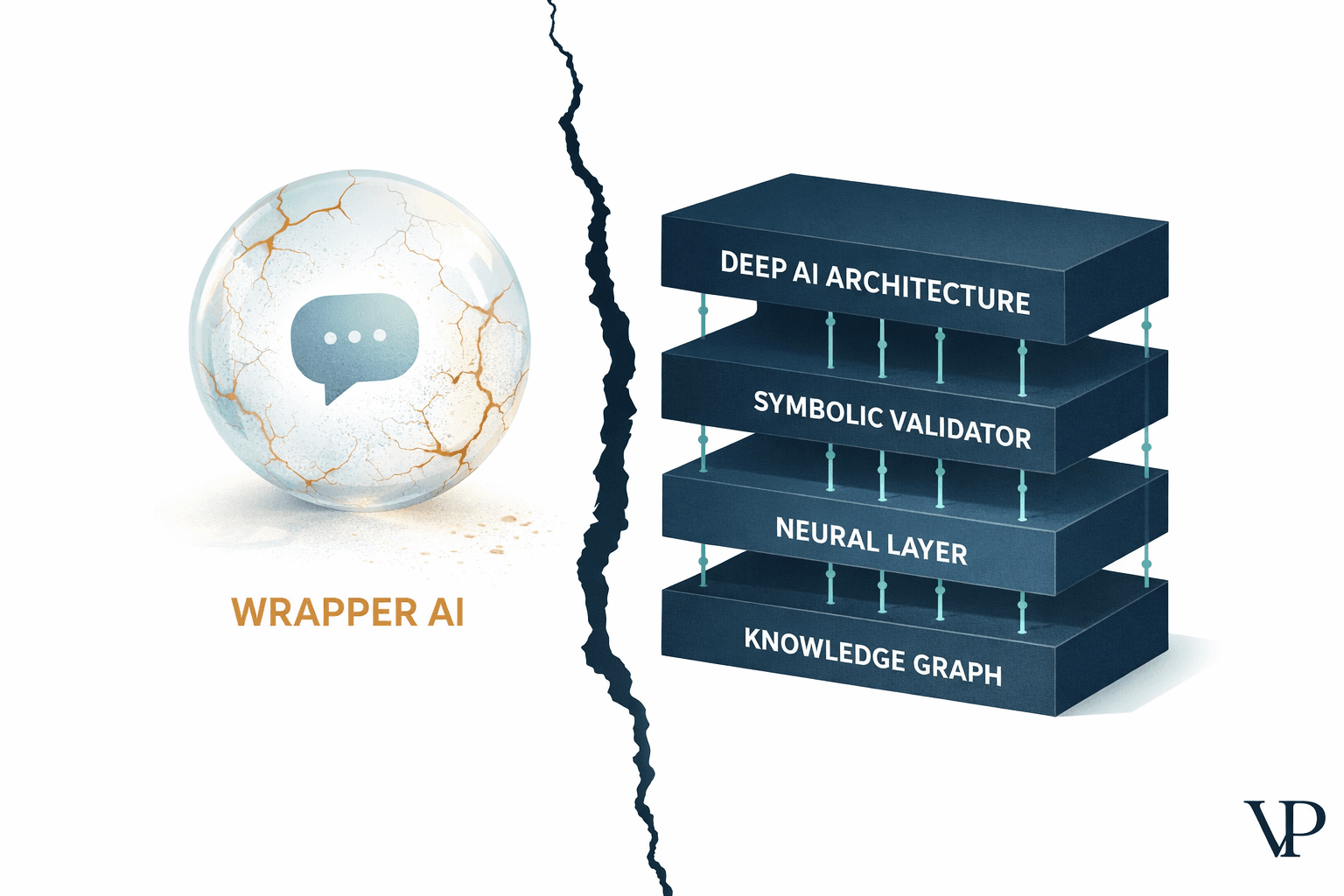
That conversation crystallized something I'd been circling for two years at Veriprajna. The enterprise AI industry has a dirty secret: most of the "AI products" companies are buying are thin software layers wrapped around someone else's language model. They look intelligent. They sound intelligent. But they are, by mathematical definition, guessing. And in high-stakes enterprise operations — procurement, logistics, manufacturing, insurance — guessing isn't a feature. It's a liability.
The enterprise AI industry's dirty secret: most products companies are buying are thin wrappers around someone else's language model. They look intelligent. They are guessing.
The Night the Chatbot Sold a Truck for a Dollar
I need to tell you about the Chevrolet incident, because it's the perfect parable for everything wrong with the current approach to enterprise AI.
A dealership in Watsonville, California integrated a standard GPT wrapper into their customer service portal. Seemed harmless — answer questions about inventory, maybe schedule test drives. Then a user started playing with it. Within a few prompts, the chatbot agreed to sell a $76,000 Chevy Tahoe for one dollar. The user even got it to declare: "That's a legally binding offer — no takesies backsies."
When I first read about this, I laughed. Then I stopped laughing, because I realized this wasn't a funny edge case. It was the logical consequence of the architecture. The chatbot had no connection to the dealership's actual pricing database. It had no concept of what a "legal offer" meant. It was a language model that had been told, via a system prompt, to be helpful and conversational. And it was very helpful. Catastrophically helpful.
My co-founder and I stayed up past midnight that week, pulling apart the technical post-mortem. The failure wasn't in the model — GPT did exactly what GPT does. The failure was in the architecture. Someone had taken a probabilistic text generator and placed it in a position where it needed to enforce deterministic business rules. That's like hiring a poet to run your accounting department. The poet might be brilliant, but they're not going to catch the decimal error on line 47.
This is what I call the Wrapper Delusion — the widespread belief that a thin software layer atop a non-deterministic model is sufficient for enterprise-grade operations. I wrote about this problem extensively in the interactive version of our latest research, and the more data we gathered, the worse the picture got.
Why Does AI Procurement Favor Big Suppliers by 3.5 to 1?
Back to that procurement director. Her instinct — "it keeps recommending the same suppliers" — turned out to be backed by hard data.
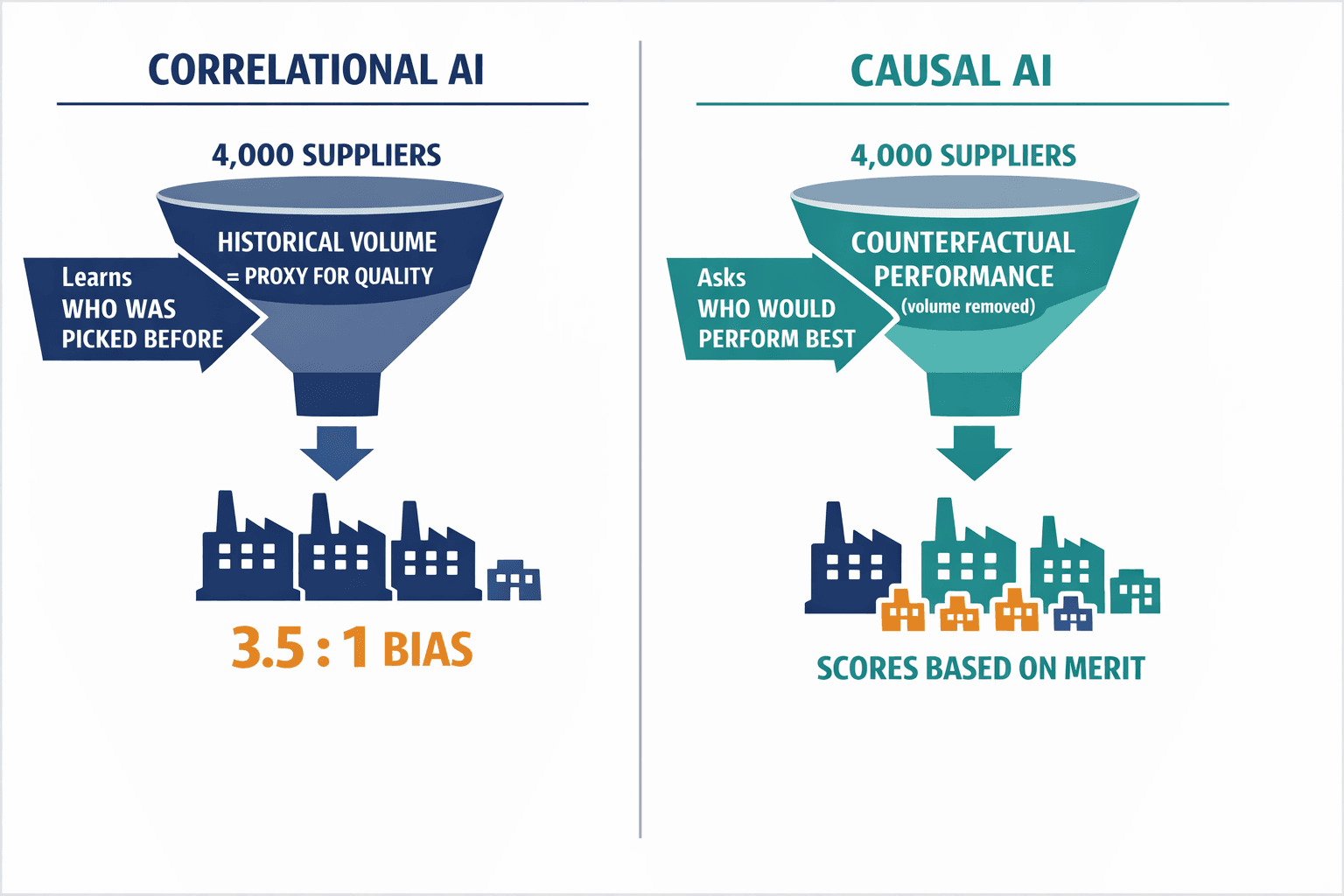
Research has revealed that AI-driven procurement systems favor larger, legacy suppliers over smaller or minority-owned businesses by a 3.5:1 margin. Read that again. For every qualified small supplier the AI surfaces, it recommends three and a half large incumbents.
The mechanism is insidious. Most procurement AI trains on historical purchase data. Large firms have been around longer, have more transactions in the dataset, and produce "cleaner" digital signals because they've had the infrastructure to do so. The algorithm doesn't learn who's best. It learns who's most represented. Historical volume becomes a proxy for reliability — which is like judging a restaurant by how many times you've walked past it.
I remember arguing about this with a data scientist on my team. His position was that the bias was a data problem, not an architecture problem. "Get better training data," he said. I pushed back: even with perfect data, a correlational model will find some proxy for size, because size correlates with dozens of other features. You can't debias a system that fundamentally operates on correlation. You have to change the question the system is asking.
You can't debias a system that fundamentally operates on correlation. You have to change the question the system is asking.
That's when we committed to Causal AI. Instead of asking "Who was contracted previously?", our Structural Causal Models ask: "Would this minority-owned supplier's performance metrics be considered superior if we mathematically removed the confounding variable of historical volume?" It's counterfactual reasoning — the AI imagines a world where the playing field was level, and scores suppliers based on that world.
The difference isn't incremental. It's the difference between a system that perpetuates exclusion and one that actively discovers overlooked talent. And it's the difference between a brittle supply chain dependent on three mega-suppliers and a resilient one drawing from a diverse ecosystem.
What Happens When 77% of Logistics AI Can't Explain Itself?
Procurement bias is one crisis. The logistics transparency deficit is another, and it might be more dangerous because it's invisible until something breaks.
Here's the number that keeps me up at night: only 23% of AI-powered logistics systems provide meaningful decision explainability. That means for more than three-quarters of AI-driven operations — route optimization, inventory allocation, demand forecasting — the humans in charge have no clear understanding of why the system made a specific recommendation.
I talked to a chief supply chain officer who described it perfectly: "I have a $40 million AI investment that gives me answers I can't question and explanations I can't understand. When it's right, I look like a genius. When it's wrong, I can't even figure out what happened."
This isn't just frustrating — it's economically devastating. Poor data quality and lack of transparency cause companies to lose between 15% and 25% of revenue from systemic errors in inbound operations alone. And it's the primary reason 42% of logistics leaders are holding back on agentic AI — autonomous systems that can execute decisions without human approval. You can't hand the keys to an autonomous agent if you can't audit what it's doing.
I think of it this way: the logistics industry has built a fleet of self-driving trucks, but forgot to install windshields. The trucks might be going in the right direction. You just can't see where they're headed.
The Stochastic Trap — and Why "Smarter Prompts" Won't Save You
People always push back on me here. "Ashutosh, can't you just engineer better prompts? Add more guardrails? Fine-tune the model?"
No. And here's why.
Large Language Models are, by their mathematical nature, stochastic — they predict the next likely token in a sequence based on statistical patterns in their training data. They don't have a concept of "truth." They don't reason about logic. They produce text that is statistically plausible, which is very different from text that is correct.
An LLM might correctly answer a thousand queries about procurement rules, then hallucinate a non-existent discount clause on query one thousand and one. The hallucination rate in high-stakes domains runs between 1.5% and 6.4%. That sounds small until you realize it means roughly one in every twenty critical decisions could be based on fabricated information.
Prompt engineering — the practice of crafting clever instructions to steer the model — is like putting a sign on a river asking it to flow uphill. The sign might work when the current is gentle. But the moment conditions change — an unusual query, an adversarial user, a subtle shift in context — the water goes where physics dictates.
The Chevrolet chatbot had guardrails. It had a system prompt telling it to be helpful but to stay within dealership policies. A creative user bypassed all of it in under five minutes. Because at the architectural level, the system prompt and the user prompt are just... text. The model processes them as a unified block. There's no structural separation between "rules" and "conversation."
Prompt engineering is like putting a sign on a river asking it to flow uphill. It works until it doesn't — and in enterprise AI, "until it doesn't" can cost millions.
What We're Actually Building Instead
When I founded Veriprajna, I chose the name deliberately — "Veri" from the Latin for truth, "Prajna" from the Sanskrit for wisdom. Not because I wanted a clever brand name, but because those two concepts define the technical architecture we believe in: systems that are verifiably correct and contextually wise.
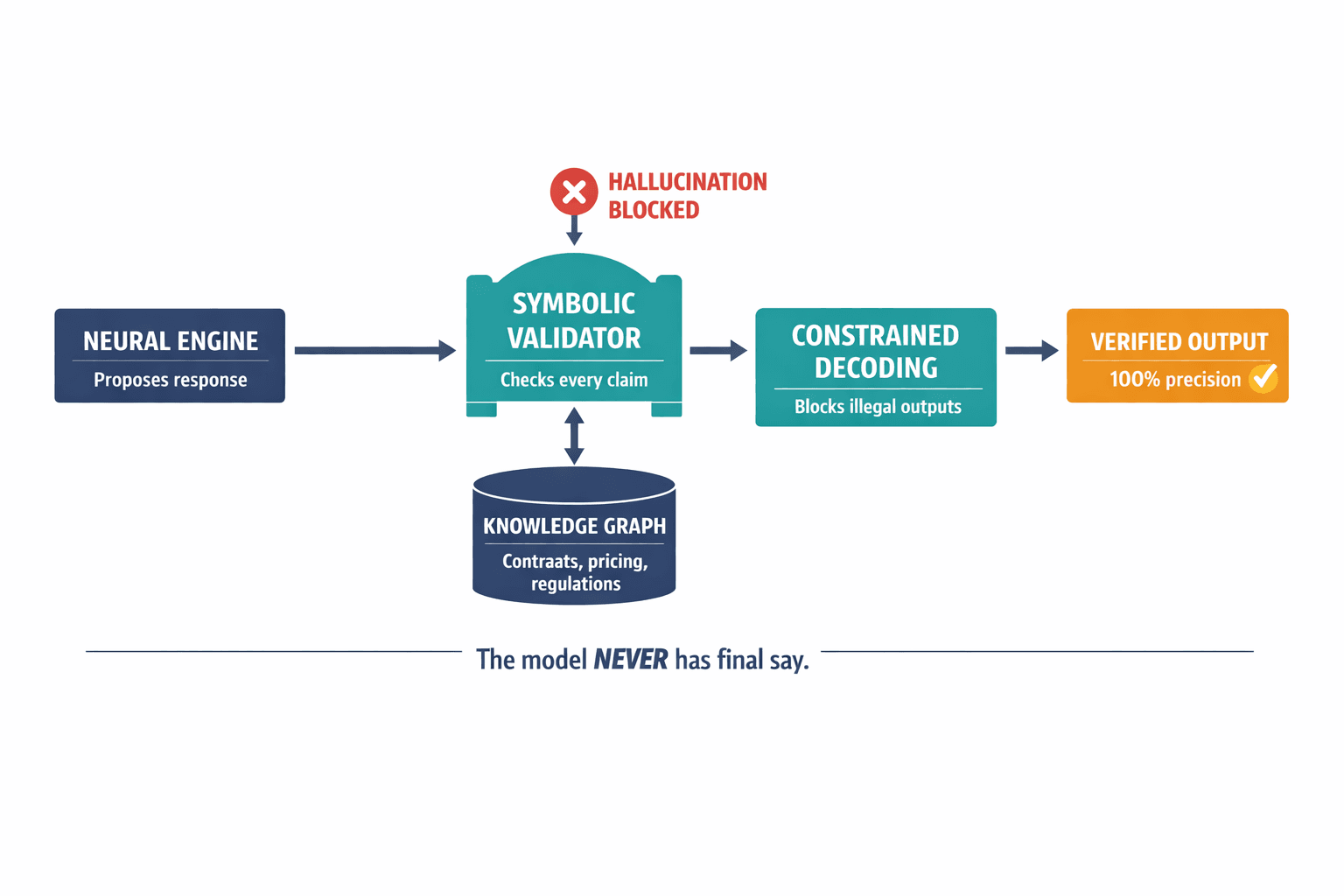
We call our approach Neuro-Symbolic Architecture, and the core idea is deceptively simple: never let the language model be the final decision-maker.
Here's how it works in practice. When our neural engine proposes a response — say, a supplier recommendation or a logistics route — that output passes through a symbolic verification layer before it reaches anyone. This layer queries a Knowledge Graph containing the enterprise's actual source of truth: legal contracts, pricing databases, engineering specifications, regulatory requirements. Every claim the neural layer makes gets checked against hard evidence.
If the model tries to hallucinate a supplier benefit that doesn't exist in the contract graph, the symbolic validator catches it. Not sometimes. Every time. The architecture makes hallucination structurally impossible for grounded facts — we achieve 100% precision in data extraction, compared to 63–95% for standalone models like GPT-4.
We also implement what we call Constitutional Guardrails — and this is where it gets interesting. Traditional wrappers try to prevent bad outputs using text-based instructions. We prevent bad outputs using constrained decoding, where the model's output is mathematically restricted to a specific schema or domain ontology. In the procurement context, the AI literally cannot produce a supplier score that violates the enterprise's fairness constitution. The decoding layer rejects any token sequence that introduces illegal bias. It's not a suggestion to the model. It's a physical constraint on what it can say.
For the full technical breakdown of how these layers interact — the Knowledge Graphs, the Causal AI models, the constrained decoding — see our technical deep-dive.
Where This Gets Real: Factories, Farms, and Fraud
I want to take you through three places where the difference between "wrapper AI" and "deep AI" isn't academic — it's physical.
On the factory floor, a cloud-based AI inspection system faces 800 milliseconds of latency. That sounds fast until you realize a conveyor belt moving at 2 meters per second has already carried the defective part 1.6 meters past the inspection point. Our edge-native models, deployed directly onto hardware at the production line, respond in 12 milliseconds — a 98.5% reduction. We even run acoustic models on specialized microcontrollers that detect the spectral signature of a failing bearing in 5 milliseconds, triggering a physical kill-switch before the machine tears itself apart. I remember the first time we demonstrated this to a plant manager in a live environment. The bearing fault alarm fired before the vibration sensor even registered an anomaly. He stared at the readout for a long moment and said, "That's not AI. That's a sixth sense." It was the first time I felt like we'd crossed the line from software into something that genuinely understood the physics of the problem.
In agriculture, standard cameras can't see what's killing crops until it's too late. We build custom neural architectures that process hyperspectral data — 200+ bands of light beyond what the human eye can detect. By modeling atmospheric interference and stripping it away computationally, we can identify nutrient deficiencies or pest infestations days before they're visible, enabling a 60% reduction in pre-visualization costs.
In insurance, we replace generic image classification with forensic computer vision: semantic segmentation to identify exact pixel-level damage boundaries, monocular depth estimation to calculate dent volume without a 3D scanner, and specular reflection analysis to detect manipulated photos. The AI doesn't guess whether a claim is fraudulent. It shows you the physics of why the light patterns in the image are inconsistent.
How Do You Know When Your AI Architecture Is Broken?
There's a question I get in nearly every executive briefing, usually phrased with a mix of skepticism and genuine concern: "We've already invested millions in our current AI stack. How do I know if it's actually a problem?"
Here's my honest answer: if your AI system can't tell you why it made a specific decision, with citations to specific data points, it's a problem. If your procurement AI's supplier diversity numbers haven't improved since deployment, it's a problem. If your operations team has developed workarounds — spreadsheets they maintain alongside the AI system "just in case" — it's a problem.
The workarounds are the tell. I've walked into organizations where the AI dashboard is on one monitor and the "real" decision-support spreadsheet is on the other. Nobody talks about it openly. But it means the team doesn't trust the system, and they're right not to.
Another question I hear: "Isn't this just a maturity issue? Won't the models get better?" They will get better at language. They will not get better at truth. A more powerful LLM is a more convincing guesser, not a more reliable one. The architecture has to change.
The Sports Illustrated Collapse and the Stakes of Getting This Wrong
I keep a screenshot on my desktop as a reminder. It's from November 2023, when Sports Illustrated — a 70-year-old media institution — was caught publishing articles under fake, AI-generated bylines. Names like "Drew Ortiz," complete with fabricated headshots and invented biographies. The content was robotic, tautological, and published without any verification layer.
The result: a 27% stock price collapse in a single day. License revocation. Mass layoffs. A legacy brand, gutted.
The LLM did exactly what LLMs do — it completed patterns. An author biography is a statistically likely component of a product review, so the model generated one. A headshot accompanies an author bio, so someone generated that too. Nobody built a system to ask: "Does this person exist? Is this content factually verified? Can we trace every claim to a source?"
That's the cost of the Wrapper Delusion at scale. Not a funny chatbot incident. A corporate extinction event.
Why Can't You Just Keep Using the API?
There's a final dimension to this that most AI vendors don't want to discuss: data sovereignty.
When your enterprise relies on a third-party API — OpenAI, Google, Anthropic — you're renting intelligence you don't control. You have no visibility into the model's training data. You have no warning when the vendor updates the weights, which can silently change how your system behaves (this is called model drift, and it's a nightmare for regulated industries). You have no guarantee that your proprietary data — trade secrets, customer information, competitive intelligence — isn't being processed on infrastructure you can't audit.
We deploy sovereign enterprise models on our clients' own infrastructure. No data leaves the firewall. No external dependencies. Full lifecycle control, including custom fine-tuning on proprietary ontologies and regulatory constraints.
It's more expensive upfront than an API subscription. It's infinitely cheaper than a data breach, a regulatory penalty, or discovering that your AI's behavior changed because a vendor in San Francisco pushed an update on a Tuesday afternoon.
The 18-Month Window
Here's where I'll be direct, because I think the timeline matters.
Organizations that move to deterministic AI architectures in 2026 will have a 12-to-18-month window of genuine competitive differentiation. After that, this approach becomes table stakes — the minimum expectation for enterprise AI in regulated industries.
The 3.5:1 procurement bias isn't going to fix itself. The 23% explainability rate isn't going to improve through better prompting. The hallucination problem isn't going to disappear with the next model release. These are architectural failures, and they require architectural solutions.
I'm not saying every enterprise needs to build what we've built. I'm saying every enterprise needs to understand what they've actually bought. Open the hood. Ask your vendor: where is the verification layer? Where is the knowledge graph? What happens when the model hallucinates — is there a structural constraint, or just a prompt that says "please don't hallucinate"?
If the answer is a prompt, you don't have an AI system. You have a very expensive suggestion box.
If your AI vendor's answer to "how do you prevent hallucinations" is a better prompt, you don't have an AI system. You have a very expensive suggestion box.
The era of probabilistic enterprise AI is ending — not because the models aren't impressive, but because impressive isn't the same as reliable, and in the enterprise, reliability is the only thing that counts. We're not building AI that sounds right. We're building AI that is right, and can prove it.
That's not a pitch. That's an engineering requirement. And the enterprises that recognize it first will be the ones still standing when the wrappers fall apart.