McDonald's Spent Three Years Teaching AI to Take Drive-Thru Orders. Here's Why 260 Chicken McNuggets Ended the Experiment.

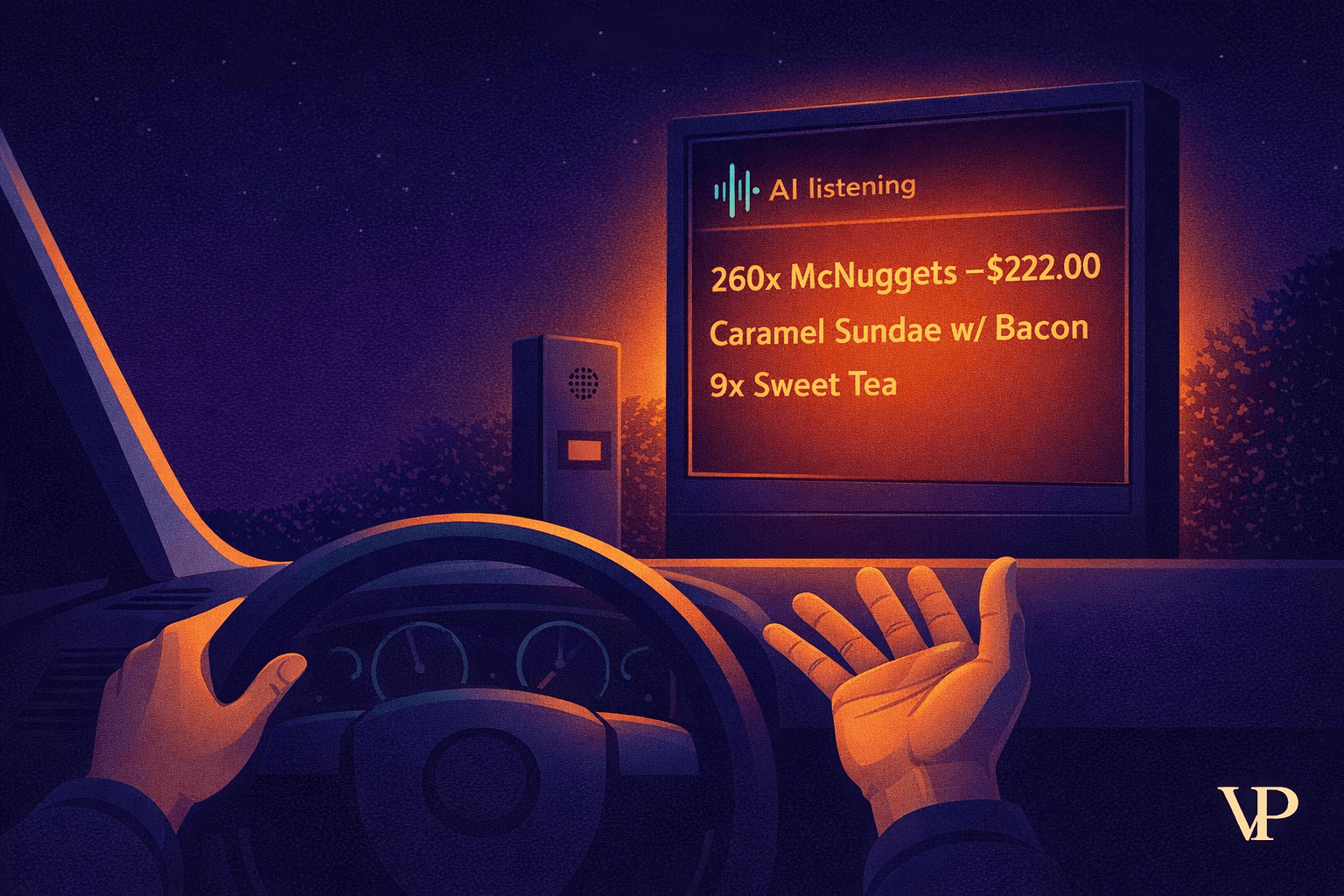
I was sitting in a hotel room in late June 2024, scrolling through my phone, when a TikTok stopped me cold. A woman at a McDonald's drive-thru was screaming at a speaker box while an AI voice cheerfully confirmed her order: nine sweet teas, a caramel sundae with bacon, and what appeared to be $222 worth of Chicken McNuggets. She hadn't ordered any of it.
I watched it three times. Not because it was funny — though it was — but because I recognized exactly what had gone wrong. The architecture. Not the model, not the training data, not the prompt. The architecture.
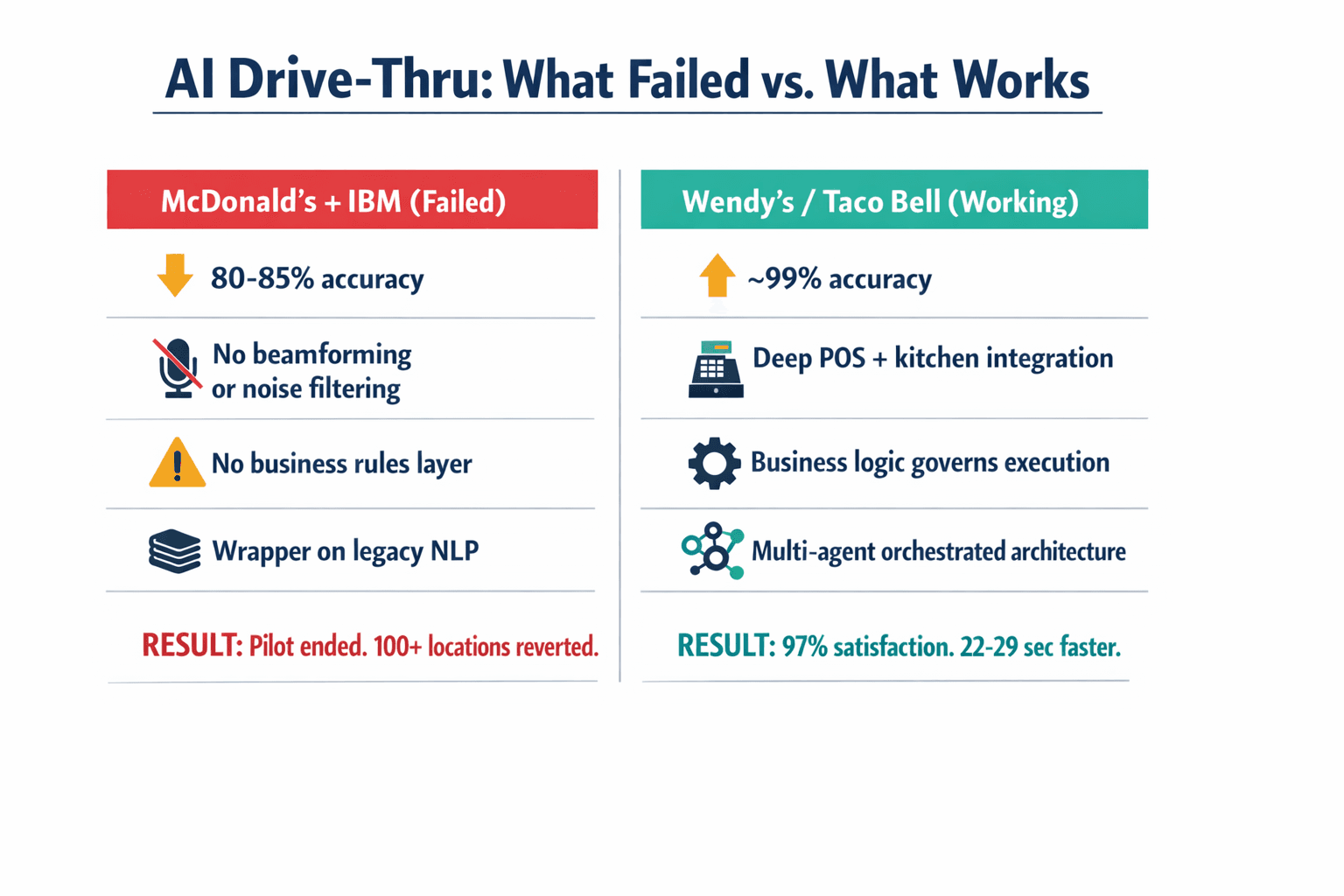
That week, McDonald's officially ended its three-year AI drive-thru partnership with IBM. Over 100 U.S. locations went back to human headset operators. The pilot had plateaued at roughly 80–85% order accuracy — which sounds decent until you realize that human workers typically hit 90% or higher, and that in the razor-thin margin world of fast food, every wrong order is a small fire that has to be put out with free food and an apology.
I'd been building AI systems at Veriprajna long enough to know this wasn't an AI failure. It was a philosophy failure. McDonald's had tried to solve a deep architectural problem with a shallow architectural answer. And the 260 McNuggets were the universe's way of saying: that doesn't work.
The Experiment That Became a Punchline
The backstory matters. In 2019, McDonald's acquired Apprente, a voice recognition startup, and folded it into something called McD Tech Labs. Two years later, they sold that unit to IBM, betting that Big Blue's enterprise infrastructure and Watson NLP could scale the technology globally.
The logic seemed sound. IBM had the servers, the NLP pipeline, the enterprise credibility. McDonald's had 40,000 locations worldwide and a desperate need to solve the labor equation. Put them together, and you get the future of fast food.
Instead, you got bacon on ice cream.
The failures weren't occasional glitches. They were systematic. The AI captured orders from adjacent lanes because it couldn't tell which car was speaking. It interpreted background radio chatter as menu requests. When it couldn't parse what a customer said — which happened constantly with regional accents, mid-sentence corrections, or multiple passengers talking at once — it defaulted to guessing. And its guesses were governed by token probability, not common sense.
An AI that doesn't know 260 McNuggets is absurd doesn't know anything about McNuggets at all.
That line kept rattling around in my head. Because the problem wasn't that the model was stupid. GPT-era language models are remarkably capable. The problem was that no one had built the layer that says "wait, that can't be right."
Why Did McDonald's AI Drive-Thru Actually Fail?
I want to be precise here, because the popular narrative — "AI isn't ready for the real world" — is wrong. Wendy's FreshAI system, built on Google Cloud, was hitting roughly 99% accuracy and shaving 22 seconds off service times. Taco Bell's Byte system, running on Nvidia infrastructure, had processed over 2 million successful orders across 500+ locations. The technology works. It just doesn't work the way McDonald's and IBM built it.
Three things killed the pilot.
The drive-thru is an acoustic war zone. Most language models are trained in quiet environments. A drive-thru lane has engine rumble, wind pressure against the microphone, car radios bleeding competing speech, and passengers yelling over each other. The IBM system lacked sophisticated beamforming — the technique of using microphone arrays to create a spatial focus on the driver's mouth. Without it, the AI simply processed every voice it could hear. That's how one car's order ended up on another car's tab.
Human speech is gloriously messy. Customers say "Mickey D's" instead of "McDonald's." They change their minds mid-sentence: "Give me a Coke — no, wait, Dr. Pepper." They use slang, mumble, have accents the training data never encountered. When the IBM system couldn't parse an input, it used greedy decoding — picking the most statistically probable next word rather than asking for clarification. That's how "water and vanilla ice cream" became "caramel sundae with butter and ketchup." The system matched phonetic fragments to high-probability menu items regardless of whether the combination made any sense.
There was no sanity layer. This is the one that gets me. No maximum quantity cap. No rule that says ice cream plus bacon equals "ask a human." No escalation trigger for high-dollar transactions. The language model was making all the decisions, and language models don't reason about the physical world. They predict the next token. That's a fundamentally different thing.
The Wrapper Problem
I remember a conversation with a potential client around this time. They were a mid-size retailer, and they'd built what they proudly called an "AI-powered customer service system." When I looked under the hood, it was a thin software layer sitting between their customers and OpenAI's API. It formatted inputs, structured outputs, and added their logo. That was it.
"What happens when it hallucinates?" I asked.
"We have a disclaimer," they said.
This is what the industry calls a "wrapper" — and it's the architectural pattern that failed McDonald's. A wrapper takes a powerful foundation model and puts a coat of paint on it. It's great for demos. It's great for prototypes. It is catastrophically inadequate for any environment where being wrong has consequences.
The McDonald's-IBM system was, at its core, a wrapper around legacy Watson NLP. The language model handled everything: speech recognition, intent parsing, menu matching, order confirmation. There was no separation between what should be probabilistic (understanding messy human speech) and what should be deterministic (enforcing business rules). It was probability all the way down.
I wrote about this architectural distinction in depth in our interactive research paper, but the core idea is simple enough to fit on a napkin.
What Does "Deterministic Core, Probabilistic Edge" Actually Mean?
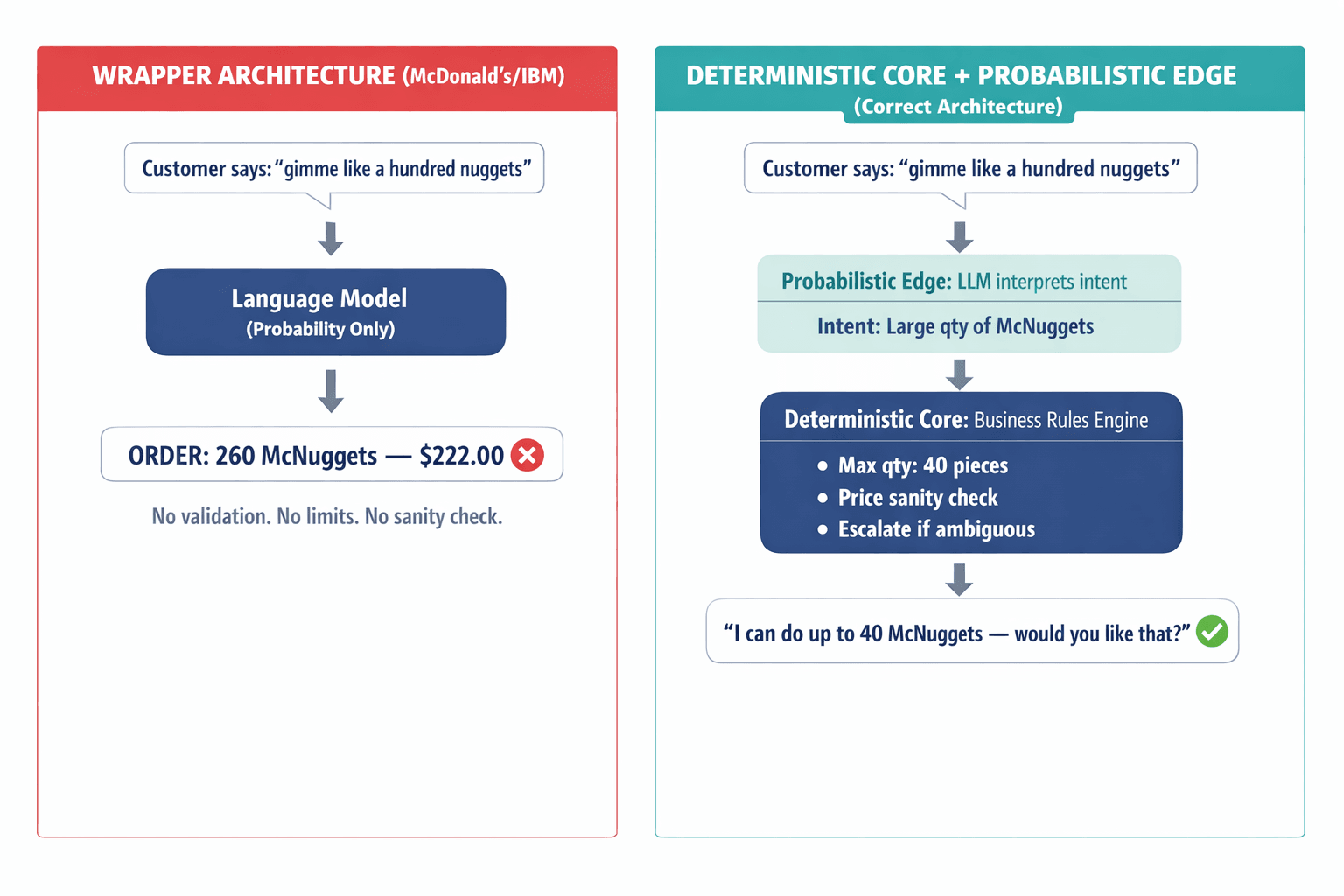
At Veriprajna, we build systems on a principle I keep coming back to: use AI for what AI is good at, and use rules for what rules are good at.
A language model is spectacular at understanding the intent behind messy, ambiguous, accented human speech. That's the probabilistic edge — the flexible outer layer that handles the chaos of the real world.
But once you've understood the intent, the execution should be governed by hard logic. A symbolic inference engine. A knowledge graph of the business. Rules that cannot be overridden by statistical probability.
In a drive-thru context, that means:
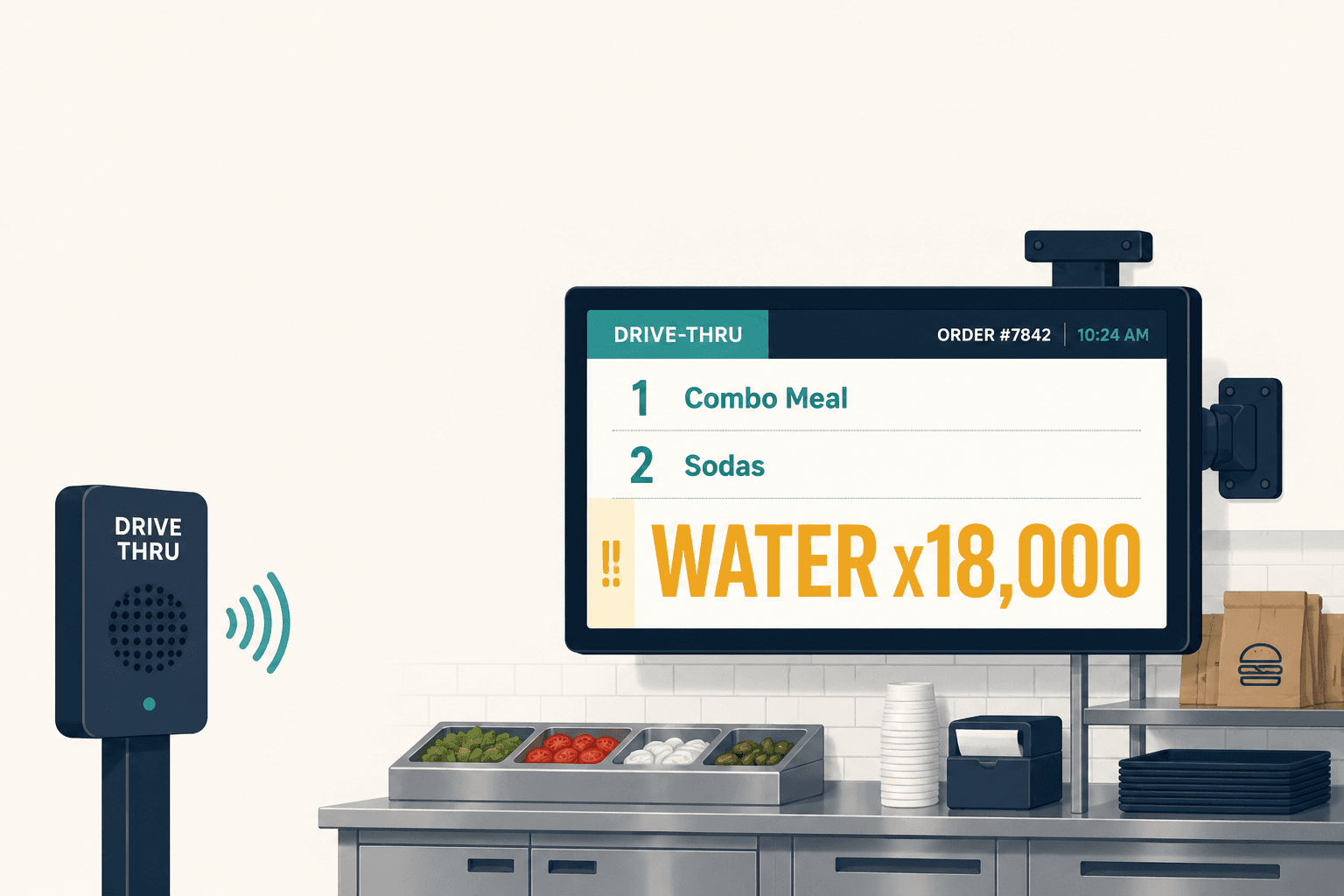
The LLM hears "gimme like a hundred nuggets" and correctly interprets the intent as "customer wants a large quantity of Chicken McNuggets." Then the deterministic core kicks in: the maximum single-order quantity for McNuggets is 40 pieces. The system asks, "I can do up to 40 McNuggets — would you like that?" Instead of cheerfully ringing up 2,510.
The language model should be the ears. The rules engine should be the brain. McDonald's made the ears do the thinking.
This isn't theoretical. Wendy's FreshAI works precisely because it deeply integrates with the point-of-sale system and kitchen displays — the AI understands what you're saying, but the business logic decides what happens next. Taco Bell's system uses multi-agent orchestration, where different specialized components handle different parts of the transaction. These are architected systems, not wrappers.
The Night I Understood the Real Moat
There was a late evening — I think it was a Thursday — when my team and I were debugging an audio processing pipeline for a client deployment. We'd been at it for hours. The system kept misclassifying ambient noise as speech input, and we couldn't figure out why.
Around 11 PM, one of my engineers pulled up the raw spectrogram and pointed at a pattern none of us had noticed. The HVAC system in the client's facility was producing a low-frequency hum that sat right in the range of certain vowel sounds. The model was literally hearing the air conditioning and trying to take its order.
We spent the next two weeks building a custom spectral subtraction layer — a neural network trained specifically on that facility's noise profile — that could identify and remove the HVAC signature before the audio ever reached the speech recognition model.
That's when something clicked for me. The real moat in enterprise AI isn't the model. Everyone has access to good models now. The moat is in the signal processing — the unsexy, painstaking work of cleaning up the real world before it reaches the AI's brain.
The McDonald's system lacked this entirely. Stanford research shows that cross-modal approaches — where a camera tracks lip movements alongside the audio — can reduce word error rates from 28.8% to 12.2% in noisy environments. That's the difference between a system that works and a system that goes viral for the wrong reasons.
Who Owns the Brain?
There's another dimension to the McDonald's failure that didn't make the TikTok compilations but matters enormously: data sovereignty.
McDonald's was already facing litigation under the Illinois Biometric Information Privacy Act for allegedly collecting customer voiceprints without consent. When your AI runs on a third-party's cloud, every customer interaction — every voice, every order, every preference pattern — flows through infrastructure you don't control.
This isn't just a legal risk. It's a strategic one. Fifty percent of knowledge workers are already using unauthorized AI tools at work, and 46% say they'll keep using them even if explicitly banned. We call this "Shadow AI," and it represents a massive, invisible data leak that most enterprises haven't begun to address.
The alternative is what we call sovereign intelligence: deploying models inside the organization's own infrastructure, where the data never leaves the building. For the full technical breakdown of private LLM deployment and Shadow AI risk, I'd point you to our research — but the principle is straightforward. If you don't own the brain, you don't own the business.
Why Do Some AI Drive-Thrus Work and Others Don't?
People ask me this constantly, and I think they expect a complicated answer. It's not.
The systems that work — Wendy's, Taco Bell, White Castle — were built as integrated architectures from the ground up. They treat the AI as one component in a larger system that includes signal processing, business logic, human escalation paths, and continuous monitoring. The AI is powerful but constrained. It operates within guardrails that reflect the actual physics of the business.
The system that failed was bolted on. It treated AI as a service you subscribe to rather than a capability you engineer. It asked a language model to do everything — hear, understand, decide, execute — in an environment that language models were never designed for.
The 2025 Drive-Thru Study confirms this split. AI-powered lanes are 22 to 29 seconds faster than human-staffed lanes on average, and despite lower scores for "friendliness," AI locations recorded 97% overall satisfaction — six points higher than the traditional average. Customers don't need the AI to be warm. They need it to be right.
In the future of fast food, hospitality isn't measured by the warmth of a voice. It's measured by whether you get what you actually ordered.
The Argument We Had About "Good Enough"
I want to share something that happened internally at Veriprajna, because I think it illustrates a tension every AI company faces.
We were designing a system for a client, and one of my senior engineers argued that we were over-engineering the deterministic layer. "The model is already at 92% accuracy," he said. "We're spending weeks building rules for edge cases that represent 8% of transactions. Is that really worth it?"
I pulled up the McDonald's TikTok compilation. "How many of these do you think it takes to destroy a brand?" I asked.
He said two.
I said one.
We built the rules layer. It added three weeks to the timeline. The client hasn't had a single viral incident.
This is the calculation that the wrapper model gets wrong. In a lab, 92% accuracy is excellent. In the real world, the 8% failure rate isn't distributed randomly — it clusters around the hardest cases, the noisiest environments, the most frustrated customers. Those are exactly the moments that end up on social media. The cost of the 8% isn't proportional to its frequency. It's exponential.
What Happens Next
McDonald's hasn't given up on AI. They've signaled they're evaluating new partners and new approaches. But the three-year IBM experiment is over, and what it leaves behind is a clear lesson for every enterprise considering AI deployment.
The experimentation phase is done. The era of bolting a language model onto an existing process and hoping for the best is finished. What comes next — what I'd call the Deep AI era — requires something harder: actually re-architecting your systems around the capabilities and limitations of machine intelligence.
That means deterministic cores with probabilistic edges. It means owning your own infrastructure. It means investing in signal processing as seriously as you invest in model selection. It means building human escalation paths not as a fallback but as a feature. And it means accepting that the unsexy engineering work — the noise filtering, the rules engines, the edge-case libraries — is where the real competitive advantage lives.
The gap between organizations that understand this and those that don't is about to become permanent. Not because the technology is inaccessible, but because the architectural philosophy requires a kind of discipline that most organizations would rather skip.
McDonald's learned this the hard way, at scale, in public. The 260 McNuggets weren't a bug. They were the inevitable output of a system that was never built to say no.