The Day 8.5 Million Computers Died — And What It Taught Me About Building Software That Can't Fail

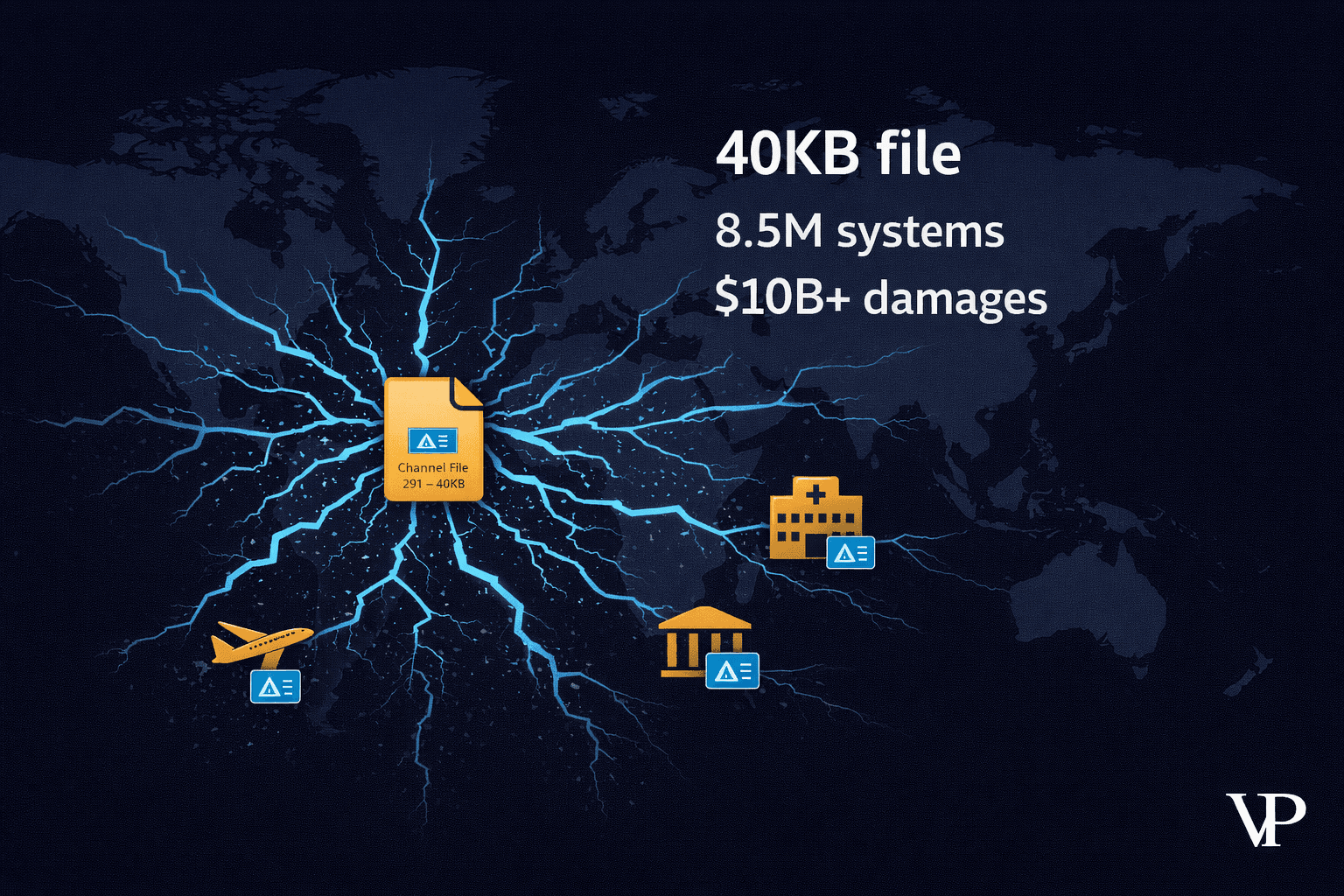
I was sitting in a hotel lobby in Hyderabad when my phone started buzzing. Not the usual trickle of Slack notifications — this was a flood. A client's entire fleet of Windows machines had gone blue. Then another client. Then the news broke: airports grounding flights, hospitals canceling surgeries, banks freezing transactions. All because of a single file update from CrowdStrike that was smaller than the photo you'd take of your lunch.
July 19, 2024. The day approximately 8.5 million Windows systems simultaneously crashed into the Blue Screen of Death. The day that would eventually cost the global economy over $10 billion in damages. And the day I became obsessed with a question that still keeps me up at night: Why are we building the most critical systems in human history on foundations that can be destroyed by a configuration file?
I run Veriprajna, an AI consultancy. We build what I call "Deep AI" solutions — systems that integrate with core infrastructure, not the thin ChatGPT wrappers that dominate the market right now. When the CrowdStrike outage happened, half the AI industry shrugged. "Security problem," they said. "Not our domain." But I saw something different. I saw the exact same architectural fragility that plagues every enterprise rushing to bolt AI onto their operations without understanding what's happening underneath.
I spent months after the outage tearing apart the root cause analysis, tracking the Delta Air Lines litigation, and studying the emerging research on formal verification. What I found changed how my team builds everything. I wrote a comprehensive interactive breakdown of the full analysis here, but this essay is the story behind the research — the parts that don't fit neatly into a whitepaper.
A File Smaller Than a JPEG Took Down Global Aviation
Here's what actually happened, stripped of the jargon.
CrowdStrike's Falcon security platform runs inside the Windows kernel — the deepest, most privileged layer of the operating system. Think of it as the engine room of a ship. If something goes wrong up on deck, you can fix it. If something goes wrong in the engine room, the ship sinks.
To detect new threats quickly, CrowdStrike built a system called "Rapid Response Content." Instead of pushing full software updates (which are slow and require testing), they push small configuration files — basically instruction sheets that tell the security engine what patterns to look for. It's clever. It's also, as we learned, terrifyingly dangerous.
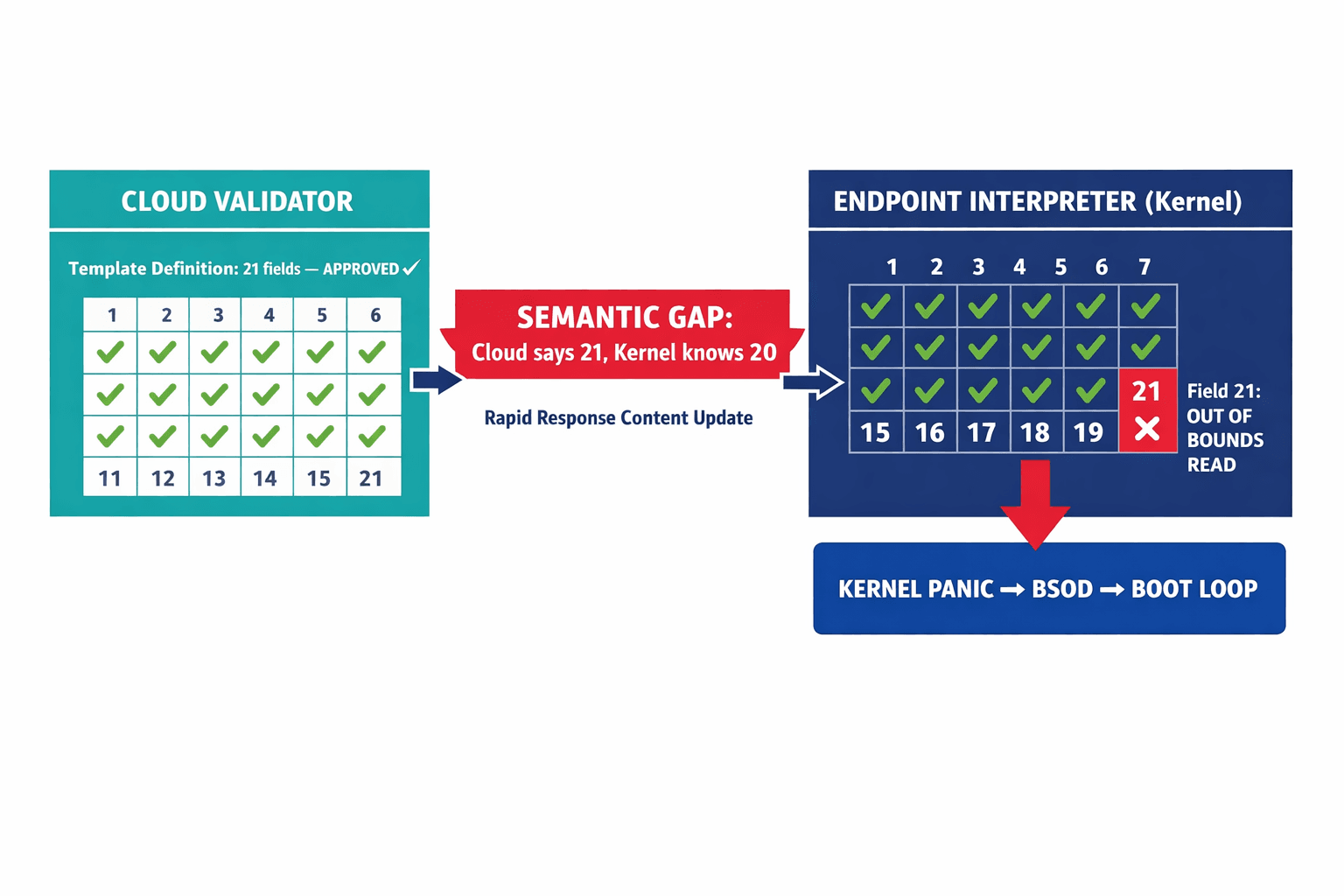
On that morning, two new instruction sets were deployed for detecting a specific type of inter-process communication. These instructions referenced 21 input parameters. The problem? The engine running on every endpoint — the actual code executing in the kernel — only understood 20 parameters.
The cloud said "read 21 fields." The kernel only knew about 20. That mismatch crashed 8.5 million computers.
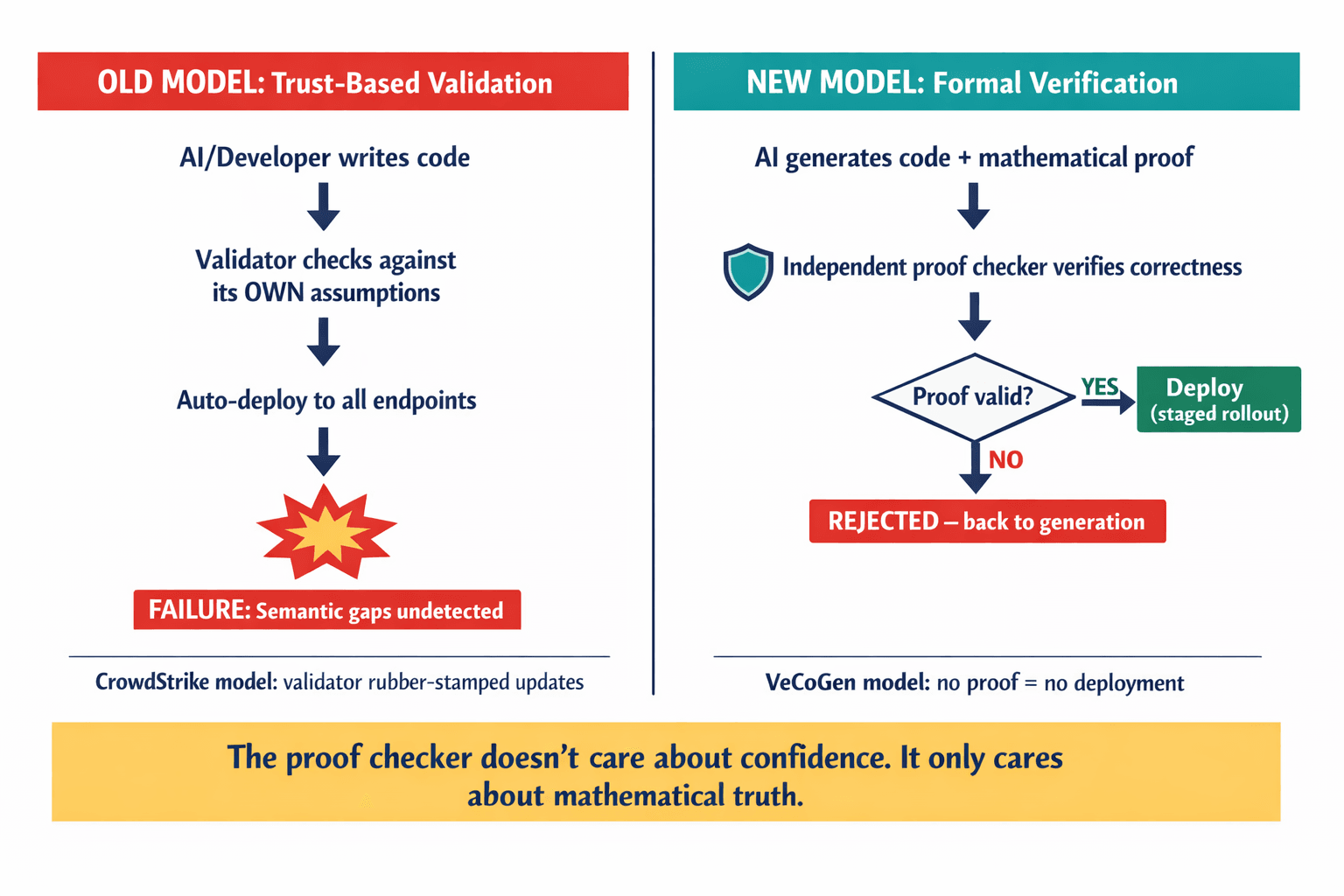
The validator in the cloud approved the update because its definition of the template included 21 fields. It was checking against its own expectation, not against the reality of what the endpoint could handle. When the kernel-level interpreter tried to access that 21st field, it read beyond the boundary of allocated memory. In kernel space, that's not a recoverable error. It's an instant crash. Blue screen. Reboot. Crash again. Reboot. Crash again. An infinite death loop.
I remember explaining this to a non-technical investor over dinner a few weeks later. He stared at me and said, "So you're telling me that nobody tested whether the thing receiving the update could actually process the update?" I nodded. He put his fork down. "That's not a software bug. That's negligence."
He wasn't wrong. And a judge in Georgia would essentially agree with him.
Why 40,000 Servers Had to Be Fixed By Hand
The part of the story that doesn't get enough attention is the recovery — or rather, the impossibility of remote recovery.
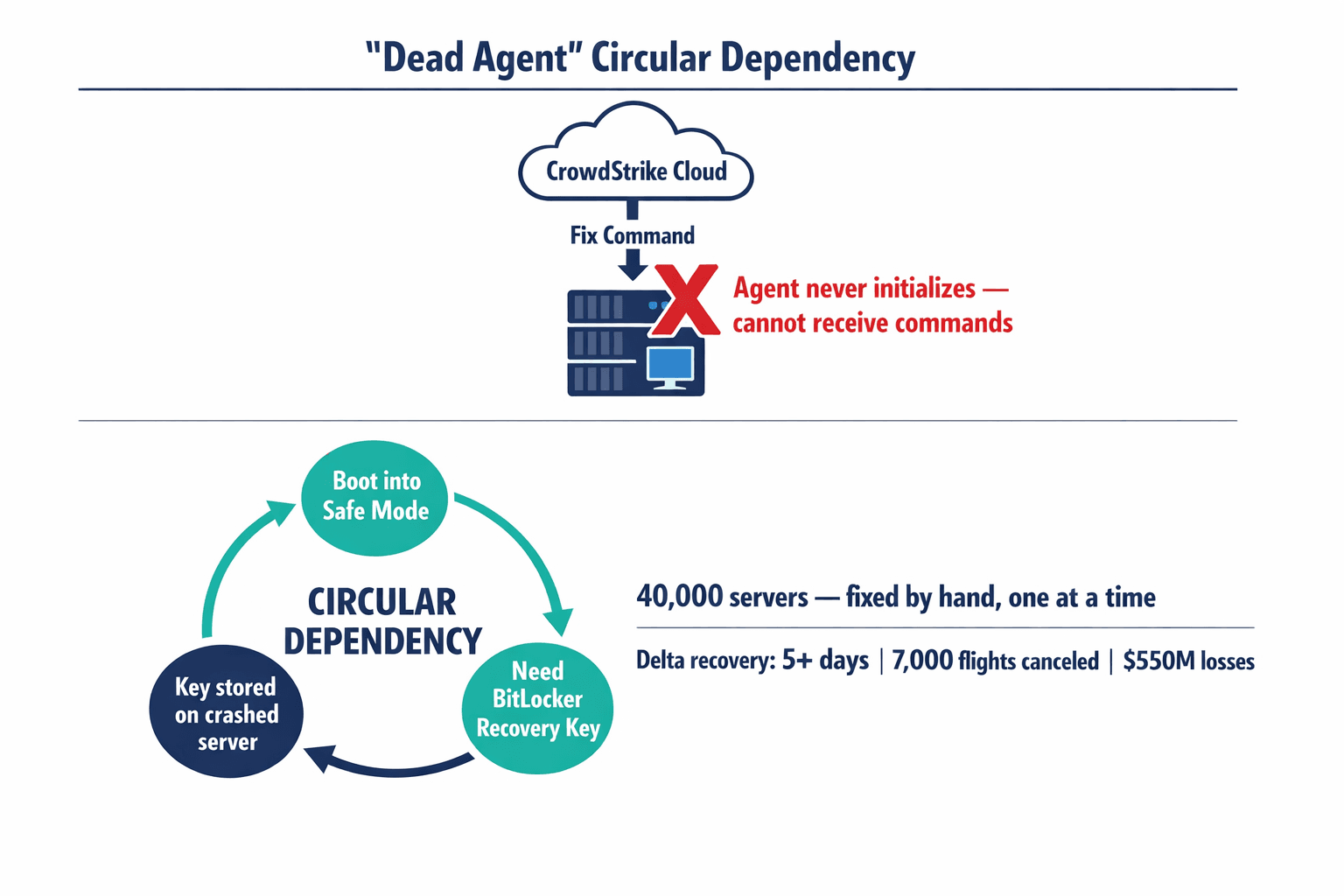
Here's the cruel irony: the CrowdStrike agent is the thing that receives commands from the cloud. "Roll back this update." "Apply this fix." But the crash happened so early in the boot sequence that the agent never initialized. The software that was supposed to receive the rescue signal was the very thing causing the drowning.
My team started calling this the "Dead Agent" problem. Every affected machine was orphaned. It could not phone home. It could not receive instructions. The only fix was to physically boot each machine into Safe Mode, navigate to C:\Windows\System32\drivers\CrowdStrike\, and manually delete the faulty file.
For Delta Air Lines, that meant touching approximately 40,000 servers and thousands of workstations. By hand. One at a time.
I've managed IT recovery operations before, and the logistics of that scale are almost incomprehensible. You need physical access to machines that might be in locked server rooms across different cities. You need technicians who know how to boot into Safe Mode — which, in an era of BitLocker encryption, often requires recovery keys that are stored on... other servers that are also crashed. It's turtles all the way down.
Delta's competitors — American Airlines, United — recovered within one to three days. Delta's disruption lasted over five days and resulted in more than 7,000 canceled flights and $550 million in losses. The difference? Delta's crew-tracking system, the software that tells the airline where its pilots and flight attendants are and when they're available, ran almost entirely on Windows. When those servers died, Delta didn't just lose computers. They lost the ability to know where their own people were.
What Happens When a Software Bug Becomes "Gross Negligence"?
This is where the story shifts from the server room to the courtroom, and where I think the implications get truly industry-changing.
Delta sued CrowdStrike. That alone isn't surprising — companies sue vendors after major failures all the time. What's surprising is what the judge allowed to proceed.
Historically, software vendors have been protected by their contracts. Buried in the terms of service is always a liability cap — usually limited to whatever the customer paid for the subscription. It's a cozy arrangement. You sell software that operates at the deepest level of a customer's infrastructure, and if it destroys everything, your maximum exposure is twelve months of license fees.
In May 2025, Judge Kelly Lee Ellerbe of the Fulton County Superior Court declined to dismiss Delta's claims of gross negligence and — this is the one that made me sit up straight — computer trespass.
The gross negligence argument is straightforward: CrowdStrike pushed the update to all 8.5 million systems simultaneously. No staged rollout. No canary deployment. No "let's try this on 1% of machines first and see what happens." Delta's lawyers argued this represented a conscious disregard for known risks. CrowdStrike's own post-incident report admitted the Content Validator had a logic error and the Content Interpreter lacked a runtime bounds check.
But the computer trespass claim is the one that should terrify every SaaS vendor reading this. Delta had opted out of automatic updates in their settings. CrowdStrike pushed the update anyway through the kernel-level channel file mechanism. The judge ruled that statutory duties regarding computer trespass are independent of the subscription agreement — meaning the liability cap in the contract doesn't apply.
When a vendor overrides your explicit preferences to push code into your kernel, the contract's liability cap may not protect them. That's the new legal reality.
I've talked to three different CISOs since this ruling, and every one of them said the same thing: "We're rewriting our vendor agreements." The era of unlimited trust in automated updates from security vendors is over.
The Uncomfortable Parallel to the AI Industry
Now here's where I'm going to be blunt, and where some of my peers in the AI space won't like what I have to say.
The AI industry is building on the same fragile foundations that CrowdStrike exposed. We're just doing it faster and with more hype.
The market right now is dominated by what I call "LLM wrappers" — thin application layers that make API calls to GPT-4 or Claude, wrap the response in a nice UI, and call it an AI product. I've seen pitch decks from companies whose entire technical architecture is literally "we send a prompt to OpenAI and display the result." They're valued at tens of millions of dollars.
I was at a conference last year where a founder proudly demonstrated their "AI-powered security analysis tool." I asked a simple question: "What happens if OpenAI changes their API, raises prices 10x, or goes down for six hours?" He looked at me like I'd asked what happens if gravity stops working. "That won't happen," he said.
It will happen. It always happens. The CrowdStrike outage proved that even the most trusted infrastructure vendors, the ones you've staked your entire operation on, can push a single bad file and bring everything down.
This is why we built Veriprajna around what I call "Deep AI" — and I want to be precise about what I mean, because the term gets thrown around loosely.
A Deep AI solution doesn't rent its intelligence from a single third-party provider. It uses hybrid architectures — specialized small language models, vision-language models, graph neural networks — deployed on the customer's own infrastructure when the use case demands it. It integrates at the system level, not the UI level. And critically, it uses formal verification to provide mathematical guarantees about its behavior, not just probabilistic best guesses.
The difference matters. An LLM wrapper gives you a chatbot that's usually right. A Deep AI system gives you an engine that is provably correct for the specific task it's designed to perform.
Why I Became Obsessed With Formal Verification
I'll be honest: before the CrowdStrike outage, I thought formal verification was an academic curiosity. Something researchers published papers about and nobody used in production. The seL4 microkernel — a formally verified operating system kernel — was impressive but seemed like a one-off achievement that required years of PhD-level effort.
Then I read CrowdStrike's root cause analysis for the third time, and something clicked.
The entire disaster came down to a semantic gap. The cloud validator believed the template had 21 fields. The endpoint interpreter believed it had 20. Two components of the same system held contradictory beliefs about reality, and nobody caught it because there was no shared, mathematically rigorous specification that both components were verified against.
Formal verification eliminates semantic gaps. It uses mathematical proofs to ensure that software — the actual implementation — always satisfies its specification. Not "usually." Not "in our testing." Always. If the proof checks out, the software cannot violate its spec. Period.
My team spent weeks last year experimenting with a framework called VeCoGen, which combines large language models with formal verification engines to automatically generate verified C code. The LLM proposes candidate implementations, and a proof checker mathematically confirms correctness before anything gets deployed. If the code has a bug — even a subtle one like an off-by-one error in an array boundary — the proof fails and the code is rejected.
I remember the first time we got it working on a non-trivial example. My lead engineer, who'd been skeptical of the whole endeavor, looked at the verified output and said, "So the AI writes the code and the proof that the code is correct?" Yes. And the proof checker is a separate, trusted system that doesn't care about the AI's confidence — it only cares about mathematical truth.
We're entering an era where AI-generated code will be preferred over handcrafted code — not because AI is smarter, but because AI can generate the mathematical proof alongside the implementation.
Martin Kleppmann made this prediction recently, and I think he's exactly right. The "proof checker" becomes the gatekeeper. No proof, no deployment. It's the opposite of the CrowdStrike model, where the validator was essentially rubber-stamping updates based on its own assumptions.
What If the System Could Have Healed Itself?
There's a detail about July 19 that haunts me. The crash happened globally, across all 8.5 million endpoints, because there was no automated mechanism to detect the failure pattern and halt the rollout in real time.
Think about that. Millions of machines started crashing simultaneously. The telemetry signals were there — out-of-bounds memory reads, immediate kernel panics, boot loops. But no system was watching for those signals in a way that could trigger an automatic kill switch.
This is the problem that AI-driven telemetry is built to solve. Traditional monitoring works on static rules: "Alert if CPU usage exceeds 90%." That's like setting a smoke detector that only goes off when the house is already engulfed. What you need is a system that understands what "normal" looks like at a granular level and can detect the first microseconds of deviation.
We've been building what the research community calls AI-Driven Telemetry Analytics, or AITA frameworks. These use unsupervised machine learning — isolation forests, autoencoders, density-based clustering — to establish behavioral baselines for system components. The results from recent research are striking: 35% reduction in mean time to detect anomalies, 40% reduction in false positives, and anomaly detection accuracy reaching 97.5% precision with 96.2% recall.
In the CrowdStrike scenario, an AITA-enabled system would have detected the out-of-bounds read as a deviation from baseline behavior within the first milliseconds of the update being applied. It could have triggered a local kill switch — isolating the faulty driver, rolling back to the last known-good configuration — before the crash cascaded. Not after 8.5 million machines went down. Before the second machine went down.
We're not talking about science fiction. We're talking about systems that already exist in research and are moving into production. The question isn't whether enterprises will adopt self-healing architectures. It's whether they'll adopt them before or after the next global cascade.
How Do You Actually Build for This Future?
People always ask me some version of: "Okay, I'm convinced this matters. But my company can't rebuild everything from scratch. Where do we start?"
Fair question. Here's where my thinking has landed after a year of working through this.
First, audit what's running in your kernel. Most enterprises have no idea how many third-party agents are operating at Ring 0 — the deepest privilege level. Every one of those agents is a potential CrowdStrike-style risk. Demand that any vendor operating at kernel level provides evidence of staged rollout procedures, schema versioning between their cloud validators and endpoint interpreters, and boot-loop simulation testing. If they can't provide it, that's your answer about their engineering rigor.
Second, stop treating AI as a UI layer. If your "AI strategy" is a collection of LLM wrapper tools that all depend on the same two or three model providers, you have a concentration risk that mirrors the CrowdStrike dependency problem. Start building or acquiring specialized models that run on your infrastructure for your most critical workflows. This is what AI sovereignty means in practice — not ideology, but operational resilience.
Third, make formal verification a procurement requirement, not a research aspiration. The tools exist now. VeCoGen and similar frameworks are making it possible to generate verified code at scale. For any safety-critical component — anything that touches the kernel, processes financial transactions, or makes medical decisions — demand mathematical proof of correctness, not just test coverage percentages.
I had an argument with a potential client about this last point. He said, "You're asking us to slow down our deployment pipeline." I said, "CrowdStrike's deployment pipeline was very fast. It pushed a faulty update to 8.5 million machines in minutes. Speed wasn't the problem. Speed without verification was the problem."
He signed the contract.
The Precedent That Changes Everything
Here's what I think most people in tech are missing about the Delta v. CrowdStrike case.
The gross negligence ruling isn't just about one airline and one security vendor. It's establishing a new standard of care for automated software updates. When a judge says that pushing untested code to millions of machines without staged rollout might constitute gross negligence, that applies to every vendor doing the same thing. When a judge says that overriding a customer's update preferences to push kernel-level code might constitute computer trespass independent of the contract, that rewrites the rules for every SaaS company with auto-update mechanisms.
The "gross negligence" of today will become the baseline expectation of tomorrow. Staged rollouts, formal verification, runtime bounds checking, self-healing telemetry — these aren't competitive advantages anymore. They're the minimum standard that courts and regulators will demand.
And here's the thing that excites me, even as it terrifies me: the AI industry is about to face this same reckoning. Right now, most AI systems operate probabilistically — they're "usually right," and when they're wrong, we shrug and call it a hallucination. But as AI moves deeper into critical infrastructure — managing power grids, approving medical treatments, executing financial transactions — "usually right" will carry the same legal weight as "we didn't test the update before pushing it to 8.5 million machines."
The $10 billion cost of the CrowdStrike outage isn't the price of a bug. It's the down payment on a global upgrade to how we build and verify software.
The companies that understand this — that invest in Deep AI, formal verification, and sovereign architectures now — won't just avoid the next catastrophe. They'll define the standard that everyone else scrambles to meet after it happens.
I know which side of that divide I want to be on. The question is whether you'll choose before the next July 19, or after.