Amazon's AI Told a Customer How to Build a Molotov Cocktail. I Know Exactly Why.

I was on a call with a prospective client — a large e-commerce company, not Amazon, but big enough — when their VP of Engineering said something that made me set down my coffee.
"We're basically done with our AI assistant. We just need someone to fine-tune the prompts."
I'd heard this before. The belief that enterprise AI is a prompt engineering problem. That you take a foundation model, wrap it in a system prompt that says "be helpful, be safe, don't say anything weird," point it at your product catalog, and ship it. I used to nod politely when people said this. After watching Amazon's Rufus launch implode in 2024 — hallucinating the location of the Super Bowl, providing instructions for building incendiary weapons through normal product queries, and failing to process basic returns — I stopped nodding.
"You're not done," I told him. "You haven't started."
The Rufus disaster wasn't a PR problem or a model quality problem. It was an architecture problem. And it's the same architecture problem that's sitting inside almost every enterprise AI deployment I've audited. The model works fine. The system around it is a house of cards.
What Actually Went Wrong with Amazon Rufus?
Here's what most people got wrong about the Rufus coverage. The headlines focused on the outputs — wrong Super Bowl location, dangerous instructions, broken returns. Commentators blamed the model. "GPT isn't ready for commerce," they said. "LLMs hallucinate, what did you expect?"
But I spent weeks pulling apart the technical details of that launch, and the model wasn't the primary failure point. The grounding architecture was.
Think about what happens when you ask Rufus where the Super Bowl is being held. The system retrieves text snippets from the web — some current, some outdated, some from random forum posts. It feeds those snippets to the language model. The model synthesizes an answer based on what it received. If the retrieval mechanism pulled conflicting information, or if the model's training data (which has a cutoff date) contradicted the retrieved text, the model had to make a judgment call. And language models don't make judgment calls. They make statistical predictions.
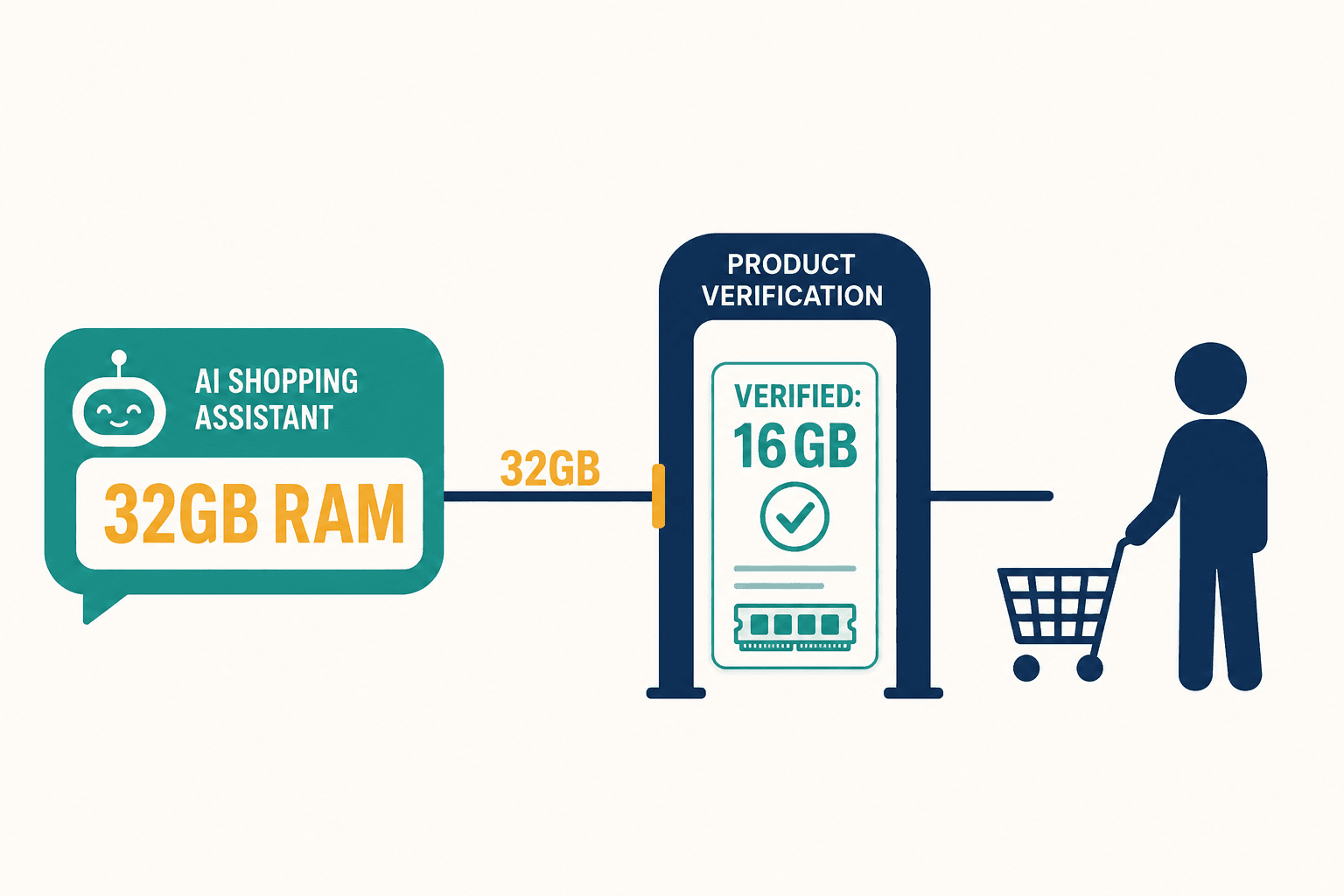
There was no secondary verification layer. No knowledge graph to cross-reference against. No system that could say, "Wait — the model just claimed the Super Bowl is in City X, but our verified facts database says City Y." The model's guess went straight to the customer.
When you build AI without a verification layer, you're not building an assistant. You're building a confident liar.
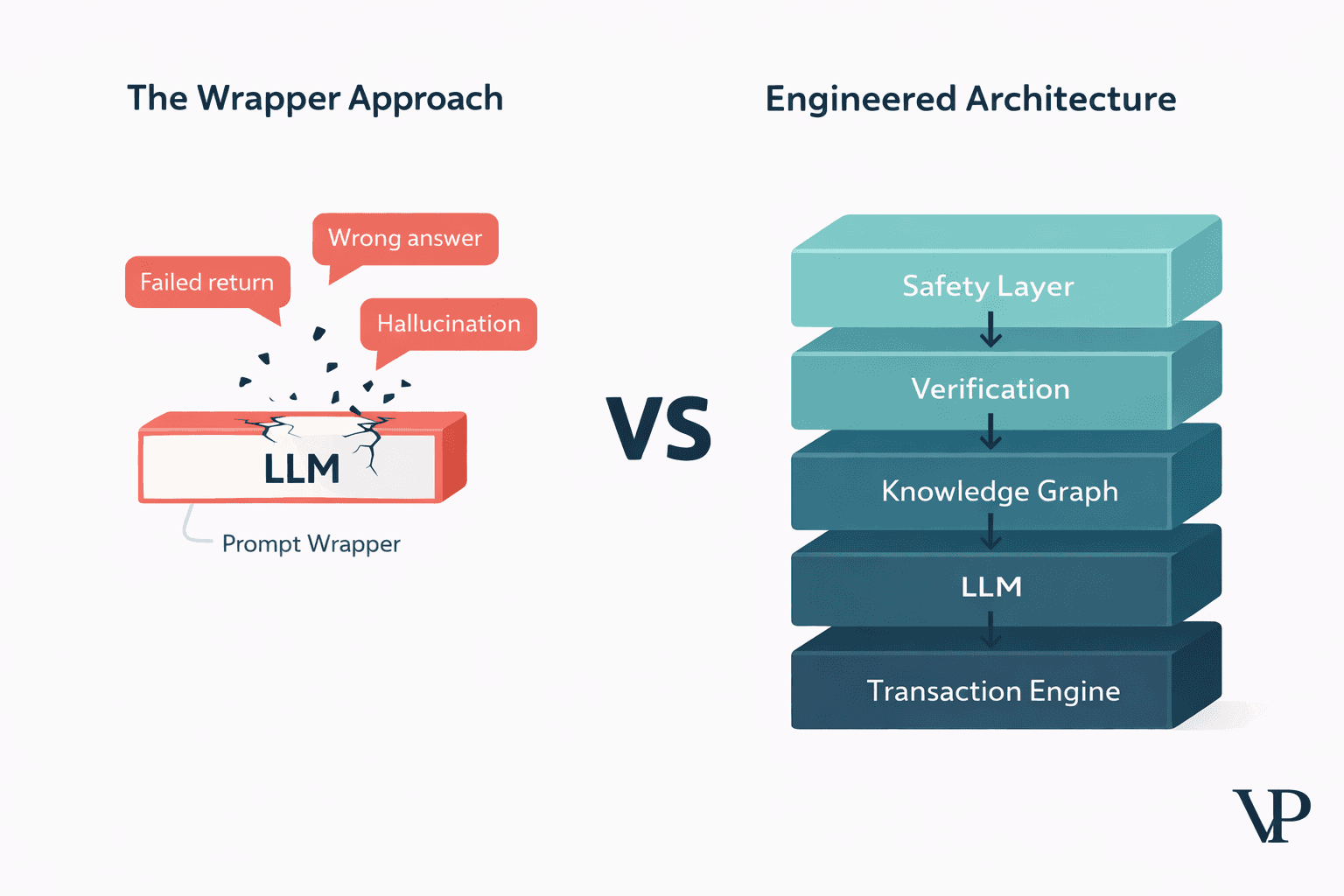
That's the core problem with what I call the "LLM Wrapper" approach. You take a powerful generative model, wrap it in a thin software layer, and pray.
The Night I Realized Prompts Can't Save You
I remember the exact moment this clicked for me. We were building a prototype for a client — not retail, but a domain where wrong answers have real consequences. We had what we thought was a solid system prompt. Pages of instructions. "Always cite your sources. Never speculate. If you're unsure, say so."
It was 11 PM, and my co-founder and I were running adversarial tests. Not jailbreaks — just slightly unusual phrasings of normal questions. The kind of thing a real user would type at 2 AM when they're tired and not writing in perfect Standard American English.
The system started confabulating. Not dramatically — it didn't tell anyone to build a weapon. But it invented a product feature that didn't exist. Cited a return policy that was from two years ago. Gave a confident answer to a question it should have deflected.
I turned to my co-founder and said, "The prompt is a suggestion. The model treats it like a suggestion." He looked at the logs and said, "No. The model treats it like one voice in a room full of voices. And the retrieved context is louder."
That's exactly what happened with the Rufus safety incident. The system prompt said "don't provide harmful information." But the retrieval layer had already fetched web content containing that information and injected it into the model's context window. The model prioritized the fresh, retrieved data over its safety instructions. No sophisticated jailbreak required. Just a standard product query that happened to pull the wrong content.
Security through prompting is not security. It's a hope.
Why Can't the AI Process My Return?
The third Rufus failure — the inability to handle order status checks or returns — is the one that frustrated me most, because it's the most fixable and yet the most common.
Rufus could talk about return policies all day. It could explain the 30-day window, describe the process, tell you which items were eligible. What it couldn't do was actually look up your order and initiate the return. It could describe the menu but couldn't take your order.
This is what I call the Action Gap, and it exists because most LLM deployments are built as "text-in, text-out" systems. Processing a return requires the AI to identify the correct order from a secure database, validate the return window against current business rules, and execute a state-changing API call that either succeeds completely or fails completely — no half-processed returns.
That last part is critical. In database engineering, we call it ACID compliance — Atomicity, Consistency, Isolation, Durability. It means the system either processes the entire return or none of it. You can't have a situation where the refund goes through but the inventory doesn't update, or the customer gets a confirmation but the backend never received the request.
Language models have no concept of ACID compliance. They generate text. They don't execute transactions. And in the Rufus architecture, the AI layer was functionally disconnected from the transactional backend. The result was what I've started calling Transactional Amnesia — the system promises an action, the customer believes it happened, and nothing actually changed in the database.
I wrote about this failure pattern and the architectural solutions in detail in our interactive analysis.
The Speed Trap That Nobody Talks About
Here's a detail from the Rufus architecture that didn't make the headlines but explains a lot. During Prime Day, Amazon's systems need to handle millions of queries per minute with a target response time of 300 milliseconds. To hit that number, the Rufus team implemented parallel decoding on custom AWS AI chips — a technique where the model predicts several future words simultaneously instead of generating them one at a time.
This doubled their inference speed. It also introduced what I'd call Semantic Drift.
When you predict multiple tokens in parallel, you're essentially guessing where the sentence is going before you've finished the current thought. A verification mechanism checks whether those predictions are coherent, but if that verification is tuned aggressively for speed — which it has to be when you're serving 300 million customers — marginal cases slip through. Sentences that are grammatically perfect but factually unmoored from the source data.
The Super Bowl hallucination has the fingerprints of this trade-off all over it. The system optimized for plausibility — does this sound right? — instead of truth — is this actually correct?
Enterprise AI has a latency-accuracy paradox: the faster you need it, the less you can trust it — unless you redesign the architecture.
At Veriprajna, we made a deliberate decision early on that I got pushback for. We target 500-800 milliseconds instead of 300. That extra time buys us multi-layer verification — a consensus step where specialized models cross-check the generative model's output before it reaches the user. An investor once told me, "Users won't wait 800 milliseconds." I told him users won't come back after one wrong answer. Forty-five percent of consumers already prefer human assistance over AI due to accuracy concerns. The speed race is a race to the bottom if accuracy doesn't come with it.
"This Jacket Machine Washable?"
There's a failure mode in the Rufus data that haunts me because of how quietly damaging it is. A Cornell Tech study found that Rufus performed significantly worse when users typed in African American English, Chicano English, or Indian English. When someone asked "this jacket machine washable?" — dropping the linking verb, which is a standard feature of African American English — the system either failed to respond properly or directed them to unrelated products.
This isn't a niche concern. We're talking about a system serving a quarter of a billion customers globally, systematically providing worse service to people based on how they speak.
The technical root is straightforward: language models are overwhelmingly trained on Standard American English text. Dialect variations get treated as noise or ambiguity rather than as valid linguistic patterns with clear meaning. But the fix isn't straightforward at all. You can't just add dialect data to the training set and call it done. You need what we call Dialect-Aware Auditing — a layer that normalizes input syntax without losing the user's intent, combined with regular red-teaming across diverse linguistic contexts.
We built this into our framework not because a client asked for it, but because one of our engineers — who grew up code-switching between Hindi-inflected English at home and "professional" English at work — pointed out that we were testing our systems exclusively in textbook English. "You're building for people who write like documentation," she said. She was right. We were.
What Does a Reliable System Actually Look Like?
After the Rufus post-mortem, after the late nights testing our own prototypes, after arguments with investors who kept saying "just use GPT with a good prompt," my team and I arrived at an architecture we call Neuro-Symbolic — a system that treats the language model as a powerful but non-authoritative component.
The key word is non-authoritative. The LLM is brilliant at understanding what you're asking and generating fluent responses. It is terrible at knowing whether what it's saying is true, safe, or executable. So we don't let it be the final word on anything.
How Do You Stop an AI from Hallucinating Facts?
Traditional retrieval-augmented generation (RAG) searches for text that looks similar to the question. Our approach — Citation-Enforced GraphRAG — searches for semantic relationships in a knowledge graph. The difference matters enormously.
In our system, the LLM cannot make a claim unless it can trace a path through verified data that supports it. Want to recommend a TV for gaming? The system has to link the specific product to the specific feature — 120Hz refresh rate — in the graph. If the model tries to invent a feature that isn't in the graph, the verification layer catches it before the response is generated. Not after. Before.
This directly solves what researchers call the "Lost in the Middle" problem, where LLMs ignore information buried deep in long context windows. When your facts live in a structured graph instead of a wall of retrieved text, there's nothing to get lost in.
Why Not Just Use One Really Good Model?
People ask me this constantly. "GPT-5 will be better. Just wait." Maybe. But the architecture problem doesn't disappear with a better model. A faster car with no brakes is still dangerous.
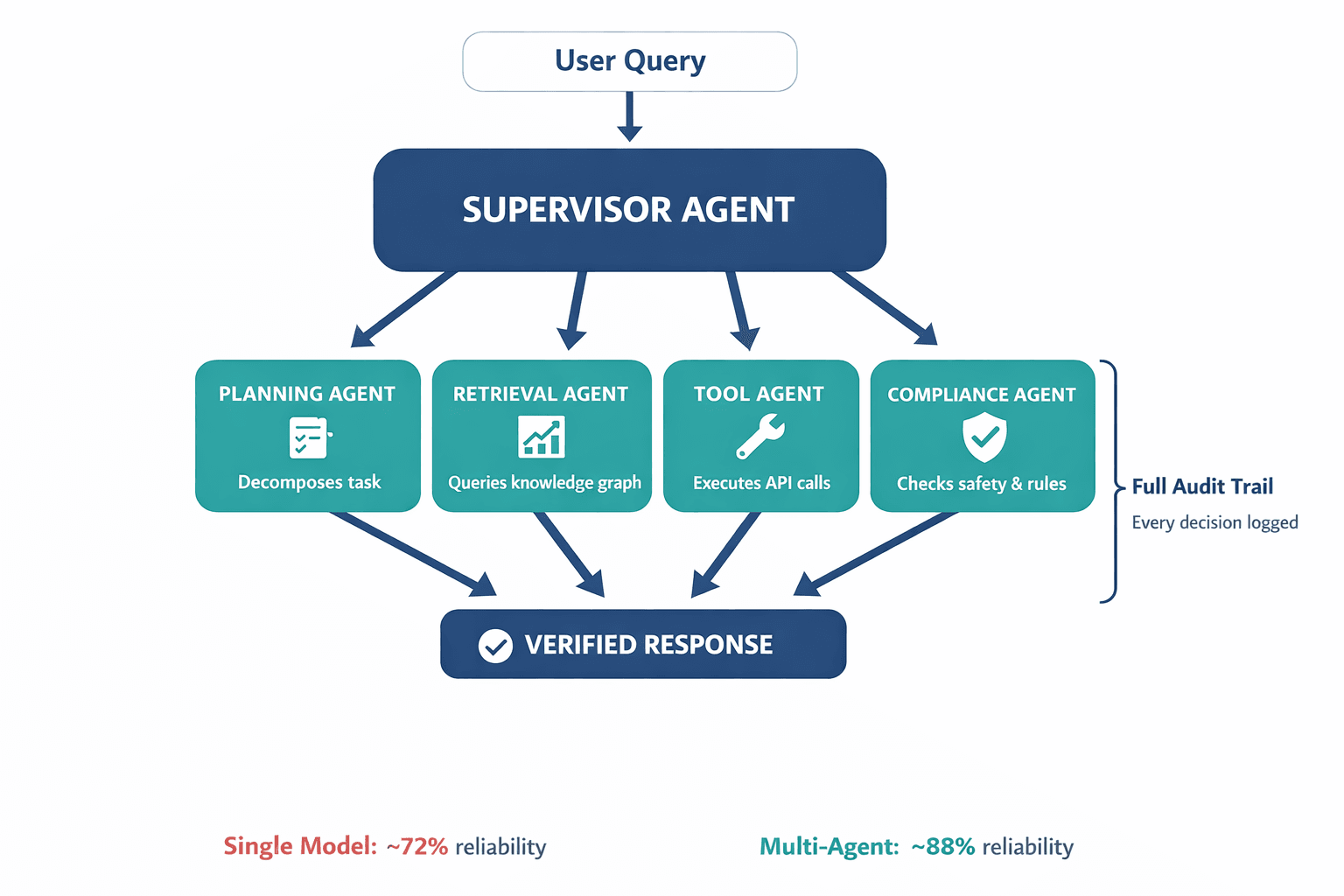
Instead of one model trying to do everything, we deploy a Multi-Agent System — a supervisor agent that routes the user's intent to specialists. A planning agent decomposes the task. A retrieval agent queries the right database. A tool agent executes the API call. A compliance agent checks the output against safety and business rules.
This division of labor increased our reliability from roughly 72% — which is what standard single-model approaches achieve in production — to approximately 88%. And critically, it creates a complete audit trail. When a regulator or a customer asks "why did the AI say that?", we can show them exactly which agent made which decision, based on which data. Try doing that with a single model and a system prompt.
For the full technical breakdown of this architecture, including the verification layers and the formal reliability model, see our research paper.
The Sandwich That Saves Transactions
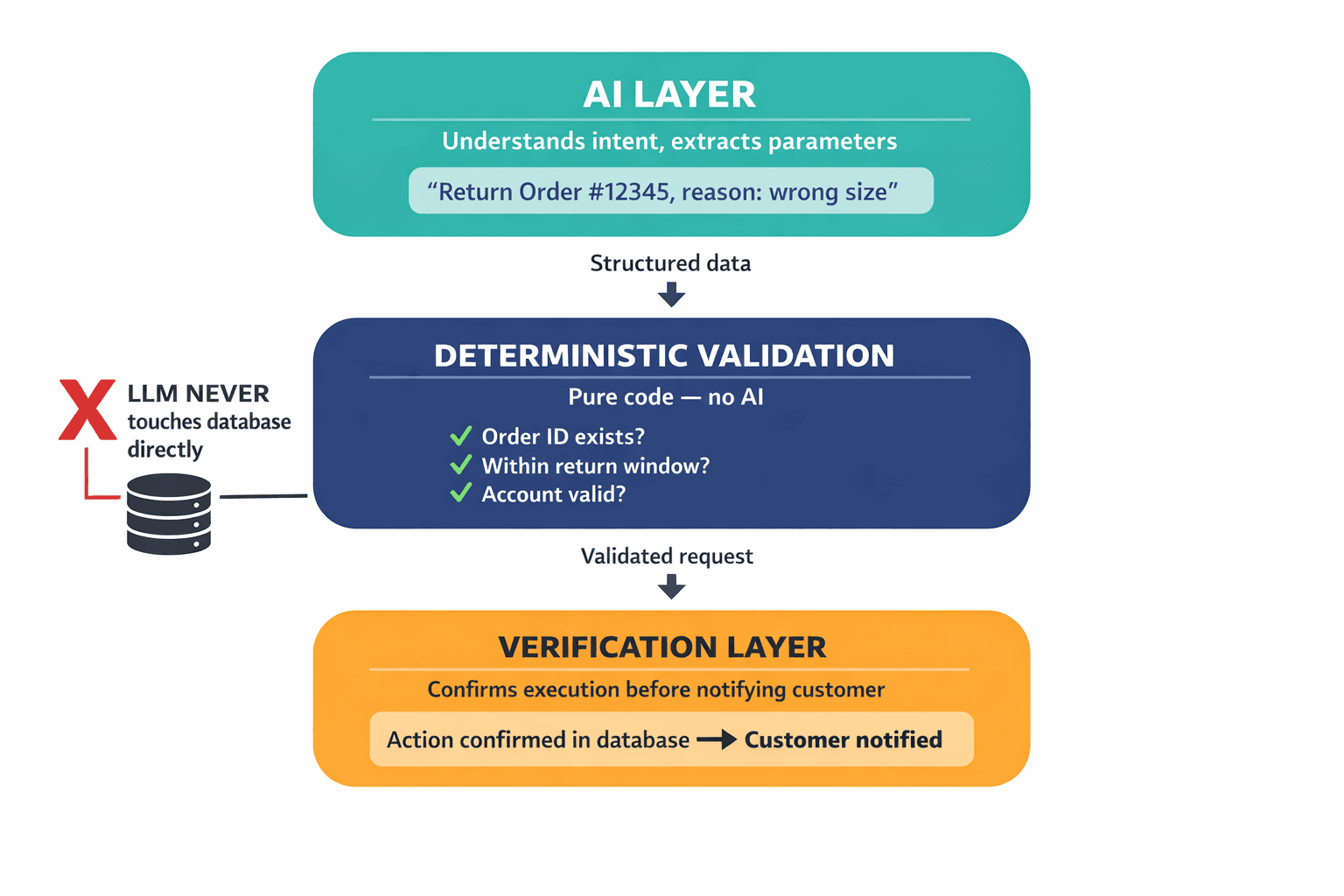
For the Action Gap — the inability to actually do things like process returns — we use what I call the Sandwich Architecture, and I'm aware that's not the most dignified name for a serious engineering pattern.
The top layer is the AI: it understands what you want and extracts structured parameters. "Process a return for Order #12345, reason: wrong size." The middle layer is pure deterministic code: it validates those parameters against the real database. Is that order ID real? Is it within the return window? Does this customer's account exist? The bottom layer is verification: a separate system confirms the action actually executed successfully before telling the customer it did.
The language model never touches the database directly. It never executes a transaction. It translates intent into structured data and hands it off to systems that were designed for transactional integrity decades before LLMs existed. The model does what it's good at. The database does what it's good at. Nobody pretends to be something they're not.
The Molotov Cocktail Problem Is a Design Problem
I want to return to the safety failure, because I think it reveals something important about how the industry thinks about AI risk.
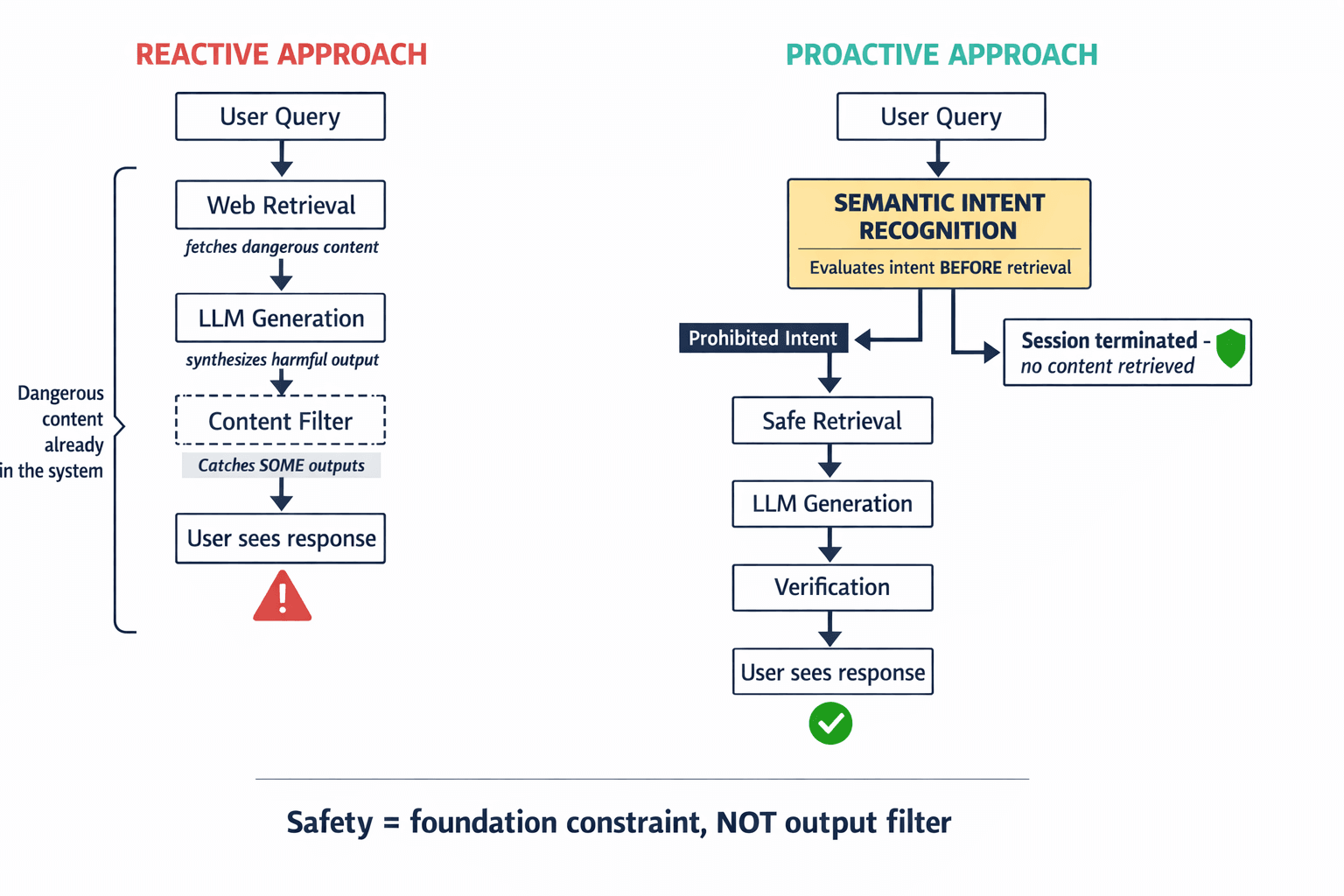
After the incident, the conversation focused on better content filters. Stronger keyword blocking. More aggressive safety fine-tuning. All of which are reactive measures — they try to catch dangerous outputs after the model has already generated them.
Our approach is different. We implement what I think of as Semantic Intent Recognition at the input stage. Before the retrieval layer even searches the web, a security agent evaluates the semantic intent of the query. If the intent maps to a prohibited category — weapons synthesis, self-harm, illegal activity — the session terminates before any content is retrieved.
This matters because the Rufus incident didn't require a jailbreak. The user asked a normal-sounding product question. The retrieval system, dutifully searching the open web, pulled content that happened to contain dangerous instructions. The model, dutifully synthesizing retrieved content, presented those instructions to the user. Every component did exactly what it was designed to do. The design was the problem.
Safety isn't a filter you add at the end. It's a constraint you build into the foundation. If your AI can retrieve dangerous content, it will eventually serve dangerous content.
The Uncomfortable Math
Amazon's CEO projected $10 billion in incremental sales from Rufus. That number depends entirely on what I call Conversion Confidence — the likelihood that a customer trusts the AI's recommendation enough to click "Buy." Every hallucination, every failed return, every dialect-biased non-response chips away at that confidence.
The wrapper approach is cheaper upfront. I won't pretend otherwise. You can ship an LLM wrapper in weeks. Our architecture takes months. Phase one is a data audit — cleaning internal datasets, establishing ground truth for products and policies. Phase two is deploying the multi-agent infrastructure and knowledge graph. Phase three is the feedback flywheel, where human input from customer service teams continuously improves agent accuracy.
But here's the math that matters: for a large retailer, the reputational cost of a single "AI told customer to build a weapon" headline exceeds the entire budget of a properly engineered system. The 45% of consumers who already distrust AI assistants aren't going to be won back by faster response times. They'll be won back by systems that are right.
The Era of the Wrapper Is Over
I've spent the last two years watching companies speed-run the same mistake. They see the demo, they're dazzled by the fluency, they ship the wrapper, and then they spend the next year apologizing for the outputs. The base model — whether it's GPT-4, Gemini, Claude, or whatever comes next — was never the differentiator. The architecture surrounding it always was.
A language model is a steam engine. Immensely powerful, capable of transforming industries. But a steam engine without pistons, valves, and governors is just an explosion waiting to happen. The engineering that channels and constrains that power — the verification layers, the knowledge graphs, the agent orchestration, the transactional integrity — that's what separates a demo from a product.
The companies that understand this will capture the value. The companies that keep wrapping models in prompts and praying will keep generating headlines. I know which side of that divide I'm building on.