Your Employees Are Already Leaking Your Secrets to ChatGPT — Banning It Only Made Things Worse

I was sitting across from a CISO at a large financial services firm when he said something that stuck with me for weeks. He leaned back, rubbed his temples, and said: "We blocked ChatGPT on every device we manage. We updated the acceptable use policy. We sent three company-wide emails. And last Tuesday, I found out our entire M&A team has been pasting deal terms into Claude on their personal phones during lunch."
He wasn't angry. He was exhausted. He'd done everything the cybersecurity playbook told him to do, and it hadn't worked.
That conversation crystallized something I'd been seeing across every enterprise engagement my team at Veriprajna had taken on: banning generative AI doesn't stop people from using it — it just makes them hide it. And hidden usage is infinitely more dangerous than visible usage. The data tells the same story. Forty-six percent of employees say they'd keep using AI tools even if their company explicitly banned them. Thirty-eight percent admit they've already shared sensitive work data with public AI platforms without telling anyone. The volume of data flowing to generative AI apps has increased thirtyfold year over year. This isn't a policy problem. It's an architectural one.
The Night Samsung Changed Everything
In May 2023, three engineers at Samsung's semiconductor division did something completely rational. They were debugging proprietary chip fabrication code — complex, high-stakes work where a second opinion could save days of effort. So they pasted their code into ChatGPT.
One uploaded source code for semiconductor measurement databases. Another shared program logic for identifying yield defects — the kind of data that directly impacts Samsung's stock price. A third uploaded an internal meeting recording to generate minutes.
None of them were trying to harm the company. They were trying to do their jobs well. They treated ChatGPT the way you'd treat a calculator: put something in, get something out, move on. What they didn't fully grasp was that OpenAI's terms of service at the time allowed inputs to be retained — potentially used for model training, definitely stored on servers outside Samsung's control.
I remember reading the news coverage and feeling a knot in my stomach. Not because the leak was surprising — I'd been warning clients about exactly this scenario — but because Samsung's response was so predictable. They issued a company-wide ban. Threatened termination for violations. Locked down the network.
And I knew, with absolute certainty, that it wouldn't work.
Why Does Banning AI Always Backfire?
Here's what most security teams get wrong: they model the threat as if employees are adversaries. Build a higher wall, and the problem goes away. But the people leaking data to ChatGPT aren't adversaries. They're your best performers.
Think about who actually uses AI tools at work. It's not the person coasting through their day. It's the engineer who's under pressure to ship by Friday. The analyst who needs to summarize forty pages of due diligence by morning. The developer who knows the AI can spot a bug in seconds that would take them an hour to find manually.
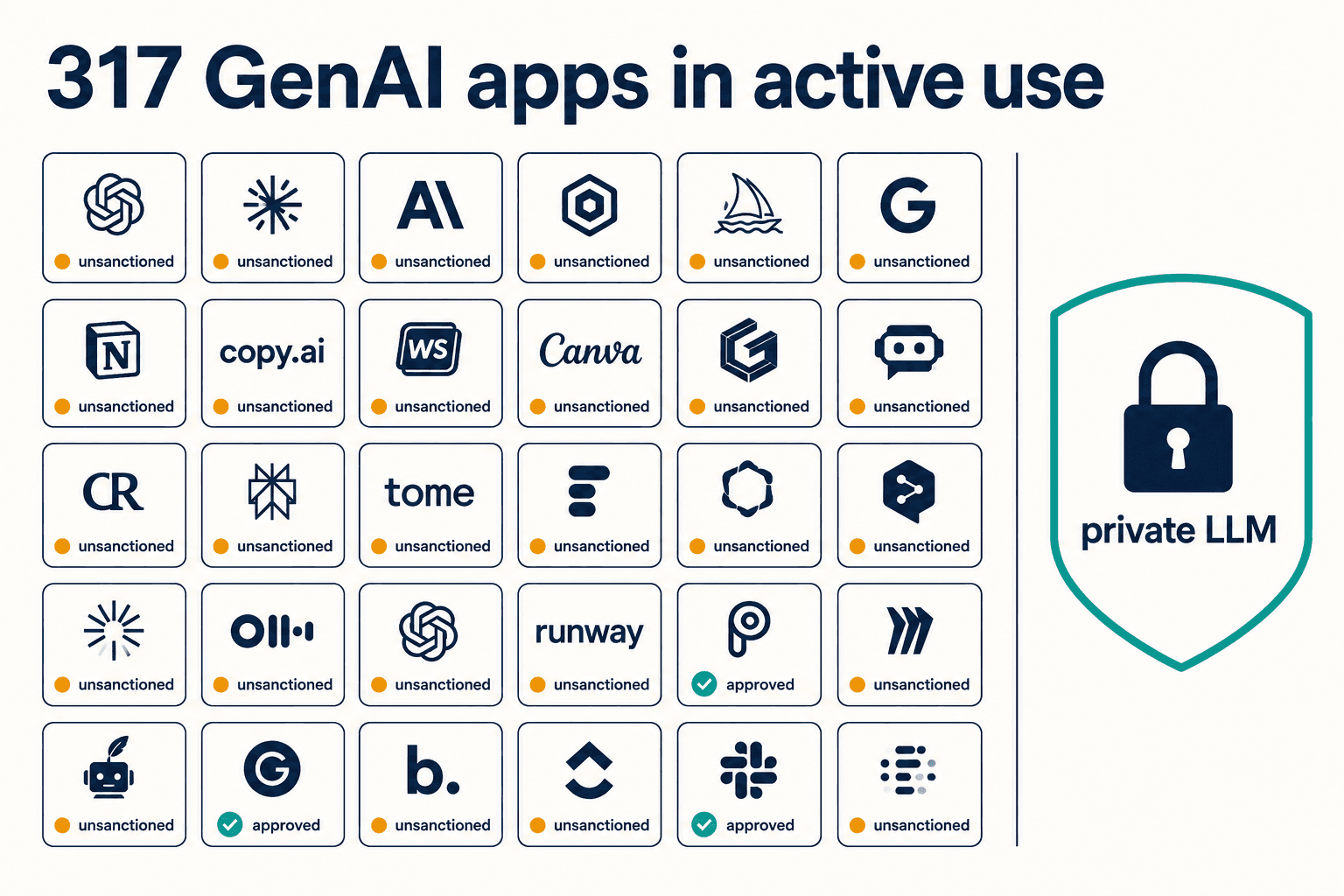
When you ban the tool, you're telling your most productive people: "Be slower. Be less effective. Watch your competitors outpace you, and accept it." Of course they don't comply. They just switch to their personal phones. They use 4G hotspots to bypass the corporate network. They find one of the 317-plus distinct generative AI apps that Netskope has tracked in enterprise environments — because even if you block OpenAI, Google, and Anthropic, there are hundreds of smaller, less secure alternatives waiting.
When security is perceived as a blocker rather than an enabler, your most conscientious employees become your primary policy violators.
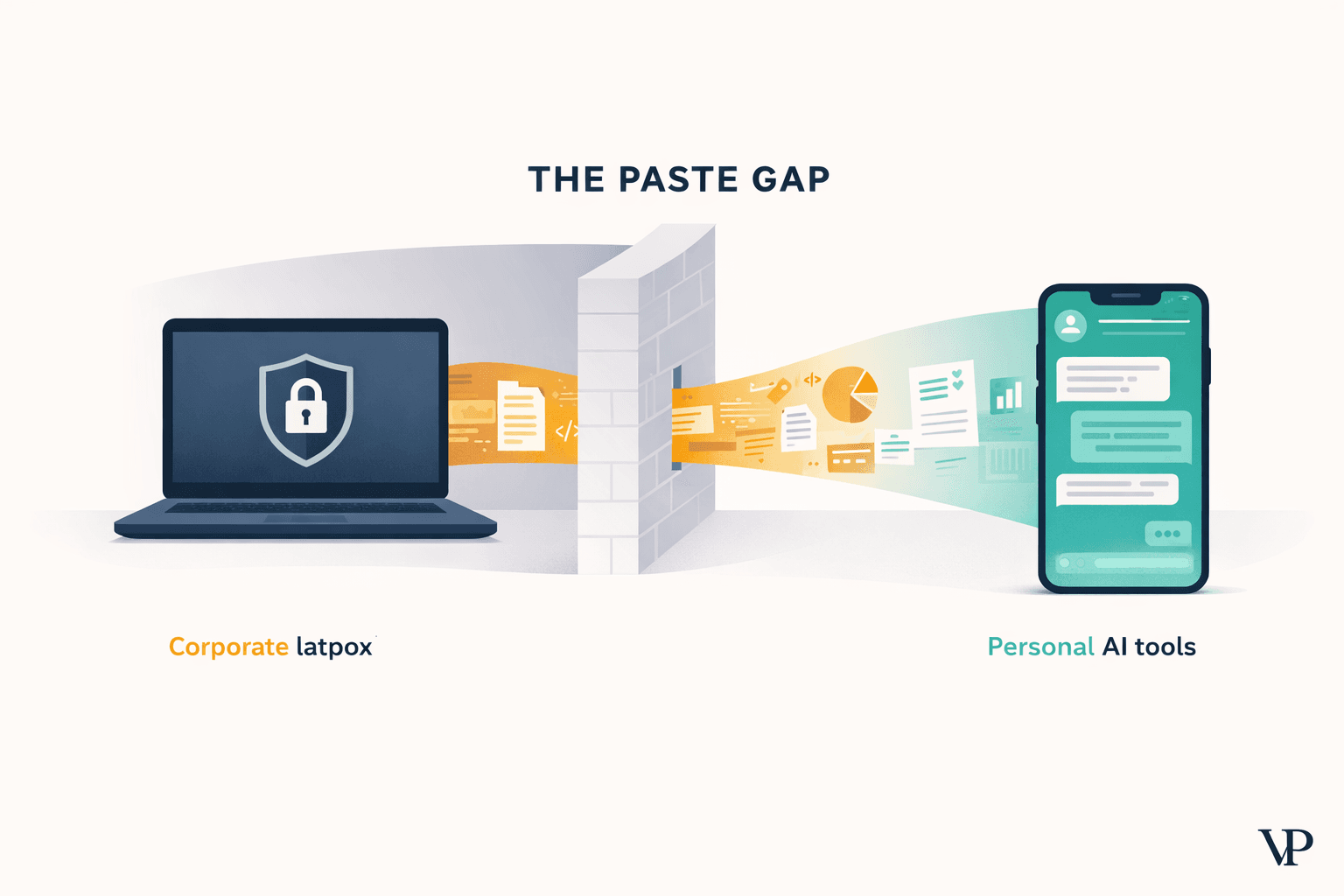
I started calling this the "Paste Gap" in conversations with my team. Data leaves the secure corporate laptop, travels to a personal device, and gets pasted into a public cloud service. No firewall catches it. No CASB logs it. It's invisible. And it's happening right now, in every organization that tried to solve this problem with a policy memo.
The numbers are staggering: a 485% increase in proprietary source code being pasted into AI tools. Seventy-two percent of enterprise AI usage happening through personal accounts, completely outside IT visibility. This isn't a trickle. It's a flood, and the levees are made of paper.
What I Got Wrong About "Enterprise" AI Tiers
I'll be honest — when OpenAI launched ChatGPT Enterprise, I thought it might be enough. Zero data retention. No training on business data. SOC 2 compliance. It checked the boxes.
Then we started doing deeper diligence for our clients, and the cracks showed.
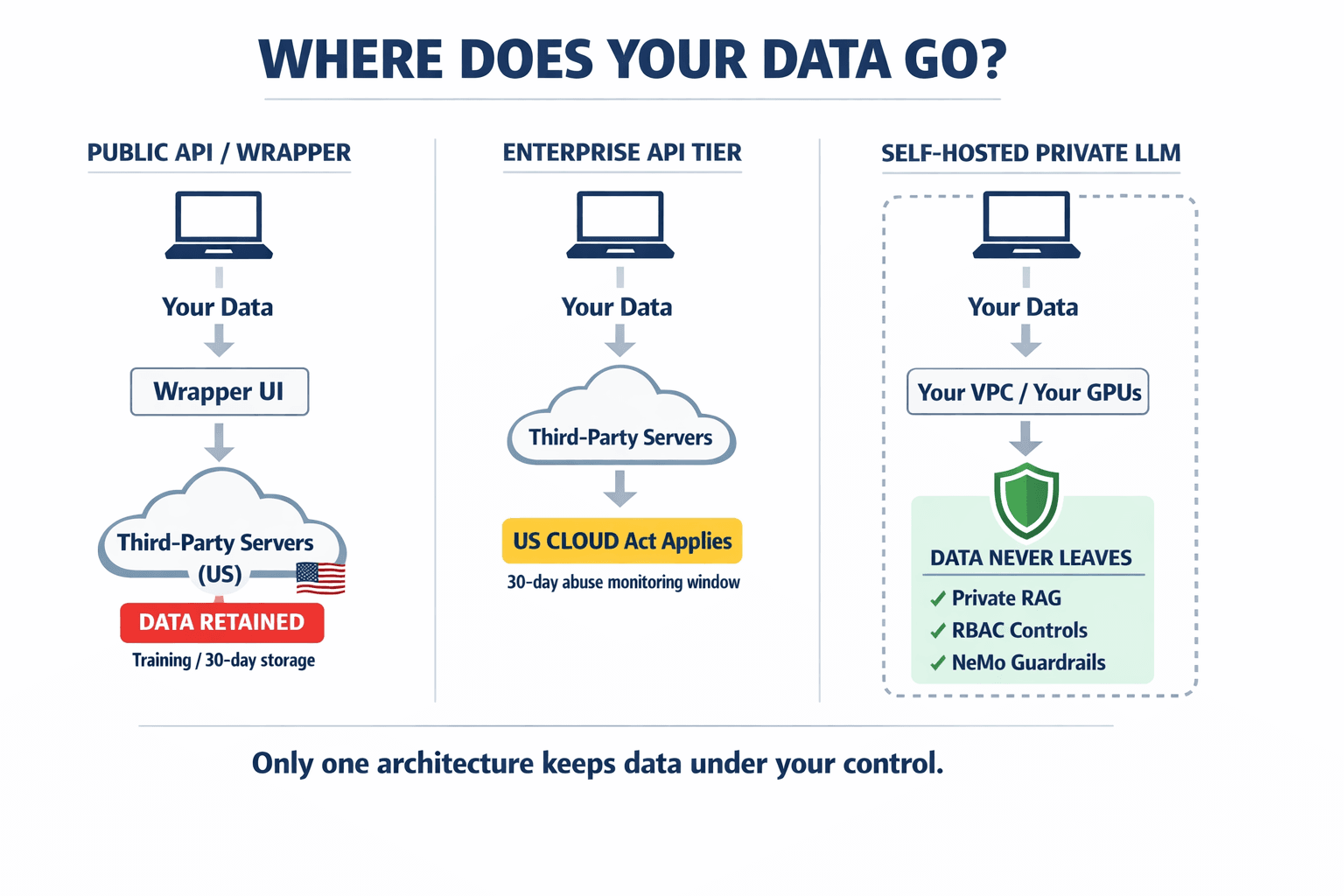
Even enterprise agreements typically include a short data retention window — often thirty days — for abuse monitoring. That's thirty days where your most sensitive prompts sit on someone else's servers. And "someone else" is a US-based company, which brings us to a problem that keeps European CISOs up at night.
The US CLOUD Act — the Clarifying Lawful Overseas Use of Data Act — allows US law enforcement to compel American technology companies to hand over data stored on their servers, regardless of where those servers are physically located. If a German bank uses Azure OpenAI with a Frankfurt data center, the data might be "at rest" in the EU, but the controlling legal entity is still subject to US warrants. During inference — when the model actually processes your data — it may still route through US-controlled infrastructure.
I watched a room full of compliance officers go pale when I walked them through this. They'd signed the enterprise agreement thinking they'd solved the sovereignty problem. They hadn't even scratched it.
I wrote about this architecture problem — and the full threat model — in our interactive whitepaper on Shadow AI and private enterprise LLMs. It was born from exactly these conversations.
The Wrapper Trap
Around the same time, my inbox started filling with pitches from AI consultancies. "We'll build you a custom AI solution!" Most of them were wrappers — a nice interface bolted on top of the OpenAI API, maybe with a system prompt that said "You are a helpful legal assistant."
I sat through one demo where the vendor proudly showed a "proprietary AI platform" for contract analysis. I asked one question: "Where does the data go when a user uploads a contract?" Silence. Then: "Well, it goes to the OpenAI API, but we have a BAA in place."
That's not a solution. That's a middleman adding latency to your data leak.
A wrapper doesn't solve the data sovereignty problem. It just beautifies the interface of data egress.
Wrappers fail enterprises in three specific ways. First, they're trivially replicable — if your "AI solution" is a prompt plus an API key, your intern can rebuild it in an afternoon. Second, they lack deep integration with your actual data, struggling with the nuance of company-specific terminology, legacy codebases, or access controls. Third — and this is the killer — they still send your data across the public internet to a third-party provider. The security risk hasn't changed. You've just added a logo to it.
What Does "Owning the Intelligence" Actually Mean?
There was a specific moment when our approach at Veriprajna crystallized. We were working with a client in a regulated industry — I can't say which one, but think "the kind of data where a leak makes the evening news." Their legal team had just killed a promising AI pilot because it relied on a public API. The engineering team was furious. The business unit was threatening to go rogue and build their own thing with personal accounts.
I was on a call with my lead architect, and he said something simple: "Why are we arguing about which API to use? We should just run the model ourselves."
That's when we committed fully to what I now call Deep AI — deploying open-source large language models directly inside the client's own infrastructure. Not wrapping someone else's model. Not renting intelligence by the token. Actually owning it.
Here's what that looks like in practice. You take a high-performance open-weights model — Llama 3 from Meta, for instance, where the 70B parameter version rivals GPT-4 on many benchmarks — and you deploy it on GPU instances inside the client's Virtual Private Cloud. The model weights live on hardware the client controls. The inference engine runs behind the corporate firewall. When a developer prompts the model with proprietary code, that code travels from their laptop to an internal server, gets processed in memory, and comes back. It never touches the public internet. It never lands on a third-party server.
We pair this with what we call Private RAG — Retrieval-Augmented Generation built on vector databases deployed inside the same secure environment. The company's documents get ingested, embedded, and stored locally. And critically, the system respects existing access controls. If you don't have permission to see a document in SharePoint, the AI won't retrieve it to answer your question either. That "flat authorization" problem — where a chatbot accidentally surfaces confidential data to anyone who asks — simply doesn't exist in this architecture.
How Do You Make a Raw Model Enterprise-Grade?
One of the hardest lessons we learned early on: deploying a model is maybe thirty percent of the work. Making it safe for thousands of employees to use every day — that's the other seventy.
Raw language models are unpredictable. They'll happily discuss topics they shouldn't, generate content that violates company policy, or respond to clever prompt injections designed to bypass safety protocols. You need guardrails — essentially a firewall for prompts.
We implement NVIDIA NeMo Guardrails as a programmable layer around the model. Before a prompt reaches the model, it gets scanned. If someone types a Social Security number or a credit card number, the guardrail catches it. If someone asks an HR bot about database passwords, the system recognizes the intent mismatch and refuses. If someone tries a jailbreak attack — those "ignore all previous instructions" tricks — the defense layer intercepts it.
I remember a penetration test we ran on one of our early deployments. Our red team spent two days trying to extract training data or bypass topic restrictions. They got creative — nested role-play prompts, encoded instructions, the works. The guardrails held. My architect sent me a screenshot of the blocked attempts log at 2 AM with a single message: "Wall's solid." That was a good night.
For the full technical breakdown of this architecture — the inference stack, the vector database configuration, the guardrail implementation — see our technical deep-dive on enterprise AI security.
"But GPUs Are Expensive and APIs Are Cheap"
This is the objection I hear most often from CFOs, and it's wrong in a way that's worth unpacking.
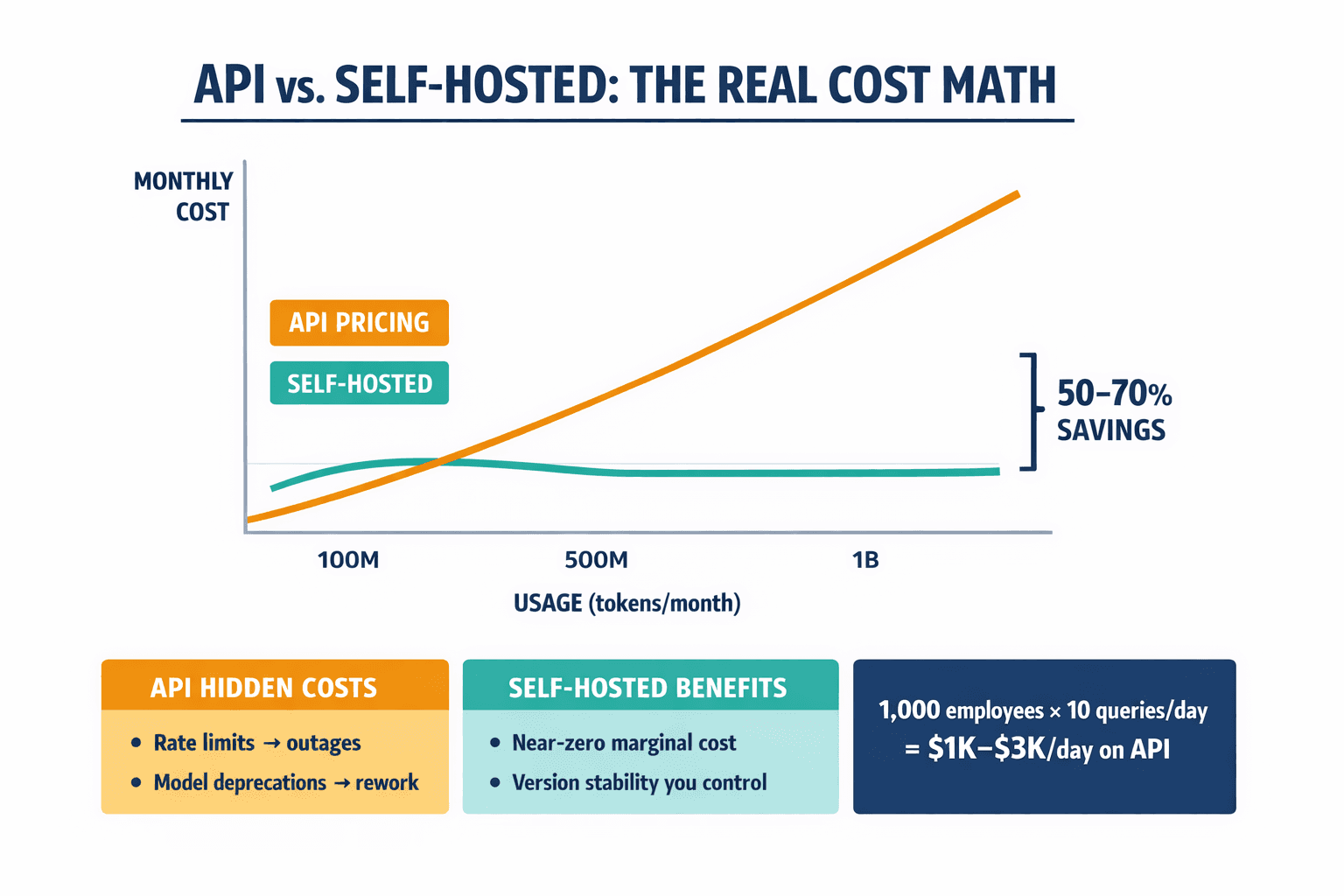
Yes, API pricing looks cheap on the surface — fractions of a cent per token. But enterprise RAG applications are ravenously token-hungry. To answer a single question, the system might retrieve ten pages of context as input tokens. Multiply that across a thousand employees asking ten questions a day, and you're looking at $1,000 to $3,000 per day. That's potentially a million dollars a year, and it scales linearly. If adoption doubles, the bill doubles.
Self-hosted models work differently. You're paying for the hardware — GPU rental or purchase — and electricity. A single well-configured node can handle thousands of requests per second. Until you saturate that node, the marginal cost of the next token is effectively zero. For a mid-sized company processing a billion tokens per month, we've seen self-hosting come in at 50 to 70 percent cheaper than equivalent API costs, with privacy as a free bonus.
And there are hidden costs to APIs that never show up on the invoice. Rate limits that cause outages during company-wide rollouts. Model deprecations that force you to re-test every prompt and workflow when the provider retires a version. With a self-hosted model, nothing changes unless you decide to upgrade it. You get stability. You get predictability. You get to stop worrying about what OpenAI's pricing committee decides next quarter.
At enterprise scale, self-hosting isn't the expensive option. It's the one that doesn't bankrupt you when adoption succeeds.
Why Isn't Everyone Doing This Already?
People ask me this, and the honest answer is: it's hard. Not conceptually — the logic is straightforward — but operationally. You need people who understand GPU orchestration with Kubernetes, who can configure vLLM for optimal throughput, who know how to build RBAC-aware retrieval pipelines, who can implement guardrails that are strict enough to prevent misuse but flexible enough not to frustrate users.
Most enterprises don't have that team. Most AI consultancies don't either — they know how to call an API, not how to deploy an inference stack. That's the gap we fill at Veriprajna. We don't sell access to a model. We build the capability to run models independently. When we leave, the client owns everything — the fine-tuned model weights, the vector indices, the orchestration infrastructure. It's theirs. That's the whole point.
The other thing that slows adoption is inertia. The CISO who blocked ChatGPT feels like they did something. Admitting the ban didn't work means admitting the last year of policy enforcement was theater. That's a hard conversation to have with a board. But the alternative — pretending the problem doesn't exist while employees paste source code into personal AI accounts — is worse. It's not a matter of if the next Samsung-scale leak happens. It's when, and whether it happens to you.
The Signal Hidden in Shadow AI
Here's what I think most people miss about the Shadow AI epidemic: it's not just a security problem. It's a signal. A loud, unmistakable signal that your workforce is desperate for better tools and willing to risk their jobs to get them.
Forty-six percent of employees say they'd defy an explicit ban. That's not defiance for the sake of it. That's people telling you, through their actions, that AI has become essential to how they work. The question isn't whether your organization will use generative AI. That decision has already been made — by your employees, without your permission, on their personal devices, during lunch.
The only question left is whether you'll provide a secure way to do what they're already doing unsafely.
Shadow AI is your workforce voting with their keystrokes. They've chosen AI. Now you choose: visible and secure, or invisible and hemorrhaging data.
We've moved past the era where "no" was an acceptable AI strategy. The open-source models are good enough. The deployment infrastructure is mature enough. The economics work. The only thing standing between most enterprises and sovereign AI capability is the willingness to stop pretending that prohibition works.
You don't need to ban AI. You need to own it.