
A convincing video call still needs a payment release rule

A convincing video call can make a payment request feel settled before its authorization is settled. For a treasury team, the consequential question is what evidence permits the wire to leave. I want that answer to survive a persuasive caller and to give legitimate business a defined route forward.
That position creates a design problem. Blocking every uncertain instruction puts the cost of uncertainty on the business. Allowing any instruction that receives a reassuring second response can make the control easy to override. A payment policy needs to distinguish missing evidence that can be obtained from a failed condition that a confirmation alone cannot repair.
VoxFence, our demo at Veriprajna, makes that distinction inspectable. It uses synthetic payment cases, supplied call and device signals, and simulated treasury and verification adapters. It demonstrates an authorization mechanism; it does not perform forensic analysis of a real video call.
The score does not answer the release question
Consider a synthetic $25.6 million wire instruction to new beneficiaries, supported only by a video call. Its supplied detector input is labeled P(authentic) and set to 0.90. That is a configured score, not a measured or calibrated probability that the caller is authentic. The fixture also supplies an injection flag and an unattested endpoint, meaning the device has not satisfied the configured device check.
The policy gate blocks this instruction before the simulated treasury rail. The score is not a decision condition in the gate. At or above its configured $50,000 boundary, an injection flag or an unattested device causes a block. Raising the score cannot satisfy those release conditions.
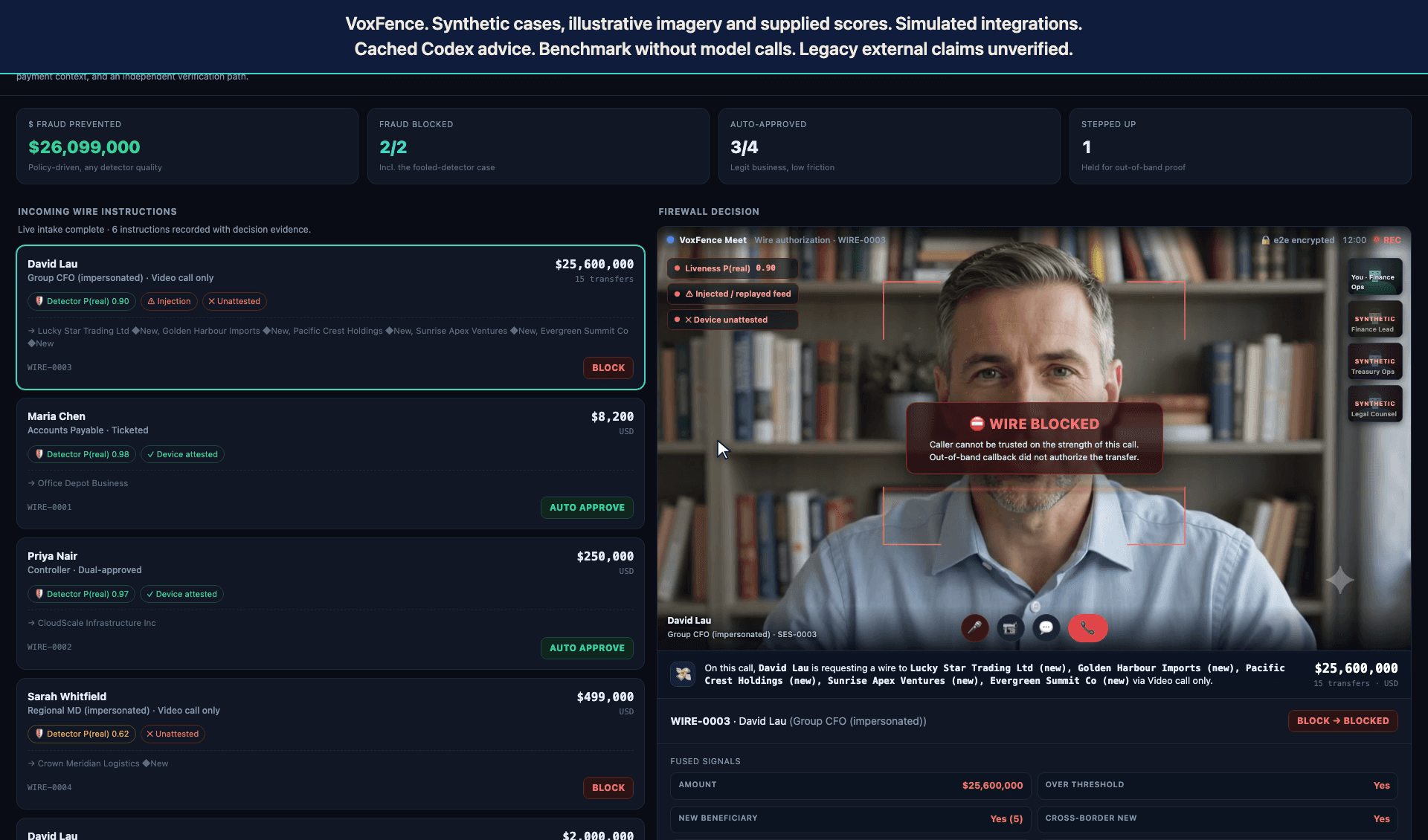
I prefer this separation because media authenticity and payment authority ask different questions. Even an authentic executive can send an instruction without the required corroboration, or ask for a change in beneficiary details that has not been independently established. That is a hypothetical authorization problem, not a claim about an incident shown here. Improving the answer to who appears on the call does not establish every fact needed to release the payment.
A detector can still contribute evidence. The architectural choice is which decisions that evidence is allowed to make. If a high score can override failed payment conditions, the release rule effectively delegates authority to the score. In this demo, the binding decision stays in deterministic code. The dashboard's advisory explanations are cached Codex-generated replies; they cannot change that decision.
This is a narrow, inspectable claim. The injected-media and device flags are supplied inputs, not capabilities VoxFence has measured from the illustrated call. A production control would need dependable ways to obtain them. Separating authority from detection does not make unreliable signals reliable.
Legitimate business needs a recovery path
Now consider the synthetic $2 million instruction to a new beneficiary. It is also video-only, but its supplied endpoint flag is attested and no injection is flagged. The policy requires independent verification rather than blocking it outright. A simulated callback through a pre-registered channel authorizes the instruction, and the simulated rail executes it.
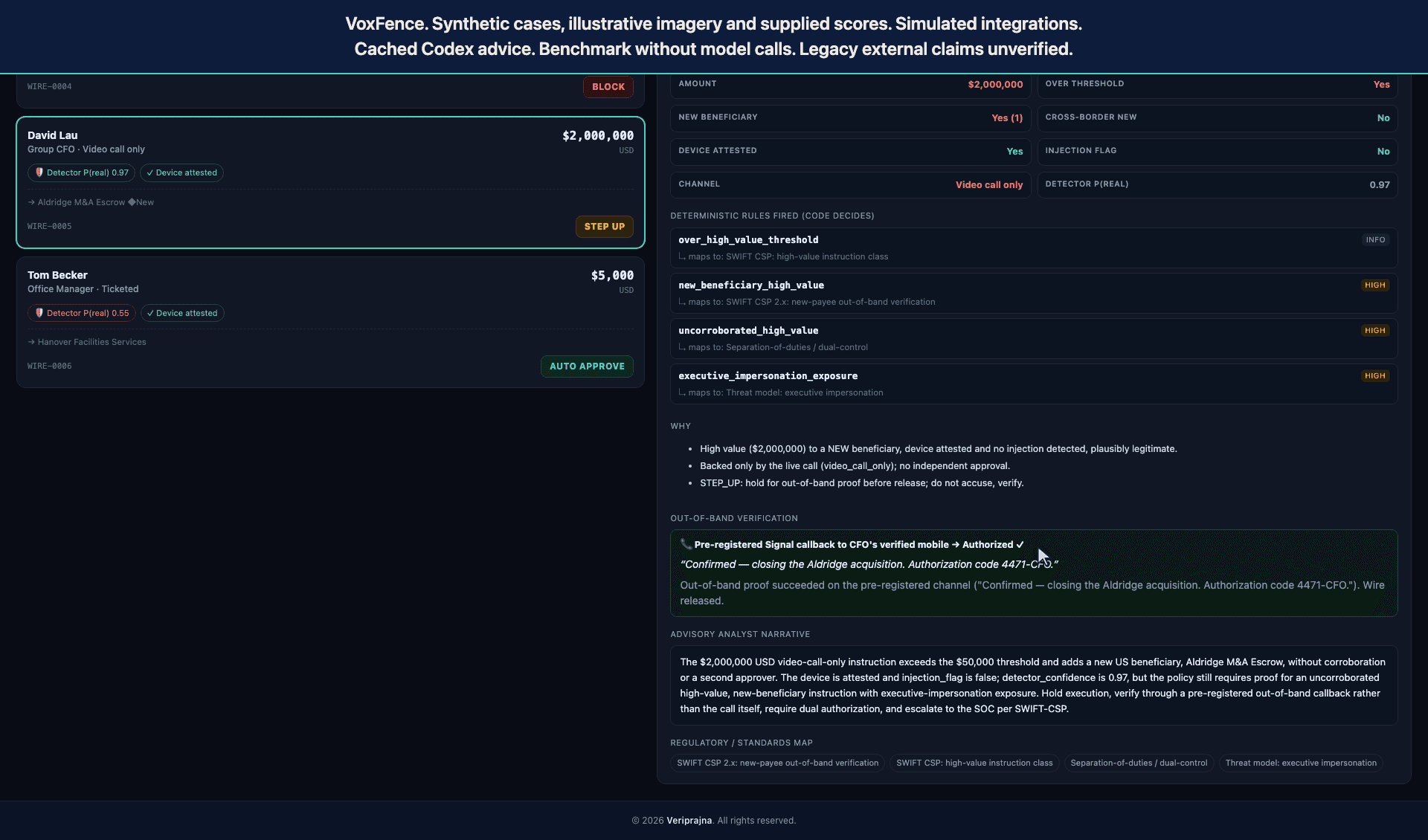
The pause has a purpose: obtain evidence the call did not provide. It also has a cost. Someone must be reachable and able to confirm the instruction, and the payment remains held if the simulated callback is unreachable or does not authorize it. Eventual execution does not mean zero friction.
That cost is easier to justify when the policy identifies what confirmation resolves. Here, the missing independent authorization can be supplied through the separate channel. The caller's confidence, urgency or familiarity is not the release condition. The callback provides the configured authorization needed for this branch.
A blanket block would discard that distinction and stop this legitimate fixture. Automatic release would skip it. The verification path preserves the possibility of completing business while requiring something additional to happen first. I regard the recovery rule as part of the control itself, because an unexplained pause leaves the operator with pressure to improvise an exception.
The other case sets an equally important limit. A BLOCK remains blocked even if a simulated callback reports authorization. Confirmation does not erase its failed injection or device condition. Treating every callback as an override would collapse two different decisions into one: whether the instruction is independently authorized, and whether the configured channel conditions permit execution.
For a hypothetical production workflow with those hard vetoes, recovery would require resolving the failed condition and submitting an instruction that meets the release policy. It could require a trusted endpoint or a fresh approved channel. Those are design requirements, not recovery functions demonstrated by this app. The tradeoff is real: an authorized payment can remain delayed when its environment cannot meet the policy.
Independence has to survive the exception
The phrase "independent verification" is only useful if the evidence comes from outside the instruction being challenged. A caller who supplies the number to call has also supplied the route to confirmation. In the production design I favor, contact details must be established through a trusted process before the request, and confirmation must concern the actual amount and beneficiary, not merely whether the executive recognizes a conversation.
VoxFence simulates a pre-registered callback. It does not establish that a deployed directory, verification service or banking integration is secure. That is where the operational design would need scrutiny: who can change the contact record, what the verifier confirms, and whether every route that releases money enforces the same decision.
Imagine a payment deadline arriving while the independent approver is unavailable. A timer that releases the instruction would turn availability into authorization. Asking the caller for another contact would hand control of the evidence route back to the same request. Under the policy I favor, the payment waits or follows a separately established exception process with its own authority. The organization accepts delay rather than quietly changing what counts as proof.
This is not an argument for copying the demo's policy into production. Its current branch below $50,000 auto-approves regardless of other risk flags. That is an explicit coverage gap: a small instruction with a new beneficiary or an injection flag does not receive a complete risk veto. The boundary would need deliberate review, including a hypothetical sequence of smaller requests. The demo does not demonstrate aggregation across such requests.
The finite benchmark cannot settle that policy choice. Across six synthetic labeled cases, the gate stops both fraud fixtures and all four legitimate fixtures ultimately execute. One legitimate high-value case takes the verification path. Those results demonstrate the configured paths; they do not establish fraud coverage, acceptable delay or loss prevention in an operating treasury team.
Here is my walkthrough of these synthetic payment cases and the release policy.
The VoxFence explainer provides the video and screenshots behind these examples. The decision I want a reader to carry into a review is specific: for each payment path, identify the evidence that releases funds, the failure that keeps them held, and the authority that can change either. If urgency can rewrite those answers through an informal bypass, a convincing call still has a route to becoming payment permission.