The Night 60 Data Centers Vanished From the Grid — And What It Taught Me About the Limits of AI

I was on a call with a utility executive when he said something that stopped me cold.
"The grid didn't lose power that night. It lost demand. And nobody had a playbook for that."
He was talking about July 10, 2024 — the evening a single lightning strike in Fairfax, Virginia triggered the simultaneous disconnection of 60 data centers, vaporizing 1,500 megawatts of electricity demand in under two minutes. That's roughly the entire power consumption of Boston, gone in the time it takes to brush your teeth. The North American Electric Reliability Corporation — NERC, the federal body that keeps the lights on for 400 million people — later called it a "five-alarm fire for reliability."
And I remember sitting there thinking: this is the event I've been warning about. Not a generation failure. Not a cyberattack. A cascade of automated protection logic, each system doing exactly what it was told, collectively producing an outcome nobody designed for. The grid didn't break because something went wrong. It broke because everything went right — at the wrong time, in the wrong sequence, at a scale no one modeled.
This is the story of what actually happened that night, why the current wave of AI "solutions" would have made it worse, and what my team at Veriprajna has been building instead.
What Happens When Lightning Hits the World's Internet Capital?

Northern Virginia routes 70% of global internet traffic. It's not a metaphor to call it the backbone of the digital economy — it literally is. And on that July evening, a lightning arrestor failed on Dominion Energy's Ox-Possum 230-kilovolt transmission line, creating a permanent fault.
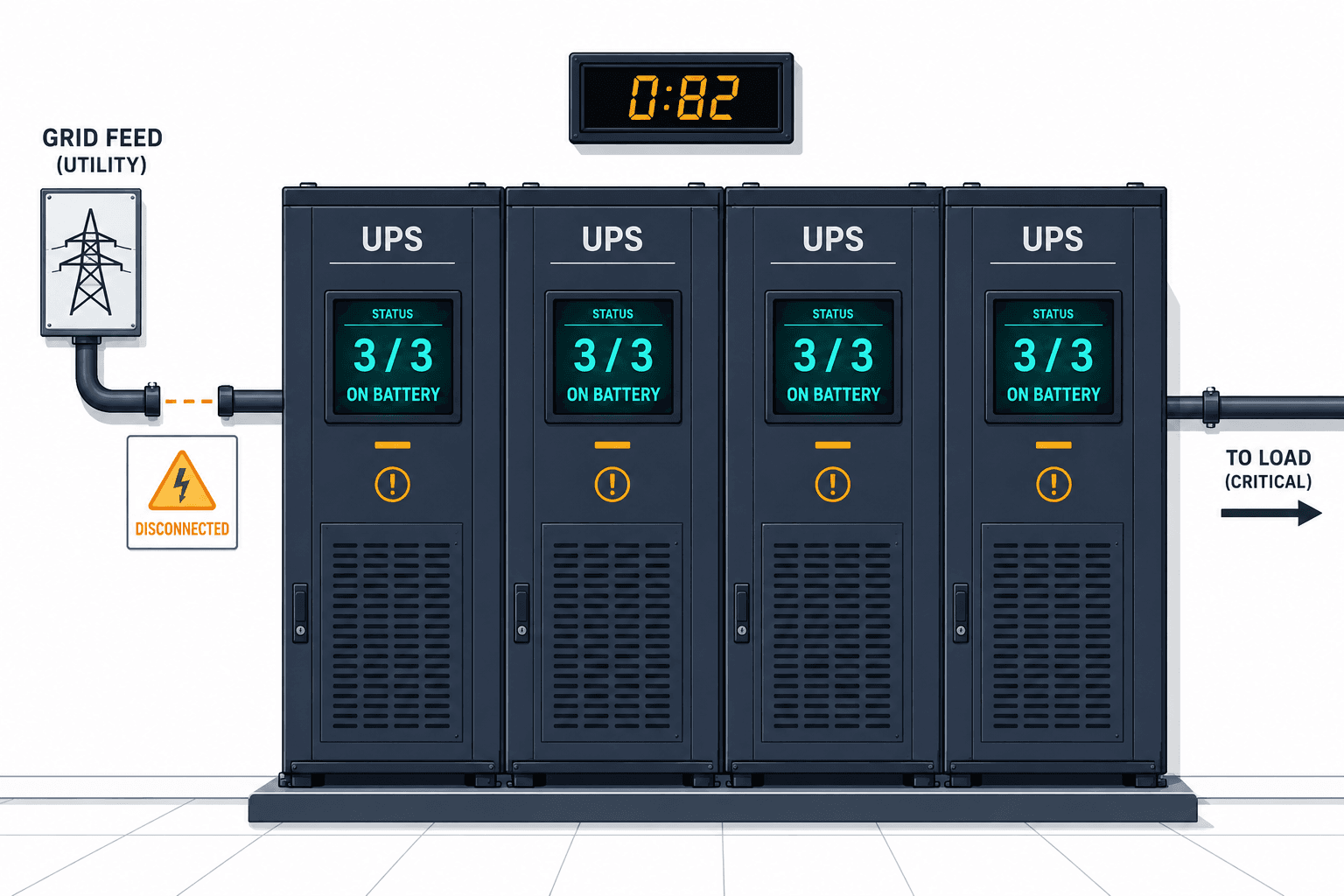
Here's where it gets interesting. The grid's protection systems did their job. They attempted to auto-reclose the line — a standard procedure, like flipping a breaker back on to see if the fault clears. The system tried six times over 82 seconds, three attempts from each end of the line. Each attempt caused a brief voltage dip.
None of these dips were dangerous on their own. Each stayed within the ±10% range that grid standards consider normal. But the Uninterruptible Power Supply systems inside those data centers were counting. They're programmed with a simple rule: if you see three voltage disturbances within a minute, assume the grid is failing and cut over to diesel backup generators. Protect the servers at all costs.
So the UPS systems counted to three, and 60 facilities simultaneously said: we're out.
A routine fault on a single transmission line caused 1,500 MW of load to vanish in under 82 seconds — fifty times faster than a typical power plant failure.
The grid operators at PJM Interconnection, which manages electricity for 65 million people across 13 states, suddenly had a massive surplus of generation. Frequency spiked to 60.047 Hz. In a normal outage, frequency drops because you've lost a generator. Here, it surged because the generators were still spinning but the load had disappeared. Operators had to scramble to do the opposite of what they're trained for — they manually throttled down 600 MW from gas plants in Pennsylvania and 300 MW from a nuclear unit in Virginia just to keep the system from overloading transformers.
And the data centers? They sat on diesel for hours. The transition to backup was automatic. The return to the grid was not. It required manual intervention, facility by facility, burning thousands of gallons of diesel while technicians coordinated reconnection.
I keep coming back to the absurdity of it. The most sophisticated computing infrastructure on Earth, housing the models that are supposedly going to transform every industry, was taken offline by a counting algorithm that couldn't distinguish between "six dips from one fault" and "six separate emergencies."
Why I Knew the "Just Use GPT" Crowd Would Get This Wrong
About a week after the incident hit the trade press, I got an email from an investor who'd been following our work. His suggestion, paraphrased: "Couldn't you just fine-tune an LLM on grid data and have it predict these cascades?"
I drafted three different responses before settling on the polite version. But here's what I wanted to say:
No. And the fact that you're asking tells me exactly how deep the misunderstanding goes.
Large Language Models are probabilistic engines. They predict the next likely token in a sequence. They optimize for plausibility — what sounds right — not veracity — what is right. This distinction is academic when you're generating marketing copy. It's catastrophic when you're managing a system where frequency must stay within 0.036 Hz of its target or transformers start overheating.
My team and I spent weeks after the Virginia incident studying the failure chain, and we kept arriving at the same conclusion: the dominant approach to AI in critical infrastructure — what I call the "wrapper" architecture, where you drape a thin software layer over GPT-4 or Claude and call it a solution — would have been useless here. Possibly worse than useless.
Think about what a standard Retrieval-Augmented Generation system would do with grid data. It treats everything as text segments. It might retrieve a document about the Ox-Possum line and another about UPS ride-through standards, but it has no concept that a voltage dip at substation A propagates electromagnetically to substation B in milliseconds. It can't reason about Kirchhoff's Laws. It doesn't know what a swing equation is. It would generate a confident, well-formatted answer that might be physically impossible.
We saw this pattern play out in a different domain. In 2023, Sports Illustrated deployed a wrapper architecture that generated entire journalist personas and articles — plausible, polished, and completely fabricated. The stock dropped 27%. For a media company, that's a scandal. For a grid operator, the equivalent "hallucination" in a load-balancing algorithm doesn't crash a stock price. It crashes a grid.
I wrote about this failure mode extensively in our interactive analysis of the Virginia disturbance, where we map the full cascade from lightning strike to diesel generators.
The Argument That Changed How We Build
There was a moment — I think it was late August 2024, maybe three weeks after we'd started our deep analysis — when two of my engineers got into a genuine argument about architecture. One wanted to build a purely neural approach: train a massive model on historical grid telemetry and let it learn the physics implicitly. The other insisted that implicit learning wasn't enough, that you had to encode the physics directly into the model's loss function.
I let them argue for almost an hour. Not because I didn't have an opinion, but because the argument itself crystallized something I'd been circling for months.
The neural-only advocate pulled up results from a standard deep learning model applied to AC Optimal Power Flow — the core optimization problem that determines how power moves through a grid. The model was fast: 52.6 milliseconds for inference. But when we stress-tested it against scenarios resembling the Virginia event — sudden, massive load drops — it produced states that violated basic power flow equations. It "hallucinated" grid states that couldn't physically exist. A voltage at a bus that would require current to flow in a direction prohibited by the network topology.
The physics-first advocate then showed what happened when you embed the residuals of the governing partial differential equations directly into the neural network's loss function. This is what's called a Physics-Informed Neural Network, or PINN. The model doesn't just learn patterns from data; it learns patterns constrained by the laws of electromagnetism. Every prediction it makes must be consistent with Kirchhoff's Laws and the swing equation for frequency stability.
The results were striking: 0.64 MW deviation from ground truth versus 0.73 MW for the unconstrained model, with inference times under 50 milliseconds. More importantly, the physically constrained model maintained feasibility under extreme scenarios. It couldn't hallucinate impossible grid states because the physics wouldn't let it.
When your AI's loss function includes the laws of physics, hallucination isn't just unlikely — it's mathematically penalized.
That argument ended with both engineers on the same side. And it became the foundation of what we now build at Veriprajna.
How Do You Make AI That Can't Lie About Physics?
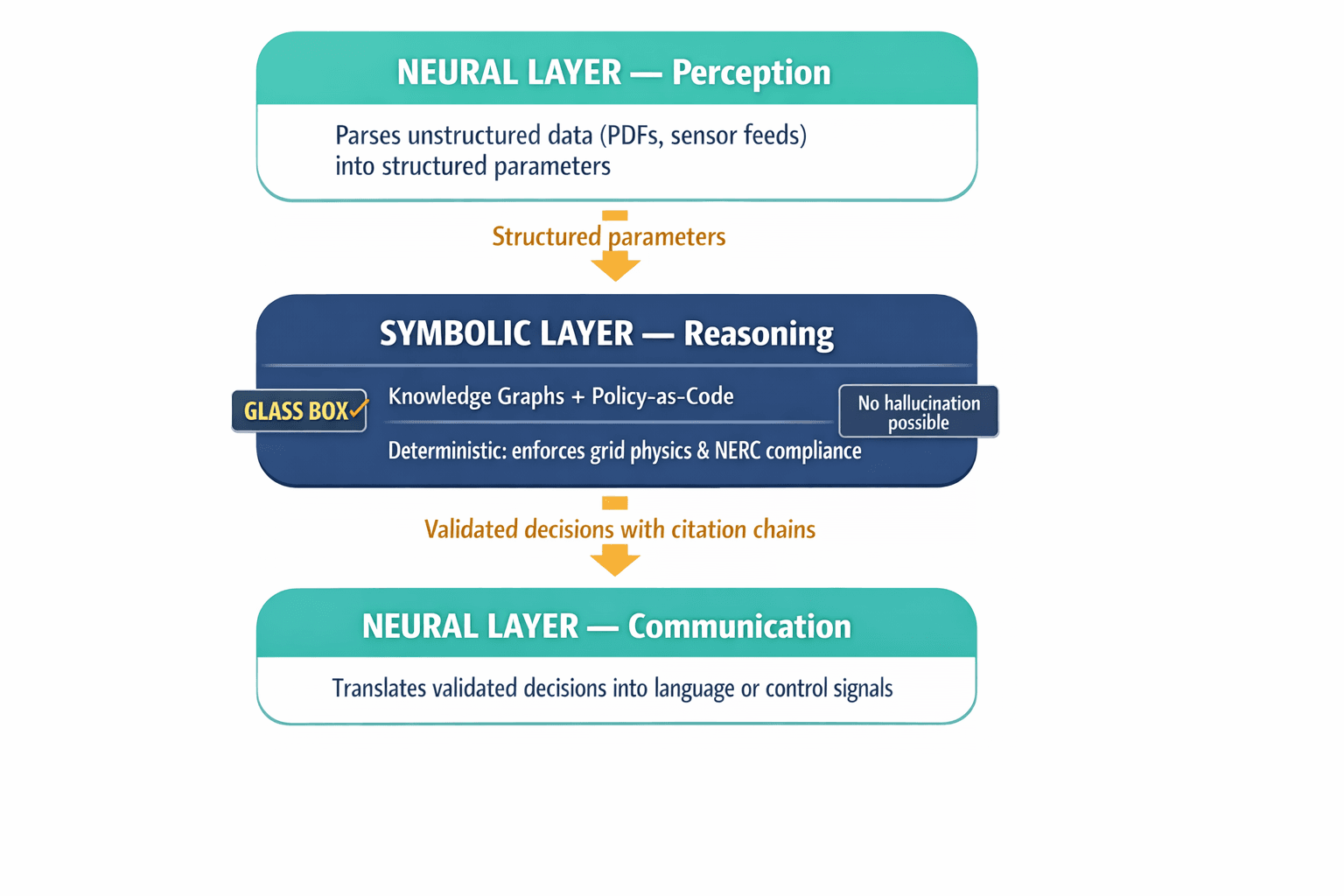
The architecture we developed has a structure I sometimes describe as a "sandwich" — though that undersells its precision.
The top layer is neural. It handles perception: reading unstructured data, extracting intent, recognizing entities. If a large load interconnection request comes in as a 200-page PDF filing, this layer parses it into structured parameters. It's good at this. LLMs are genuinely excellent at perception tasks.
The middle layer is symbolic. This is where the actual reasoning happens, and it's entirely deterministic. Knowledge Graphs store the relationships between substations, transmission lines, data center contracts, and NERC compliance standards. Hard-coded business rules — what we call Policy-as-Code — validate every extracted parameter against grid physics and regulatory requirements. No amount of prompt engineering can bypass this layer. If a proposed load ramp violates the N-1 contingency constraint defined in NERC TPL-001, the system flags it. Period. There's no "temperature" setting that makes it more creative about safety.
The bottom layer is neural again. It takes the validated decision from the symbolic layer and translates it into natural language or machine control signals. It's a communicator, not a thinker.
This is what I mean by a "Glass Box" approach. Every decision has a citation chain. Instead of a black box that says "trust me, I'm AI," our system says: "I flagged this because the proposed ramp rate exceeds the threshold defined in Section 4.2 of the interconnection agreement, cross-referenced with real-time telemetry from PMU data at Substation 7."
People always push back on this. "Isn't the symbolic layer just rules? Aren't you just building an expert system with extra steps?" No. The neural layers handle the parts that rules can't — perception of unstructured data, pattern recognition across thousands of variables, real-time anomaly detection in noisy sensor feeds. The symbolic layer handles the parts that neural networks can't — guaranteed compliance, physical feasibility, auditability. Neither alone is sufficient. Together, they cover each other's blind spots.
What Does the Grid Actually Need Right Now?
NERC's response to the Virginia incident was swift and, to their credit, substantive. They established the Large Loads Task Force in August 2024 and issued a Level 2 Industry Recommendation Alert in September, urging utilities to overhaul how they model, monitor, and communicate with large loads.
The core problem NERC identified is what I'd call invisibility. Grid operators couldn't see inside those 60 data centers. They had no real-time telemetry on UPS counting logic, no visibility into when facilities were approaching their disconnect thresholds. The data centers were black boxes drawing gigawatts from a system that treated them like oversized houses.
One technical development that gives me genuine hope is the PERC1 model — Power Electronic Ceasing and Reconnecting. Traditional load models were designed for motors and heaters, devices that slow down gradually during a fault. Data centers don't slow down. They cease consumption entirely, in milliseconds, through power electronic switching. PERC1 is the first model specifically designed to represent this behavior, and it's critical for any simulation that wants to predict what actually happens during events like July 10.
But models alone aren't enough. Data centers need to become active participants in grid stability, not passive consumers who disconnect when things get uncomfortable.
This is where OpenADR 3.0 — the modernized automated demand response standard — becomes essential. The older version used clunky XML messaging with sub-minute response times. Version 3.0 uses RESTful APIs and JSON with sub-second latency. That's the difference between "please reduce load sometime in the next 60 seconds" and "shift 50 MW of batch processing to your Oregon facility right now."
If data centers curtailed just 0.5% of their annual electricity use during peak periods, 100 GW of new capacity could connect to the grid without building a single new gas plant.
EPRI's DCFlex initiative is already recruiting data centers into voluntary demand response programs built on this premise. The math is compelling, but the execution requires AI that can dynamically shift computational workloads between geographic regions while respecting both grid constraints and service-level agreements. That orchestration layer — fast enough for sub-second response, smart enough to respect physics, auditable enough for regulators — is exactly what our PINN-based architecture is designed to provide.
For the full technical breakdown of how we integrate PINNs with the neuro-symbolic stack, see our research paper on the Virginia disturbance.
Why Virginia's Problem Is Everyone's Problem
I need to talk about the human cost, because the technical community has a tendency to discuss grid stability in the abstract.
Dominion Energy's data center capacity is projected to grow from 4 GW today to nearly 40 GW in contracted capacity. Virginia has given $2.7 billion in subsidies to data center operators over the past decade. The state needs $28.3 billion in new transmission infrastructure and 40% more transmission capacity to handle projected load — a buildout rate that the state's own Joint Legislative Audit and Review Commission calls "very difficult to achieve."
Meanwhile, regional capacity prices have spiked 833%. Residential electricity bills are projected to hit $380 per month by 2045. Northern Virginia data centers consumed nearly 2 billion gallons of water for cooling in 2023 — enough to supply 50,000 people — and rely on nearly 9,000 diesel backup generators that are, as July 10 proved, not just backups but a core part of the operational strategy.
The Department of Energy projects that without significant intervention, outages could spike from 2.4 hours per year today to over 430 hours by 2030.
I'm not anti-data center. My company exists because of the computational infrastructure these facilities provide. But I am deeply opposed to the idea that we can keep scaling AI compute while treating the grid like an infinite resource and AI itself like a magic text box that will somehow figure it out.
The 2 AM Realization
There was a night — I think it was early September, deep into our analysis — when I was reviewing the PJM frequency data from the July 10 event. I'd been staring at the 60.047 Hz spike for probably the hundredth time. And something clicked that I hadn't articulated before.
The data centers' UPS systems did exactly what they were designed to do. The grid's auto-reclosing did exactly what it was designed to do. PJM's operators did exactly what they were trained to do. Every individual actor behaved correctly. The catastrophe emerged from the interaction — from the gap between systems that were never designed to talk to each other.
This is the same failure mode I see in enterprise AI deployments everywhere. The LLM does what it's designed to do — generate plausible text. The retrieval system does what it's designed to do — find relevant documents. The user interface does what it's designed to do — present results cleanly. And the whole thing produces a confident, well-sourced answer that's physically impossible, legally wrong, or financially ruinous, because no layer is responsible for ground truth.
That's the problem we're solving. Not building a better chatbot. Not wrapping a smarter prompt around GPT. Building architectures where truth is structural — where the physics can't be overridden by probability, where the logic can't be hallucinated, where every output has a citation chain that a regulator, an engineer, or a judge can follow from conclusion back to evidence.
The Virginia blackout wasn't caused by a system failing. It was caused by systems succeeding independently in ways that produced collective catastrophe. That's the same failure mode lurking in every AI wrapper deployed to critical infrastructure today.
Where This Goes From Here
I'll be direct about what I think is coming.
The era of the LLM wrapper is over for anything that matters. For generating blog posts and summarizing meetings, fine — wrappers will persist and improve. But for systems where wrong answers have physical consequences — power grids, financial compliance, medical devices, structural engineering — the industry will split. One path leads to increasingly elaborate prompt chains wrapped around probabilistic models, with "guardrails" that are themselves probabilistic. The other leads to hybrid architectures where neural perception feeds deterministic reasoning, constrained by the actual laws governing the domain.
I know which path I'm building on. The Virginia grid didn't need a more eloquent AI. It needed an AI that understood, at the level of differential equations, what happens when 1,500 MW of load disappears in 82 seconds. It needed an AI that could see the counting logic in those UPS systems ticking toward disconnection and intervene — not with a suggestion, but with a physics-verified control signal dispatched in under a millisecond.
Power reliability is now a board-level variable. The next time the grid blinks in Northern Virginia — and it will, because the load is growing ten times faster than the transmission capacity — the question won't be whether AI was involved. It will be whether the AI understood physics, or just predicted the next token.