Adaptive Learning AI · Compliance Training

Your LMS tracks completion. Attest tracks competence.

Two employees finish the same AML recertification module and the LMS shows two identical green checkmarks. Attest reads each learner's raw interaction stream with a real knowledge-tracing model, certifies only the concepts it can prove, and hands you a signed Competence Certificate instead of a checkmark.

51.9%

Cohort seat-time reduction

Simulated 500-learner cohort, computed live

0.83 AUC

Held-out SAKT model quality

Our seeded synthetic KT benchmark

0 of 18

Certified for an AI-gamed learner

Competence gate, live app output

A runnable demo, not a deployment. The cohort and interaction logs are synthetic, and every number on this page is computed by the running app.

Completion is not competence

A green checkmark tells you an employee watched a video. It does not tell you they learned.

SCORM reports "Completed." Auditors want mastery evidence. A senior BSA analyst who already knows the material and a six-month branch manager with real gaps sit through the identical 4-hour AML course and earn the identical checkmark. The record cannot tell them apart, because it was never measuring what either one knows.

Incumbents that market themselves as "adaptive" mostly run collaborative filtering ("people like you took Course X next"), not concept-level knowledge tracing ("you have not mastered concept Y"). And employees increasingly use AI assistants to breeze through modules, so the completion record says "trained" when the learning never stuck.

In regulated work that gap is a liability an auditor can price. U.S. corporate training spends about $102.8B a year at roughly $874 per learner (Training Magazine, 2025), and much of it buys a completion record rather than proof of competence. Where a training gap carries regulatory consequence, in AML and BSA recertification or under EU AI Act Article 4 role-based AI-literacy rules that begin August 2, 2026, a green checkmark is exactly the wrong evidence to bring.
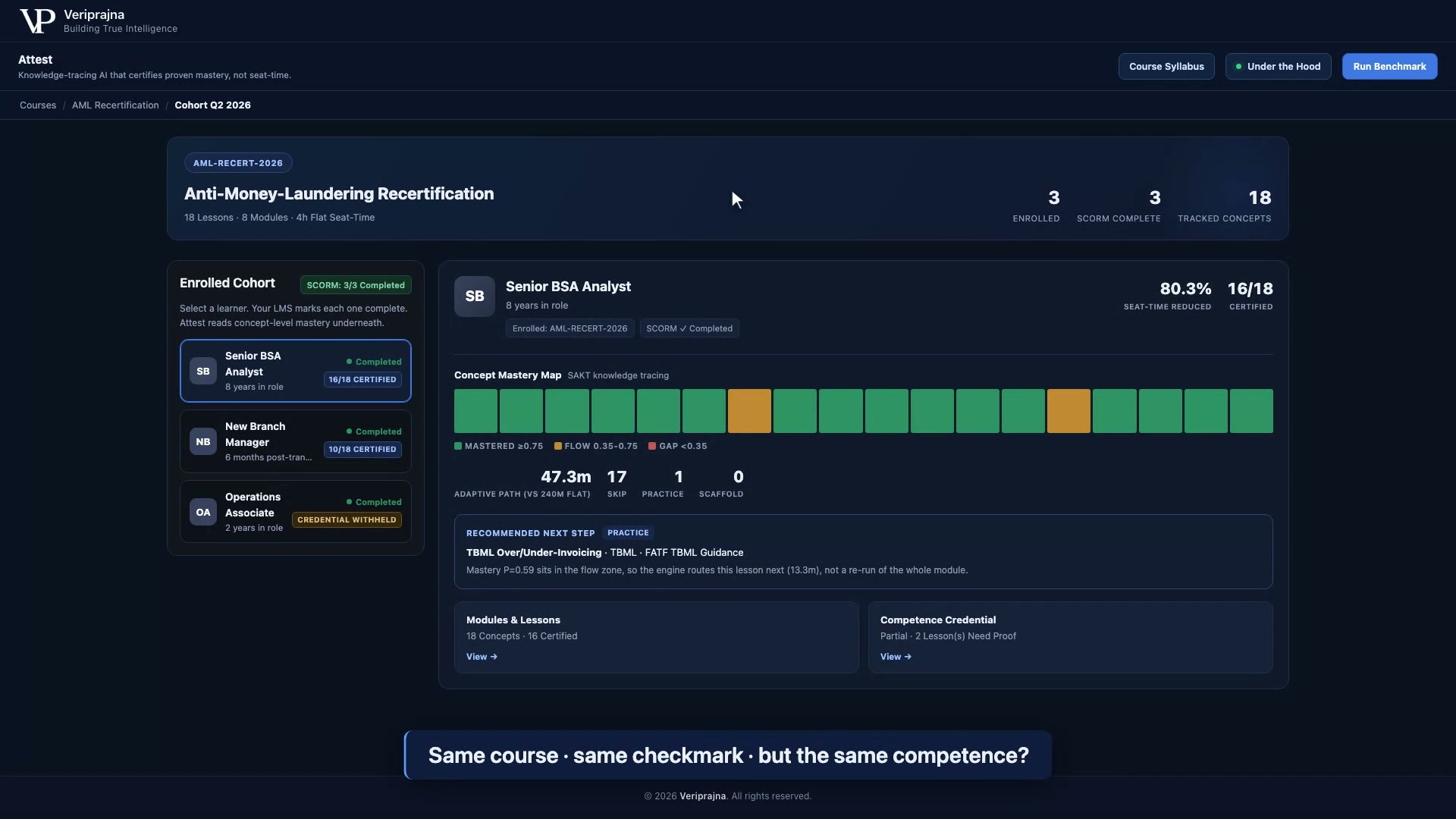
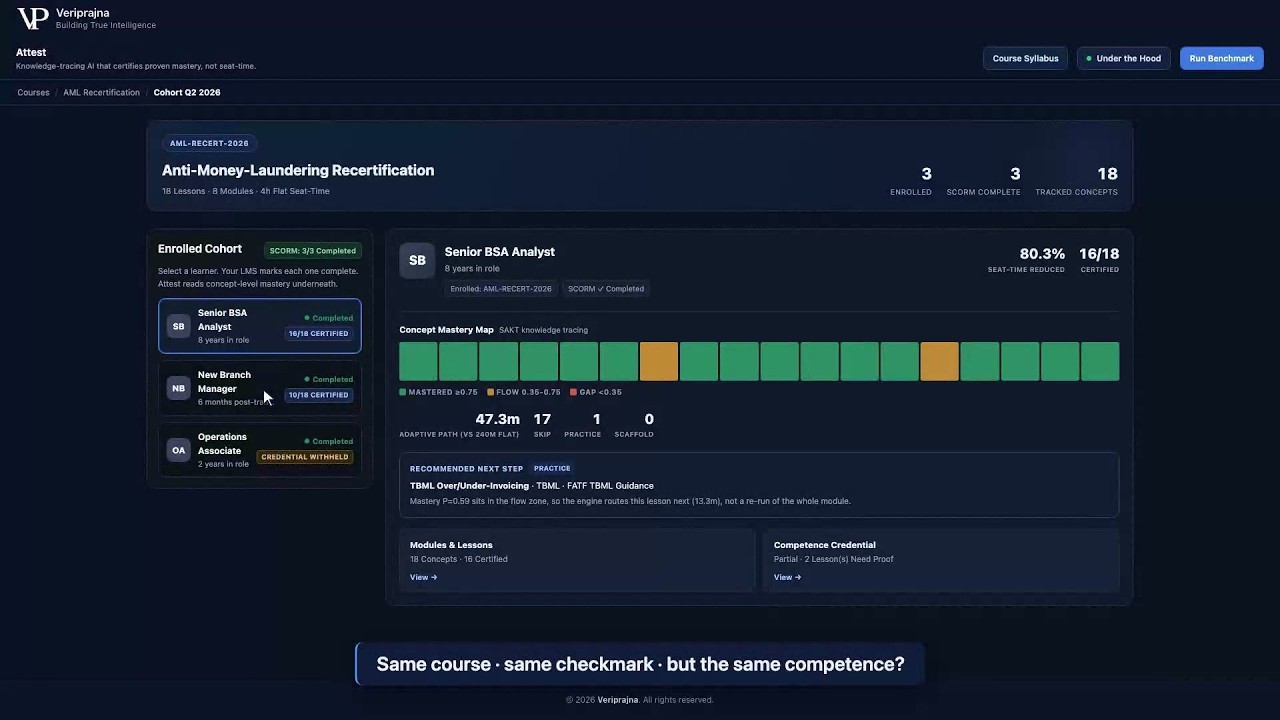
Attest dashboard for an AML recertification cohort where every enrolled learner reads SCORM Completed, shown next to Attest's concept-level mastery map for the Senior BSA Analyst reporting 16 of 18 concepts certified and 80.3% seat time reduced.
Same course, same SCORM checkmark. Attest reads the concept-level mastery underneath.

How it works: agents advise, code decides

Four stages turn one flat course into per-concept mastery and a signed certificate. An LLM does the reading; deterministic code makes every decision that matters.

The concept-mapping agent turns one course into 18 traceable concepts

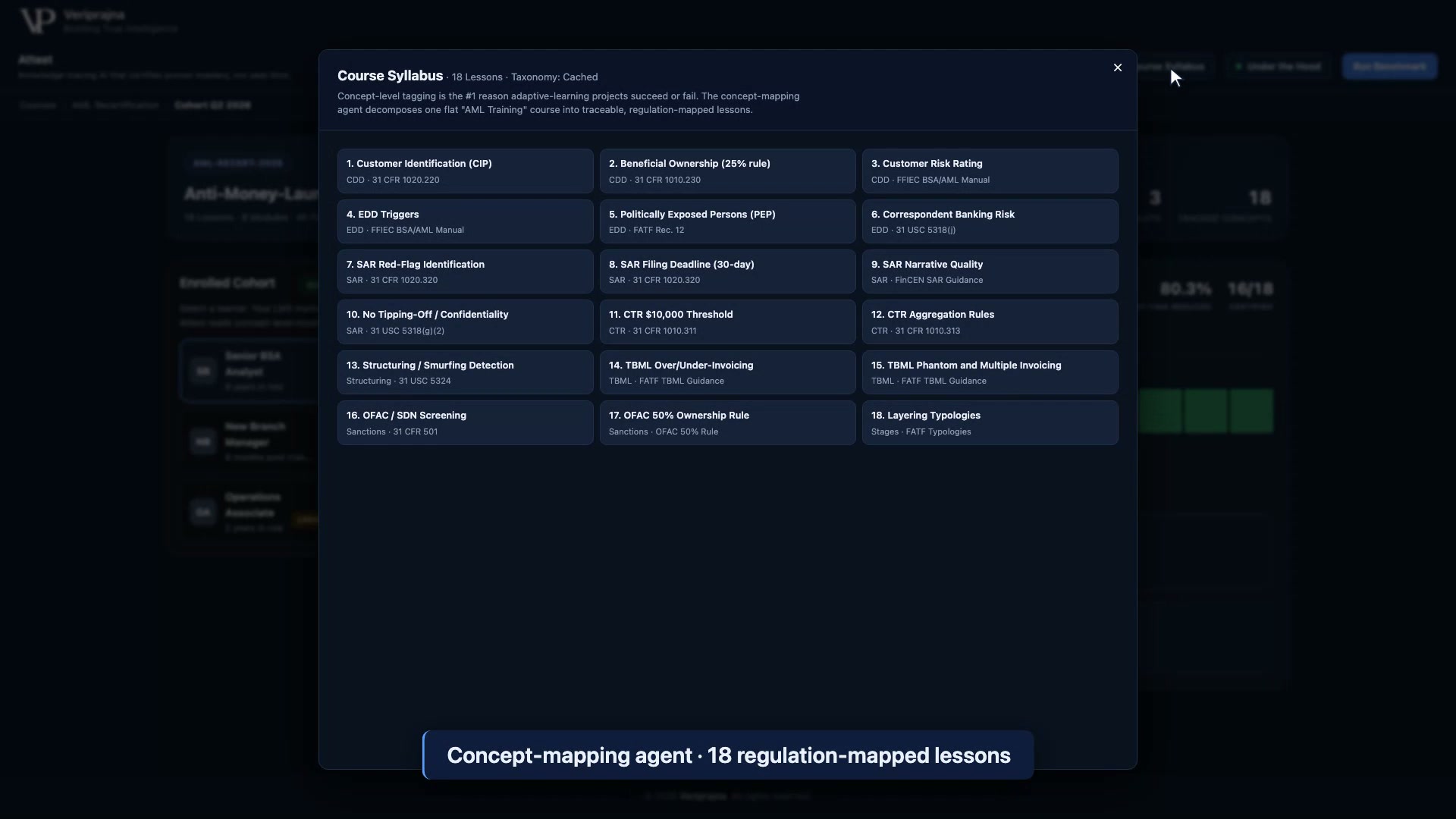
It decomposes a single flat "AML Training" course into an 18-concept taxonomy (customer due diligence, SAR narrative quality, structured-transaction detection, TBML over and under-invoicing, OFAC sanctions screening, and more) and tags each lesson to its concepts. Content tagging is the step the field calls the number-one reason adaptive-learning projects fail, and this automates it. The agent is built on Pydantic AI, provider-swappable across Anthropic, OpenAI, Gemini, and Ollama, defaulting to claude-opus-4-8, with a cached-taxonomy offline fallback so the demo runs with no API key.

A real SAKT model infers what each learner actually knows

The core is a real self-attentive knowledge-tracing transformer: 119,809 parameters, PyTorch, trains on CPU in about 90 seconds and caches after. It replays each learner's interaction sequence and infers a per-concept mastery probability conditioned on the full history. It is not an LLM and not an agent. It is the durable machine-learning core that makes this true knowledge tracing rather than a gradebook.

A deterministic Flow-Zone sequencer decides the path

Plain Python, no model in the loop. For each concept, a mastery probability at or above 0.67 routes to skip and verify, 0.38 to 0.67 routes to flow, and below 0.38 routes to scaffold. The sequencer computes adaptive versus flat seat time and cohort ROI. The cut-points are cross-validation-fitted from the labeled cohort, backed by a 5-fold A/B that strictly improves on the hand-set fallback, not hand-tuned magic numbers.

A competence gate the model cannot override decides what gets certified

This is governance, not personalization. The gate certifies a concept only when mastery is at least 0.747, evidence is sufficient (at least 3 interactions), and the response pattern is not anomalous. Otherwise it marks the concept "needs proof" and issues a verification challenge. It never certifies on thin or anomalous evidence.

The output is a signed Competence Certificate (HMAC-SHA256): per-concept mastery, the evidence trail, model name, version and benchmark AUC, the Flow-Zone thresholds applied, adaptive versus flat seat time, the regulatory mapping, and an honest-limitation footer. It is what you hand a regulator instead of a checkmark. The principle throughout: we certify what we can prove, and we never bluff a green check.

Attest course syllabus modal listing the 18-concept taxonomy the concept-mapping agent produced from one flat AML Training course, each concept tagged with its regulation such as 31 CFR 1020.220 and FATF TBML Guidance.
The concept-mapping agent decomposes one course into 18 regulation-mapped lessons.
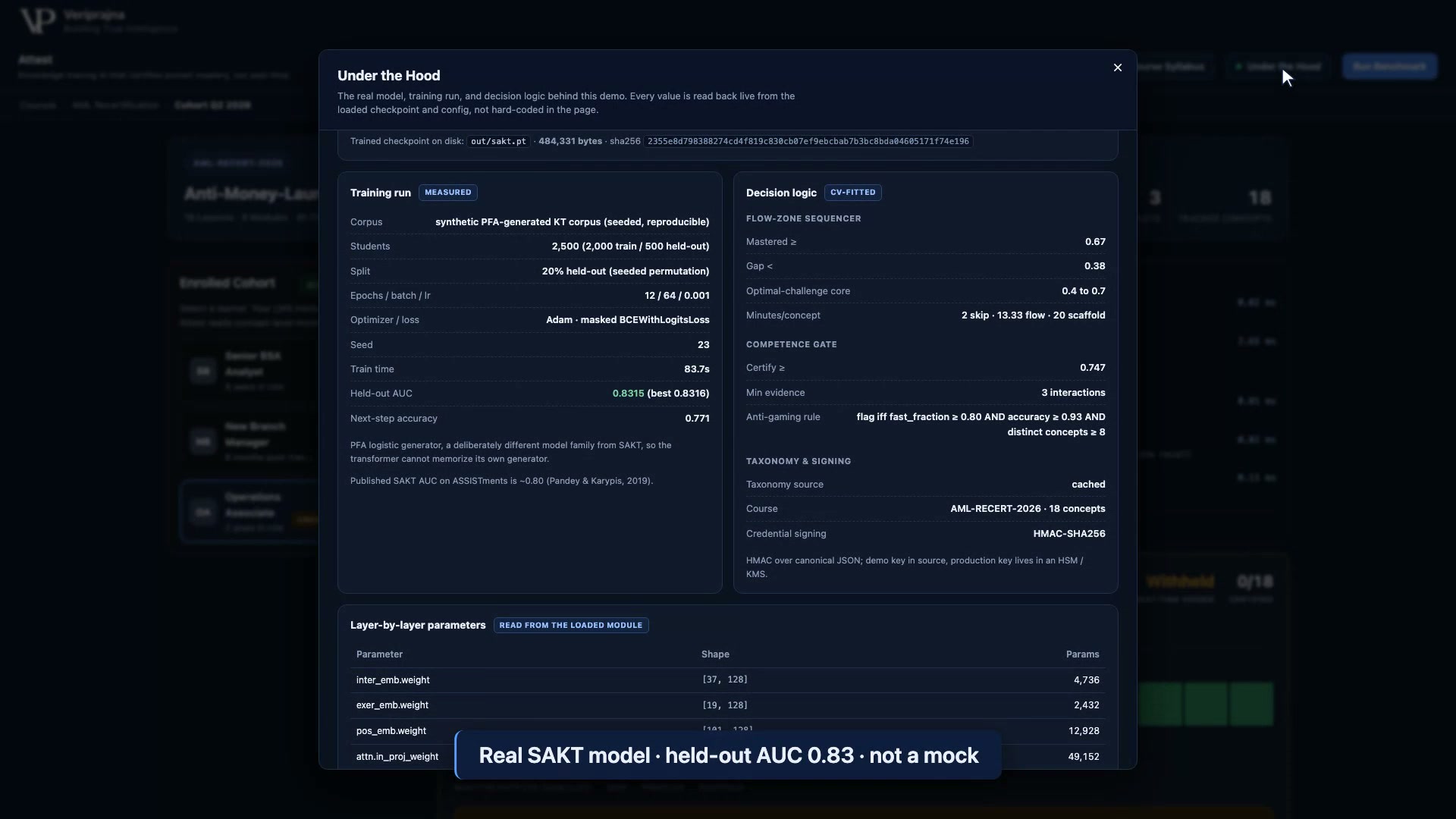
Attest Under the Hood panel showing the measured training run: synthetic PFA-generated KT corpus, 2,500 students, held-out AUC 0.8315, next-step accuracy 0.771, plus the deterministic Flow-Zone and competence-gate decision logic read live from the loaded checkpoint.
Every value in the engine panel is read back live from the loaded checkpoint and config, not hard-coded in the page.

Three learners, one honest verdict each

Every figure below is the running app's real output on synthetic learners.

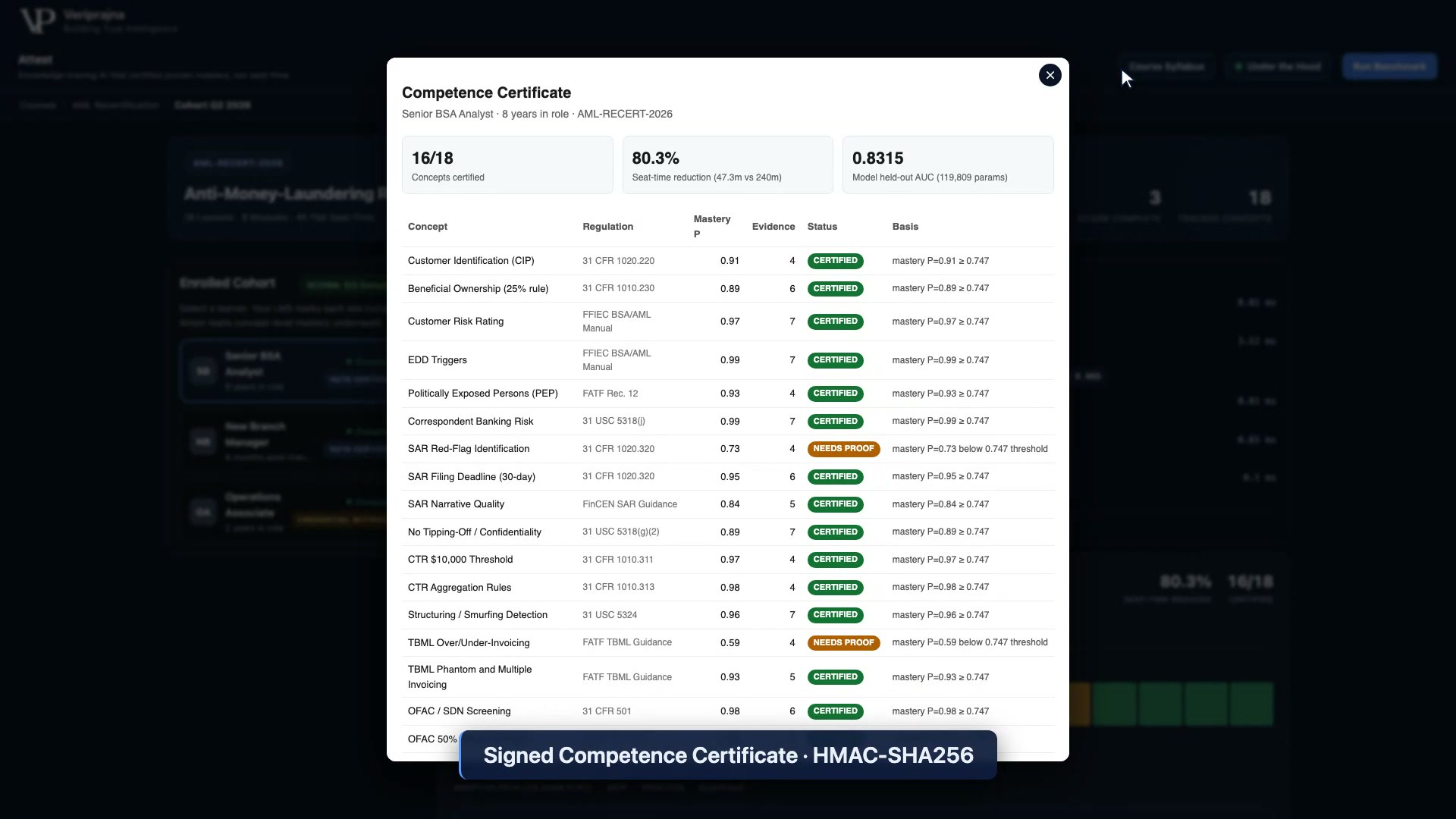
The Senior BSA Analyst (8 years in role) reads green almost everywhere, weak only on Trade-Based Money Laundering and one SAR red-flag concept. Attest certifies 16 of 18 concepts, routes 2 to needs-proof, and does not flag the evidence. Seat time drops from 240 minutes flat to 47.3 minutes adaptive, 80.3% saved. This is the "already knows most of it, skip what is proven" case.

The signed Competence Certificate for the Senior BSA Analyst: 16 of 18 concepts certified, 80.3% seat-time reduction, model held-out AUC 0.8315, a per-concept table with mastery probability, evidence count and certified or needs-proof status, and an HMAC-SHA256 signature.
The analyst's signed certificate: two concepts sit below the 0.747 certify threshold and are routed to needs-proof rather than waved through.

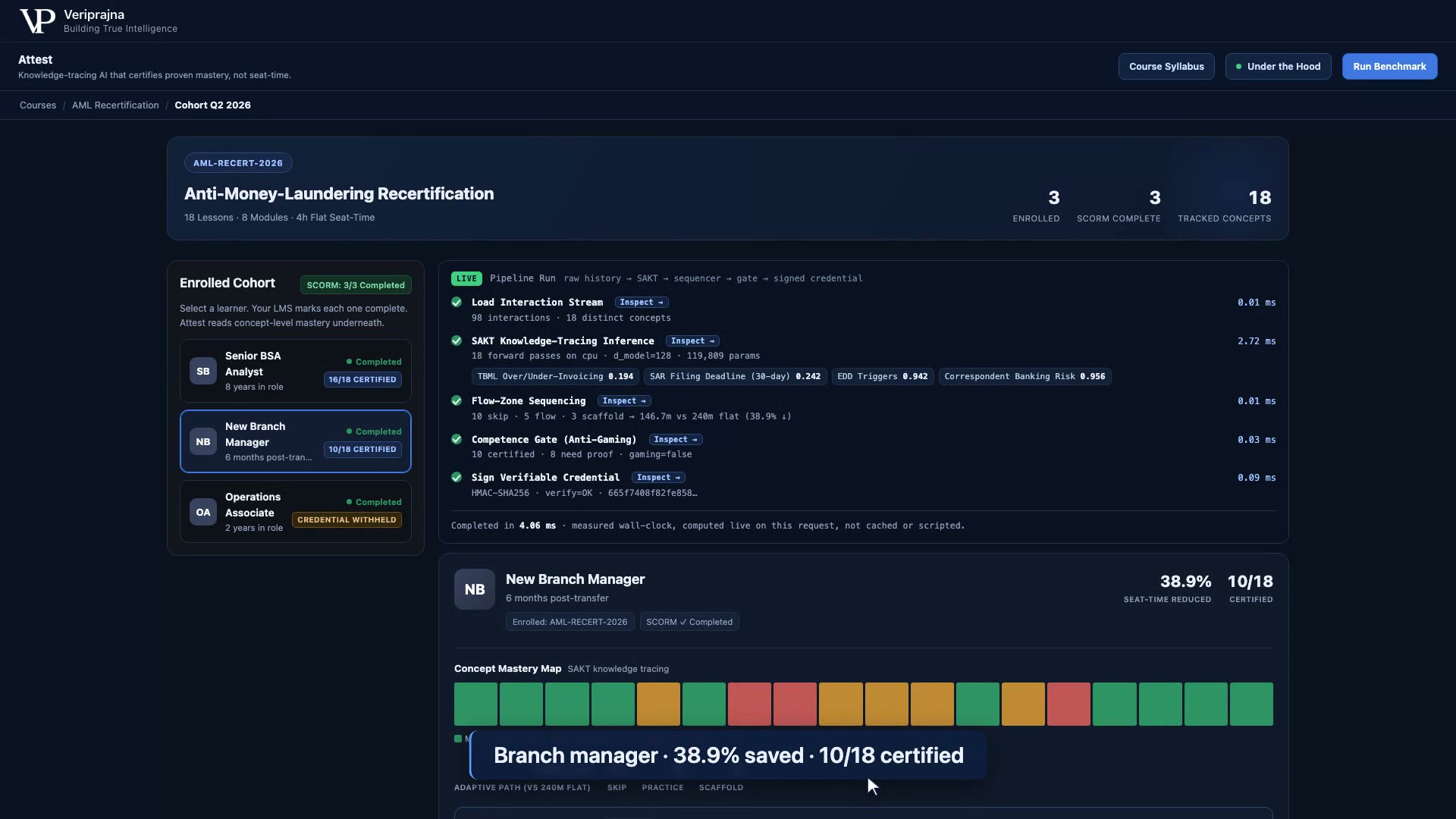
The New Branch Manager (6 months post-transfer) has real gaps across SAR narrative and TBML. The model infers low mastery on several concepts and routes them to flow or scaffold rather than skip. Attest certifies 10 of 18 concepts, routes 8 to needs-proof, and cuts seat time from 240 to 146.7 minutes, 38.9% saved. Fewer concepts certified than the analyst, because this learner genuinely needs the training. The savings track the mastery, not a flat discount.

Attest live pipeline console for the New Branch Manager showing SAKT inference, Flow-Zone sequencing with 10 skip, 5 flow, 3 scaffold, and a competence gate result of 10 certified and 8 needing proof, with 38.9% seat time saved and 10 of 18 certified.
The branch manager's live pipeline: a redder mastery map means less skipping and a smaller, honest saving.

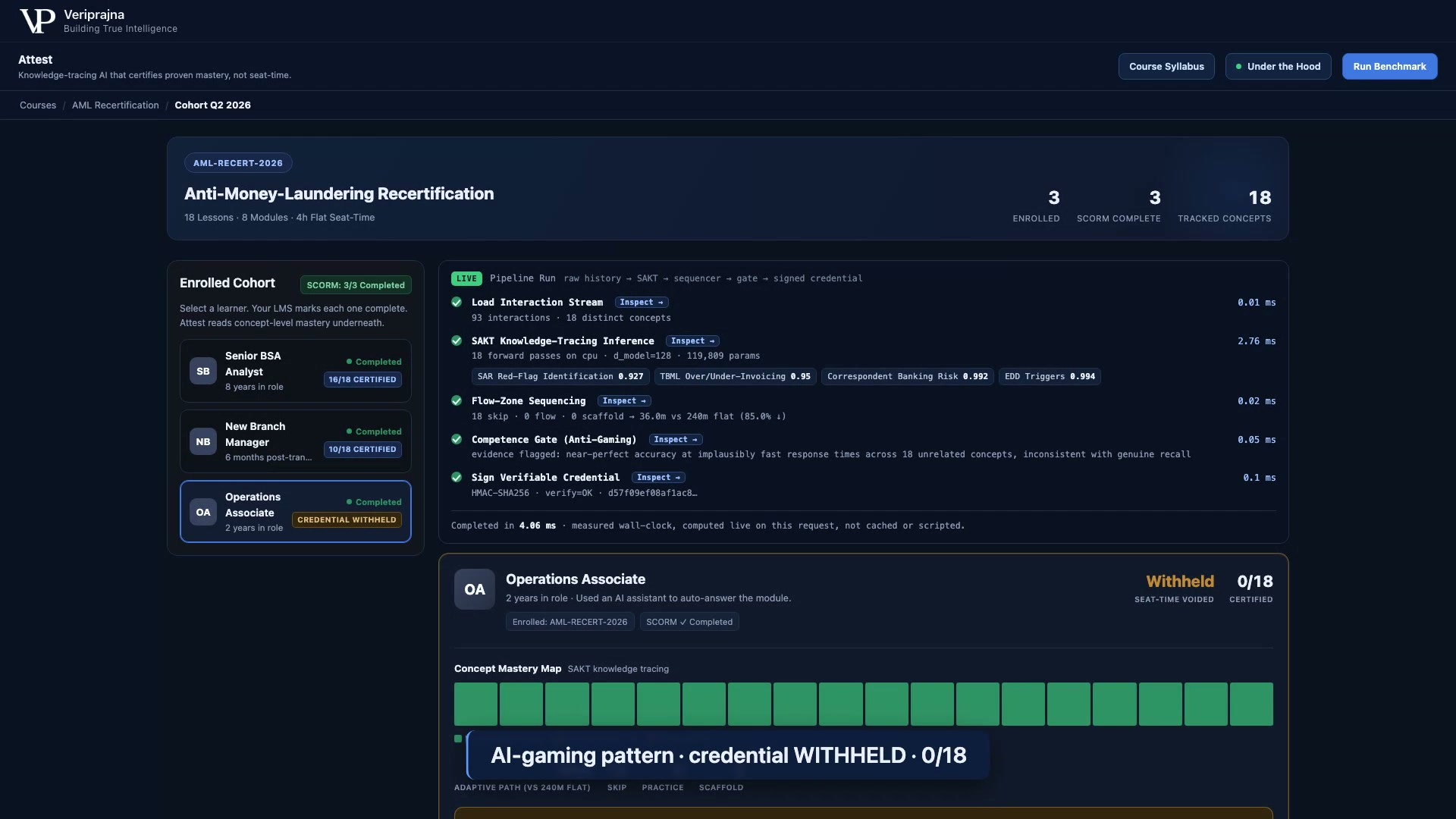
The Operations Associate is the hard case. This learner answered fast and perfect across 18 unrelated concepts, a response-time distribution inconsistent with genuine recall. Apparent mastery looks high, but the competence gate flags the evidence and certifies 0 of 18. All 18 route to needs-proof, evidence is marked flagged, and seat time is withheld pending verification. We frame this as value, not a "gotcha": we only certify what we can prove.

Attest competence gate flagging the Operations Associate for near-perfect accuracy at implausibly fast response times across 18 unrelated concepts, inconsistent with genuine recall, and withholding the credential with 0 of 18 certified and seat time voided.
The AI-gaming case: apparent mastery is high, but the gate withholds every credential rather than bluff a green check.

The cohort result, computed live

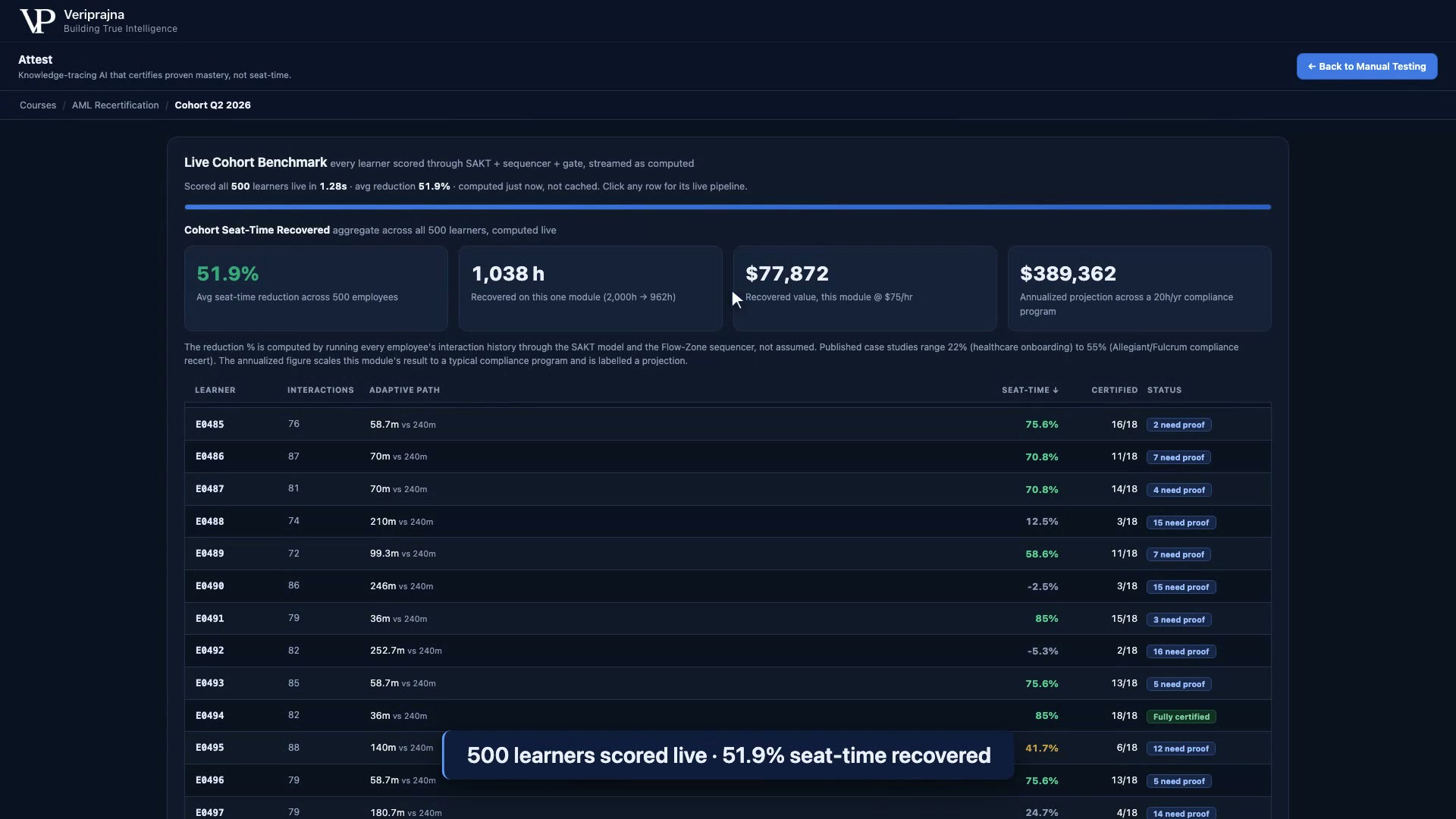
Over a genuinely-simulated 500-person annual-recertification cohort at a $75 per hour fully-loaded wage, Attest computes about 51.9% cohort seat-time reduction (2,000 flat hours down to roughly 962 adaptive hours, about 1,038 hours recovered), about $77,872 recovered on this one module, and about $389,362 annualized when scaled to a typical 20-hour compliance program. The dollar figures are computed from the model's outputs, and the annualized number is labeled a projection on screen.

Attest live cohort benchmark scoring all 500 synthetic learners in 1.28 seconds, reporting 51.9% average seat-time reduction, 1,038 hours recovered on this module, $77,872 recovered value, and a labeled $389,362 annualized projection.
Five hundred learners scored live: the reduction is computed by running every interaction history through the model, not assumed.

The model benchmark, the independent anchor

Held-out AUC is 0.8315 on a seeded, reproducible synthetic PFA-generated KT corpus (2,000 train and 500 test students, 18 concepts, 12 epochs), with next-step accuracy 0.771. Because the data-generating process (Performance Factors Analysis, a classical logistic learner model) is a different model family from the transformer we train, the held-out AUC shows SAKT recovered real latent learning structure rather than grading its own assumptions. For external context, published SAKT AUC on the public ASSISTments dataset is about 0.80 (Pandey & Karypis, 2019). The durable headline stays the percentage of seat time saved and the percentage auto-certified, which hold at any model quality. The AUC proves the model is real knowledge tracing, not the product's headline number.

Where Attest fits, and what this demo does not do

Completion tracking and recommendation engines both leave the auditor empty-handed. Knowledge tracing plus governance does not.

Approach What it measures What you can hand an auditor
SCORM / LMS completion Whether the learner opened and finished the content A green checkmark, with no mastery evidence
"Adaptive" via collaborative filtering What similar learners took or did next A course recommendation, still no concept-level proof
Attest (knowledge tracing plus governance) Per-concept mastery inferred from each learner's interactions A signed Competence Certificate with the full evidence trail

For a named market example, Cornerstone's March 2026 "Adaptive Learning Agent" uses collaborative filtering rather than concept-level knowledge tracing (Cornerstone product announcement, March 2026). The distinction is the whole point: a recommendation is not a mastery estimate, and neither one is an audit artifact.

What this demo does NOT do

  • The LMS itself and the Cornerstone-REST and SAP-BTP connectors are fixture stubs, not live integrations. A production build would wire to your real system of record.
  • The 500-person cohort and the interaction logs are synthetic, realistic and modeled on the research table, not real employees. The three named learners are synthetic too.
  • The certificate is HTML-first, with PDF export best-effort. Verification-challenge content is LLM-generated on demand.
  • Mastery probabilities are evidence, not a retention guarantee. AUC measures next-item prediction, not long-term retention, which the certificate's own limitation footer states.
  • This is a demo that proves the mechanism. It is not a deployed pipeline.

Questions buyers ask

Isn't "adaptive learning" just course recommendations with a new label?

Most tools marketed as adaptive run collaborative filtering: they recommend what similar learners took next. That is a recommendation engine, not knowledge tracing. Attest uses a real self-attentive knowledge-tracing transformer (SAKT) that infers a per-concept mastery probability from each learner's own interaction history. Cornerstone's March 2026 Adaptive Learning Agent, as one named example, uses collaborative filtering rather than concept-level tracing (Cornerstone product announcement, March 2026).

Can an employee game this by using an AI assistant to answer fast?

That is exactly the case the competence gate is built for. In the demo, a learner who answered fast and perfect across 18 unrelated concepts triggers the anomaly rule, and the gate certifies 0 of 18, routing every concept to needs-proof with seat time withheld. The gate certifies only when mastery, evidence sufficiency, and the response-pattern check all pass, so implausibly fast perfection is refused rather than rewarded.

What do we actually hand an auditor?

A signed Competence Certificate, not a checkmark. It lists each concept's mastery probability and certify or needs-proof status, the evidence trail of which interactions and timestamps produced each estimate, the model name, version, and benchmark AUC, the Flow-Zone thresholds applied, adaptive versus flat seat time, the regulatory mapping, and an honest-limitation footer, all under an HMAC-SHA256 signature.

Does this replace our LMS?

No. Attest is an intelligence layer that reads the interaction stream your LMS already produces, not a new LMS. In this demo the LMS and the Cornerstone-REST and SAP-BTP connectors are simulated stubs, and a production build would connect to your real system of record. Your LMS keeps recording completion while Attest adds the concept-level mastery and the certificate.

Where does the 51.9% seat-time reduction come from? Is it a real customer result?

It is computed live on a synthetic 500-person recertification cohort, not measured on real customers. Attest runs each simulated learner's interaction history through the SAKT model and the Flow-Zone sequencer and reports the aggregate reduction of about 51.9%, the hours recovered, and a labeled annualized projection. The independently anchored claim is the model quality (AUC 0.83), not the dollar figure.

Is the 0.83 AUC measured on a public dataset?

No. The held-out AUC of 0.8315 is measured on our own seeded, reproducible synthetic PFA-generated KT corpus, not on a public benchmark. It matters because the corpus is generated by a different model family (PFA logistic) than the transformer we train, so a high held-out AUC shows the model recovered real learning structure. Published SAKT results on the public ASSISTments dataset are about 0.80 (Pandey & Karypis, 2019), cited only as external context.

Technical Research

The research behind this demo — the architecture, the verification design, and the enterprise blueprint.

Bring competence evidence to your compliance training

For chief learning officers, L&D directors, and compliance leaders running mandatory recertification.

If your team is weighing how to prove mastery, not just completion, for a regulated training program, we would like to compare notes on what that takes. The problem is industry-wide and the answers will be too.

Training assurance assessment

  • ✓ Concept-level mastery gap analysis on one module
  • ✓ Seat-time and cohort ROI modeling on your numbers
  • ✓ Audit-artifact and regulatory-mapping review
  • ✓ An honest read on where knowledge tracing helps and where it does not

Custom build

  • ✓ Concept-mapping agent tuned to your courseware
  • ✓ SAKT knowledge tracing on your interaction data
  • ✓ Deterministic Flow-Zone sequencer and competence gate
  • ✓ Signed Competence Certificate wired to your system of record