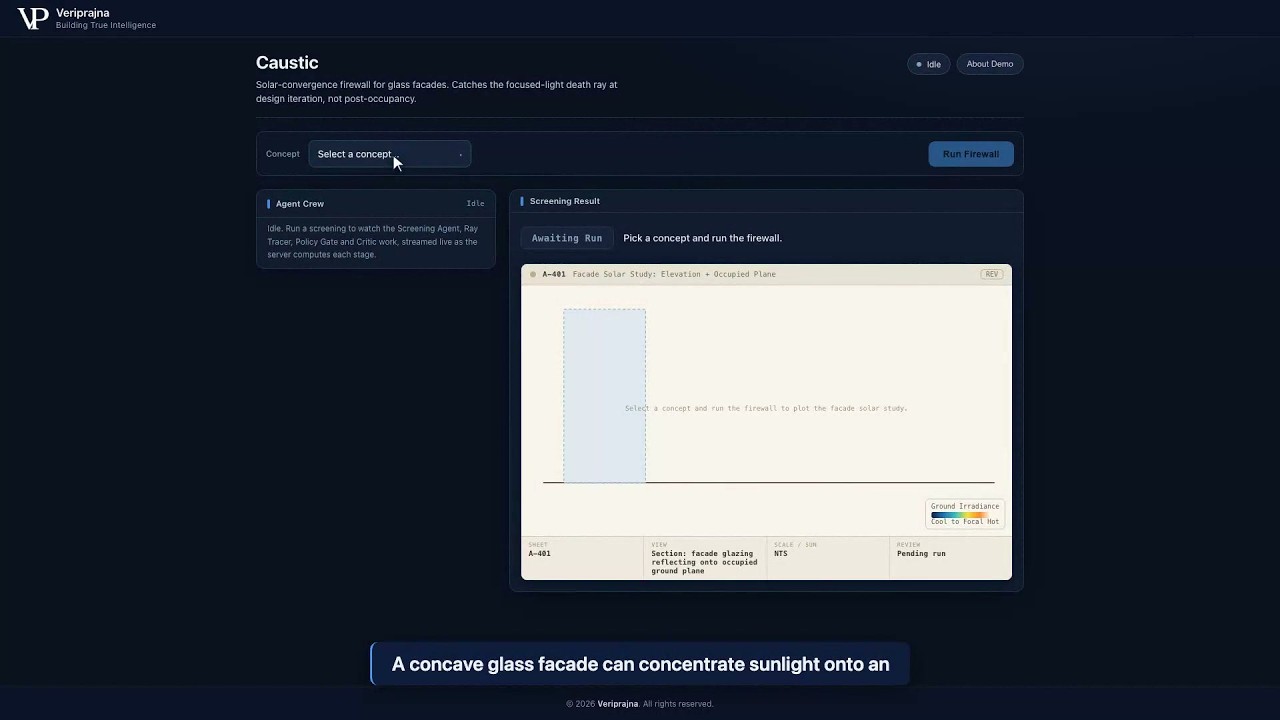
The same illustrative program makes the case.
The before-and-after comparison is the page's concrete anchor. All three gallery concepts below are synthetic and illustrative.
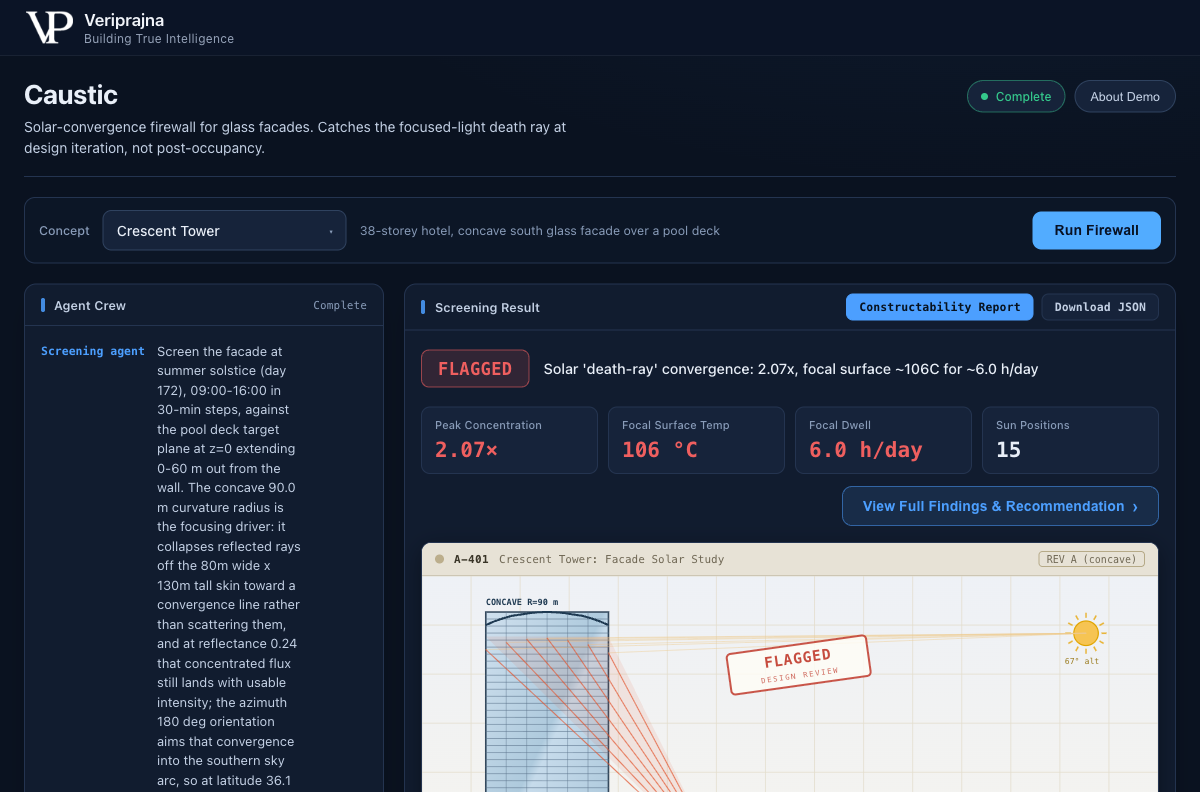
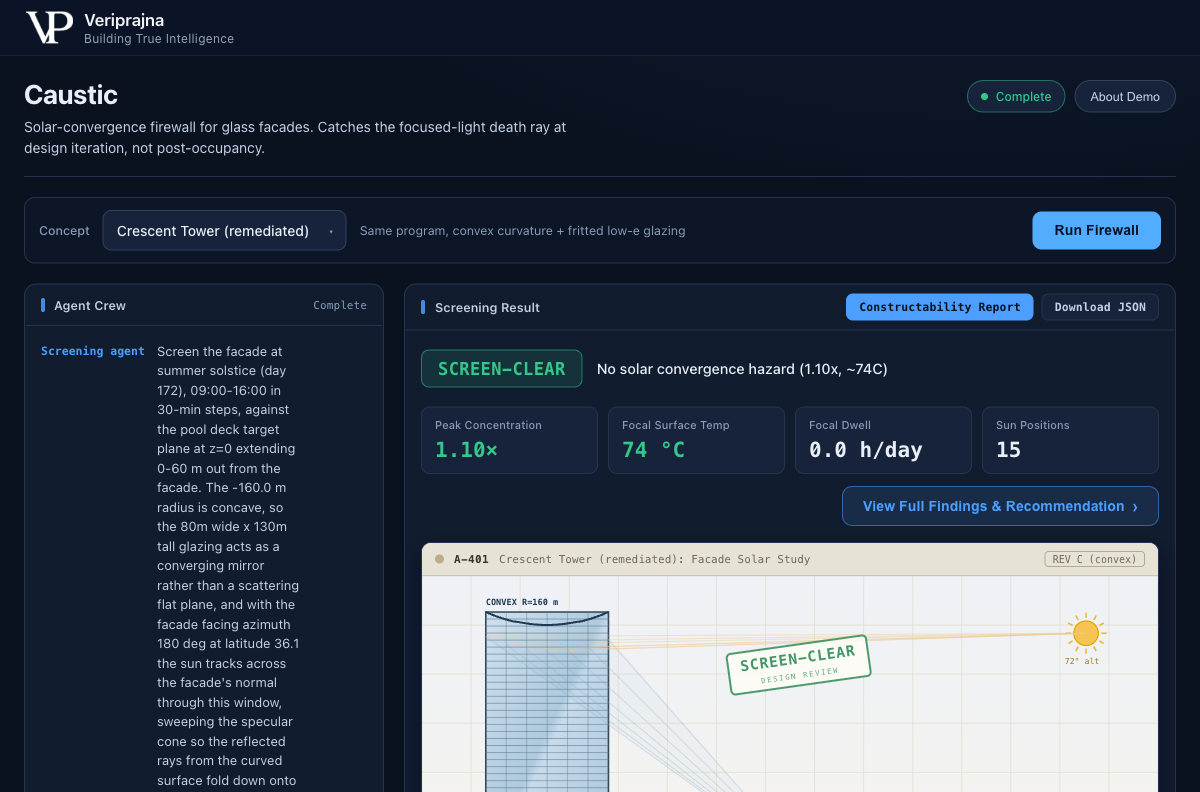
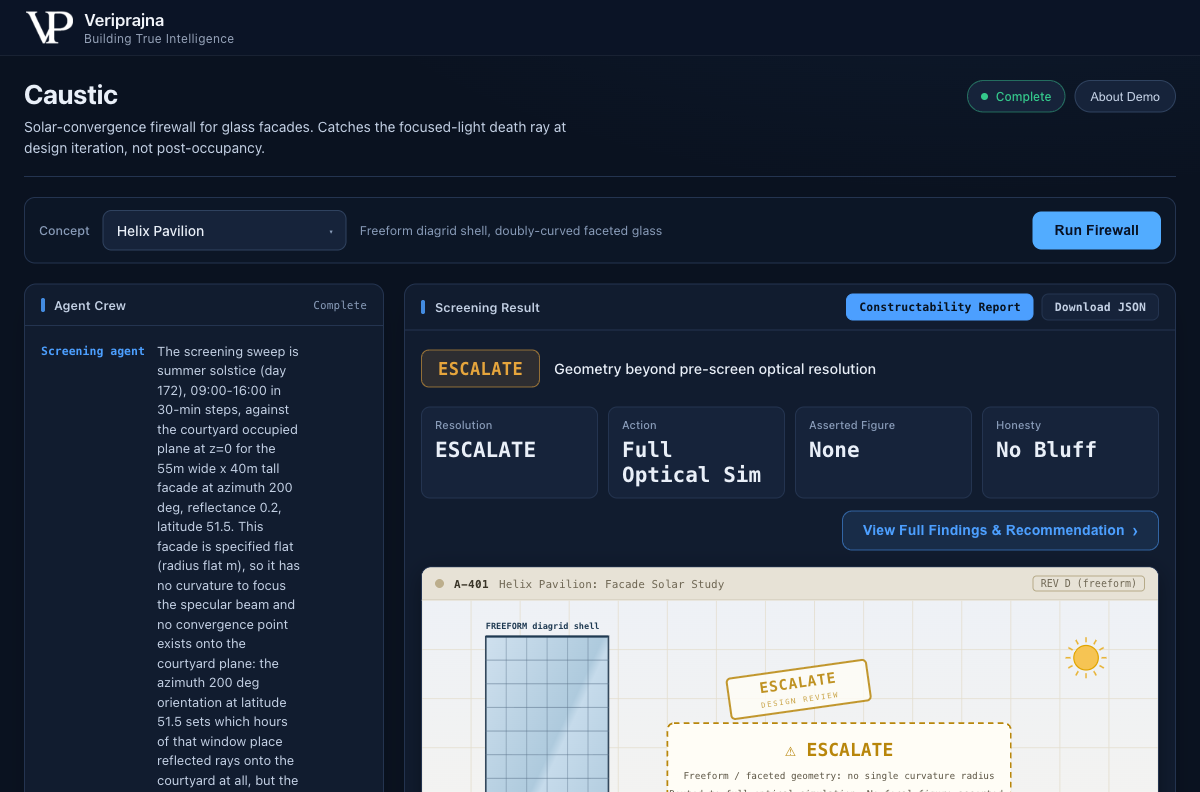
Concept-stage facade pre-screen
Concentrated reflected sunlight damaged materials and drove retrofit work at Vdara's pool deck and London's 20 Fenchurch St. Caustic gives design teams a deterministic, inspectable screen during concept iteration. Pre-screening only, not a stamped analysis.
2.07×
peak concentration
Synthetic Crescent Tower demo
~106 °C
focal surface temperature
Synthetic Crescent Tower demo
6.0 h/day
focal dwell
Synthetic Crescent Tower demo
The hero walkthrough shows a synthetic, illustrative concept screened across 15 sun positions. Its result is a concept-stage decision aid, not a permit or safety determination.
Generative design can produce form without evaluating the path of reflected sunlight. A concave glass facade can therefore enter a concept review as an image problem and emerge after construction as a focused-light hazard.
Concept work is where curvature, orientation, glazing, and target-plane assumptions can still change without a retrofit decision driving the conversation.
The relevant question is where parallel sunlight reflects and concentrates across a defined sweep, not whether an assistant sounds confident about a rendering.
Caustic keeps the early screen visible while preserving the work that belongs to full optical simulation and licensed review.
Caustic leads with the ray trace and policy, so the result can be inspected instead of accepted on an agent's word.
01 / INPUT AND PROTOCOL
A synthetic, illustrative FacadeSpec records curvature, orientation, dimensions, glazing reflectance, site latitude, and occupied target plane. The Screening Agent narrates the deterministic protocol for the relevant summer-solstice sweep.
02 / RAY TRACER
The Ray Tracer discretizes the facade, reflects parallel sun rays over 15 positions, intersects the occupied plane, and computes peak concentration, focal surface temperature, and focal dwell.
03 / POLICY GATE
The deterministic Policy Gate applies 1.45× concentration, 80 °C focal temperature, and 30 minutes of above-threshold dwell. It sets the verdict from those fixed thresholds.
04 / REVIEW RECEIPT
The Critic Agent checks that the protocol and narrative agree with the computed result. The Constructability Report exports inputs, raw result, thresholds, provenance, critic note, verdict, and pre-screening disclaimer in HTML and JSON.
The before-and-after comparison is the page's concrete anchor. All three gallery concepts below are synthetic and illustrative.
The offline evaluation harness reports precision 1.0 and recall 1.0 on its five-case fixed golden set only. That set includes two public-description approximations of documented hazard outcomes, two flat controls, and one remediated control. It is not a production accuracy claim.
| Question | What Caustic does in this demo | What remains outside the demo |
|---|---|---|
| Concept-stage risk | Runs a deterministic 15-position solar ray trace and records the figures used by the fixed gate. | Final environmental simulation and licensed professional analysis. |
| Geometry beyond resolution | Returns ESCALATE for freeform or faceted geometry without a resolvable single curvature radius. | Full optical simulation and specialist review. |
| Design-review record | Exports the Constructability Report with input, protocol, result, thresholds, critic note, verdict, provenance, and disclaimer. | A stamped analysis, permit workflow, or engineering approval. |
It does not ingest live BIM or Revit data, use live weather or irradiance data, integrate hardware, perform structural sizing, estimate glazing costs, run CFD wind or acoustic focusing studies, or connect to real ETABS or Revit workflows. Gallery JSON is a stub for BIM ingestion, and the solar resource is deterministic clear-sky reference data.
A synthetic, illustrative FacadeSpec records facade curvature, orientation, dimensions, glazing reflectance, site latitude, and occupied target plane. Those inputs define the geometric context for the deterministic solar sweep.
The illustrative same-program alternative uses convex curvature and fritted low-e glazing. In the demo's tested sweep it returns 1.10× peak concentration, approximately 74 °C focal surface temperature, and 0.0 h/day focal dwell.
Helix Pavilion is a synthetic freeform, doubly-curved diagrid shell without a resolvable single curvature radius for this pre-screen. Caustic therefore returns ESCALATE and does not assert a focal number.
The Constructability Report exports the concept input, screened protocol, raw result, thresholds, critic note, verdict, provenance, and a pre-screening disclaimer. The demo renders the report in HTML and JSON.
The offline harness includes two public-description approximations of documented real-world hazard outcomes, two flat controls, and one remediated control. It reports whether the documented hazard analogues are flagged and the controls clear, alongside the stated fixed-set precision and recall results.
No. The Screening Agent narrates and justifies the deterministic protocol, while the Ray Tracer and Policy Gate compute and set the result. A Critic Agent then checks whether the protocol and narrative agree with the computed result.
The research behind this demo — the architecture, the verification design, and the enterprise blueprint.
We work with AEC teams that want the physical consequence of ambitious form to be inspectable before it becomes expensive to change.
A useful next conversation starts with the facade geometry, occupied target plane, and the review decision your team needs to make. We can scope the deterministic pre-screen and its handoff to specialist review together.