Clinical Trial Eligibility Reasoning Engine
A patient-matching model reads a note as text, so it confuses a central venous catheter with a cardiac catheterization and excludes a patient who was eligible. TrialProof lets an LLM only read the note, resolves meaning through a SNOMED-CT knowledge graph, and computes ELIGIBLE, EXCLUDED, or NEEDS-REVIEW in deterministic code an LLM cannot override. Every verdict carries a reasoning trace a regulator can file.
100%
Decision accuracy on the labeled gold set
vs 53.8% for the fair lexical baseline (13 cases)
0 vs 3
Eligible patients lost
TrialProof loses 0 where the baseline loses 3
100% vs 0%
Reasoning-trace coverage
Every verdict traced; byte-identical on re-run
This is a runnable demo on a fixed, labeled gold set. All patients, notes, and protocols are synthetic, the ontology is a curated 24-concept SNOMED-CT subgraph, and connectors such as live FHIR ingestion are simulated.
The failure mode behind wrongful exclusions in AI patient matching.
Patient-matching AI reads clinical notes as text, so it confuses words that look alike but mean different things medically. The canonical failure is concrete. A Phase III anticoagulant trial excludes cardiac catheterization; a patient's note says central venous catheter placement. A similarity matcher sees two cardiovascular catheter procedures, scores them high, and excludes a patient who was eligible. Published evaluations confirm AI models make this exact catheterization error (Fierce Biotech, 2025).
The same class of error is wider than one procedure. It covers negation, where no evidence of diabetes is matched as diabetes. It covers family history attributed to the patient. And it covers exception clauses, such as unless completed more than 12 months before randomization, that a similarity score cannot represent at all. A better base model does not remove any of these, because they are not language problems. They are logic problems.
The cost is not academic. Enrollment delay runs 800,000 dollars per day in lost prescription sales for each day a trial slips (Tufts CSDD Impact Report, 2024), rising to 840,000 dollars per day in oncology and 1.4 million dollars per day in cardiovascular trials (Tufts CSDD). 80% of trials miss their enrollment timelines (industry consensus, 2025), the average screen failure costs 1,200 dollars (Antidote.me, 2025), and trial procedures have grown 139% more complex since 2005 (IQVIA, 2026). Against numbers like these, an eligible patient wrongly screened out is not a rounding error.
The agents advise on extraction. Deterministic code decides eligibility. This is neuro-symbolic: an LLM reads the prose, symbolic logic rules on the patient.
Each patient runs against each protocol through five stages, streamed live to the interface. The important boundary is that only one stage is probabilistic, and it never decides anything.
Loads the FHIR-shaped synthetic patient record, its free-text note, the trial criteria, and the randomization date.
A provider-swappable LLM proposes candidate facts, each with a verbatim note span, a candidate SCTID drawn from a closed vocabulary, and a confidence. It advises; it does not decide. Coded observations that arrive as trusted FHIR never pass through the extractor. When the offline lexicon fallback is used, the live console says so rather than hiding it.
Every proposed fact is challenged against the literal note with three checks: span-present (which catches a hallucinated entity), negation, and subject (family history versus patient). Rejected facts are flagged REJECTED with the check that fired and the reason, and never reach the decision.
The exact verified fact set entering the logic engine, marked coded-FHIR versus free-text.
A deontic-logic engine evaluates prohibition, temporal-exception, controlled-unless, and requirement criteria via SNOMED is-a subsumption and date math, and emits ELIGIBLE, EXCLUDED, or NEEDS-REVIEW with a full trace. An LLM cannot override this gate.
The deterministic stages genuinely run in tens of microseconds per criterion, while the model reading the note takes seconds. That contrast is the point, not a claim of instant screening: the slow, fallible part is confined to reading, and the decision it feeds is fast, cheap, and reproducible.
The comparison in the demo is a fair lexical baseline, and deliberately so. It is entity-level TF-IDF cosine similarity, a real vector-similarity method, given a generous setup with clean entity-to-concept resolution, and its decision threshold cross-validated on its own behalf (t = 0.6932). It never calls the LLM. Its only handicaps are the missing hierarchy, negation, temporal, and abstention logic, which is the whole thesis. It was not tuned to fail.
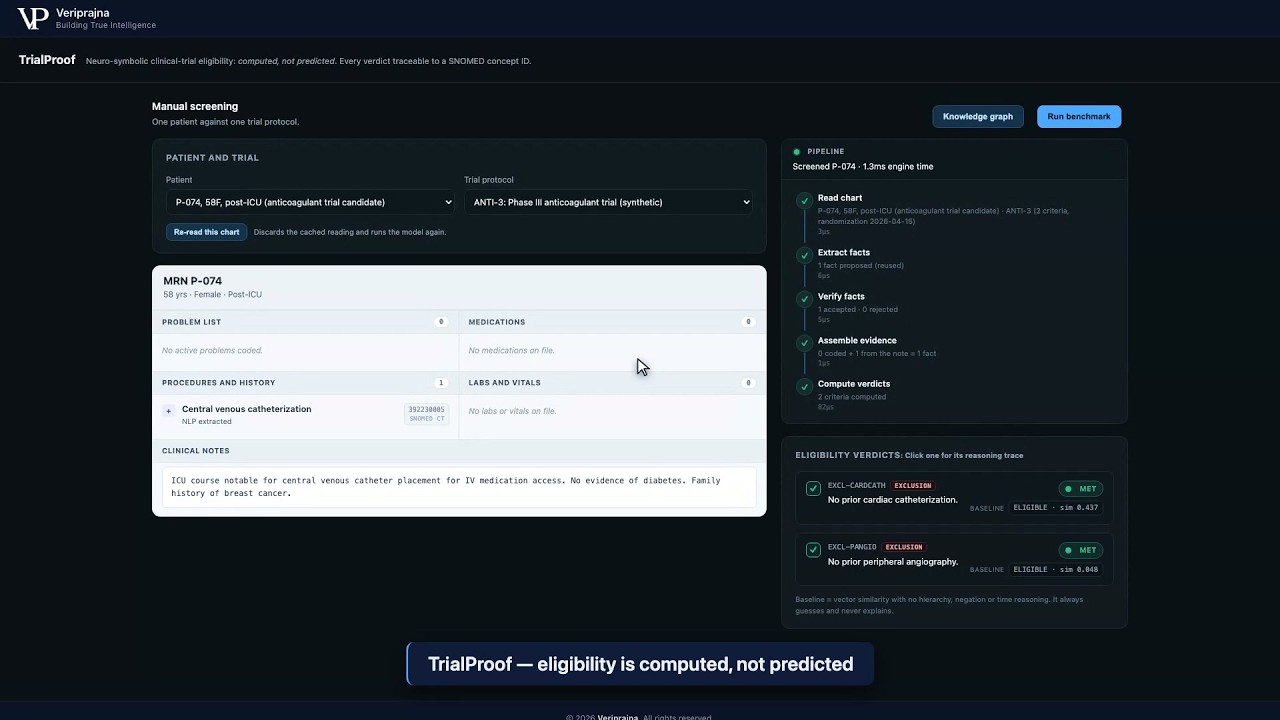
Synthetic patient P-074 and its cohort, against the synthetic protocols ONC-204 and ANTI-3. Every image below is a screenshot of the running TrialProof app.
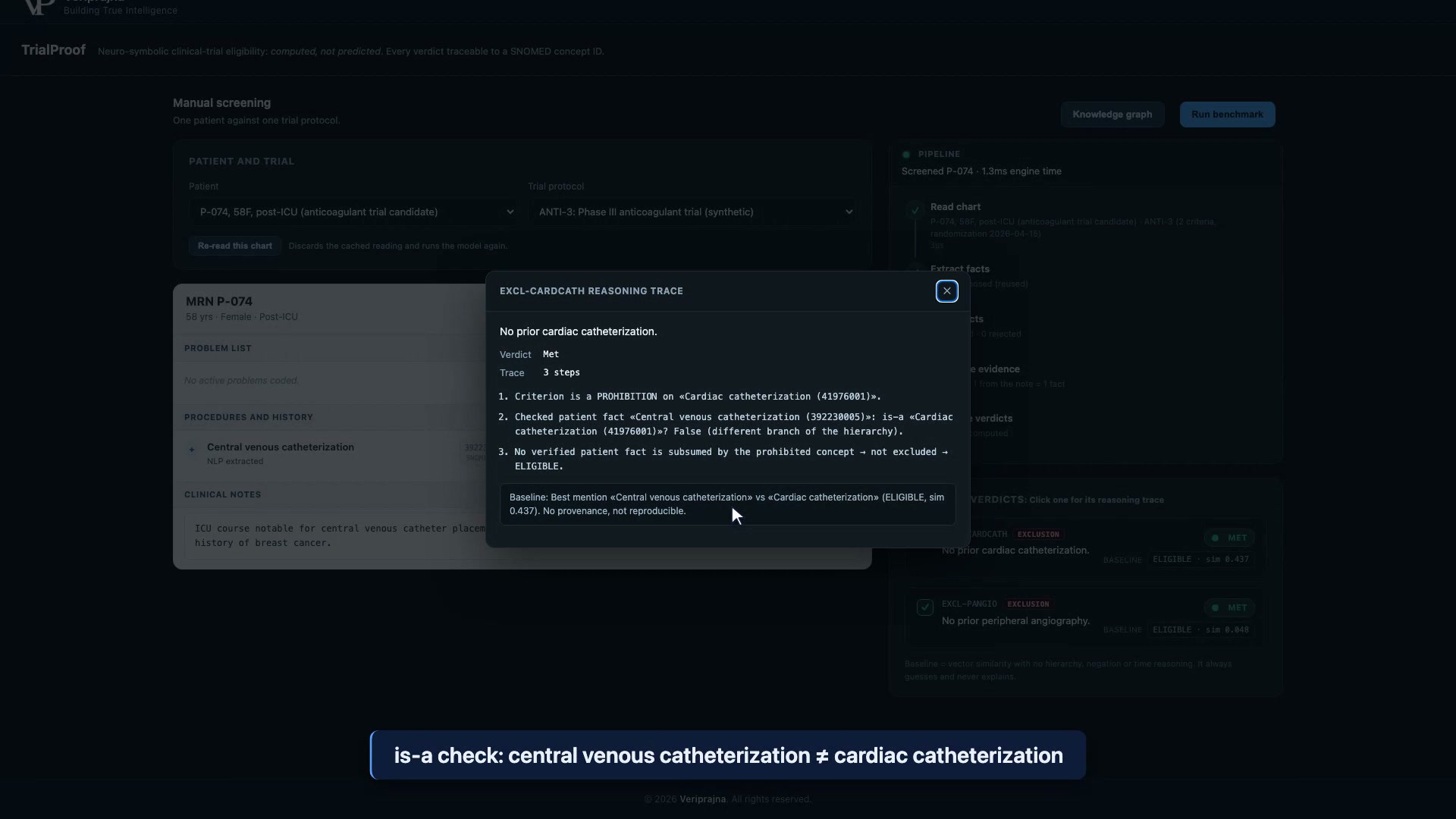
P-074's ICU note reads central venous catheter placement for IV medication access. Against ANTI-3's criterion EXCL-CARDCATH (no prior cardiac catheterization), a similarity matcher sees two cardiovascular catheter procedures. TrialProof asks the ontology instead: is Central venous catheterization (392230005) an is-a descendant of Cardiac catheterization (41976001)? It is not. The two concepts sit on different branches of the SNOMED-CT hierarchy, so no subsumption path exists, and the verdict is ELIGIBLE with a three-step trace naming both SCTIDs. Both codes are real and checkable on any public SNOMED browser. The fair lexical baseline also returns ELIGIBLE here, but at a bare similarity of 0.437 with no reasoning trace and nothing a regulator could file.
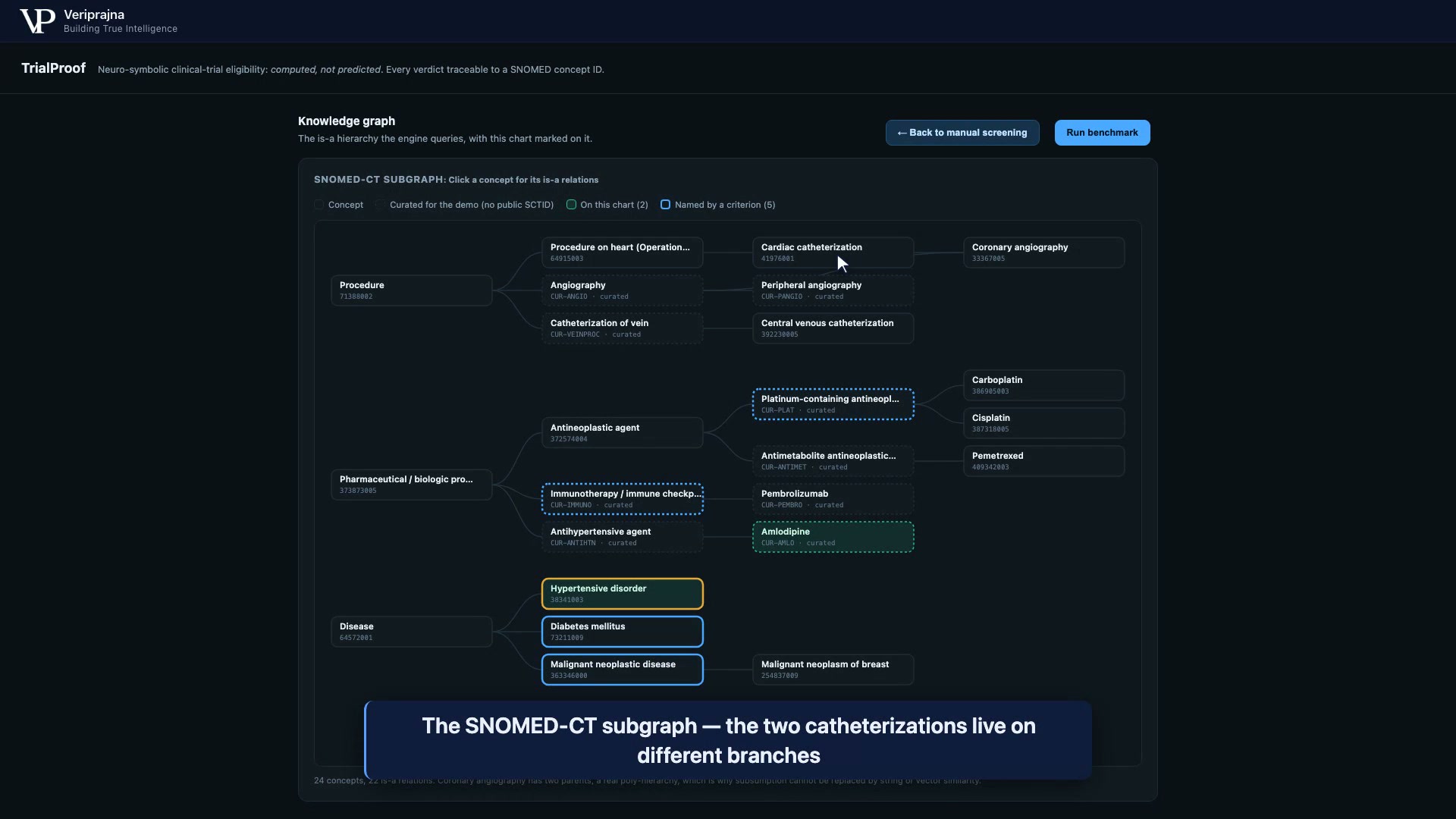
The engine does not query all of SNOMED-CT. It walks a curated 24-concept subgraph with 22 is-a relations. Concepts with a real SCTID are drawn solid; the 9 curated for the demo with no public SCTID are prefixed CUR- and drawn dashed rather than passed off as real codes. Verified facts are green, criterion concepts are outlined, and the walked is-a paths are bold. The two catheterizations visibly live on different branches, which is exactly why a string or vector similarity cannot stand in for subsumption.
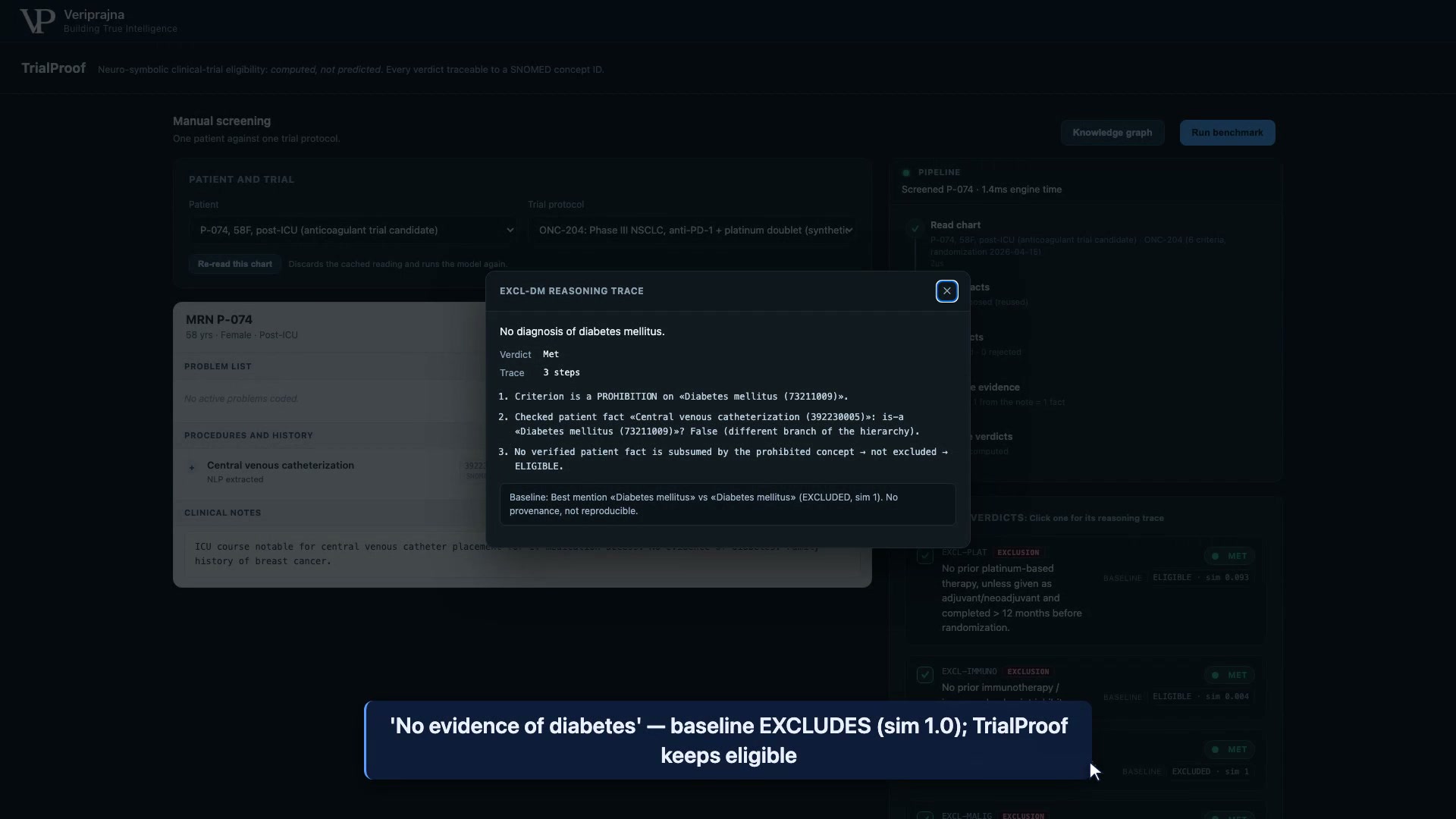
The same note says No evidence of diabetes. Against ONC-204's EXCL-DM (no diagnosis of diabetes mellitus), the vector baseline matches the token diabetes at similarity 1.0 and returns EXCLUDED, because it has no model of negation. TrialProof's verifier strips the negated mention before it can reach the decision, so the verdict is ELIGIBLE. This is the eligible patient a similarity matcher throws away, and on the gold set it is one of the three the baseline loses.
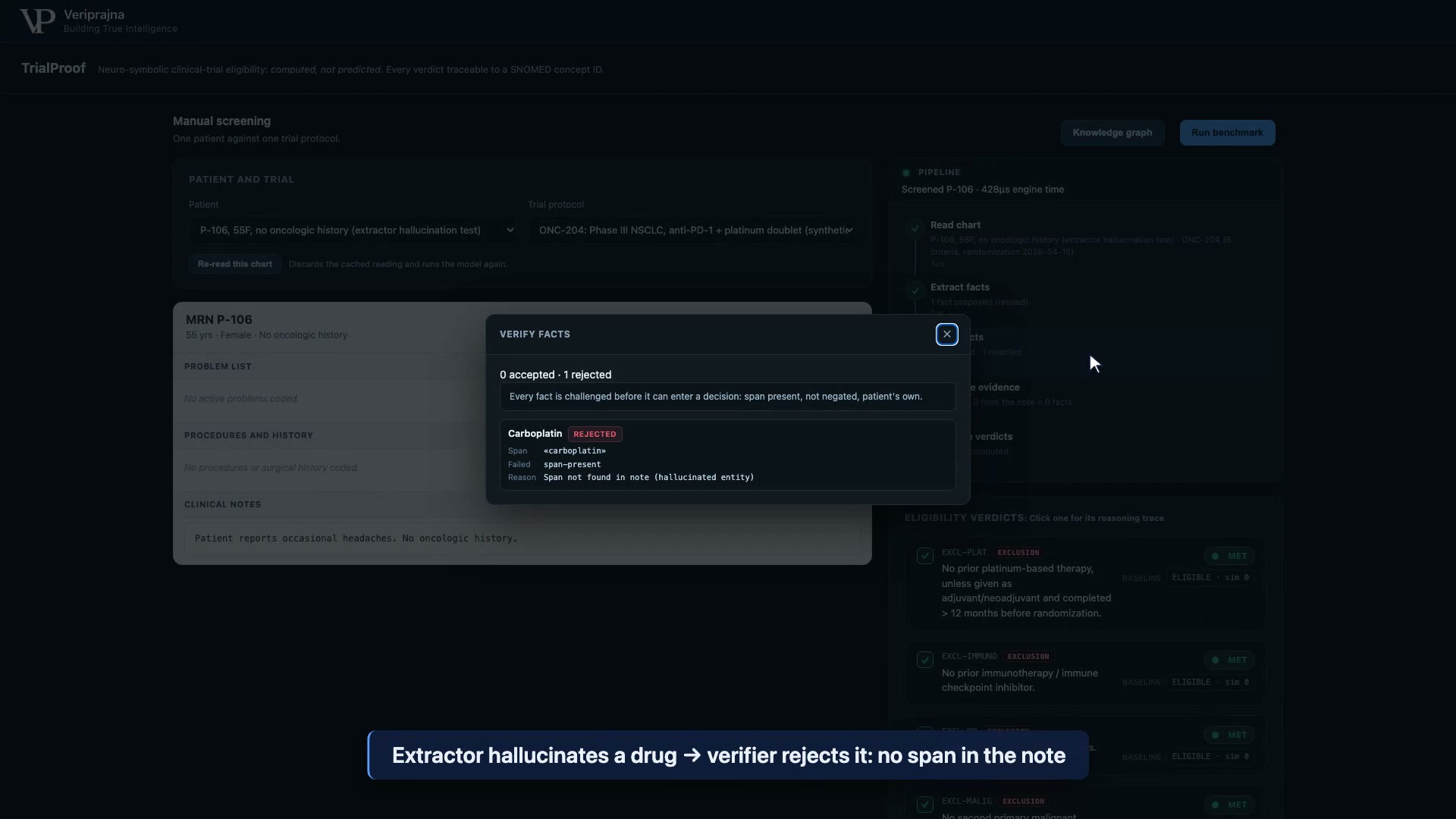
For P-106 the extractor proposes a carboplatin fact that has no supporting span in the note, a planted hallucination. The adversarial verifier runs span-present, negation, and subject on every proposed fact; the carboplatin fact fails span-present (span not found in note) and is flagged REJECTED, so it never reaches the decision. Across the gold set the verifier rejected 7 fact instances (3 distinct bad facts: a negated diabetes mention, a family-history breast-cancer attribution, and this hallucinated carboplatin) on 4 of the 13 scored case-runs. The agents advise on extraction; deterministic code decides eligibility.
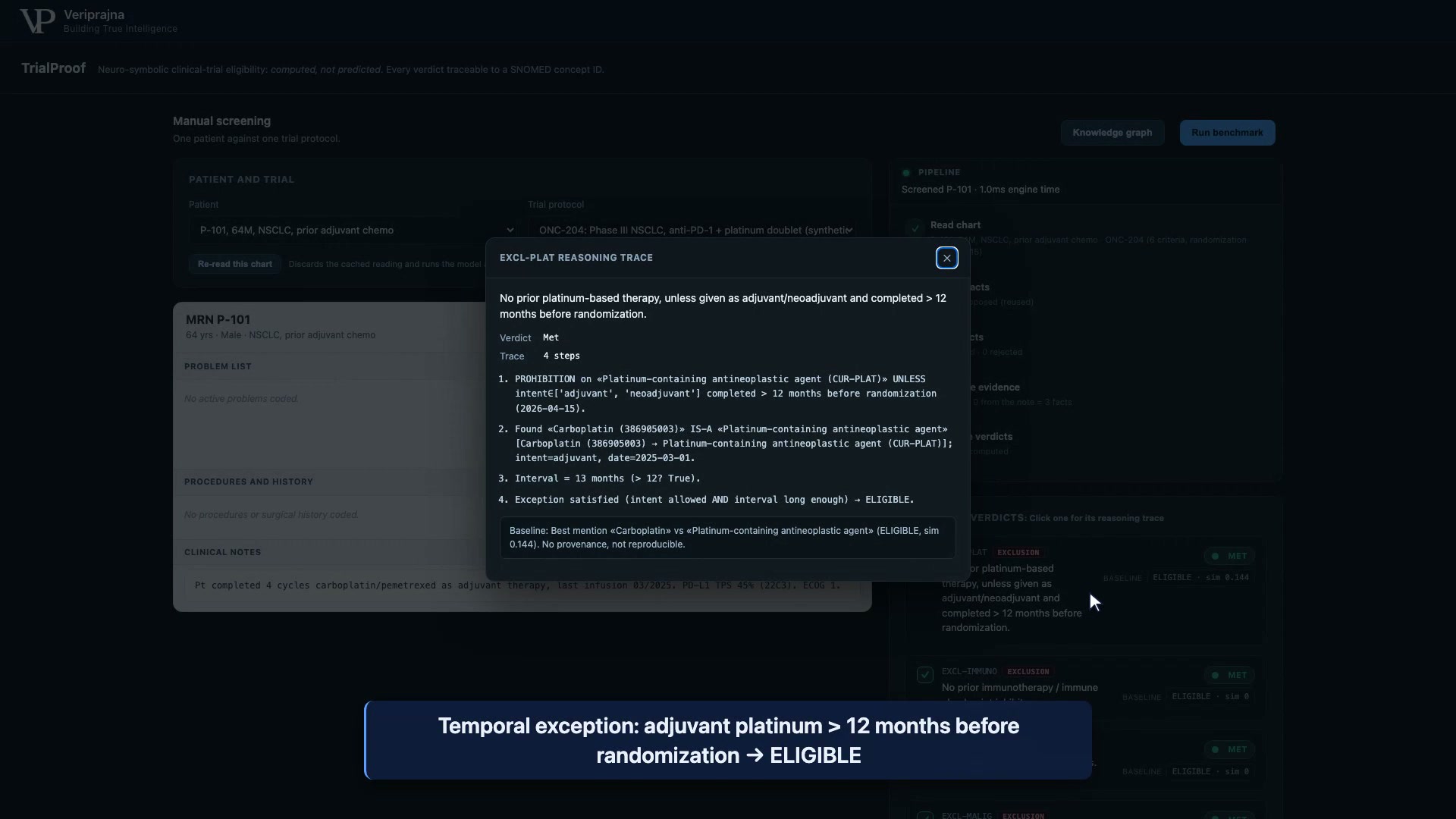
P-101 completed adjuvant carboplatin and pemetrexed, last infused 03/2025. ONC-204's EXCL-PLAT prohibits prior platinum therapy unless given as adjuvant or neoadjuvant and completed more than 12 months before randomization (2026-04-15). The engine confirms Carboplatin (386905003) is-a Platinum-containing antineoplastic agent, computes the interval at 13 months, satisfies the exception, and returns ELIGIBLE with a four-step trace. When the same clause is tested on a palliative-intent patient, the exception does not apply and the verdict flips to EXCLUDED. Same criterion, opposite verdicts, both correct, because it is the logic engine and not a threshold.
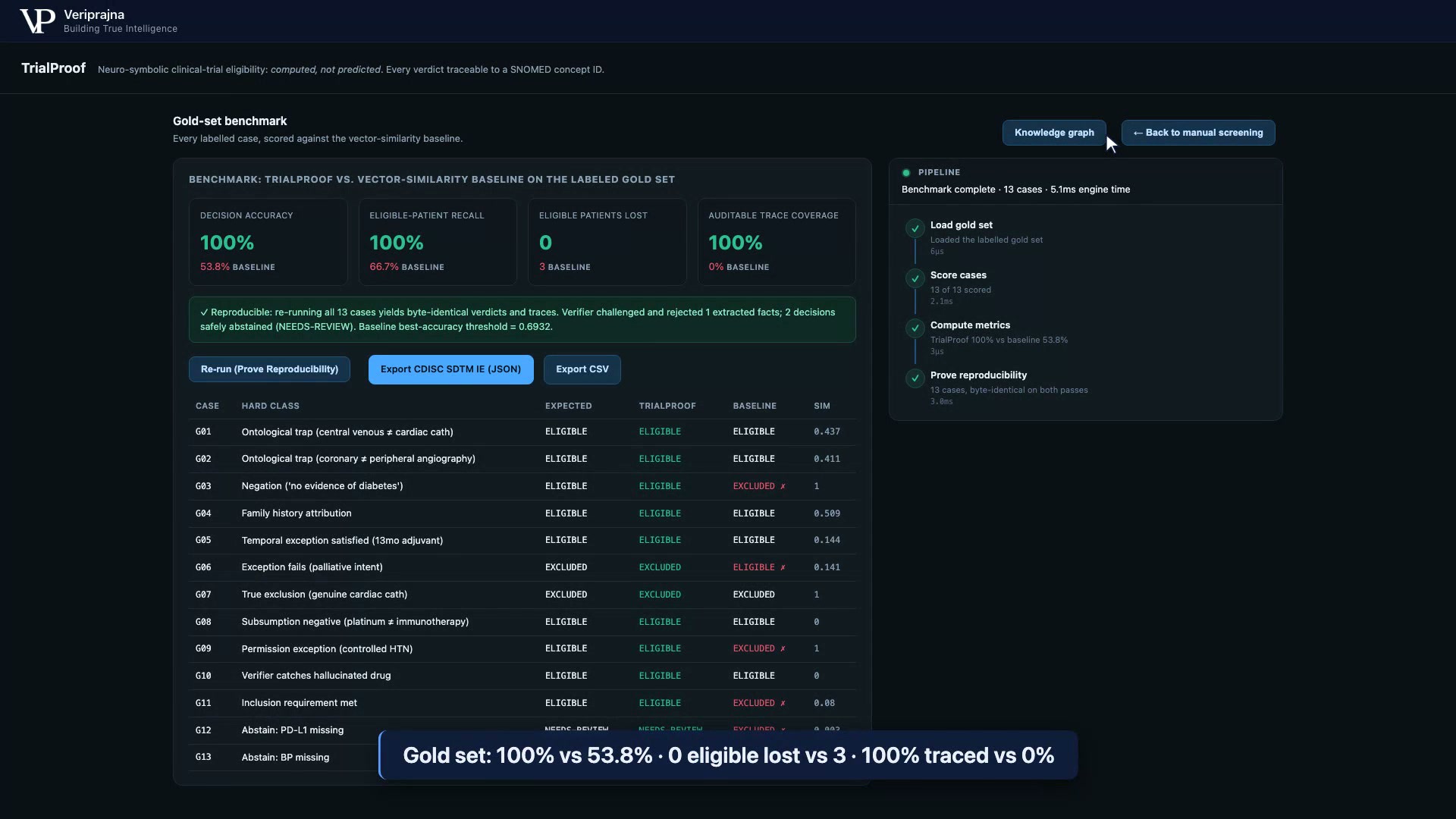
On a fixed gold set of 13 labeled cases drawn from 7 synthetic patients across 2 synthetic protocols, scored against the cross-validated lexical baseline at t = 0.6932, TrialProof scores 100% decision accuracy to the baseline's 53.8%, loses 0 eligible patients where the baseline loses 3, and carries a reproducible reasoning trace on 100% of decisions to the baseline's 0%. It abstains safely twice with NEEDS-REVIEW where the baseline guesses, and re-running all 13 cases yields byte-identical verdicts and traces (13 of 13). We attribute every figure to this labeled gold set, never as an open-world claim.
The same comparison the demo scores, dimension by dimension.
| Dimension | Fair lexical baseline | TrialProof |
|---|---|---|
| Who decides eligibility | A similarity score over a threshold | A deterministic deontic-logic engine, outside the agents |
| Hierarchy / is-a | None, token proximity only | SNOMED-CT is-a subsumption |
| Negation (no evidence of diabetes) | Matched as present | Stripped by the verifier |
| Family history attribution | Attributed to the patient | Rejected on the subject check |
| Temporal exception clauses | Not representable | Date math over the randomization date |
| Missing lab or vital | Guesses, never abstains | NEEDS-REVIEW, naming what is missing |
| Reasoning trace | None, a bare similarity number | Full trace, exported as CDISC SDTM IE |
| Reproducibility | Not applicable | Byte-identical on re-run (13 of 13) |
TrialProof is not a data network or a cloud matching platform, and it is not a clone of those tools. It is the deterministic reasoning and provenance layer they lack: the part that makes the eligibility verdict computable, checkable, and filable. A matching platform hands you a ranked list with a score; TrialProof hands you ELIGIBLE, EXCLUDED, or NEEDS-REVIEW with the SNOMED concept IDs and the graph edge that decided it. It is meant to sit alongside a matching pipeline, not replace the data network under it.
Because it reads a clinical note as text and scores similarity, so it confuses words that look alike but mean different things medically. A note that says central venous catheter placement scores high against a trial that excludes cardiac catheterization, and the patient is wrongly excluded. The same failure covers negation (no evidence of diabetes matched as diabetes), family history attributed to the patient, and exception clauses a similarity score cannot represent at all. Published evaluations confirm AI models make this exact catheterization error (Fierce Biotech, 2025).
Yes. Every decision exports as a CDISC SDTM IE record in JSON and CSV, one row per patient and criterion, carrying the criterion, the verdict, and the full deterministic reasoning trace that names the SCTIDs and the deontic operation. Where a fact matched, the row also carries the is-a path and, for note-derived facts, the verbatim span. On the 13-case gold set, 100% of TrialProof decisions carry a reproducible trace and the baseline carries 0%, and re-running the set produces byte-identical output (13 of 13).
Every concept the demo cites for a decision carries a real SCTID, checkable on any public SNOMED browser: Central venous catheterization is 392230005 and Cardiac catheterization is 41976001, and they sit on different branches, which is why no subsumption path connects them. The engine queries a curated 24-concept subgraph with 22 is-a relations, not full SNOMED-CT. The 9 concepts curated for the demo with no public SCTID are prefixed CUR- and drawn dashed rather than passed off as real codes. Full SNOMED-CT, MedDRA, and LOINC are the deferred production path.
All data is synthetic. There is no real PHI, no live EHR, and no real trial; the patients, notes, and protocols are fabricated fixtures. This is a runnable demo that proves the mechanism, not a deployed pipeline, so it is not HIPAA-certified, SOC 2 certified, FDA-cleared, or CDS-exempt, and it does not make clinical decisions. The FDA's January 2026 Clinical Decision Support guidance is the relevant framework for a human-in-the-loop matching aid, and it is our direction, not a clearance we hold.
No, because these are not language problems, they are logic problems. A similarity score cannot represent is-a, cannot represent not, and cannot represent unless completed more than twelve months before randomization, and no amount of prompting or context adds them. So we let the model do the one thing it is genuinely good at, reading messy prose and proposing facts with the span it read them from, then have an adversarial verifier throw out what the note does not support, and have deterministic code over a medical ontology compute the verdict. The LLM cannot override that gate, which is what makes the same chart produce the same answer every run.
It is 100% decision accuracy on a fixed 13-case labeled gold set, drawn from 7 synthetic patients across 2 synthetic protocols, scored against a fair lexical baseline whose threshold was cross-validated to its own advantage (t = 0.6932). It is never a universal or open-world claim, and it is not the same as this product being right on every possible chart. On that same set TrialProof loses 0 eligible patients where the baseline loses 3, and abstains safely twice with NEEDS-REVIEW rather than guess.
The research behind this demo — the architecture, the verification design, and the enterprise blueprint.
Full solution
Explore the Clinical Trial Recruitment AI solution →The deterministic reasoning and provenance layer is the hard part. We build it.
If your team is weighing how to put an eligibility decision in front of a regulator without asking them to trust a similarity score, we would genuinely like to hear how you are thinking about it. The problem is industry-wide and the answers will be too.