Medicare Advantage AI governance
In a synthetic Medicare Advantage prior authorization case, the model strongly favors denial—but the patient's individual clinical factors account for only 22.06% of its attribution. CertaRoute holds the case for physician review and keeps the route inspectable.
Follow one case from initial assessment to the review gate and local record. The video shows the actual demonstration workflow.
Company walkthrough · 6 min 21 sec · Synthetic cases and records
01 / Initial assessment
DENY · 0.985
Stand-in model confidence for synthetic case A-4471.
02 / Individual evidence
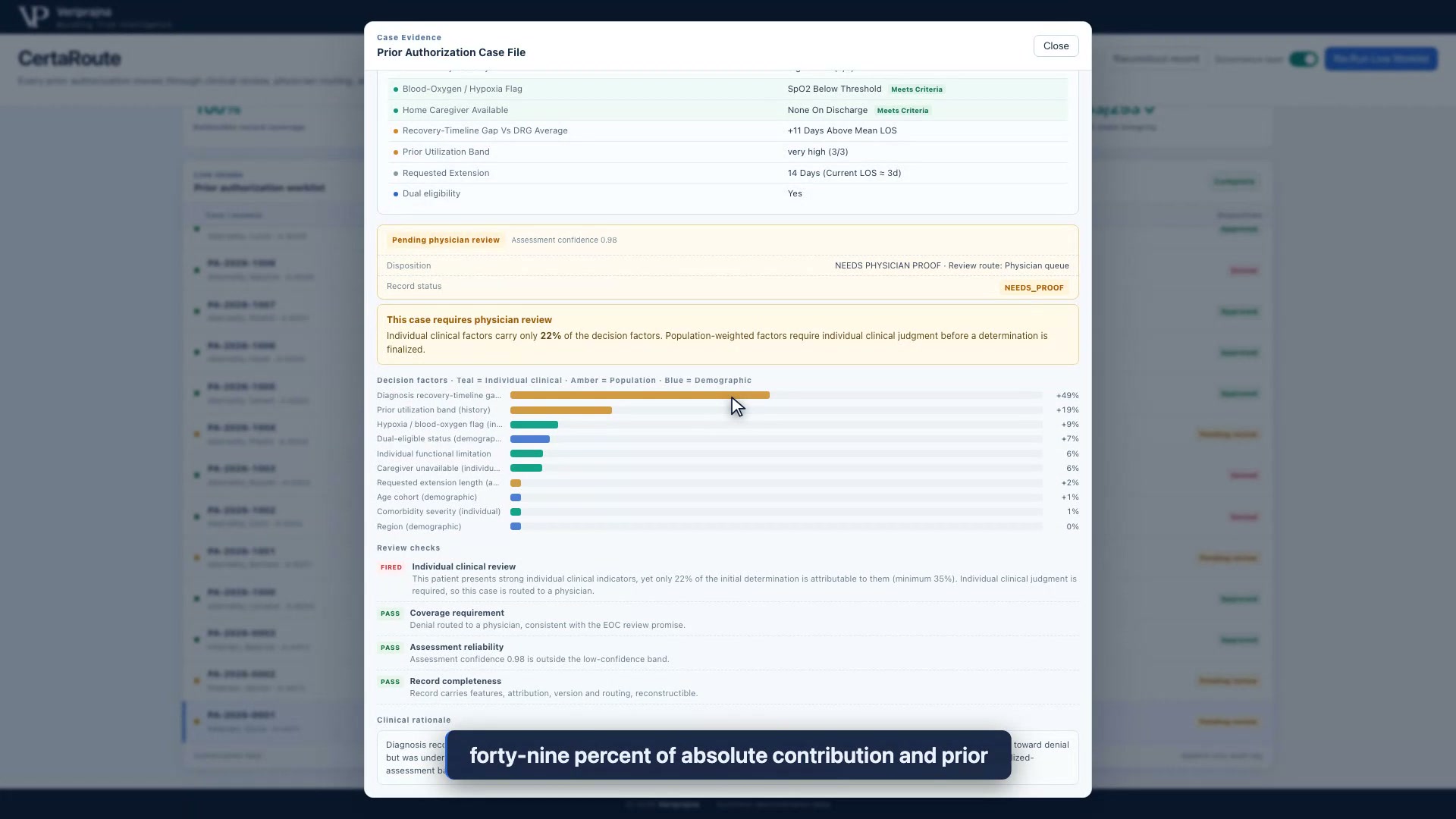
22.06%
Share of absolute attribution from individual clinical factors; below the demo's configurable 35% floor for salient denials.
03 / Governance route
Physician review
The deterministic gate holds the case; its local technical record is marked NEEDS_PROOF.
A-4471 and every other case shown here are synthetic. The walkthrough demonstrates a governance mechanism, not a medical-necessity determination or a deployed payer workflow.
The question behind the demo
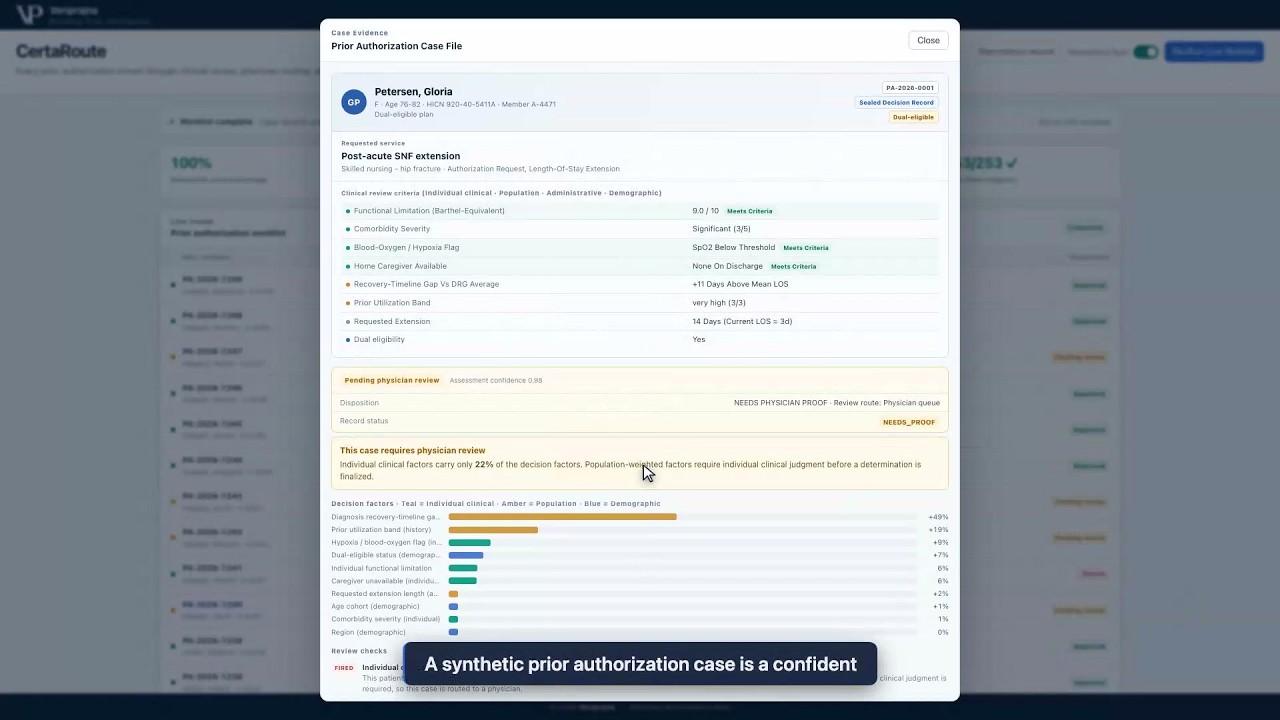
A-4471 is a scripted post-acute skilled nursing extension case. The initial model assessment is a high-confidence denial. But the evidence that explains that score is weighted toward a recovery-timeline gap and prior utilization, while the member's individual clinical factors account for a much smaller share. The score alone cannot tell a reviewer whether those patient-specific facts received enough attention.
That distinction matters in Medicare Advantage. CMS's February 2024 guidance says coverage determinations must account for individual circumstances; an algorithm trained on a larger population cannot substitute for the patient's medical history, physician recommendations and clinical notes. CertaRoute demonstrates a control that exposes the mismatch and routes a case for human review. It does not decide medical necessity.
01 / Read the assessment
The stand-in model issues an initial DENY assessment at 0.985 confidence. CertaRoute calculates exact Shapley attribution across ten model features so the reviewer can see which inputs drove that assessment. In A-4471, the two largest contributions are a recovery-timeline gap and prior utilization—not the patient's individual clinical indicators.
What to notice: high model confidence and strong patient-specific grounding are different properties. Attribution is a diagnostic view of this stand-in model, not a clinical judgment.
02 / Apply the boundary
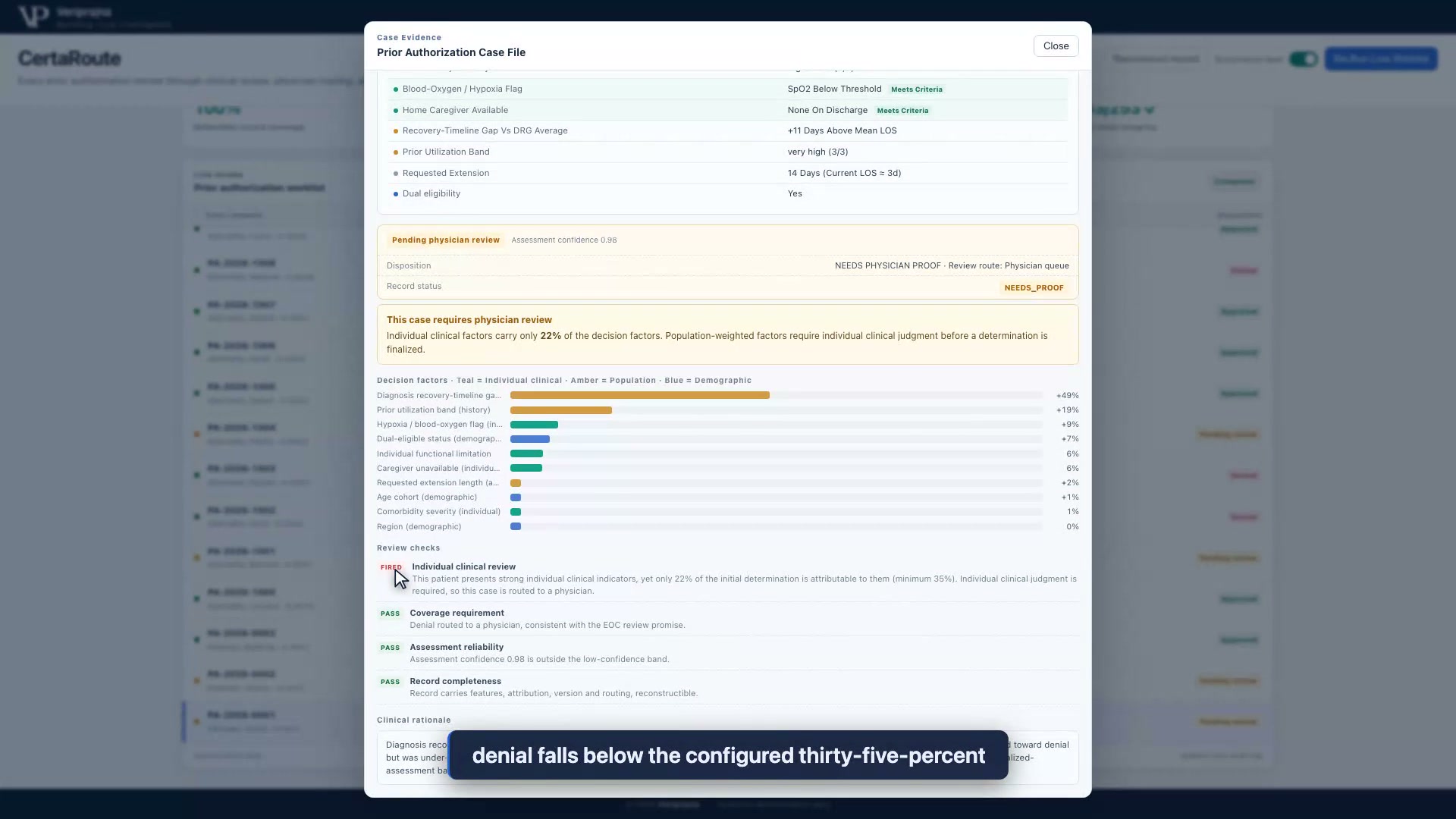
For salient denials, this demo uses a configurable 35% floor for individual-clinical-factor attribution. A-4471's 22.06% is below that floor, so the deterministic gate fires the individual clinical review check and sets NEEDS_PHYSICIAN_PROOF. The local record is marked NEEDS_PROOF.
03 / Keep an inspectable trace
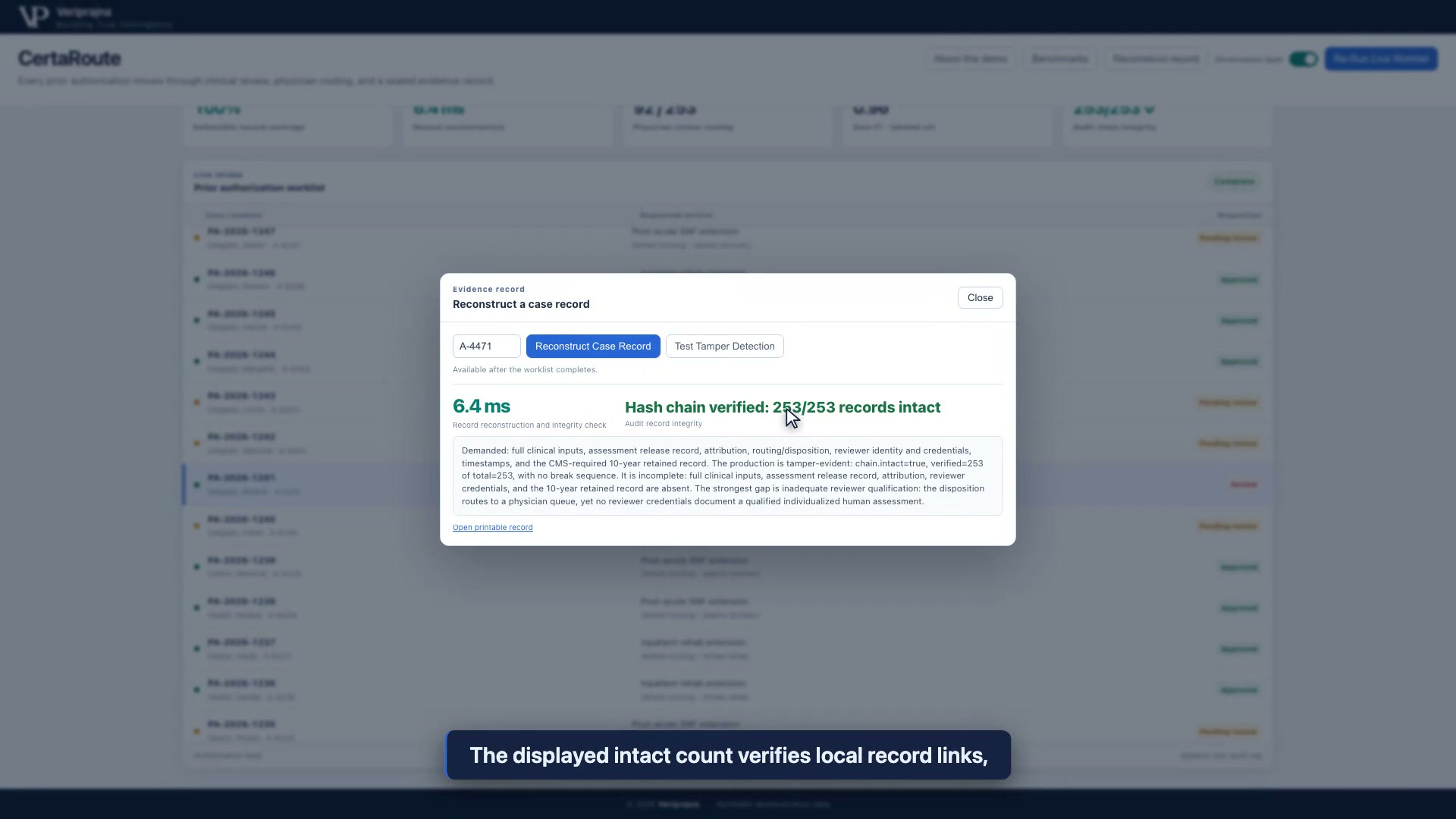
The demo app appends each processed case to a local SQLite record whose hash includes the previous record's hash. The reconstruction view brings the inputs, attribution, route and record together for inspection. In the fixed 253-case synthetic run, all 253 local links verified before tampering.
The mechanism is visible. Clinical and production validation are separate work.
| Shown in the synthetic demo | Not established here |
|---|---|
| A code gate routes A-4471 to pending physician review when individual clinical attribution is below the configured floor. | A final coverage determination or clinically validated threshold. |
| 253 of 253 fixed-run cases have a locally checkable hash-chained record before tampering. | Immutable custody, legal defensibility, or independent verification of every record field. |
| A planted dual-eligible denial-rate gap is flagged for review. | Bias or unlawful discrimination in a real health-plan population. |
| Source-system labels and an illustrative metrics panel show the proposed workflow. | Live payer connectors, staffed physician queue, Evidence of Coverage comparison, or CMS reporting compliance. |
What this demo does not do: It uses synthetic cases, stand-in QNXT, Facets and HealthEdge labels, and a demo-only reviewer state. Its completeness flag is always passed as true in the current pipeline; it does not independently inspect every field. CMS-0057-F requirements are not implemented or certified by this panel.
CMS says a Medicare Advantage coverage determination must account for the individual patient's circumstances. An algorithm drawing on a larger dataset cannot substitute for the patient's medical history, physician recommendations, and clinical notes. CertaRoute illustrates a review route; it does not make a medical-necessity decision.
In the synthetic A-4471 case, the initial denial has 0.985 model confidence, while individual clinical factors contribute 22.06% of absolute attribution. That is below the demo's configurable 35% floor for salient denials, so the deterministic governance gate marks the case NEEDS_PHYSICIAN_PROOF. The case remains pending physician review.
No. CertaRoute's code gate sets the demonstrated disposition independently of advisory text. The default explanation is a deterministic template, and an optional model-generated explanation can describe the route without authorizing it.
No live payer connection is shown. QNXT, Facets, and HealthEdge are source-system labels on synthetic cases, not working connectors. Production integration and access controls remain separate implementation work.
No. The demo stores local SQLite records whose hashes include the prior hash, and its verifier can detect a deliberate record alteration. That is a technical evidence example, not independently secured custody, a legal conclusion, or a final determination for a case pending physician review.
No. The displayed 54.5% versus 28.0% initial-denial rates come from a planted pattern in seeded synthetic cases. The plan-level test signals a reason to investigate a decision pathway; it does not establish discrimination in a real population.
No. CertaRoute's dashboard includes illustrative indicators, including hard-coded synthetic turnaround values. It is not a CMS reporting implementation or certification, and the demo does not implement the required Prior Authorization API.
Explore related research for broader context on this demonstration.
Full solution
Explore the Medicare Advantage AI Governance solution →We can examine where an automated assessment needs a human review boundary and a reconstructible record.
Bring your clinical, compliance and engineering teams to the same case-level conversation. We can discuss what a production design would have to validate beyond this synthetic demonstration.