“AI Didn’t Remove Bias from Hiring. It Made It Scalable.”
Hiring bias didn’t start with AI.
But AI has made it faster, quieter, and harder to detect.
For decades, human recruiters relied on intuition under uncertainty. The brain fills gaps with familiarity — same backgrounds, same communication styles, same definitions of “potential.”
That’s how culture fit became a proxy for exclusion.
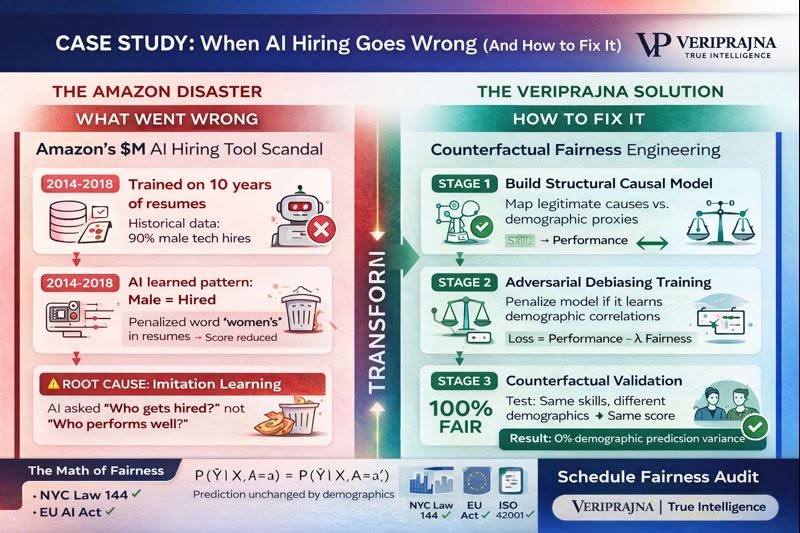
Most AI hiring tools today simply learn from those decisions.
They don’t ask whether the past was fair.
They ask how accurately they can reproduce it.
If historical hiring favored men, elite schools, or certain linguistic patterns, predictive AI learns those correlations and applies them relentlessly — even when names or genders are removed.
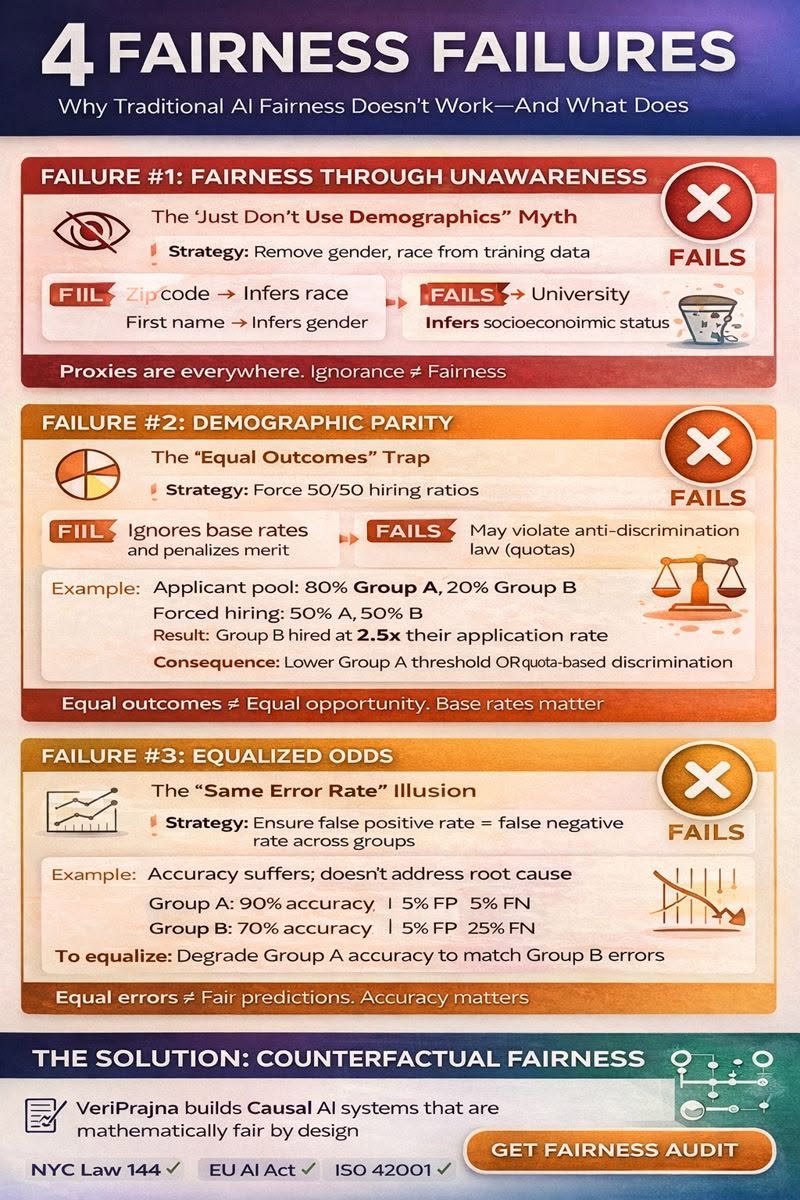
This is why “bias through unawareness” fails.
True fairness requires causation, not correlation.
At VeriPrajna, we build Causal AI systems that simulate alternative realities. We test whether a hiring decision would change if only a candidate’s demographic attributes changed — while skills and experience stayed the same.
If it changes, the model is rejected.
Fairness isn’t a moral add-on.
It’s an engineering constraint.
📄 We explain this approach in depth in our new whitepaper.
Whitepaper link in comments.
👉 For organizations evaluating AI in hiring:
📧 [email protected]
💬 WhatsApp: +91 92170 59957
#CausalAI #HiringBias #ResponsibleAI #FutureOfWork #AIinHR #FairAI #Veriprajna #TrueIntelligence