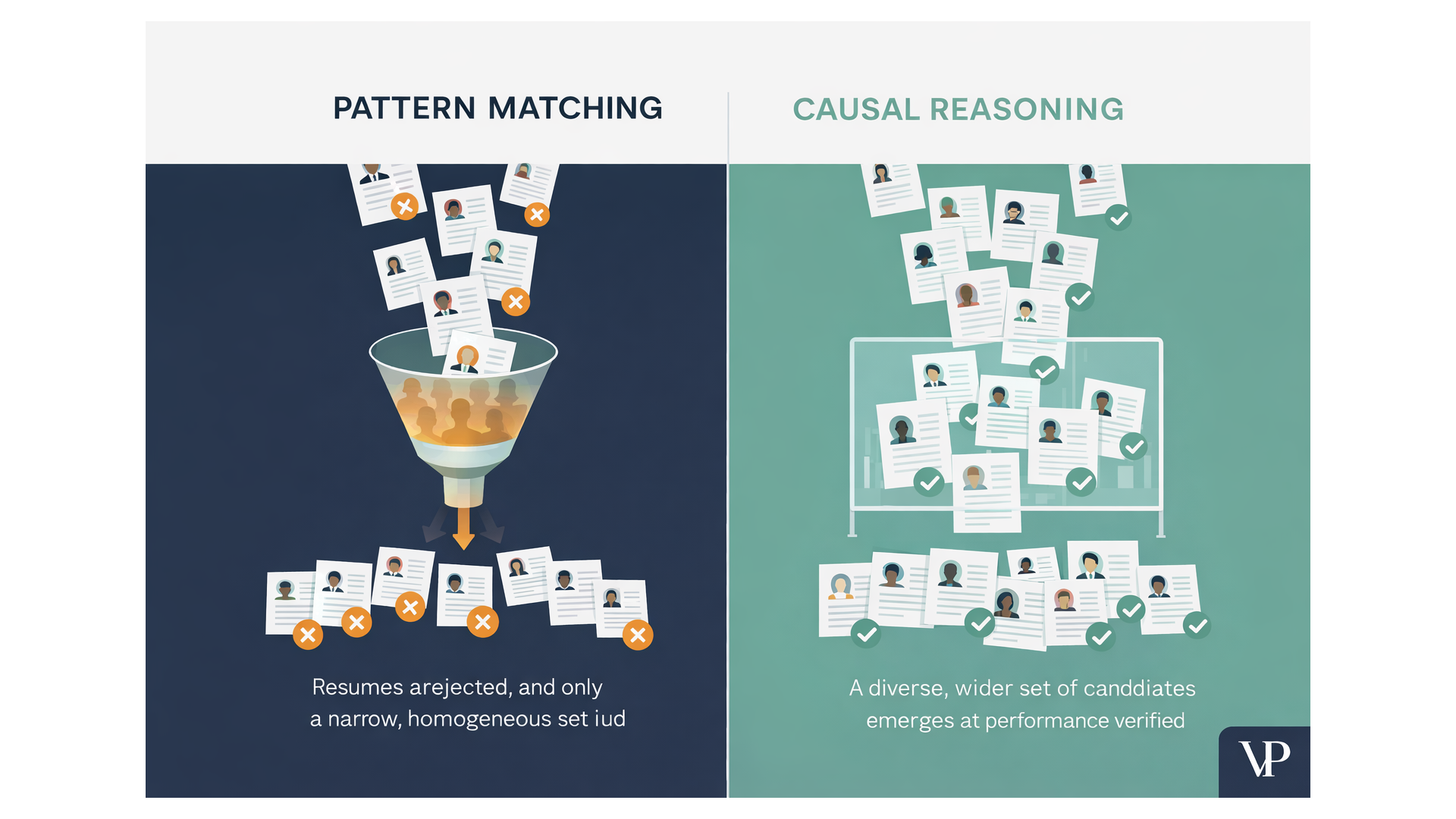
In resume screening simulations, AI tools preferred white-associated names 85% of the time. In some iterations, Black male names were never ranked first. These aren't findings from a fringe study — they come from University of Washington research on the same large language models that power today's most popular hiring tools.
The recruitment industry has an automation problem disguised as an innovation story. Companies are rushing to adopt AI-powered hiring tools, believing they're removing human bias from the process. They're not. They're scaling it. The difference between a biased recruiter and a biased algorithm is that the algorithm processes ten thousand resumes before lunch.
We've spent years studying why this happens and, more importantly, what a fundamentally different approach to AI recruitment looks like. The answer isn't better prompts or smarter wrappers around existing AI models. It's a different kind of AI entirely — one built on causal reasoning rather than pattern matching.
"Culture Fit" Is Code for Hiring Yourself
Before we talk about AI, we need to talk about the human problem AI is supposed to solve.
"Culture fit" is the most expensive euphemism in corporate hiring. On paper, it sounds reasonable — hire people who align with your values. In practice, it's a mechanism for homophily, the well-documented human tendency to prefer people who look, sound, and think like us.
A hiring manager who played lacrosse in college unconsciously codes a lacrosse-playing candidate as "disciplined" and "strategic." A candidate with an unfamiliar hobby registers as neutral — or worse, irrelevant. Research shows that candidates who mirror an interviewer's vocabulary and sentence structure receive significantly higher ratings, regardless of what they actually say. Interviewers routinely conflate "good communication skills" with "speaks like me."
This isn't malice. It's cognitive ease. Familiarity reduces perceived risk. But the organizational cost is enormous: when minority groups fall below roughly 25% of a team, homophilic hiring by the majority effectively locks them out of structural opportunities. The majority hires the majority, and the demographic status quo calcifies.
The opposite of "culture fit" isn't cultural chaos. It's "culture add" — hiring people who challenge assumptions. And research consistently links it to stronger innovation performance.
The Blind Audition Problem
The most elegant proof that "culture fit" fails comes from classical music. In the 1970s, major orchestras were overwhelmingly male. The prevailing wisdom held that women lacked the "temperament" for certain instruments.
Then orchestras introduced blind auditions — musicians playing behind a screen. Judges heard the music but couldn't see the musician. The hiring of female musicians surged. The screen forced evaluators to assess the output (sound) rather than the source (person).
This is the principle we build on. In digital hiring, you can't put every candidate behind a physical screen. But you can build AI that functions as a mathematical screen — separating the signal of performance from the noise of demographics. The problem is that most AI hiring tools today do the opposite. They act as transparent windows, letting every bias of the past flow into the predictions of the future.
Predictive AI Asks the Wrong Question
The first generation of AI hiring tools was built on a seductive but flawed idea: train a model on a decade of hiring decisions and let it learn what a "good hire" looks like.
The fatal assumption is that historical hiring decisions were correct. They weren't. If an organization historically hired mostly men for technical roles, the training data shows a strong statistical link between male-coded traits — specific sports, fraternity membership, certain vocabulary — and "hiring success." The AI doesn't understand why men were hired. It observes that they were, and it optimizes for that pattern.
This is imitation learning. The model learns to mimic the human gatekeeper. If the gatekeeper was biased, the model is biased — just faster and more consistent about it.
Amazon discovered this the hard way in 2018 when it scrapped an internal AI recruiting tool. Trained on a decade of resumes, the system learned to penalize the word "women's" — as in "women's chess club captain." It downgraded graduates of all-women's colleges. Nobody programmed it to be sexist. It simply learned that being male was a strong predictor of being hired, because that's what the historical data showed.
To be accurate to the past is to be unfair to the future. If "accuracy" means "predicting the human decision," then a "good" AI is necessarily a biased one.
We explored the full mechanics of this failure — and the alternative — in our interactive analysis of causal AI in recruitment.
The LLM Wrapper Trap
The latest wave of hiring tools takes a different approach that creates the same problem. These are "wrapper" applications — thin interfaces built on top of general-purpose language models like GPT-4 or Claude, used to parse resumes and rank candidates.
They introduce three risks that most buyers don't fully appreciate.
Internet-scale bias is baked in. Large language models learn from the open internet, which contains the full spectrum of human prejudice. When a wrapper sends a resume through one of these models, it activates latent associations between names, demographics, and perceived competence. The University of Washington research we cited earlier tested exactly this scenario — and the results were stark.
Hallucinations undermine reliability. Language models generate plausible-sounding text, not verified facts. In resume screening, this means an AI might infer a skill that doesn't exist on the resume, or invent a qualification to make a candidate's profile "flow" better. If someone is rejected based on a hallucinated skills gap, the legal exposure is real.
Explainability is essentially zero. Ask a wrapper tool "Why did you rank Candidate A over Candidate B?" and you'll get a confident-sounding paragraph that's actually a post-hoc rationalization. The underlying model — billions of parameters in a neural network — can't explain its own reasoning. In jurisdictions like the EU or New York City, where "right to explanation" requirements are becoming law, this opacity isn't just inconvenient. It's non-compliant.
From "Who Gets Hired?" to "Who Will Perform?"
Fixing AI recruitment requires changing the question the model is trained to answer.
Standard AI asks: "Will this person get hired?" It imitates past gatekeepers. If diverse candidates historically performed well but were rarely hired, this model learns to ignore them.
Our approach asks: "Will this person perform well?" We train on objective business outcomes — retention beyond 18 months, KPI achievement, performance ratings, team output improvement. By anchoring to outcomes rather than past decisions, we bypass the biased filter entirely.
This distinction sounds subtle but it's everything. One approach automates recruiter preferences. The other optimizes for business value. In one case study involving employee attrition, causal inference identified that "lack of training opportunities" — not salary — was the true driver of churn. That insight let the company intervene with targeted training programs instead of expensive across-the-board raises, reducing churn by 23.9%.
What Makes Causal AI Different
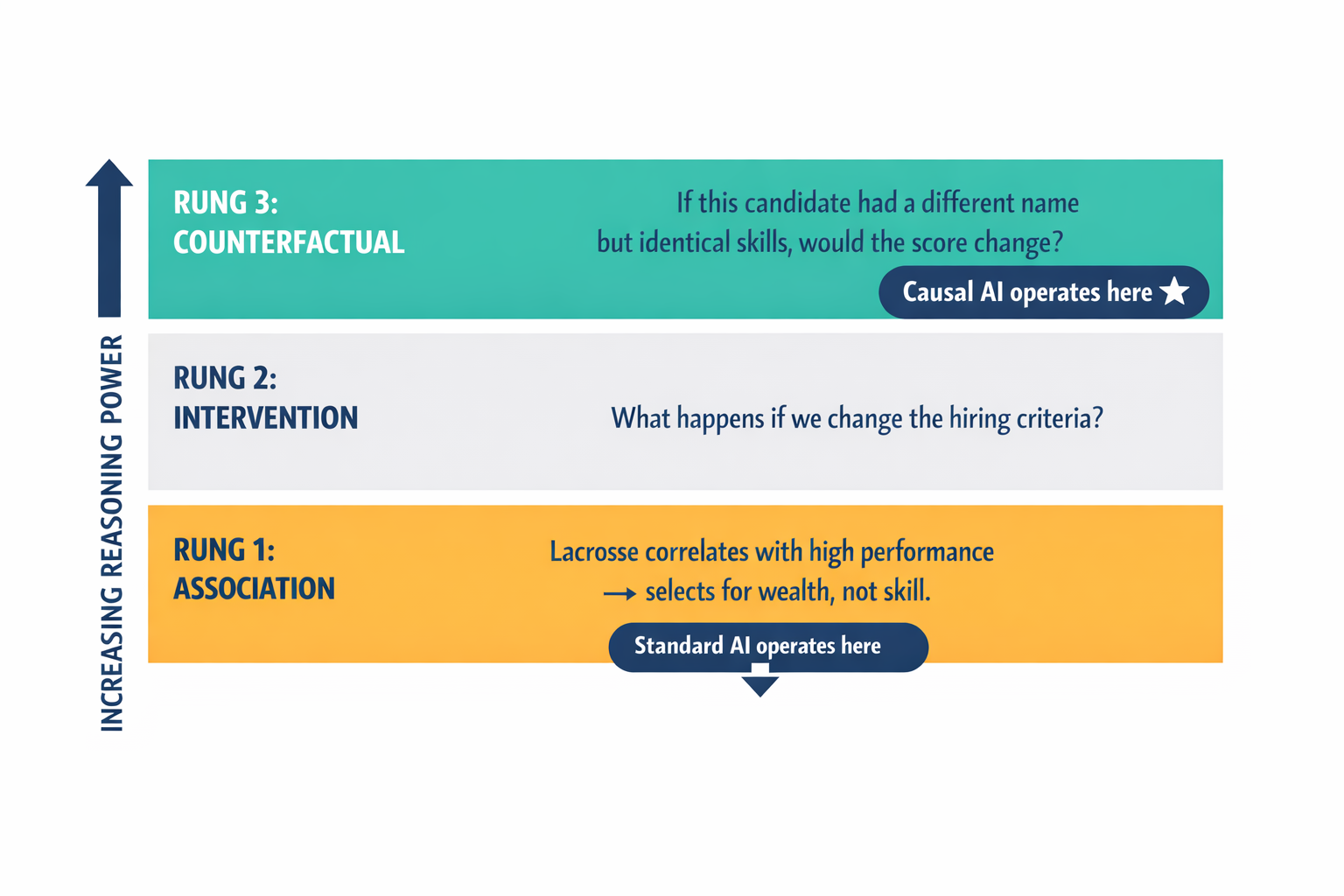
Our technology is built on what mathematician Judea Pearl calls the "Ladder of Causation" — a hierarchy that separates statistical pattern-matching from genuine reasoning.
Most AI operates at the first rung: association. It sees that lacrosse correlates with high performance and uses it as a signal. But lacrosse doesn't cause performance. It's a proxy for socioeconomic status — wealthier families afford lacrosse, send kids to elite schools, and those schools provide networks that lead to high-status jobs. A model that uses lacrosse as a feature isn't selecting for discipline. It's selecting for wealth.
Standard machine learning cannot tell the difference between a proxy and a cause. It treats both as useful prediction features.
Causal AI operates at the third rung: counterfactuals. Instead of asking "What pattern do I see?" it asks "What would have happened if this one thing were different?" Specifically: If this candidate belonged to a different demographic group, but everything else about their skills and experience stayed the same, would the prediction change?
Counterfactual fairness isn't a vague ethical aspiration. It's a mathematical constraint: the model's prediction must remain identical whether the candidate is male or female, Black or white — holding all genuine qualifications constant.
Think of it as the digital version of the blind audition screen. The model "hears" skills and experience but is mathematically prevented from "seeing" demographics.
How We Actually Remove Bias From the Model
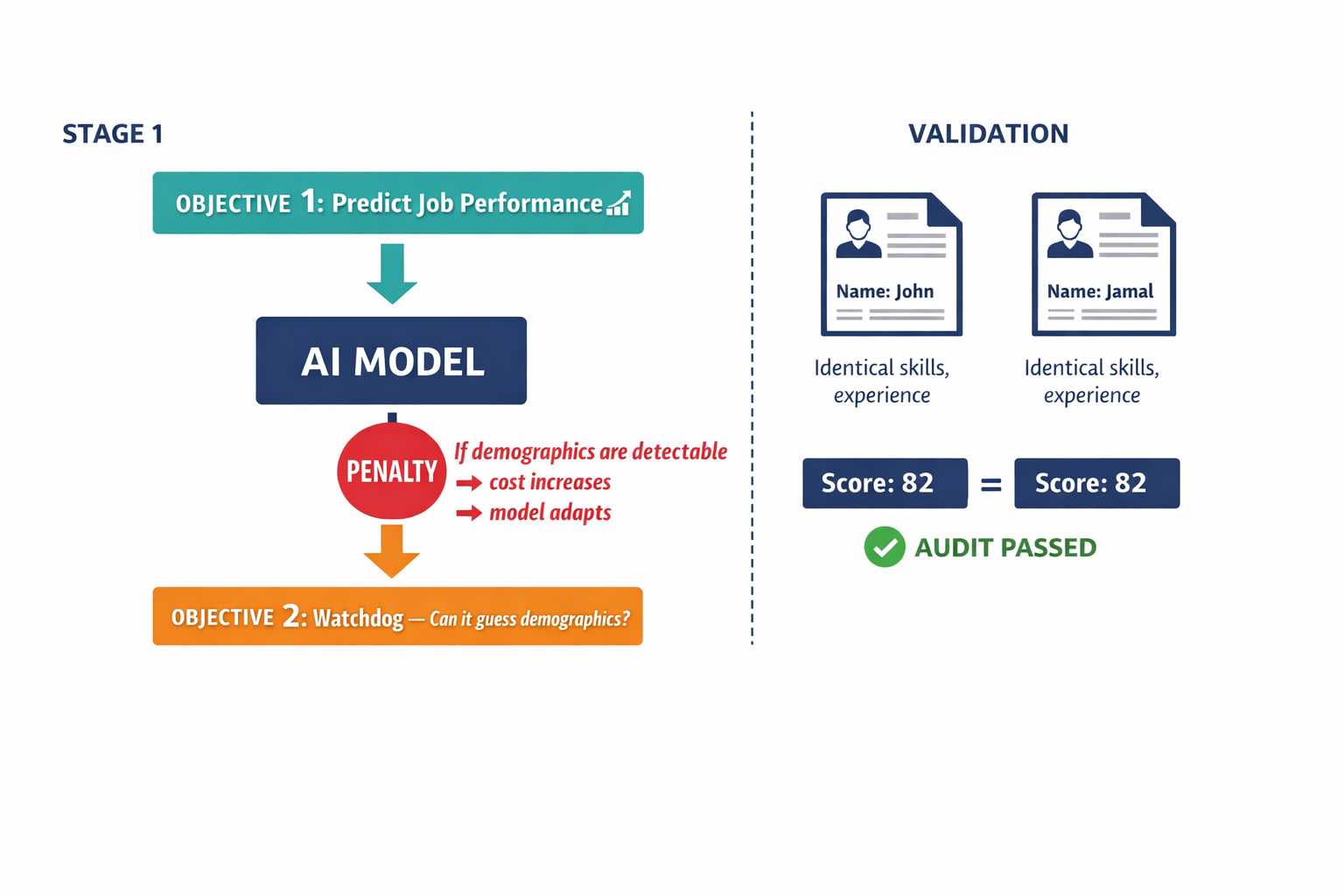
The mechanism works through what's called adversarial debiasing — training the AI against two competing objectives simultaneously.
The first objective pushes the model to accurately predict job performance. The second acts as a watchdog: it tries to guess a candidate's demographic group from the model's internal reasoning. If the watchdog succeeds — meaning the model is relying on features that reveal race or gender — a penalty kicks in, increasing the "cost" of the model's current approach.
To minimize that cost, the model is forced to find prediction pathways that don't leak demographic information. It learns to rely on skills, experience, and demonstrated competence rather than zip codes, names, or hobbies that serve as demographic proxies.
We then stress-test every model before deployment using counterfactual simulation. We generate thousands of "synthetic twins" — pairs of resumes identical in every way except demographic markers like name and pronouns. Both versions go through the model. If the scores diverge, the model fails the audit and we iterate until they converge.
For the full technical methodology behind this process — including how we use Structural Causal Models to map and block discriminatory pathways while preserving legitimate business signals — see our detailed research.
The Regulation Wave Is Already Here
This isn't a theoretical compliance concern. New York City's Local Law 144, effective since 2023, prohibits the use of automated hiring tools unless they've undergone an independent bias audit within the past year. The law mandates calculation of impact ratios — comparing selection rates across demographic groups. Many vendors using opaque models are failing these audits because they can't control how their models weight different features.
The EU AI Act goes further, classifying recruitment AI as "high risk" — the same regulatory tier as medical devices. This imposes strict requirements for data governance, human oversight, and demonstrable absence of bias. Wrapper solutions that process data through third-party APIs face an existential challenge here: the black-box nature of underlying language models makes it nearly impossible to provide the audit trails the Act demands.
If a rejected candidate sues, a company using standard AI has no defense beyond "the computer said so." A company using causal models can present the decision graph: "We rejected this candidate because of a verified skills gap, and we can prove mathematically that demographics had zero weight."
Does Fairness Come at the Cost of Performance?
This is the objection we hear most often, and the data answers it clearly: no.
Fairness and performance aren't competing objectives — they're correlated outcomes of a well-designed system. By removing the "culture fit" filter, you expand the talent pool to include high performers that competitors are systematically overlooking. Companies like Unilever and Hilton that shifted to data-driven, outcome-based hiring models reported reducing time-to-hire by up to 90% while simultaneously increasing diversity.
We think of this as the "Moneyball" principle applied to HR. Traditional recruiters overvalue pedigree — Ivy League degrees, prestigious internships — the same way baseball scouts once overvalued batting average. Causal AI finds the equivalent of on-base percentage: the undervalued signals that actually predict who wins.
What About Smaller Companies Without Rich Historical Data?
Causal AI requires robust data, and a common challenge is that minority groups are underrepresented in historical datasets. We address this through synthetic data generation — creating privacy-safe data points that mirror the statistical properties of underrepresented groups, ensuring the model has enough examples to learn fair decision boundaries for everyone.
For organizations just starting this journey, we recommend a phased approach. Start with a bias audit of your existing hiring data to identify where homophily traps already exist. Then run the causal model in shadow mode alongside human recruiters — not making decisions, but generating parallel recommendations you can compare against human choices. The gaps between AI recommendations and human decisions often reveal exactly where unconscious bias is operating.
What This Means for Your Hiring Strategy
The first generation of AI recruitment was a mirror — it reflected our biases back at us, amplified by automation. The next generation needs to be a lens, one that sees through the fog of affinity bias to the actual drivers of human performance.
Three things worth doing now:
Audit your "culture fit" criteria. Write down what it actually means at your company. If the definition maps to demographic traits rather than work behaviors, it's homophily wearing a name tag.
Ask your AI vendor the hard question. Not "Is your tool fair?" but "Can you show me the causal graph that proves demographic attributes had zero weight in this specific decision?" If they can't, you're exposed — legally and ethically.
Shift your success metric. Stop measuring time-to-fill. Start measuring 18-month retention and performance outcomes. The metric you optimize for determines the system you build.
The organizations that figure this out first won't just be more compliant or more ethical. They'll be finding talent that everyone else's algorithms are trained to ignore. That's not a fairness tax. That's a competitive advantage.
We'd welcome hearing how your organization is navigating this — whether you're evaluating AI hiring tools, running bias audits, or rethinking what "culture fit" means in practice.