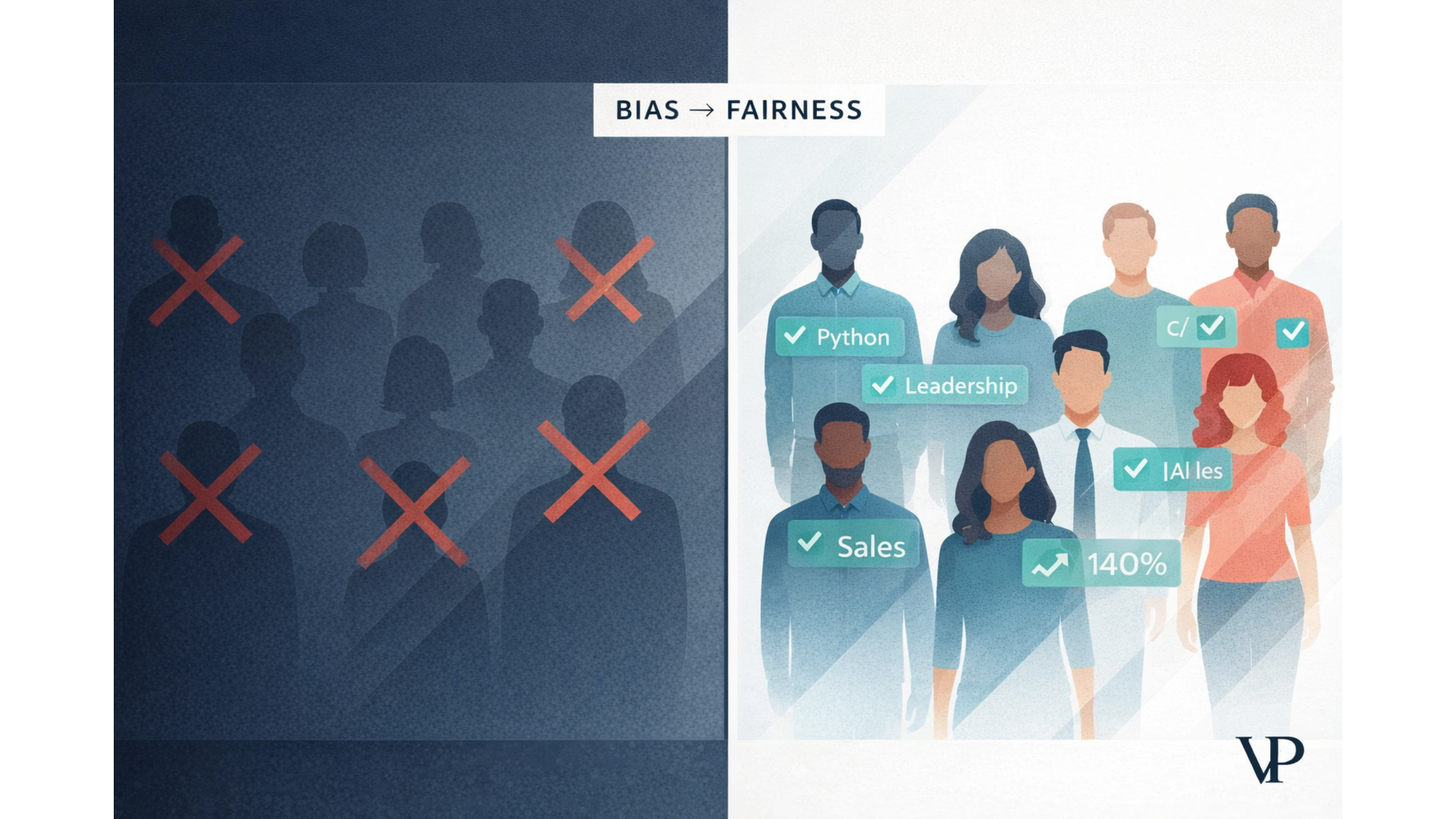
In resume screening simulations, AI tools preferred white-associated names 85% of the time. In some test runs, Black male names were never ranked first. Not once. These weren't fringe models built by amateurs — they were the same large language models powering the "AI-powered recruitment" tools flooding the market right now.
I've spent the last three years building AI systems for enterprise hiring, and the thing that keeps me up at night isn't whether AI will replace recruiters. It's that most AI hiring tools are automating discrimination faster than any human ever could. The industry calls this "AI-powered recruitment." I call it bias at scale. And fixing it requires abandoning the entire approach most vendors are taking — predictive AI trained on historical hiring data — in favor of something fundamentally different: causal AI that's engineered for fairness from the ground up.
"Culture Fit" Is Just Homophily With Better Marketing
Before we talk about AI, we need to talk about the human problem AI is inheriting.
Every hiring manager thinks they're hiring for talent. Most are actually hiring for familiarity. Sociologists have a term for this: homophily — our tendency to associate with people who resemble us. It's the scientific basis for the "old boys' network," and it hides behind a phrase you've heard a thousand times: "culture fit."
A hiring manager upgrades a candidate who played the same sport. Rates someone higher because they use similar vocabulary. Feels more "confident" about someone who attended a rival university. None of this is conscious malice. It's cognitive ease — familiarity reduces the perceived risk of a hire.
When minority groups fall below roughly 25% of an organization, homophilic hiring by the majority effectively locks them out of structural opportunities. The majority hires the majority.
Research shows that candidates who mirror an interviewer's vocabulary and sentence structure get rated significantly higher — regardless of what they actually say. Interviewers conflate "communication skills" with "speaks like me." A candidate from a different socioeconomic background who's equally competent but uses a different linguistic register gets penalized for "lack of polish."
The operational cost is real. "Culture fit" produces groupthink. Organizations that prioritize artificial harmony over diverse perspectives lose the friction that drives innovation. The evidence increasingly shows that "culture add" — hiring people who challenge assumptions — outperforms "culture fit" on innovation metrics.
The Blind Audition Problem
The most elegant proof that bias corrupts evaluation comes from classical music. In the 1970s, symphony orchestras were overwhelmingly male. The prevailing wisdom was that women lacked the "temperament" for certain instruments.
Then orchestras introduced blind auditions — musicians played behind a screen. Judges heard the music but couldn't see the musician. The hiring of female musicians surged.
The screen forced evaluators to judge the output, not the source. That insight became the foundation for everything my team builds. In digital hiring, you can't put every candidate behind a physical screen. But you can build AI that functions as a mathematical screen — separating the signal of performance from the noise of demographics.
The problem? Most AI hiring tools do the opposite. They're transparent windows that let every historical bias seep into future predictions.
Why Predictive AI Makes Bias Worse, Not Better
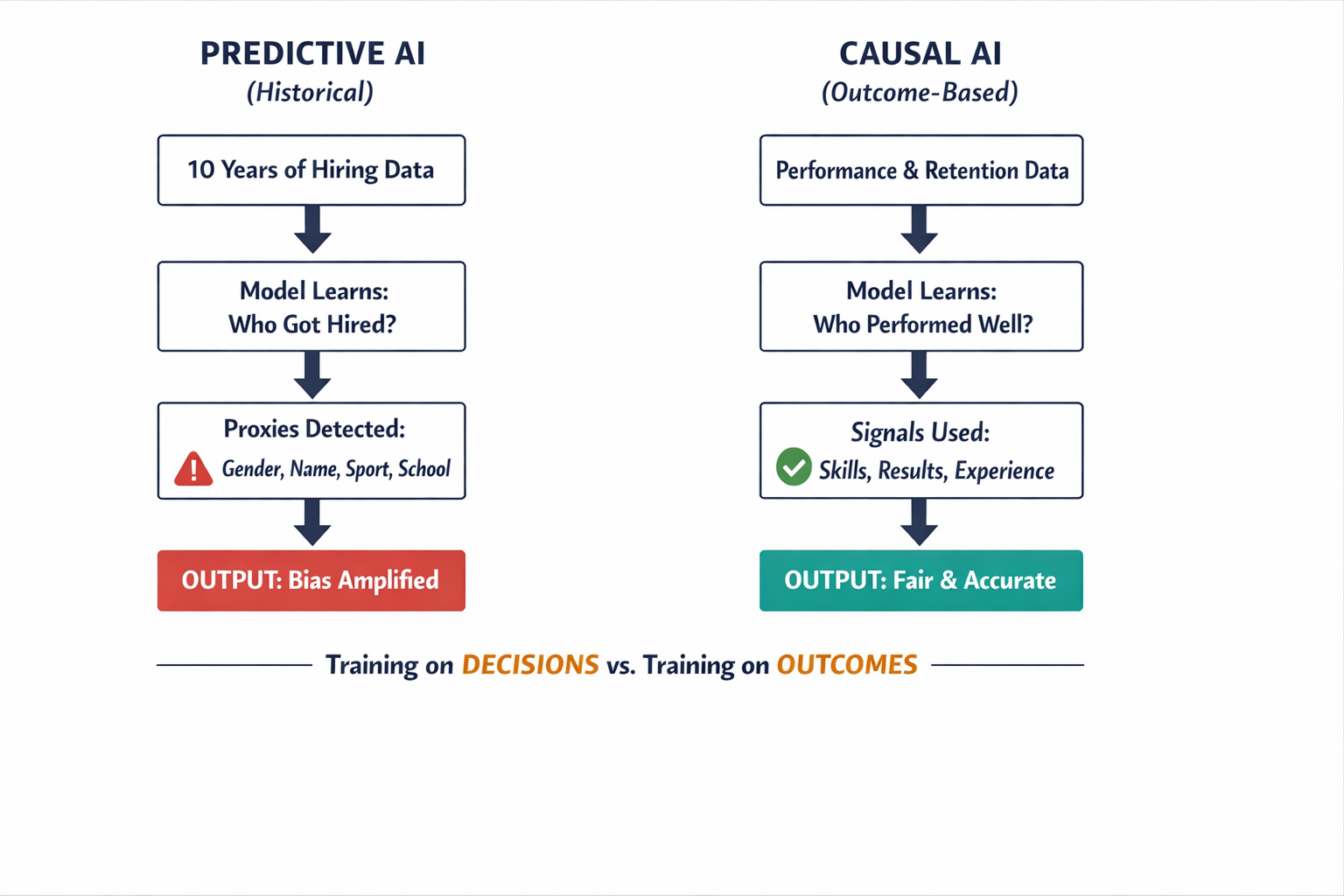
The first generation of AI recruiting tools was built on a seductive but fatally flawed idea: train a model on ten years of hiring data and teach it to predict "Who gets hired?"
If your organization historically hired mostly men for technical roles, the data shows a strong correlation between male-coded traits and "hiring success." The model doesn't understand why men were hired. It observes that they were. It latches onto correlations — specific sports, fraternities, vocabulary patterns — and applies them ruthlessly to every new applicant.
Amazon learned this the hard way in 2018 when they scrapped an internal AI recruiting tool. Trained on a decade of resumes, the system learned to penalize resumes containing the word "women's" — as in "women's chess club captain." It downgraded graduates of all-women's colleges. Nobody programmed it to be sexist. The AI simply discovered that "being male" was a strong predictor of "being hired" in the training data, then automated that pattern at industrial speed.
To be accurate to the past is to be unfair to the future. If "accuracy" means predicting the human decision, then a "good" AI is necessarily a biased one.
I remember the moment this clicked for my team. We were analyzing a client's historical hiring data and found that their model had learned to use "lacrosse" as a positive signal. Not because lacrosse develops job-relevant skills, but because it's a proxy for socioeconomic status — wealthier families afford lacrosse camps, send kids to elite universities, which feed into high-status jobs. The AI wasn't selecting for athletic discipline. It was selecting for wealth. We were looking at algorithmic redlining — digital discrimination dressed up as data science.
The "LLM Wrapper" Problem Is Even Worse
After the generative AI boom, a new class of tools emerged: thin interfaces built on top of models like GPT-4 or Claude that parse resumes and rank candidates. These look impressive. They're also deeply dangerous for enterprise hiring.
Large language models are trained on the open internet — a dataset containing the full spectrum of human bias, stereotypes, and prejudice. University of Washington research found that LLMs significantly favor names associated with white men over Black men or women, even when qualifications are identical. In some iterations of their testing, Black male names were never ranked first.
Beyond bias, these models hallucinate. An LLM might infer a candidate has a skill because related words appear nearby in the document, or fabricate a qualification to make a profile "flow" better. If someone is rejected based on a hallucinated skills gap, or hired based on an invented credential, you've got a legal and operational disaster.
And when a hiring manager asks "Why did the AI rank Candidate A over Candidate B?", a wrapper can only generate a plausible-sounding rationalization after the fact. The actual decision-making process is a black box with billions of parameters. In jurisdictions enforcing "Right to Explanation" laws — NYC, the EU — that opacity isn't just a limitation. It's non-compliant.
We explored these failure modes and the alternative approach in depth in our interactive analysis.
The Question Most AI Gets Wrong
Standard AI asks: "Based on history, will this person get hired?"
We ask a different question: "Will this person perform well?"
That distinction changes everything. When you train on outcomes — retention rates, performance reviews, sales quotas, code quality — you bypass the biased filter of the human recruiter entirely. If diverse candidates historically performed well but were rarely hired, an outcome-based model learns to value them. A model that imitates past recruiters learns to ignore them.
But outcome prediction alone isn't enough. You also need to handle the deeper problem: correlations that look predictive but are actually discriminatory proxies. A zip code might predict commute time (legitimate business factor) and correlate with race (discriminatory proxy). Standard machine learning can't tell the difference. It treats both signals identically.
This is where causal AI — specifically, Judea Pearl's framework called the Ladder of Causation — becomes essential. Most AI operates at the lowest level: seeing patterns. It notices that X correlates with Y. Causal AI operates at the highest level: imagining alternative realities. It asks, "If this candidate were from a different demographic group, would our prediction change?"
Counterfactual fairness isn't a vague ethical guideline. It's a mathematical constraint: the model's prediction for a candidate must not change if you toggle their demographic attributes while keeping their actual skills and qualifications identical.
That's the digital equivalent of the blind audition screen.
How You Actually Remove Bias From a Model
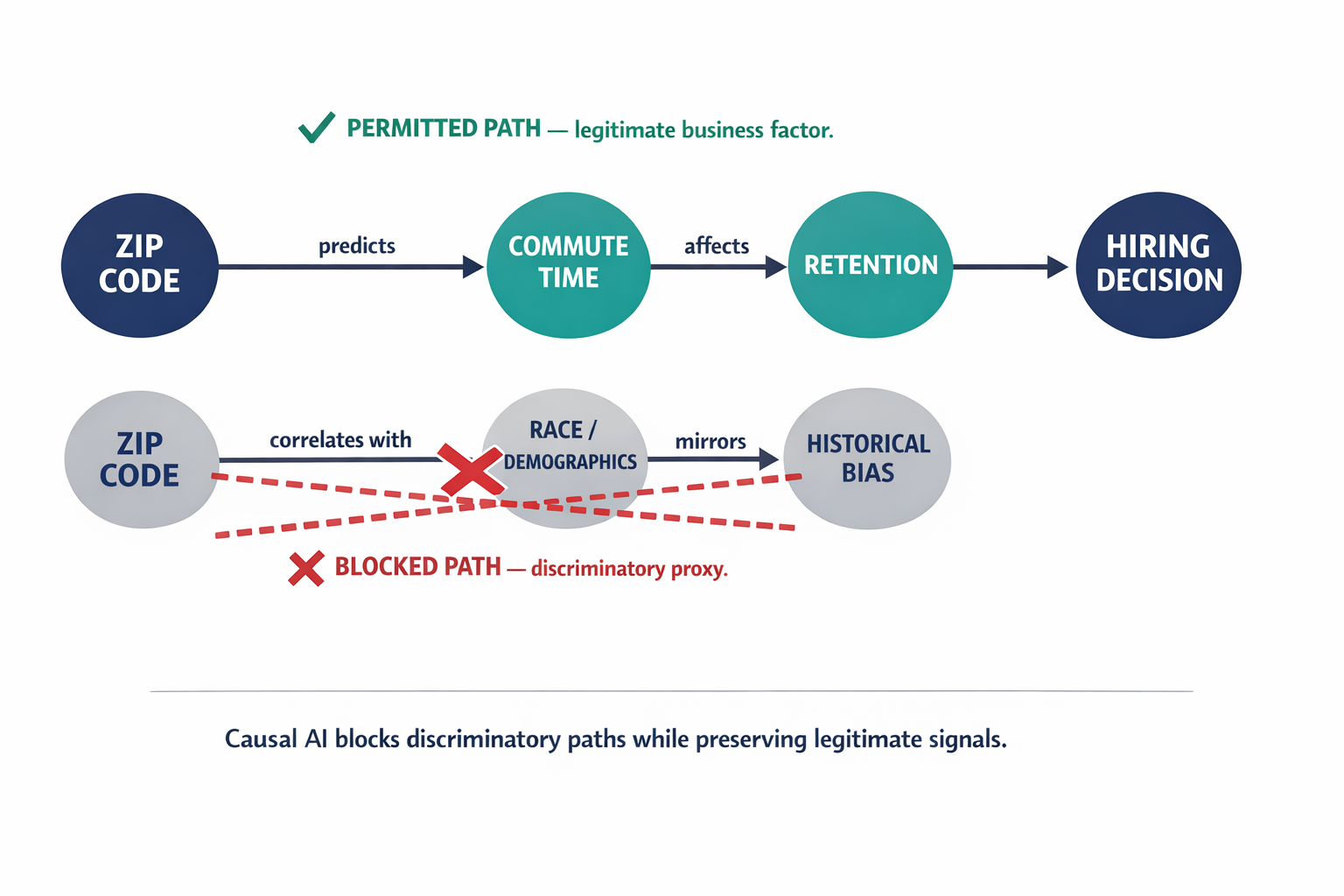
We build what we call Structural Causal Models — transparent graphs that map cause-and-effect relationships between variables. Unlike black-box neural networks, these models let you see exactly which paths connect inputs to outputs.
Take the zip code example. Our causal model maps two distinct paths. One runs from zip code through commute time to retention — that's a legitimate business relationship. The other runs from zip code through demographic inference to historical bias — that's discrimination. We mathematically block the second path while preserving the first. The model can use zip code to predict commute time, but it's penalized if it uses zip code to infer race.
During training, we optimize against two objectives simultaneously. The model needs to maximize accuracy in predicting job outcomes like retention. But we also introduce what's called a fairness penalty — think of it as a second referee watching the model's internal reasoning. If the model starts leaning on features that act as demographic proxies (like "lacrosse" or certain zip codes), the penalty kicks in and increases the cost of that approach. The model is forced to find other features — skills, experience, test results — that predict performance without revealing demographics.
Before deployment, we stress-test with thousands of synthetic twins: take a real candidate's resume, generate a copy with a different gendered name and swapped pronouns, keep everything else identical, and feed both to the model. If the scores diverge, the model fails the audit. We iterate until scores converge.
For the full technical methodology behind counterfactual fairness and adversarial debiasing, see our detailed research.
Regulation Is Coming Fast
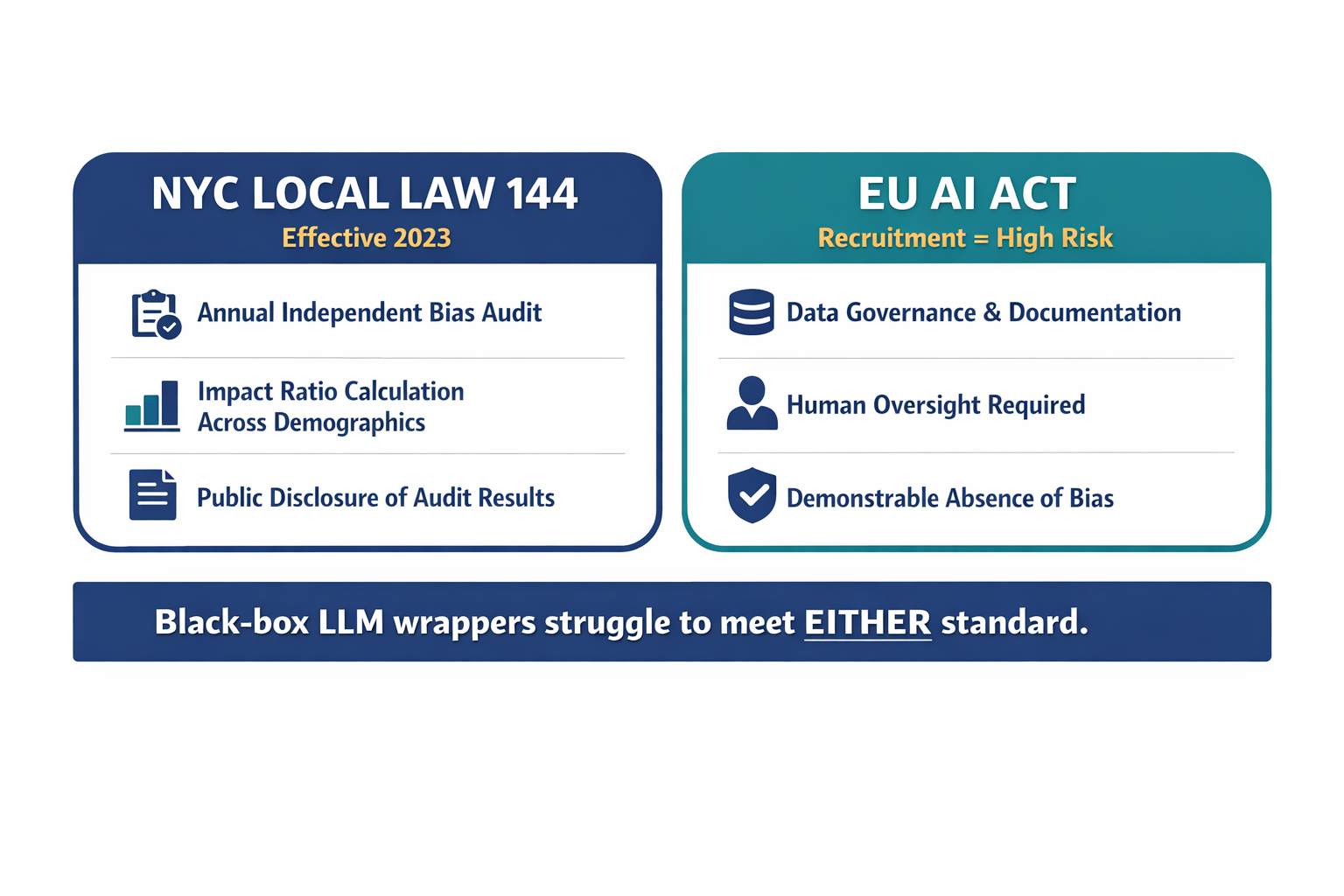
This isn't just a technical exercise. The legal landscape is making this urgent.
NYC Local Law 144, effective since 2023, prohibits using automated hiring tools unless they've undergone an independent bias audit within the past year. It mandates calculating impact ratios — comparing selection rates across demographic groups. Many black-box vendors are failing these audits because they can't control how their models weight features. They're scrambling to patch bias after the fact.
The EU AI Act goes further, classifying recruitment AI as "High Risk" — a regulatory tier comparable to medical devices. It demands data governance, human oversight, and demonstrable absence of bias. Wrapper solutions that process data through third-party APIs face an existential problem here: the black-box nature of LLMs makes it nearly impossible to guarantee what the law requires.
If a rejected candidate sues, a company using standard AI has no defense other than "the computer said so." A causal model lets you show the graph: "We rejected this candidate because of a specific skills gap, and we can prove mathematically that race had zero weight in the decision."
Fairness Isn't a Tax on Performance
I get this objection constantly: "Fairness sounds nice, but doesn't it hurt accuracy?"
The opposite is true. By removing the noise of "culture fit" bias, you expand the talent pool to include high performers that competitors are systematically overlooking. It's the Moneyball principle applied to hiring — traditional recruiters overvalue pedigree the way baseball scouts used to overvalue batting average. Causal AI finds the undervalued signals that actually predict winning outcomes.
One case study in our research found that causal inference identified "lack of training opportunities" — not salary — as the true driver of employee churn. The company intervened with training programs instead of across-the-board raises, reducing attrition by 23.9% at a fraction of the cost. Companies like Unilever and Hilton that shifted to data-driven, outcome-based hiring models reported reducing time-to-hire by up to 90% while simultaneously increasing diversity.
Fairness and efficiency aren't trade-offs. They're correlated outcomes of a system that's actually measuring the right things.
What About Companies With Limited Historical Data?
A common pushback: "We don't have enough diverse candidates in our historical data to train a fair model." It's a real challenge. Minority groups are often underrepresented in hiring datasets, making it harder to model their outcomes reliably. We address this with synthetic data generation — creating privacy-safe data points that mirror the statistical properties of underrepresented groups, ensuring the model has enough signal to learn fair decision boundaries across all demographics.
Another concern I hear: "Our hiring managers will resist this." They will — at first. Nobody likes being told their gut instinct might be biased. We've found that positioning the AI as a "bias check" rather than a replacement works. Think spell-checker, not ghostwriter. It doesn't make the hiring decision. It flags when a decision might be influenced by something other than qualifications. Frame it as "uncovering hidden talent" and suddenly competitive hiring managers are interested instead of defensive.
What This Means for Your Team
If you're leading a talent function or evaluating AI hiring tools, three things matter right now:
Audit what you have. Run impact ratios on your current hiring data. You'll likely find patterns you didn't know existed. That baseline is the starting point for any improvement.
Ask your vendors the hard questions. "Is your model trained on historical hiring decisions or on performance outcomes?" and "Can you show me the causal graph?" If they can't answer both, you're buying a bias amplifier with a nice interface.
Stop treating compliance as a checkbox. NYC Local Law 144 and the EU AI Act aren't going away. They're expanding. Building fairness into your hiring infrastructure now is cheaper than retrofitting it under regulatory pressure later.
The first generation of AI in hiring was a mirror — it reflected our biases back at us, magnified by automation. The next generation needs to be a lens that sees through the fog of "culture fit" to the actual drivers of human potential.
We don't have to keep automating the past. We can engineer something better.
If you're grappling with bias in your hiring stack — or just skeptical that AI can actually help rather than hurt — I'd genuinely like to hear your perspective.