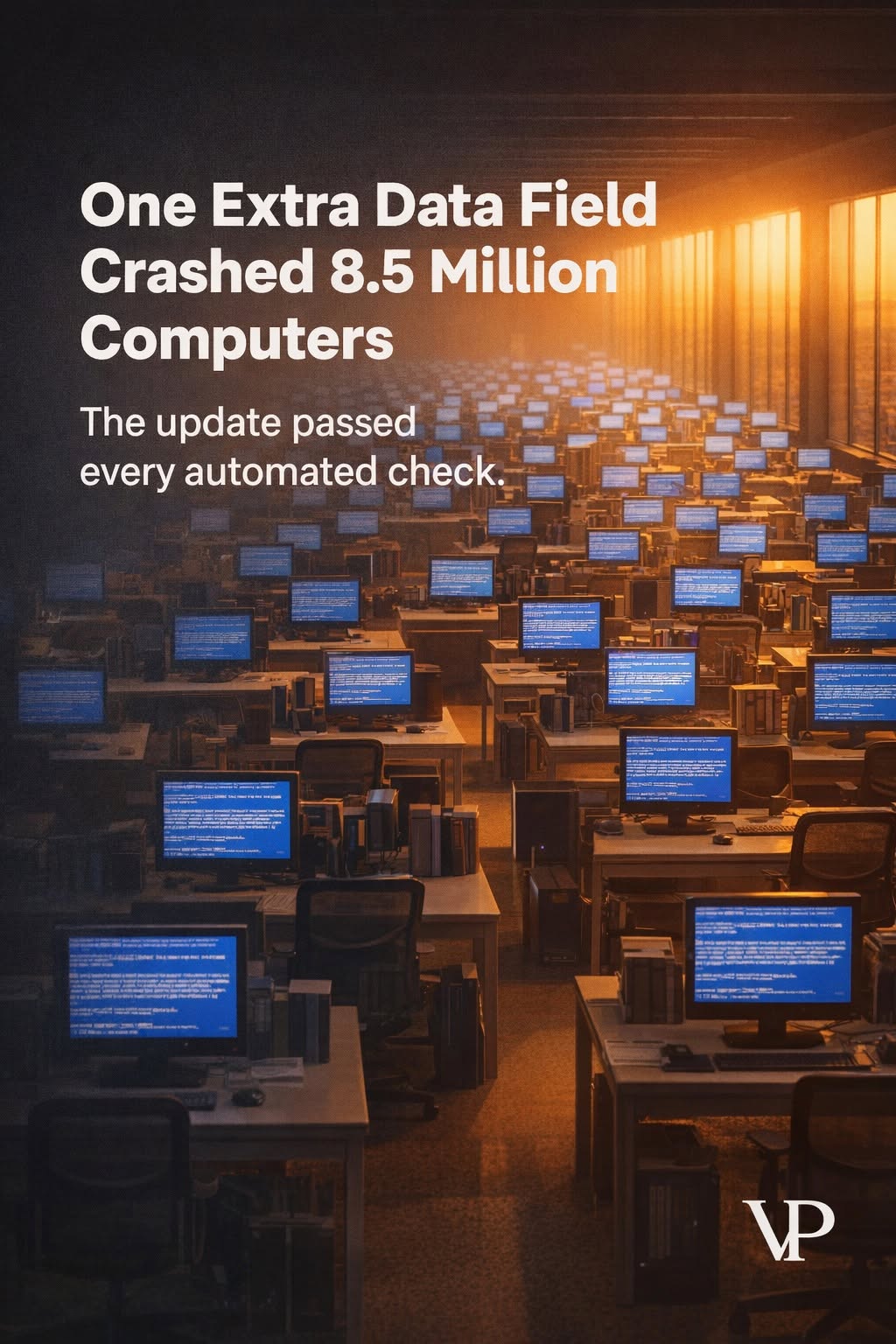
One satisfying config file satisfying took down 8.5 million computers in a single morning.
Not a cyberattack. Not ransomware. A routine security update.
On July 19, 2024, a configuration file pushed by CrowdStrike contained a mismatch that no one caught. The cloud system expected 21 data fields. The software actually running on those machines only knew how to handle 20.
That one extra field triggered an out-of-bounds memory read deep inside the Windows kernel. Instant blue screen. Endless reboot loop. No way to fix it remotely because the very software meant to receive a rollback command was the thing causing the crash.
IT teams had to physically touch each machine. Boot into Safe Mode. Manually delete the bad file. One by one. Across entire enterprises.
The estimated global damage exceeded $10 billion.
Here's what stuck with us when we dug into this: the update passed every automated check. The validator approved it. The problem wasn't that testing failed. The problem was that the validator and the software running on actual endpoints had different assumptions about the same data.
Two parts of the same system, each "correct" by its own logic, completely incompatible in practice.
Our new whitepaper breaks down exactly how this happened technically, the legal fallout that's reshaping software liability right now, and what a genuinely resilient architecture actually looks like.
Honest question for anyone in IT, engineering, or ops → should software that runs at the deepest level of your operating system ever be allowed to update itself without staged rollouts?
#SoftwareResilience #CyberSecurity #DeepAI