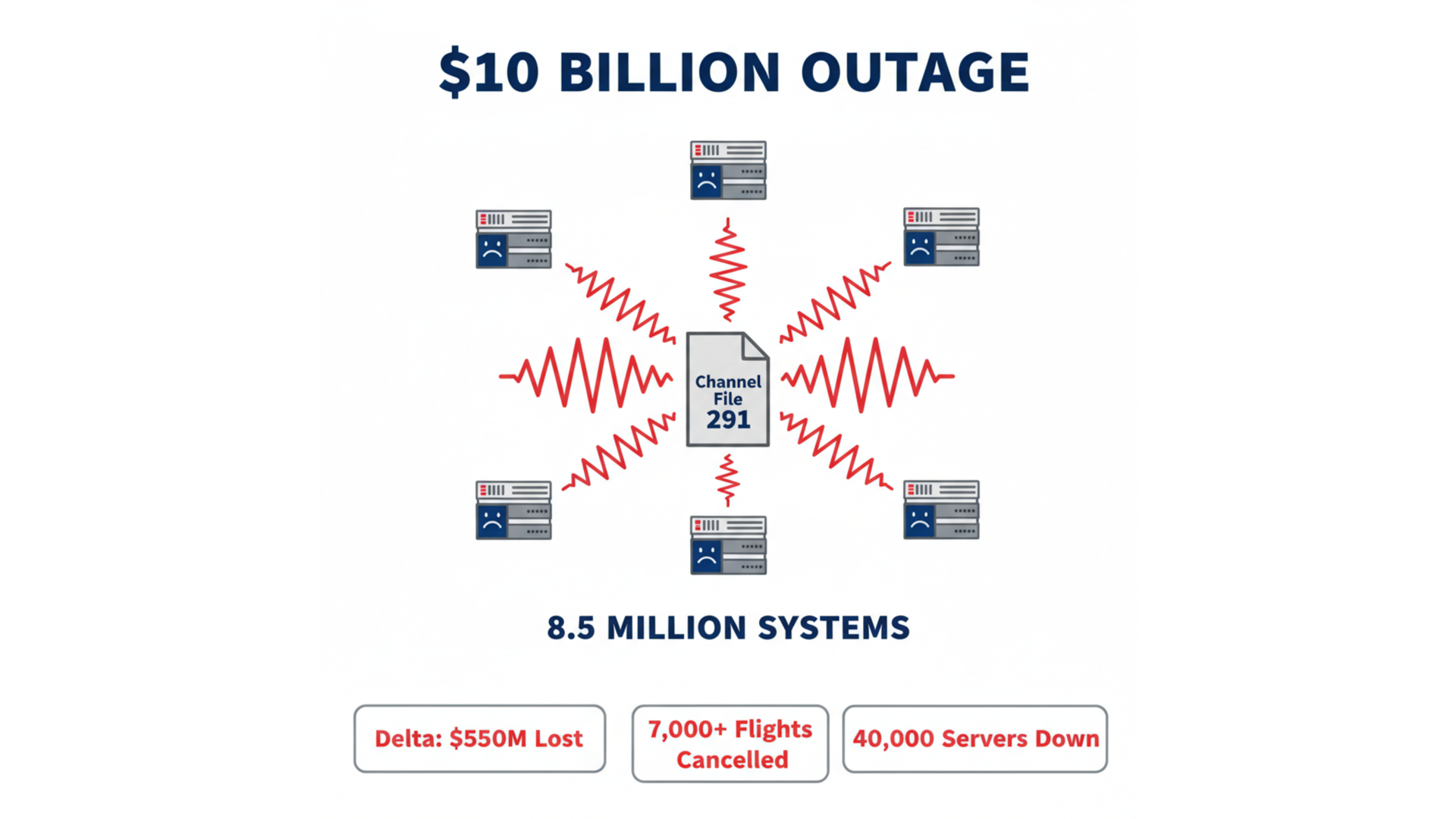
On July 19, 2024, a single configuration file crashed 8.5 million Windows systems simultaneously. The global cost exceeded $10 billion. Delta Air Lines alone lost $550 million and cancelled over 7,000 flights. And the root cause wasn't a cyberattack or a zero-day exploit -- a security flaw discovered before anyone has a fix. It was an update that nobody tested on a single machine before pushing it to every endpoint on Earth.
When I first read the technical root cause analysis, I sat with it for a long time. Not because the failure was exotic -- it wasn't. It was a bounds-checking error, the kind of bug a second-year computer science student learns to avoid. The CrowdStrike Falcon sensor tried to read a 21st data field from a configuration template that only supported 20. In the kernel -- the deepest, most privileged layer of the operating system -- that single out-of-bounds read triggered an instant crash and an endless reboot loop.
That's when it hit me: the biggest IT outage in history was entirely preventable. And the tools to prevent it already exist. We've just been choosing speed over integrity.
I explored this problem in depth in our interactive analysis, and the more my team dug into it, the clearer the picture became.
Why Couldn't CrowdStrike Just Roll It Back?
This is the question everyone asks first. The answer is both simple and infuriating.
The crash happened so early in the boot sequence that the Falcon management agent -- the software responsible for receiving remote commands -- never had time to start. Every affected machine was "orphaned." CrowdStrike couldn't send a rollback command because the thing that would process that command was the thing that caused the crash.
8.5 million machines, each requiring a human being to physically boot into Safe Mode and delete a single file.
For Delta, that meant hands-on recovery of roughly 40,000 servers and thousands of workstations. Their crew-tracking system, built on Windows, went dark. Pilots and flight attendants couldn't be located or reassigned. While American Airlines and United recovered within 72 hours, Delta's disruption stretched past five days.
I remember a conversation with my team where someone asked: "What if there had been an AI system monitoring the kernel's behavior in the first millisecond after that update loaded?" That question became the seed for much of what we've built since.
The Courtroom Is Rewriting the Rules
The fallout didn't stay in the server room. In May 2025, a Georgia judge ruled that Delta's lawsuit against CrowdStrike could proceed on claims of gross negligence and computer trespass -- not just breach of contract.
That distinction matters enormously. Software vendors have historically hidden behind contract terms that cap liability at the subscription cost. But the court found that pushing an untested kernel-level update to every customer simultaneously, without staged rollout, without canary deployment (rolling out changes to a small group first before everyone), without even a single test machine -- that might constitute a conscious disregard for known risks.
The computer trespass claim is even more striking. Delta had opted out of automatic updates. CrowdStrike pushed the configuration change through a kernel-level channel anyway, bypassing that preference. The judge ruled that statutory duties around unauthorized computer access exist independently of whatever the subscription agreement says.
The "gross negligence" of today is becoming the baseline expectation of tomorrow.
This isn't just a CrowdStrike problem. Every vendor that pushes privileged updates -- and every enterprise that accepts them without verification -- needs to reconsider their risk model.
The "Wrapper" Problem in AI Is the Same Structural Flaw
I've been watching the AI consultancy market closely, and I see the same pattern repeating. The majority of AI solutions on the market today are what I call "LLM wrappers" -- thin application layers that rent intelligence from a third-party model (GPT-4, Gemini, Claude) and dress it up with a user interface.
These wrappers work fine for generating marketing copy or summarizing emails. But they share a dangerous trait with the CrowdStrike architecture: they push complexity to the edges without verifying what happens there.
When your AI system is just an API call to someone else's model, you're one pricing change, one model deprecation, or one provider outage away from a business disruption. My team started calling this the "Deep Tech Crash" scenario -- a cascading failure where business-critical applications collapse because the AI infrastructure underneath them belongs to someone else.
The alternative is what my team has been calling "Deep AI." Not a wrapper, but intelligence integrated into the actual architecture of your systems. Specialized models running on your infrastructure. Formal verification ensuring correctness. Predictive telemetry catching anomalies before they cascade.
Formal Verification: The Math That Could Have Prevented This
The bounds-checking error that crashed 8.5 million machines would have been mathematically impossible under formal verification. This technique uses proofs -- not tests, not QA checklists, actual mathematical proofs -- to guarantee that software behaves exactly as specified.
For decades, formal verification was impractical at scale because writing proofs required enormous human effort. The seL4 microkernel, one of the few formally verified operating system kernels, took years of painstaking work. But AI is changing that equation rapidly.
Tools like VeCoGen now combine large language models with formal verification engines to automatically generate verified C code. The AI writes the implementation and the proof simultaneously. A separate proof checker -- think of it as an incorruptible gatekeeper -- rejects anything that doesn't pass mathematical scrutiny. As Martin Kleppmann predicted, we're entering an era where AI-generated code will be preferred over handcrafted code precisely because the machine can produce the proof alongside the program.
For the full technical methodology behind this shift, see our detailed research.
We don't need to choose between development speed and software correctness anymore. AI gives us both.
What a "Self-Healing" System Actually Looks Like
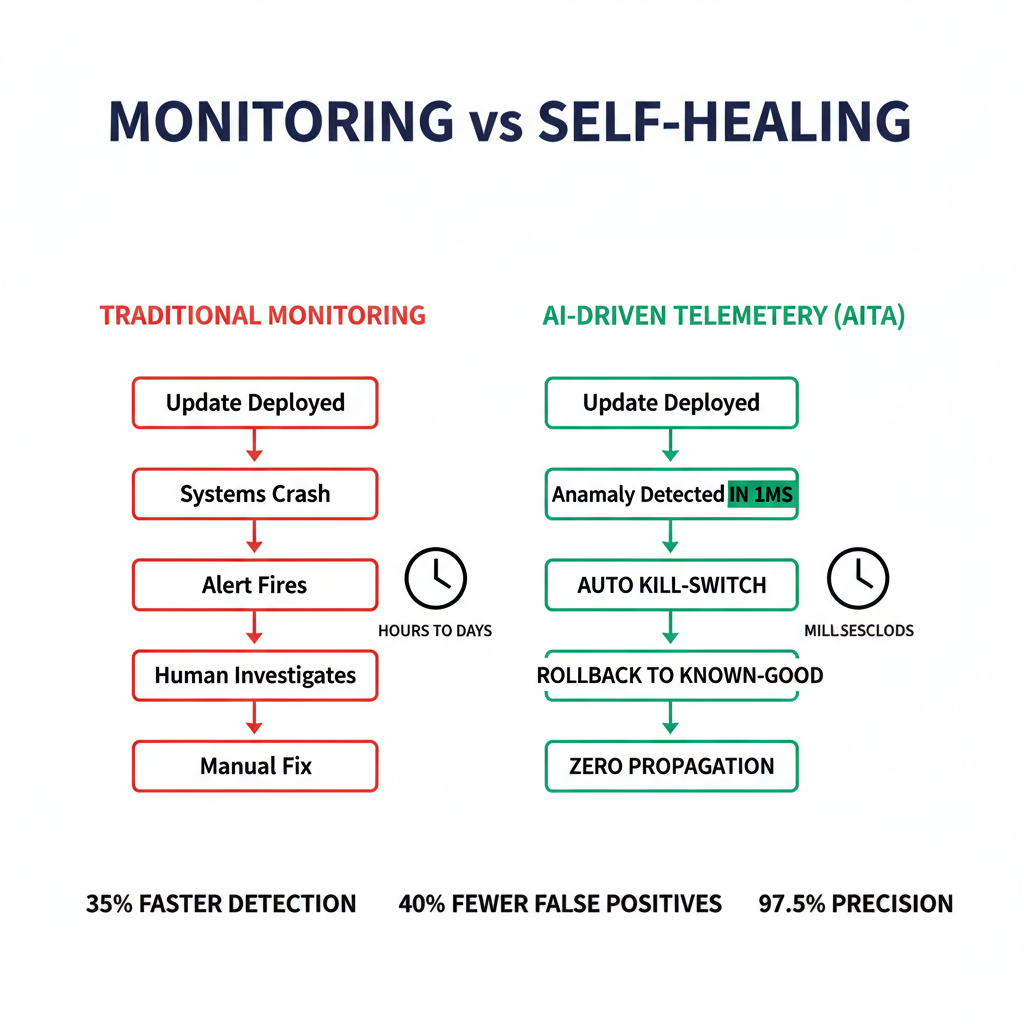
After the CrowdStrike crash, one of the most frustrating realizations was that the system had no ability to detect its own failure. The update went out, machines started crashing, and there was no automated mechanism to halt the rollout in those critical first seconds.
My team has been building around an approach called AI-Driven Telemetry Analytics, or AITA. Instead of static monitoring rules like "alert if CPU exceeds 90%," AITA uses unsupervised machine learning -- AI that finds patterns without being told what to look for -- to establish what "normal" actually looks like across the full hardware stack. The results from peer-reviewed research are striking: 35% reduction in detection time, 40% fewer false positives, and anomaly detection running at 97.5% precision.
In practical terms, an AITA-enabled kernel sensor would have flagged the out-of-bounds memory read as a deviation from baseline within the first millisecond of evaluation. It would have triggered a local kill-switch -- isolating the faulty driver, rolling back to the last known-good configuration -- before the crash could propagate across 8.5 million endpoints.
That's the difference between monitoring and resilience. Monitoring tells you something broke. Resilience means the system fixes itself before you notice.
"Isn't Formal Verification Overkill for Most Companies?"
I hear this objection often. The honest answer: it depends on where in your stack you're talking about.
For a marketing dashboard? Probably overkill. For anything that runs in the kernel, touches financial transactions, or controls medical equipment? It's negligent not to verify it. The CrowdStrike outage proved that a single configuration file operating at Ring 0 -- the highest privilege level in the operating system -- can take down global infrastructure. The legal system is now catching up to that reality.
What surprised me most about this research was how quickly the economics are shifting. Five years ago, formal verification was a luxury reserved for aerospace and military systems. Today, AI-driven proof generation is making it accessible to any organization that considers software integrity non-negotiable.
What Should Your Organization Do Right Now?
Start with your kernel-level dependencies. Find out exactly which vendors push updates to Ring 0 on your systems, and demand staged rollout protocols with defined watch windows between each deployment wave. If a vendor won't agree, that tells you everything you need to know about how they think about your risk.
Then take a hard look at your AI stack. If your business depends on AI capabilities, renting intelligence from a third-party API isn't resilience -- it's a different kind of single point of failure. Sovereign models, specialized systems running on your own infrastructure, don't disappear when a provider changes their pricing. A Small Language Model deployed locally will outlast the largest model behind someone else's API wall.
The last piece is verification, and it needs to live inside your pipeline, not around it. Governance can't be an afterthought or an external audit. Real-time verifiers running alongside every deployment, catching failures before they reach production -- that's the standard the courtroom is already holding vendors to.
Digital sovereignty and software integrity aren't features you add later. They're prerequisites for survival.
The CrowdStrike outage was a $10 billion warning. The Delta lawsuit is rewriting what "negligence" means for software vendors. And formal verification, once an academic curiosity, is becoming a competitive necessity.
I keep coming back to a question that I think every technology leader needs to sit with: if a single untested configuration file can paralyze global infrastructure, what does that say about everything else we're trusting without proof?
If you're grappling with these questions in your own organization -- how to move from reactive monitoring to genuine resilience, how to evaluate whether your AI investments are "deep" or just "wrapped" -- I'd genuinely like to hear how you're thinking about it.