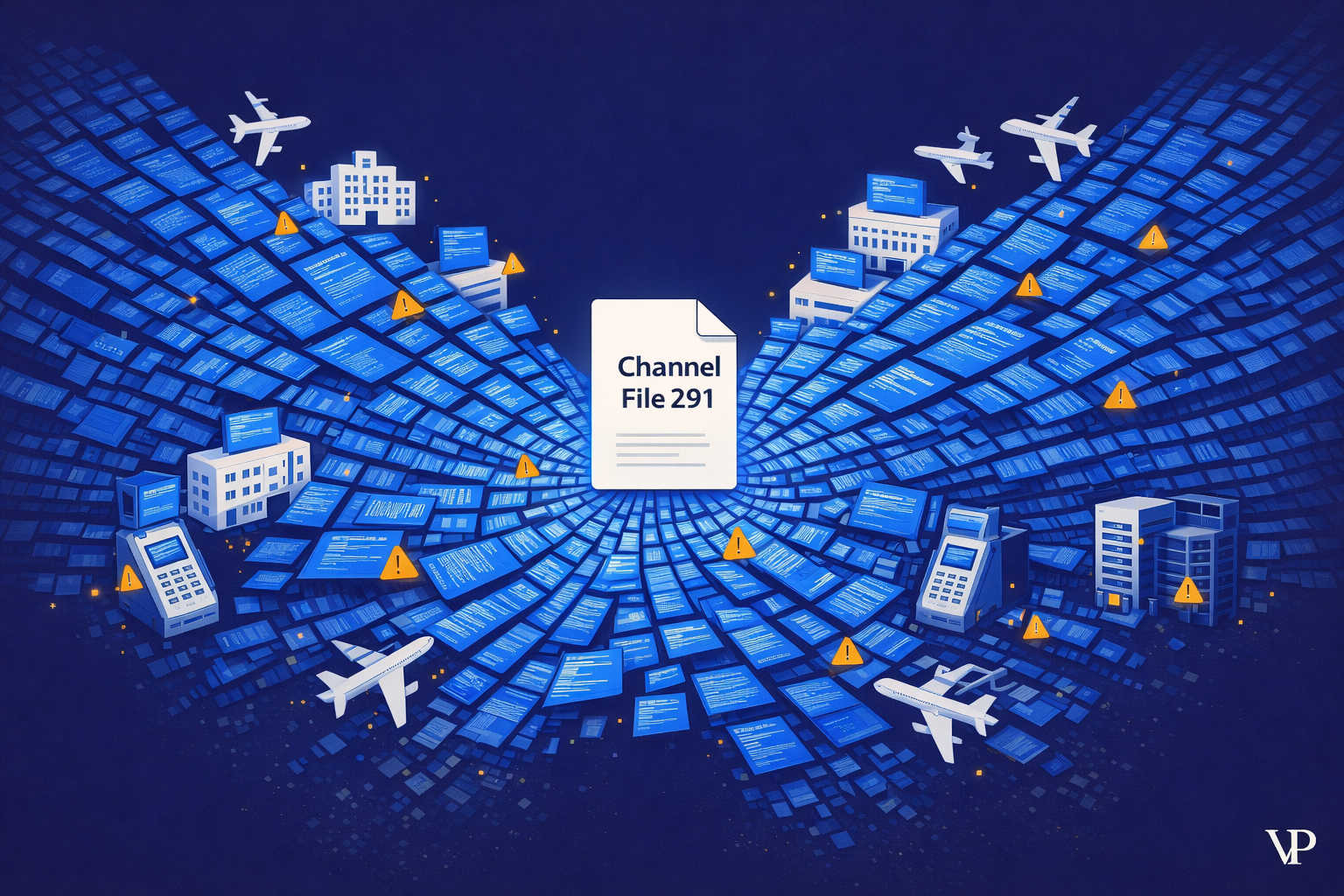
On July 19, 2024, a single configuration file — not a cyberattack, not ransomware, not a nation-state exploit — crashed 8.5 million Windows computers simultaneously. Airlines grounded flights. Hospitals postponed surgeries. Payment systems froze. The final damage estimate: $10 billion in global losses, with Fortune 500 companies alone absorbing $5.4 billion. The CrowdStrike outage wasn't just the largest IT failure in history. It was a blueprint for understanding why the way we build, deploy, and trust software — including AI systems — is fundamentally broken.
We've spent months analyzing the technical root cause, the legal fallout, and the architectural lessons of this event. What emerged isn't a story about one company's mistake. It's a warning about what happens when speed outpaces verification in any complex software system — and a roadmap for building something better.
A Security Tool Became the Threat It Was Supposed to Prevent
The CrowdStrike Falcon platform operates in the deepest layer of your operating system — the kernel, sometimes called "Ring 0." This is the layer with the highest privileges, where a single error doesn't produce an error message. It produces a Blue Screen of Death.
On July 19, CrowdStrike pushed a routine update through its "Rapid Response Content" system. This wasn't a full software update — it was a configuration file, Channel File 291, containing behavioral detection patterns. Think of it like updating the rulebook a security guard follows, without replacing the guard.
The problem: the new rulebook referenced 21 data fields. The guard — the actual code running on every endpoint — only knew how to read 20.
When the software tried to read a 21st field that didn't exist, it reached beyond its allocated memory. In the kernel, that's not a recoverable error. It's an instant crash.
Every affected machine entered an endless reboot cycle. The faulty file reloaded on every restart, crashing the system again before it could even connect to the internet to receive a fix. IT teams had to physically touch each machine — booting into Safe Mode, navigating to a system directory, and manually deleting the file. Delta Air Lines alone had to recover approximately 40,000 servers this way.
The Validator Said "Safe." The Machine Disagreed.
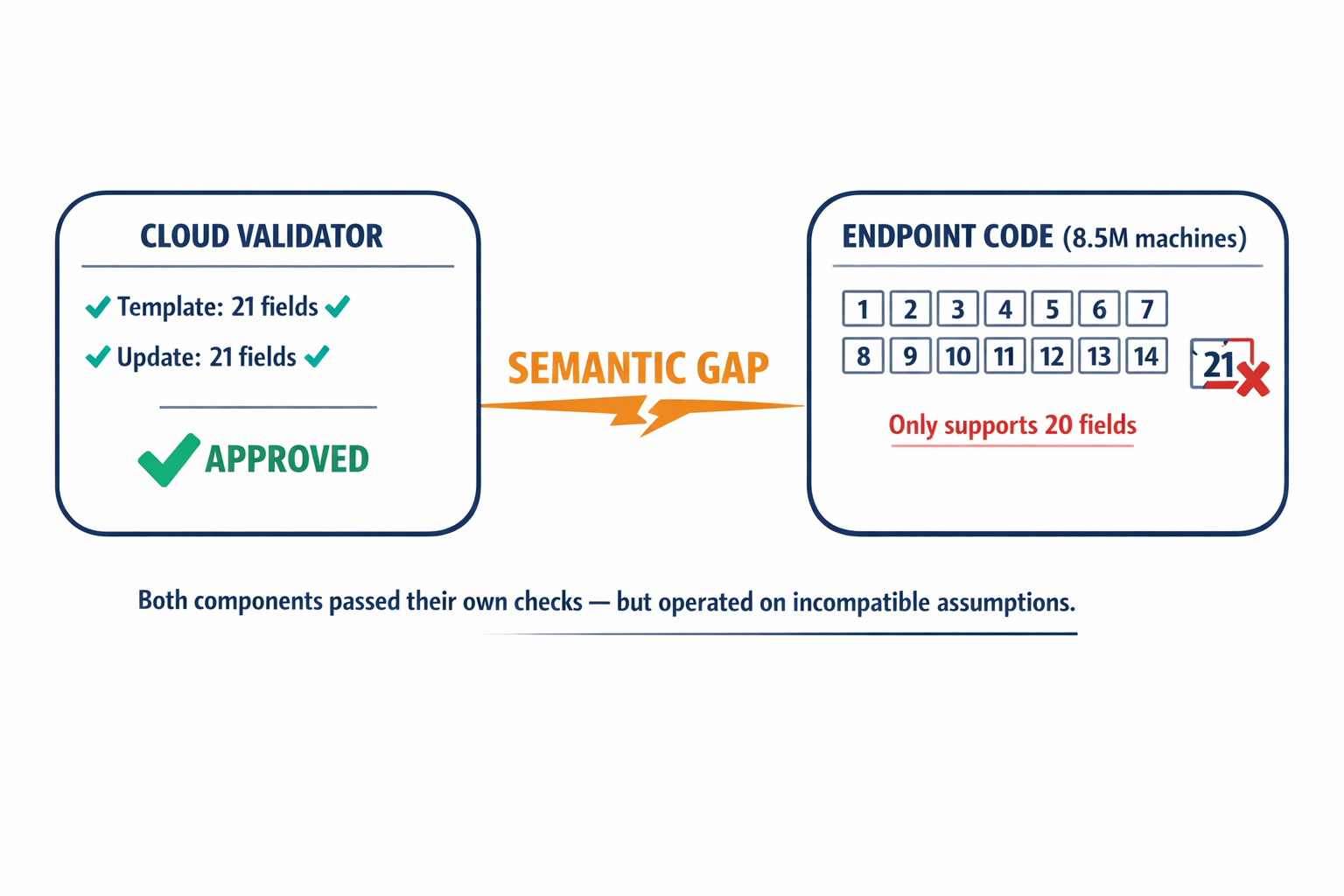
What makes this failure so instructive is where the breakdown actually occurred. CrowdStrike had a validation system — a cloud-based checker that reviewed every configuration update before deployment. On July 19, the validator approved the update. It saw 21 fields in the template definition, saw 21 fields in the update, and concluded everything matched.
But the validator was checking against the wrong reference point. The cloud definition had been updated to expect 21 fields. The actual code running on millions of endpoints still only supported 20. The validator and the interpreter had different understandings of reality, and nobody caught the gap.
This is what engineers call a "semantic gap" — two components that look compatible on paper but operate on incompatible assumptions. It's the software equivalent of two departments in a company using the same spreadsheet template but with different column definitions. Everything looks fine until someone tries to reconcile the numbers.
We explored this failure mechanism in detail — along with the "Dead Agent" race condition that made remote recovery impossible — in our interactive analysis of the outage.
Delta's Lawsuit Is Rewriting the Rules of Software Liability
The technical story is alarming. The legal story may be transformative.
Delta Air Lines suffered $550 million in losses and cancelled over 7,000 flights. While competitors recovered within 72 hours, Delta's disruption lasted more than five days — largely because its crew-tracking systems ran on Windows-based applications that couldn't function without those crashed servers.
Delta sued CrowdStrike. In May 2025, a Fulton County judge allowed the case to proceed on claims that would have been dismissed a decade ago:
Gross negligence: Delta alleges CrowdStrike pushed the update to all 8.5 million systems at once, with no staged rollout, no canary deployment, and — according to CrowdStrike's own post-incident report — no test on even a single machine running the actual endpoint code.
Computer trespass: Delta had opted out of automatic updates. The configuration file bypassed that preference entirely, deploying through a kernel-level channel that customers couldn't control. The judge ruled this claim could proceed independently of any contract terms.
The court effectively said: your contract's liability cap doesn't protect you when you may have accessed someone's systems without authorization.
This is significant for every enterprise that depends on software operating at high privilege levels. The standard playbook — bury liability limits in a subscription agreement, push updates at will, apologize later — is under direct legal challenge. The "gross negligence" of today is becoming the baseline legal expectation of tomorrow.
Why "AI Wrappers" Won't Solve Structural Problems
The CrowdStrike outage wasn't an AI failure. But the lessons map directly onto how most organizations are adopting AI today.
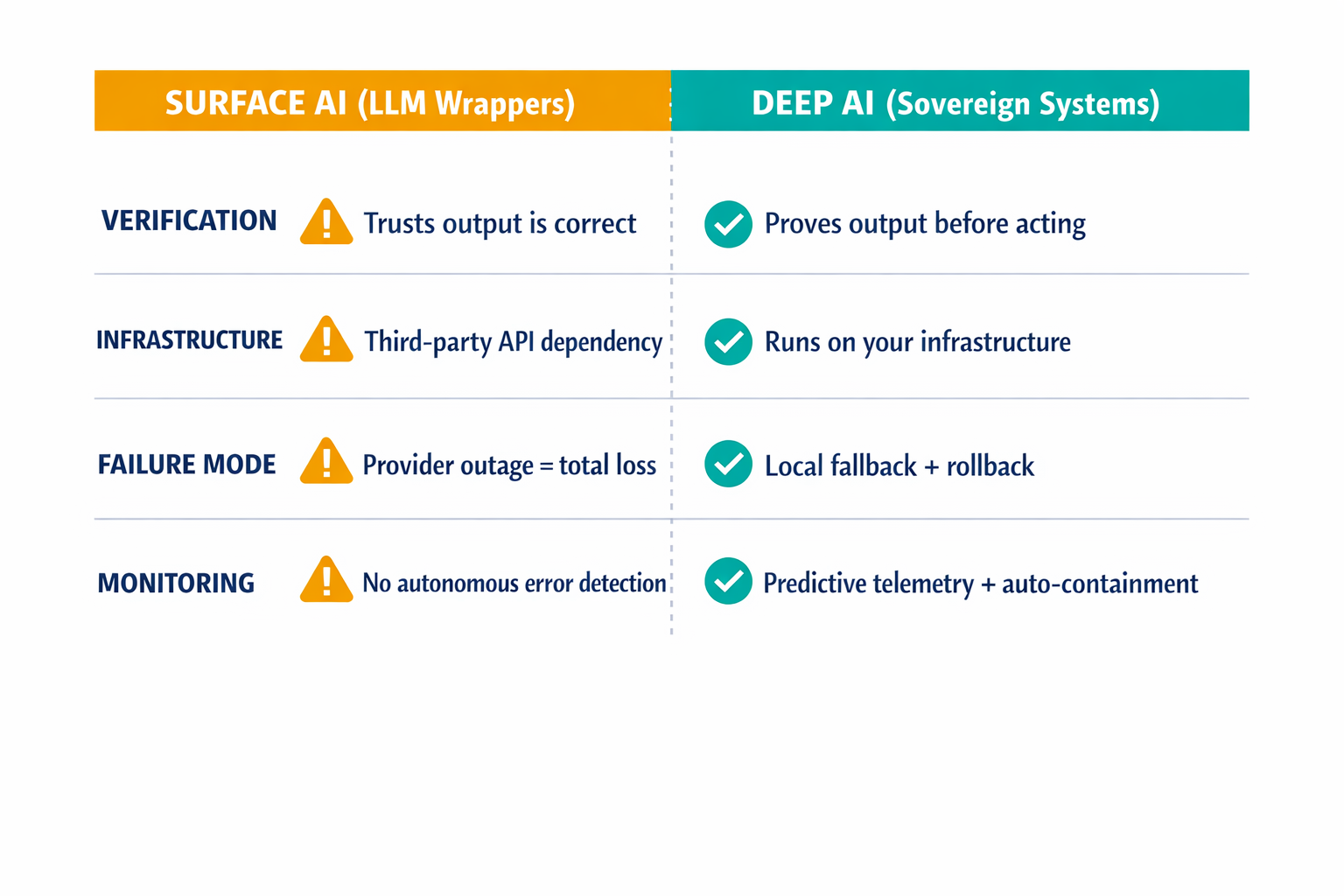
The current market is flooded with what we call "LLM wrappers" — applications that connect to a third-party AI model like GPT-4 or Claude, add a user interface, and call it a product. These tools are useful for content generation, summarization, and simple automation. But they share a critical vulnerability with the CrowdStrike update pipeline: they operate on assumptions about an underlying system that they don't verify.
An LLM wrapper trusts that the model will behave predictably. It trusts that the API will remain available. It trusts that the output is correct. There's no mathematical proof, no formal verification, no autonomous monitoring that catches errors before they propagate. It's the same "best-effort" approach that let a 21-field configuration file crash millions of machines.
We draw a distinction between this "Surface AI" and what we call Deep AI — systems that integrate with core business logic, use formal verification to guarantee correctness, and employ predictive telemetry to detect problems before they cascade.
The difference isn't academic:
Surface AI generates text and hopes it's right
Deep AI proves its output is correct before it acts
Surface AI depends entirely on a third-party provider's uptime and pricing decisions
Deep AI runs on your infrastructure, under your control
This is what we mean by AI sovereignty — the principle that your most critical AI capabilities shouldn't be rented from a provider who can change terms, raise prices, or experience their own catastrophic failure at any time.
Formal Verification: Proving Software Correct Before It Ships
The CrowdStrike bug — an out-of-bounds memory read caused by a mismatch between two components — is exactly the kind of error that formal verification eliminates.
Formal verification uses mathematical proofs to confirm that software always behaves according to its specification. Not "usually." Not "in our testing." Always. It's the difference between testing a bridge by driving trucks across it and proving through engineering calculations that it can support any load within its design parameters.
Historically, formal verification was too expensive and labor-intensive for most commercial software. The seL4 microkernel — one of the few formally verified operating system kernels — required years of painstaking human effort. But AI is changing the economics dramatically.
Tools like VeCoGen now combine large language models with formal proof engines. The AI generates candidate code, submits it to a mathematical proof checker, and iterates until the proof succeeds. As researcher Martin Kleppmann has argued, we're approaching an era where AI-generated code may be more trustworthy than hand-written code — not because AI doesn't make mistakes, but because AI can generate the proof of correctness alongside the code itself.
The proof checker doesn't care if the code was written by a human or a machine. It only cares whether the math holds.
For the CrowdStrike scenario specifically, formal verification would have caught the semantic gap between the validator and the interpreter. Both components would have been required to satisfy a single, shared mathematical specification — making it impossible for one to expect 21 fields while the other only supported 20.
For the full technical methodology behind these verification approaches, see our detailed research on building resilient systems.
Predicting Crashes Before They Happen
Verification prevents known categories of bugs. But what about the unknown? What about the emergent failures that arise from the interaction of millions of components in a live production environment?
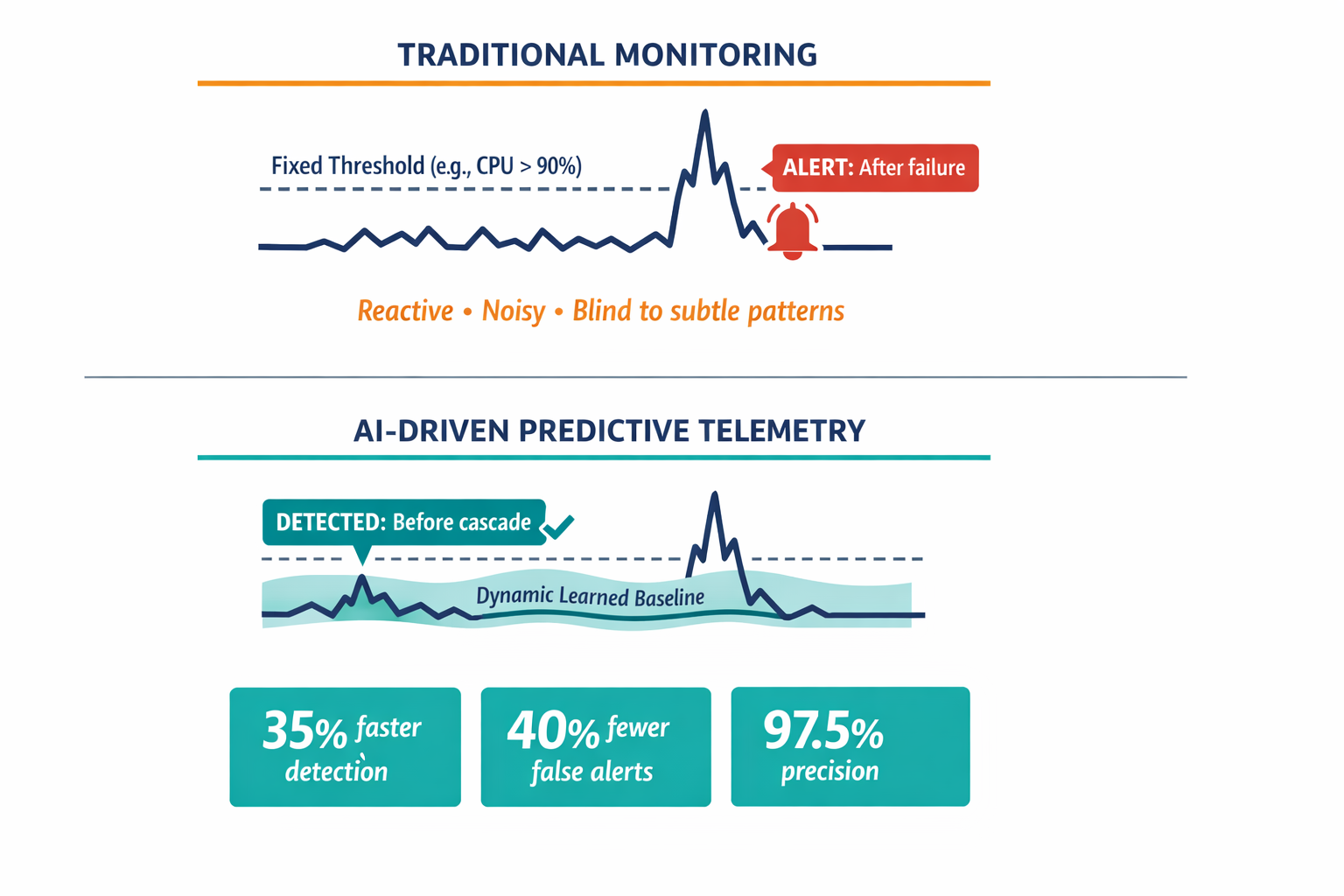
This is where AI-driven telemetry becomes essential. Traditional monitoring works like a smoke detector — it alerts you after the fire has started, based on fixed thresholds. "Alert if CPU exceeds 90%." "Alert if response time exceeds 500 milliseconds." These systems are reactive, noisy, and blind to subtle patterns.
Our research into AI-Driven Telemetry Analytics (AITA) frameworks shows a fundamentally different approach. Machine learning models trained on hardware and software telemetry data establish a dynamic baseline of "normal" behavior. They detect deviations — not based on arbitrary thresholds, but based on learned patterns of what healthy operation actually looks like.
The results from published research in this space are striking:
35% reduction in mean time to detect anomalies
40% reduction in false positives (the "alert fatigue" that causes teams to ignore real warnings)
97.5% precision in anomaly detection accuracy
Applied to the CrowdStrike scenario, an AITA-enabled system would have detected the out-of-bounds memory read within milliseconds of the first endpoint processing the update. That anomaly — a kernel-mode memory access pattern that deviated from every established baseline — would have triggered an automatic halt to the rollout before it reached more than a handful of machines.
The goal isn't faster incident response. It's making incidents that require response vanishingly rare.
This is what a "self-healing" system looks like in practice: automatic isolation of faulty components, dynamic rollback to known-good configurations, and real-time root cause analysis that tells your team why something failed, not just that it failed.
What If This Happens to an AI Provider?
One question we hear frequently: "The CrowdStrike outage was about a security tool, not AI. Why should AI leaders care?"
Because the dependency structure is identical — and in many cases, worse.
Consider a company that has built its customer service, internal knowledge management, and financial analysis workflows on top of a single LLM provider's API. Now imagine that provider experiences its own "Channel File 291 moment" — a bad model update, a corrupted fine-tuning run, or simply a prolonged outage. Every workflow breaks simultaneously. There's no fallback. There's no local model to switch to. The "Dead Agent" problem reappears: the system that's supposed to fix itself is the system that's broken.
Only 20% of companies currently have mature governance models for autonomous AI agents, according to Deloitte's 2026 State of AI report. That means 80% of organizations deploying AI have no systematic way to detect, contain, or recover from an AI system behaving unexpectedly.
The CrowdStrike outage cost $10 billion when a configuration file went wrong. The potential cost when an AI system — making thousands of autonomous decisions per minute across financial, operational, and customer-facing systems — goes wrong is a scenario most enterprises haven't seriously modeled.
Three Things Every Enterprise Should Do Now
We don't believe in publishing analysis without actionable recommendations. Based on our research, three priorities stand out:
Demand verification for high-privilege software. Any code operating in your kernel, managing your infrastructure, or making autonomous decisions should be subject to formal verification — or at minimum, staged rollout with automated rollback. The CrowdStrike outage proved that "we tested it in the cloud" is not the same as "we tested it where it actually runs."
Audit your AI dependency chain. Map every critical business process that depends on a third-party AI provider. For each one, answer: what happens if this provider is unavailable for 48 hours? If the answer is "we stop functioning," you have a sovereignty problem that needs architectural attention, not just a backup plan.
Invest in predictive telemetry, not just monitoring. Static threshold alerts were designed for a simpler era. Modern systems — especially those incorporating AI — need dynamic baselines, anomaly detection, and automated containment. The goal is to catch the next "Channel File 291" in its first millisecond, not its first million machines.
The largest IT outage in history wasn't caused by a sophisticated attack. It was caused by a configuration file that referenced a field that didn't exist. The lesson isn't that we need better defenses against complexity. It's that we need to prove our systems are correct before we deploy them — and build the intelligence to catch ourselves when we're wrong.
If your organization is rethinking how it approaches software resilience or AI infrastructure after events like this, we'd welcome the conversation.