What if your AI says a structure is “safe”… but physics says it will collapse?
The AEC industry is rushing toward Generative AI—but we’re overlooking a dangerous truth: plausible answers are not the same as correct answers. In structural engineering, that gap isn’t academic. It’s catastrophic.
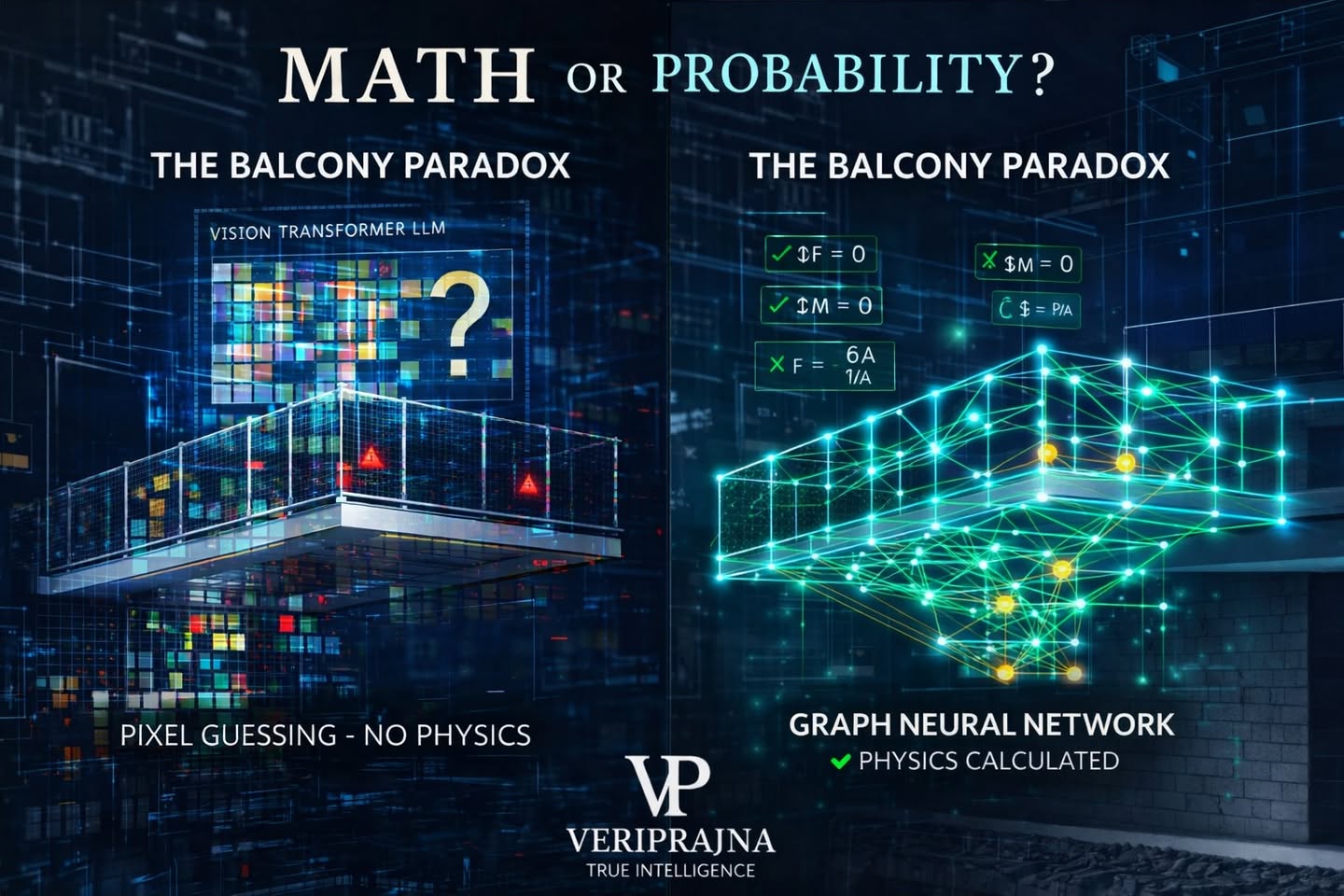
Our latest VeriPrajna whitepaper exposes what we call The Balcony Paradox:
👉 Multimodal LLMs look intelligent, yet they guess pixels instead of calculating loads.
👉 Physics, however, is unforgiving—either the load path exists, or it doesn’t.
Here’s what the data shows:
• In DSR-Bench, state-of-the-art LLMs maxed out at 0.498 accuracy on complex structural reasoning tasks—essentially a coin toss when constraints and multi-hop reasoning are required. 
• In DesignQA, models could quote engineering limits but failed to verify whether a real design met them. Fluent summaries. Wrong conclusions. 
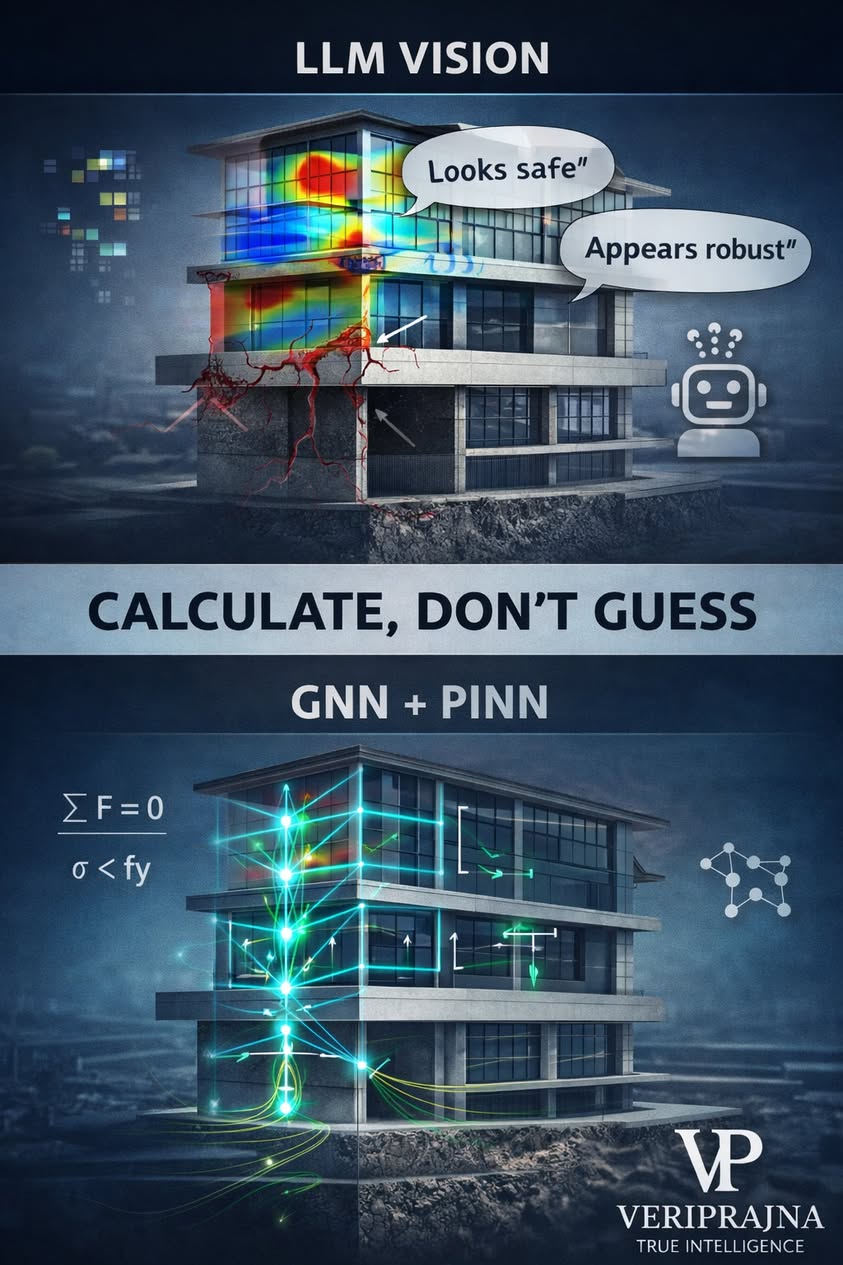
• Vision Transformers treat drawings as patches of pixels, not beams, columns, or load paths—explaining why AI can say “this looks safe” even when a critical connection is missing. 
At VeriPrajna, we take a fundamentally different approach.
We replace probabilistic guessing with deterministic verification by:
• Converting BIM and drawings into graphs, where nodes are structural members and edges are real load transfers
• Using Geometric Deep Learning + Physics-Informed Neural Networks (PINNs) that embed governing equations directly into the model
• Achieving 7–8× speedups over FEM while maintaining R² accuracy up to 0.9999, with full interpretability and on-premise security 
In short: We don’t ask “Does it look safe?”
We calculate “Will it hold?”
📄 Read the full whitepaper (link shared in the comments) to understand why the future of engineering AI must be built on math, graphs, and physics—not probabilities.
📩 Want to explore how this applies to your projects?
Email us at [email protected] or message us on WhatsApp +91 92170 59957 to discuss enterprise deployments, regulator use cases, or private on-prem implementations.
Are you building on a foundation of math—or probability?
#EngineeringAI #StructuralSafety #PhysicsInformedAI #GeometricDeepLearning