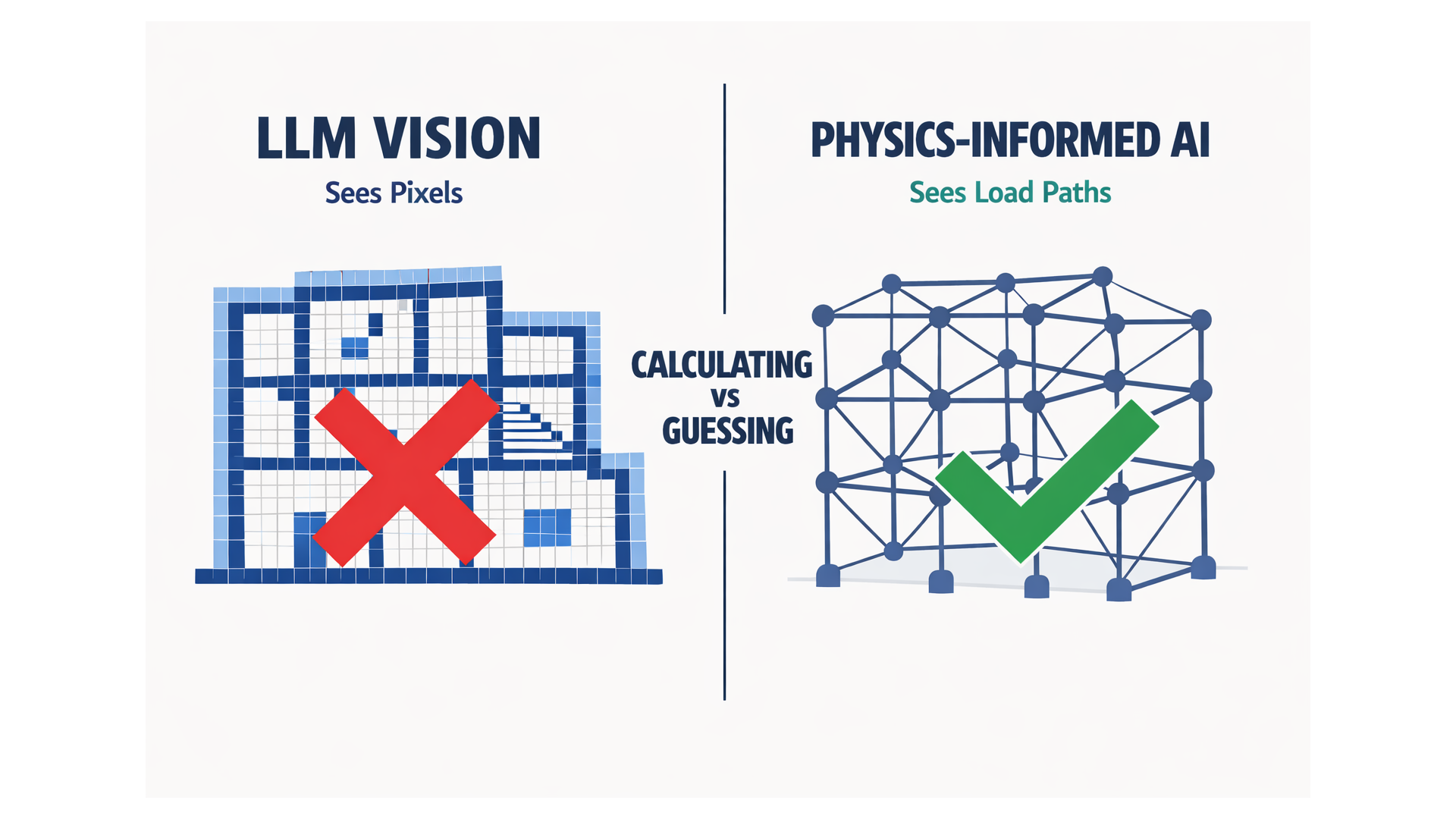
A balcony does not stand because an AI says it looks "robust." It stands because the load path is continuous, the stress stays within the elastic limit of the materials, and the math of equilibrium checks out. No exceptions. No probability. No vibes.
I have spent the better part of two years building Veriprajna around a conviction that most people in tech find uncomfortable: the current wave of generative AI is fundamentally unfit for structural engineering. Not because it is bad technology. Because it is the wrong kind of intelligence for a domain where a wrong answer is not an inconvenience -- it is a catastrophe.
When I first started explaining this to investors, I kept getting the same pushback: "But GPT-4 can read blueprints now." That sentence haunted me, because it captures the exact misconception that could get people killed. GPT-4 does not read blueprints. It looks at pixels and predicts which pixels probably come next. That distinction is everything.
What Actually Happens When an LLM "Reads" a Blueprint?
Multimodal Large Language Models like GPT-4V and Gemini process images using something called a Vision Transformer. It chops the image into small patches -- think 16-by-16 pixel squares -- and learns statistical correlations between those patches. A patch with a vertical line (a column) tends to appear near a patch with a horizontal line (a beam). The model learns that association.
But correlation is not causation. The model does not understand that the horizontal line is supported by the vertical one. If the vertical line disappears, the model's probability distribution shifts slightly. It has no internal physics engine screaming that the beam must now fall.
A connection detail that is "mostly there" but missing a critical load path is not 90% safe. It is 100% unsafe.
Research backs this up. When image pixels are scrambled, Vision Transformers often retain high classification accuracy -- proving they rely on texture and local patterns, not on understanding spatial structure. In software, that is a quirk. In engineering, where spatial structure is literally everything, it is a disqualifier.
Can LLMs Actually Reason About Structure?
I was skeptical of my own argument at first. Surely frontier models would improve fast enough. Then I read the DSR-Bench results and stopped hedging.
DSR-Bench evaluated ten state-of-the-art LLMs across 35 operations and 4,140 problem instances designed to test structural reasoning -- the ability to understand relationships between entities, which is a direct proxy for understanding a building's frame. The best frontier model scored 0.498 out of 1.0 on challenging instances. That is worse than a coin flip on the hard problems.
The failure modes were exactly what you would expect: the models collapsed on multi-hop reasoning (tracing a relationship through several intermediate points) and constraint satisfaction (following strict rules). When problems were described in natural language instead of code, performance dropped further -- the models were leaning on memorized syntax from GitHub, not engaging in genuine reasoning.
DesignQA, another benchmark built specifically for engineering design, found the same pattern. Models could answer "What is the maximum allowed deflection?" by extracting text from a building code. But they could not answer "Does this specific beam design meet that deflection limit?" The gap between retrieval and application is where buildings fail.
LLMs can quote the building code. They cannot apply it to the building.
Why Do LLMs Recommend the Wrong Materials?
One finding from the Autodesk research genuinely surprised me. When LLMs were asked to recommend materials, they consistently favored exotic, high-performance options -- titanium, carbon fiber -- even when the context called for cost-effective solutions. The reason is almost funny: those materials appear more frequently in the "high-tech" training data the models learned from.
Imagine an AI reviewing a residential balcony design. It suggests a high-strength alloy railing -- sounds impressively professional -- while completely missing that the concrete cantilever slab lacks top reinforcement. That is the actual failure mechanism. The model optimized for sounding smart, not for structural integrity. My team and I started calling this "confidence theater" -- the AI performs competence without possessing it.
How We Built an AI That Calculates Instead of Guessing
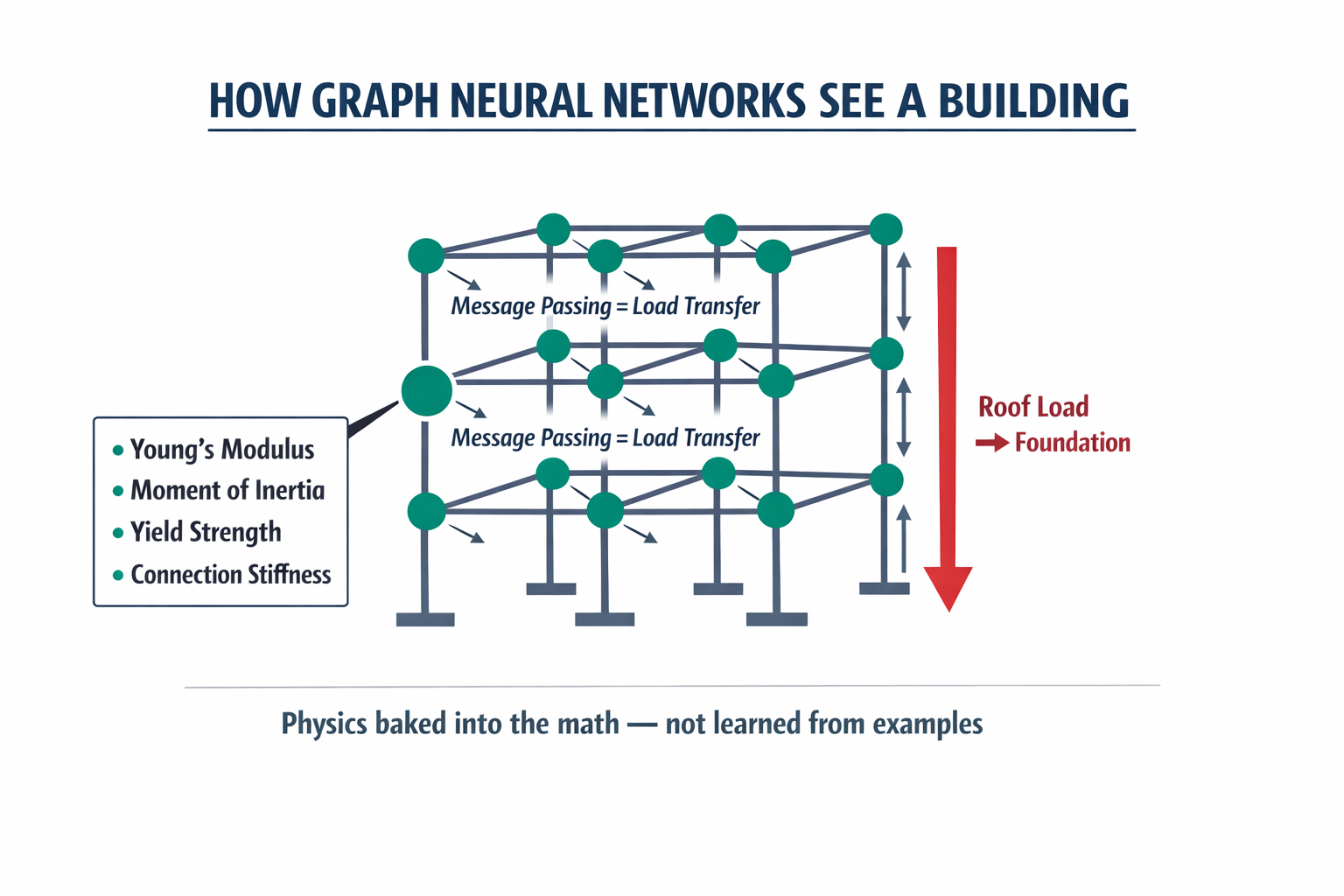
At Veriprajna, we took a fundamentally different path. Instead of feeding blueprints to a model as images, we convert them into mathematical graphs. A building is not a picture. It is a network of nodes and edges -- structural members connected by load paths.
Each node in our graph carries a rich feature vector: Young's Modulus (the stiffness of a material), Moment of Inertia (how resistant a shape is to bending), Yield Strength (the point where a material permanently deforms) -- the actual physical parameters you need for real calculations. Each edge captures connection stiffness and orientation. This is not a pixel. This is physics, encoded as data.
Our Graph Neural Networks use a mechanism called message passing that works almost exactly like load transfer in a real structure. Information flows from node to node along the edges, the same way force flows from beam to column. Stack enough layers, and a load applied on the roof mathematically influences the state of the foundation -- just like in reality. We explored this framework in depth in our interactive analysis.
The physics is not learned from examples. It is baked into the math -- the differential equations of equilibrium are part of the neural network itself.
This is the core of what are called Physics-Informed Neural Networks, or PINNs. When the network predicts a deflection shape that violates the laws of static equilibrium, the penalty term in the loss function -- essentially a mathematical alarm that fires when physics is violated -- spikes, forcing the network to correct itself. The AI literally cannot output an answer that breaks Newton's laws.
How Fast Can Physics-Informed AI Run?
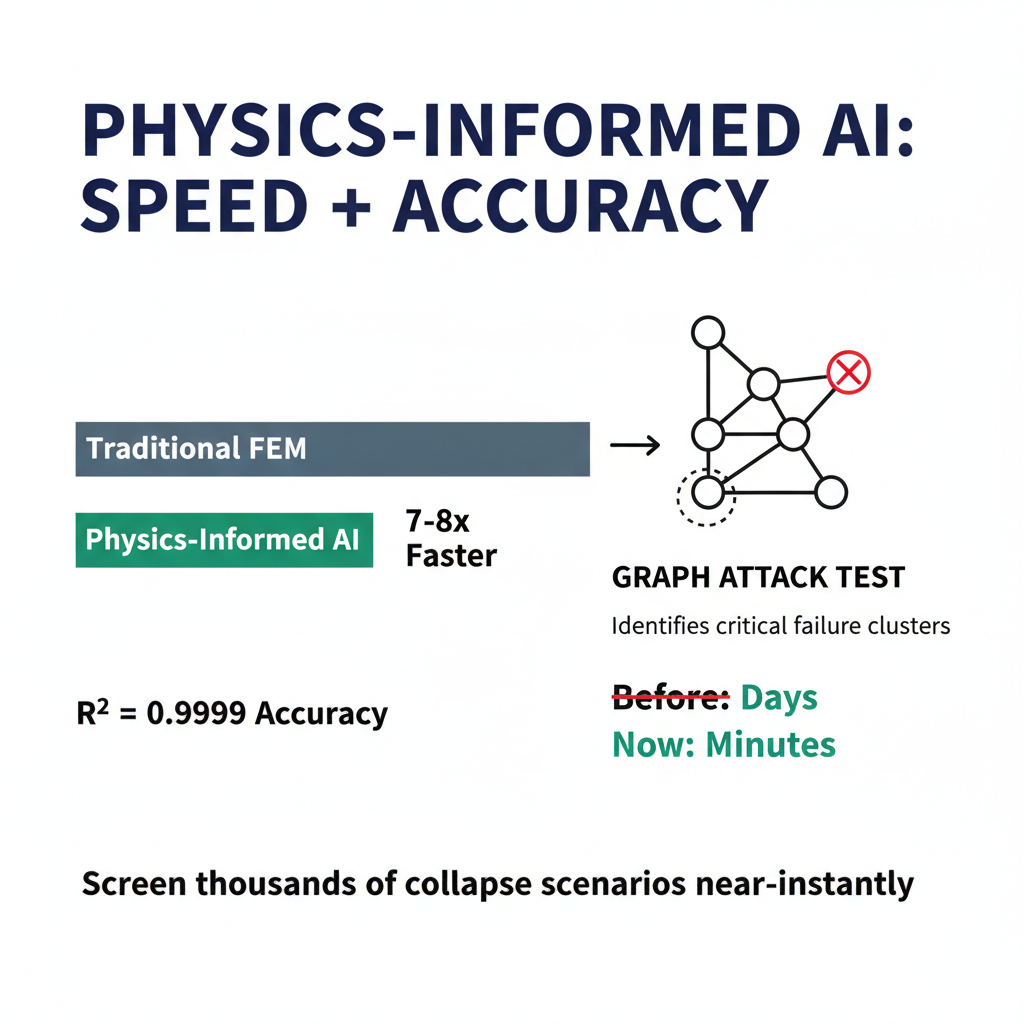
The skeptic's objection is always the same: "If you want physics, just use Finite Element Analysis." Fair point. We do not replace FEM -- we accelerate it. Our architecture, built on a Graph-Structured Physics-Informed Deep Operator Network, has demonstrated 7-8x speedups compared to traditional FEM solvers while maintaining an R-squared of 0.9999 -- essentially a perfect match between our predictions and the exact solutions.
That matters because real engineering workflows require screening thousands of scenarios -- progressive collapse, alternative load paths, material substitutions. Traditional FEM makes each scenario expensive. Our approach makes it near-instant.
We can simulate "graph attacks" -- systematically removing columns and re-evaluating the structure's connectivity -- to identify which clusters of components, if they fail, would split the building into disconnected pieces. That kind of robustness screening used to take days. Now it takes minutes. For the full technical methodology behind this, see our detailed research.
"But Won't Generative AI Get Better?"
Almost certainly. And I am not arguing we should ignore it. The future of design will involve generative AI for creative exploration -- architects using tools like Midjourney to prototype cantilevered balconies with parametric railings. That is the domain of imagination and probability.
But imagination needs a verifier. At Veriprajna, we built that verification layer. The generative model proposes a concept. Our system converts it to a graph, checks if the topology is connected, traces whether the principal load path reaches the foundation, and validates that predicted stresses stay within material limits. If it fails, the system returns a hard constraint -- "increase beam depth by 200mm" or "add a back-span connection" -- and the generative model tries again. Creativity constrained by physics.
There is also the data efficiency argument. LLMs need petabytes of internet data to learn a vague sense of what buildings look like. PINNs, because they are constrained by actual physics equations, train on small, structured datasets. A model trained on steel frames generalizes to new steel frames because Hooke's Law does not change between projects. And because the models are small and specialized, they run on-premise -- no need to send blueprints of sensitive facilities to a public API.
What Should You Ask Your AI Vendor?
The question I keep asking engineering leaders is simple: when your AI reviews a design, is it calculating or guessing? If it is predicting the next token based on what safety inspection reports typically say, it will almost always sound reassuring -- because most reports in its training data concluded "the structure appears sound." That statistical bias toward reassurance is exactly the failure mode that keeps me up at night.
Every structural report in the training data said the building was fine -- right up until one wasn't.
The AEC (Architecture, Engineering, and Construction) industry has a choice to make, and it is not between AI and no AI. It is between AI built on probability and AI built on physics.
If you are evaluating AI tools for structural review, I would push on one question: can the vendor show you the load path their model traced, node by node, from application point to foundation? If the answer involves a confidence score instead of a force diagram, you are looking at the wrong kind of intelligence.
I would genuinely love to hear how other engineering teams are thinking about this. The conversation matters more than the technology.