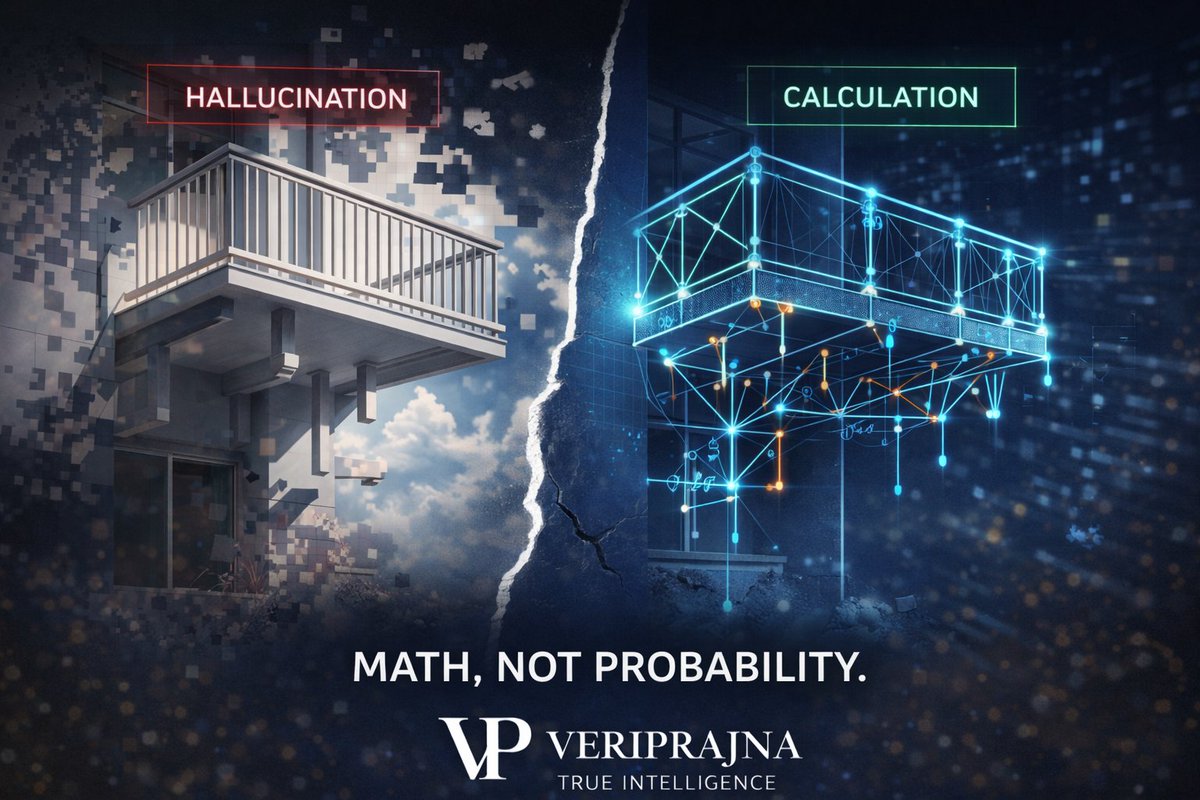

- The DSR-Bench 2024 results are in: Top LLMs score 49.8% on structural reasoning.
That's coin-flip reliability.
When your AI guesses pixels instead of calculating loads, you don't have innovation—you have liability. 🧵
#AI #StructuralEngineering - Vision Transformers divide blueprints into 16×16 pixel patches. They learn statistical correlations between patches, not spatial topology.
They might "see" a vertical line (column) near a horizontal line (beam)—but they don't know the beam is *supported* by it. - If you remove the column, the LLM's probability distribution shifts slightly.
But it has no internal physics engine to tell it the beam must now fall.
Correlation ≠ Causality. In structural safety, that gap is catastrophic. - DSR-Bench tested 10 LLMs on 4,140 structural reasoning problems.
Results:
• 0.498 score (out of 1.0) on complex instances
• Failed at multi-hop reasoning
• Failed at constraint satisfaction
• Performance dropped as spatial dimensionality increased
Source: arXiv 2024 - DesignQA benchmark found LLMs could *extract* requirements ("What's the max deflection?") but failed to *apply* them ("Does this beam meet max deflection?").
They can read the code. They can't verify compliance.
That's not engineering—it's autocomplete. - LLMs are stochastic engines. They predict the next token based on training data probability.
Structures are deterministic systems. If ΣF_y ≠ 0, the structure accelerates. No probability involved.
You're asking a probability engine to solve a certainty problem. - Veriprajna uses Geometric Deep Learning.
Buildings aren't images (Euclidean grids). They're graphs (non-Euclidean topology).
Graph G = (V, E)
• Nodes (V) = structural members with physical parameters (E, I, f_y)
• Edges (E) = load transfer connections
Math, not pixels. - We embed differential equations directly into the neural network loss function.
Standard AI: Minimize prediction error
Veriprajna PINNs: Minimize prediction error + physics residual
If the AI predicts a deflection that violates equilibrium, the loss spikes. It self-corrects. - Graph-Structured Physics-Informed DeepONet (GS-PI-DeepONet):
• R² = 0.9999 accuracy (FEM-level precision)
• 7-8× speedup vs traditional FEM
• Automated load path tracking via adjacency matrix
• Deterministic verification, not probabilistic guessing
Source: MDPI 2024 - A balcony doesn't stand because the pixels suggest "robust."
It stands when ΣM ≤ M_cap and the load path is continuous.
Are you building on a foundation of math, or probability?
Our team specializes in Physics-Informed AI. Let's discuss your implementation. - 📖 Read the full technical whitepaper here: https://veriprajna.com/whitepapers/deterministic-divide-physics-informed-ai-structural-engineering
📧 [email protected]
🌐 https://veriprajna.com
💬 WhatsApp: +919217059957
#AEC #BIM #CISO