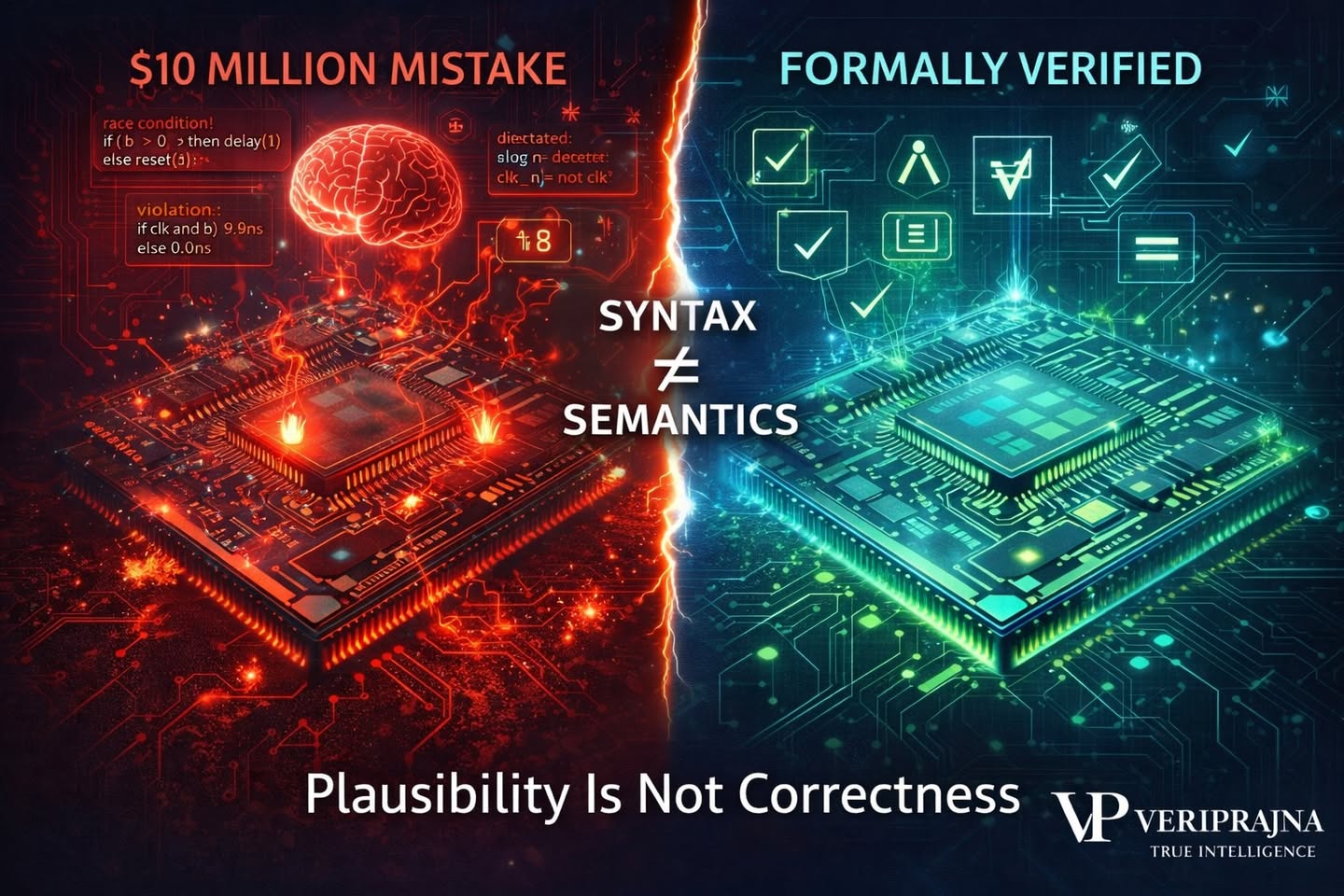

What if your AI-generated RTL passes simulation… but costs you $10 million in silicon?
The semiconductor industry is racing to adopt Generative AI for faster RTL development—but speed without correctness is a dangerous illusion. As this whitepaper reveals, only 32% of chips achieve first-silicon success, while the remaining 68% require at least one respin, often driven by subtle logic and concurrency bugs that never show up in simulation
Here’s the uncomfortable truth:
LLMs are probabilistic. Silicon is not.
A single hallucinated race condition, protocol violation, or CDC oversight can invalidate a $10–$20M mask set, delay tape-out by 3–6 months, and erase 30–50% of lifetime revenue
In our latest whitepaper, “The Silicon Singularity: Bridging the Chasm Between Probabilistic Generative AI and Deterministic Hardware Correctness”, we unpack:
- Why “LLM wrapper” copilots accelerate bug injection instead of eliminating risk
- How the Rule of Ten turns a $100 RTL bug into a $10M post-silicon disaster
- Real-world failure modes: simulation-resistant race conditions, protocol hallucinations, and CDC metastability
- How Neuro-Symbolic AI—combining GenAI with Formal Verification—enables correctness-by-construction, not hope-based design
Veriprajna’s Formal Sandwich™ methodology embeds formal proof directly into the AI generation loop—catching catastrophic bugs at the RTL stage, where they are cheapest to fix, and making zero-respin silicon a realistic goal
📄 Read the full whitepaper (link shared in comments) to see why “first-time-right” is no longer optional—it’s existential.
👉 Want to discuss how this applies to your SoC, accelerator, or RISC-V roadmap?
Email us at [email protected]
or message us on WhatsApp: +91 92170 59957 to start a confidential conversation on de-risking your next tape-out.
#GenerativeAI #SemiconductorDesign #FormalVerification #EDA #HardwareEngineering