A single race condition cost a design team $10 million. Not a typo. Not an exaggeration. A chip that simulated perfectly, passed every regression test, linted clean -- and deadlocked the moment real silicon came back from the foundry. The root cause was a subtle mismatch between how the code behaved in simulation and how it behaved once synthesized into actual transistors. The AI copilot that helped write the code saw valid syntax. The physics of nanometer-scale silicon saw a fatal flaw.
I founded Veriprajna because I watched this happen. And because I realized the semiconductor industry was about to make this mistake at scale. Every major EDA (Electronic Design Automation) vendor is now racing to wrap Large Language Models (LLMs) in a chat interface and call them "chip design copilots." The pitch is seductive: write Verilog in minutes instead of weeks. But an LLM that generates hardware code faster without verifying it more rigorously is just accelerating the production of expensive bugs.
That is not a hypothetical risk. It is an economic certainty.
Why Should the "Rule of Ten" Keep Every Chip Designer Awake?
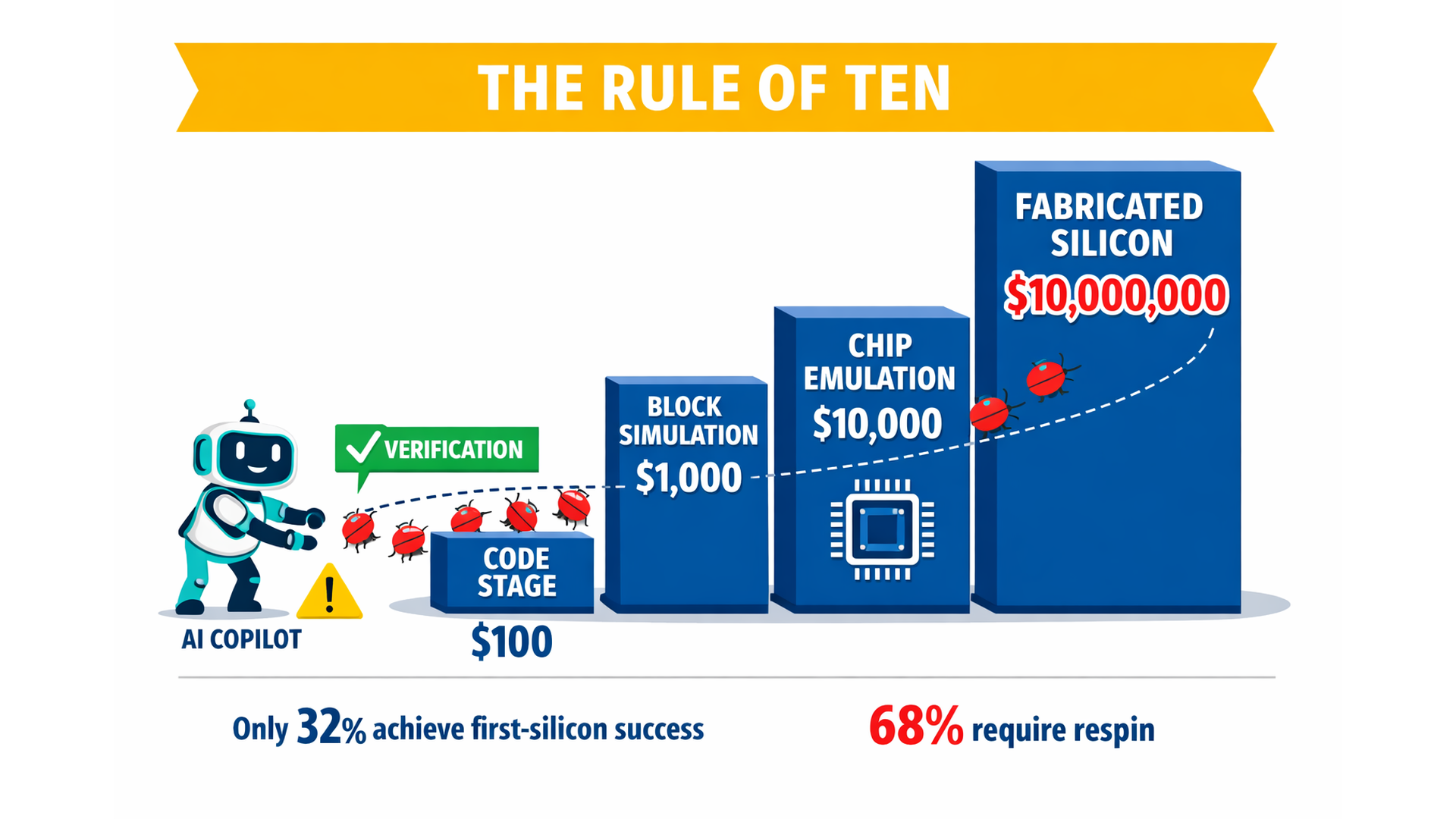
The semiconductor industry operates under what insiders call the "Rule of Ten." A bug caught while writing code costs about $100 to fix. Catch it during block-level simulation, and the cost jumps to $1,000. At full-chip emulation, you are looking at $10,000. But if that bug survives all the way to fabricated silicon -- if it only shows up when the chip is running in a lab -- the price tag is $10 million or more for a new mask set at advanced process nodes.
A 5nm mask set costs $10-20 million. Only 32% of designs achieve first-silicon success. The other 68% require at least one respin.
And the mask cost is not even the real damage. A respin adds three to six months to your schedule. In AI accelerators, where product generations last about 18 months, a six-month slip can erase 30-50% of a product's total lifetime revenue. For a company targeting a $100 million revenue stream, that is a $50 million loss -- five times the mask cost.
The current generation of AI coding tools operates almost entirely at the design stage. They help engineers write code faster. But because they lack any mechanism for deep verification, they push subtle bugs downstream, where the cost to find and fix them explodes exponentially.
Why Do LLMs Write Hardware Code That Looks Right but Is Wrong?
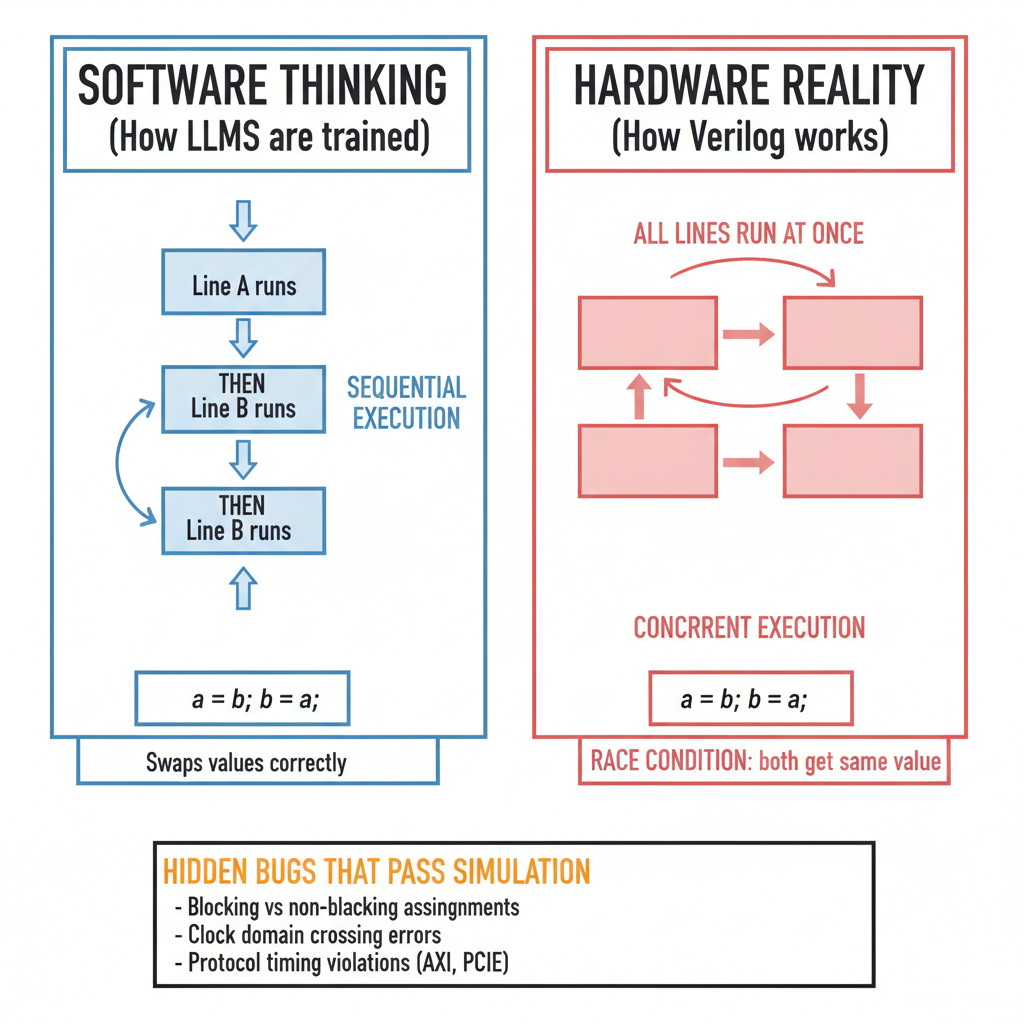
This is the part that surprised me most when I started investigating. LLMs are trained overwhelmingly on software -- Python, Java, C++. These are sequential languages. Line A runs, then Line B runs. The program's behavior follows the order you wrote it in.
Hardware description languages like Verilog work the opposite way. Everything runs concurrently and continuously. Every signal assignment, every logic block executes simultaneously. The order of lines in your source file often has zero relationship to what happens in the silicon.
The result is what I call "sequential bias." The LLM writes Verilog as if it were C code. It uses blocking assignments where non-blocking assignments are required. In software, a = b; b = a; swaps two variables. In a clocked hardware block using blocking assignments, that same code creates a race condition -- a and b can end up with the same value instead of swapping. The syntax is legal. The simulator might not catch it. The fabricated chip breaks.
Legal syntax is not correct hardware.
And it gets worse with protocols. Hardware interface protocols like AXI, PCIe, and TileLink (the standardized communication rules that connect different parts of a chip) have intricate temporal rules -- signals that must be held for specific numbers of clock cycles, handshakes that must follow exact sequences. An LLM can generate an AXI master that looks correct 90% of the time but violates a sub-clause of the AMBA (Advanced Microcontroller Bus Architecture) specification in a corner case. That code compiles. It simulates. And the chip hangs when connected to a compliant memory controller.
What Kinds of Bugs Can Simulations Never Find?
My team spent months studying the kinds of failures that slip through traditional verification. The pattern is consistent: the most dangerous bugs are "simulation-resistant."
Take the $10 million incident I mentioned. The arbiter entered an undefined state only under a specific, rare alignment of thermal throttling and high-bandwidth memory traffic. No reasonable testbench would generate that exact scenario. You would need to run billions of random simulations to stumble onto it by chance.
Or consider Clock Domain Crossing (CDC) errors -- what happens when a signal travels between two parts of a chip running at different speeds. If the signal changes value at the exact moment the receiving circuit samples it, the receiving flip-flop enters a "metastable" state, neither zero nor one, and that corruption can cascade through the entire chip. LLMs see signal names. They do not see clock domains. They routinely connect signals directly between domains, omitting the synchronization circuits that prevent metastability. Simulation without detailed timing models will pass. The silicon will not.
The open-source RISC-V (an open-source processor architecture) community has documented exactly this class of failure. Formal verification by Axiomise found a bug in the widely-used Ibex core where a debug request arriving at a specific cycle during a branch instruction could cause the processor to deadlock. Standard simulation missed it entirely.
What We Built Instead of Another Wrapper
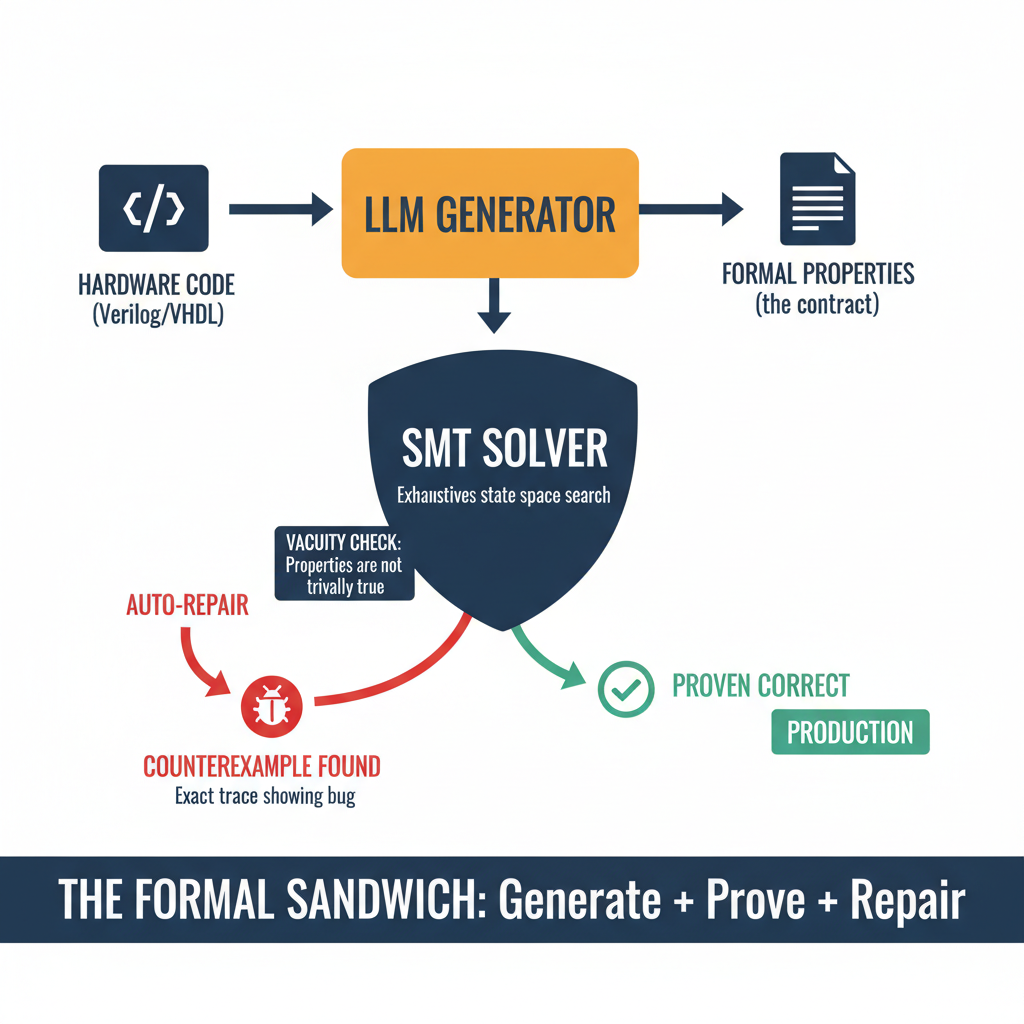
When I realized that the problem was not "LLMs are bad at hardware" but rather "LLMs need a mathematically rigorous critic," the architecture became clear. We built what we call the Formal Sandwich -- a neuro-symbolic system that combines the creative generation of neural networks with the absolute proof capabilities of formal verification.
I remember the exact moment this clicked. I was on a late-night call with one of our verification engineers, and she said something that stopped me cold: "We keep testing whether the code works. We should be proving that it can't fail." That distinction -- testing for success versus proving the impossibility of failure -- became the entire philosophy behind our approach.
The LLM does not just generate code. It generates two things simultaneously: the hardware implementation and a set of formal properties that define what "correct" means for that design. Think of it like writing a contract and a compliance test at the same time.
Then a Satisfiability Modulo Theories (SMT) solver -- essentially a mathematical engine that can explore every possible input combination -- tries to break the code. It does not run a thousand test cases. It exhaustively searches the entire state space, every possible combination of inputs and internal states, looking for any scenario where the code violates its contract. If it finds one, it produces an exact trace showing how the bug manifests, and that trace gets fed back to the LLM for automatic repair. The loop repeats until the design is mathematically proven correct.
Simulation is driving around the block a thousand times and hoping the brakes do not fail. Formal verification is using physics to calculate the stress limits of the brake pads. One tests scenarios. The other proves properties.
We also run vacuity checks -- verifying that the formal properties themselves are not trivially true. If a property says "whenever a request arrives, a grant must follow," and the request signal never goes high in the formal model, the property passes but proves nothing. Catching this kind of hollow verification is critical. I explored this methodology in depth in our interactive analysis of neuro-symbolic hardware verification.
Does "Shift Left" Actually Work This Time?
Every verification methodology in the last two decades has claimed to "shift left" -- to find bugs earlier. Most of them just added more simulation. We shift the verification burden left by making formal proof part of the generation step itself.
When our system generates a RISC-V Load-Store Unit, it automatically generates assertions for interface compliance ("if valid is asserted, it must remain high until ready is received"), data integrity ("data read from an address must match the last data written"), and forward progress ("the unit must eventually return a response"). These are not suggestions. They are enforced constraints. The code does not leave the generator until they are proven.
The economics are stark. Finding a race condition during generation costs compute time -- maybe a few dollars. Finding that same race condition in a fabricated chip costs $10 million plus six months of schedule. For the full technical methodology behind our formal verification pipeline, including how we handle state space explosion through automated abstraction, the detailed research is available.
"But Doesn't Formal Verification Take Forever?"
This is the objection I hear most from engineering leaders who tried formal tools a decade ago and gave up. They are not wrong that formal verification can be computationally expensive -- the state space of a complex chip grows exponentially with the number of signals.
We handle this through automated abstraction. Black-boxing lets us verify the glue logic while treating large sub-blocks like RAM arrays as opaque components. Cut-points let us break complex handshake paths and verify flow control independently of data processing. Symmetry reduction lets us prove a property for one channel of a multi-channel router and mathematically induce it for all channels. The compute cost is real, but it is measured in dollars, not millions.
What This Means If You Are Building Chips with AI
The question is not whether AI will transform chip design. It will. My team is building toward a world where autonomous agents handle architecture, implementation, verification, and optimization -- what we call the transition from Computer Aided Design to Computer Automated Design.
But velocity without rigor is just faster failure. If your AI workflow generates code that compiles and simulates, you have automated the easy part. The hard part -- proving that the code is correct under every possible condition -- is what separates a chip that works from a $10 million lesson.
The choice is not between fast and correct. It is between proving correctness at the $100 stage or discovering incorrectness at the $10 million stage.
If you are a design leader evaluating AI tools for your hardware team, ask one question: does this tool verify what it generates, or does it just generate? The answer will tell you whether you are reducing risk or accelerating it.
I would genuinely like to hear how other teams are handling verification in AI-assisted hardware workflows. The industry conversation around this is still surprisingly thin.